As Capcom gears up for the monumental 30th anniversary of its flagship survival horror franchise, executive producer Jun Takeuchi has pulled back the curtain on the long-term strategic vision for Resident Evil. While millions of fans remain fixated on the steady stream of modern, RE Engine-powered remakes breathing new life into franchise classics, Capcom’s internal leadership is already looking far beyond the horizon.
For years, the developer has maintained a dual-track strategy: numbered entries driving the narrative forward into uncharted territory, and high-fidelity remakes allowing both veterans and newcomers to experience the haunted history of the series. However, with the remake initiative moving at a rapid clip—having already modernized Resident Evil 2, 3, and 4, with Code: Veronica and other legacy titles waiting in the wings—industry watchers and Capcom executives alike are confronting an inevitable reality. Eventually, the remake train will catch up to the modern era.
When that happens, what comes next for survival horror’s reigning champion? According to Takeuchi, Capcom has been quietly laying the groundwork for a massive narrative convergence since the release of Resident Evil 7: Biohazard.
Executive Overview: A Dual-Track Legacy Nearing a Crossroads
Since the triumphant launch of the Resident Evil 2 remake in 2019, Capcom has enjoyed an unprecedented golden era of critical and commercial acclaim. By systematically rebuilding the foundational pillars of the franchise from the ground up, the studio has redefined what a video game remake can be. Yet, this high-velocity production line—averaging a major release every two years—means the window for revisiting the past is finite.
Takeuchi’s recent revelations during the BIOHAZARD 30th Special Mook celebrations emphasize that the studio is not operating day-to-day. Instead, Capcom views Resident Evil 7: Biohazard (2017) as a pivotal inflection point—not just mechanically, due to its shift to a first-person perspective, but structurally, as the genesis of a long-term plan to weave disparate eras of franchise lore together.
As the remake pipeline inches closer to the divisive action-heavy entries of Resident Evil 5 and Resident Evil 6, Capcom is positioning its overarching narrative for a grand crossover event. By purposefully reintroducing legacy terminology, classic factions like Umbrella, foundational figures like Lord Spencer, and geographic touchstones such as Raccoon City into recent titles like Resident Evil Village and Requiem, Capcom is orchestrating a masterclass in slow-burn narrative payoff.
Detailed Chronology: From Survival Horror Roots to Modern Remakes
To understand where Resident Evil is heading, it is necessary to examine how Capcom arrived at this strategic juncture. The franchise’s history can be broadly categorized into distinct eras, each reflecting the evolving trends of the video game industry.
1. The Classic Era (1996–2005)
Beginning with Shinji Mikami’s genre-defining 1996 original, Resident Evil established the survival horror template. Utilizing fixed camera angles, tank controls, and resource scarcity, titles like Resident Evil 2 (1998), Resident Evil 3: Nemesis (1999), and Resident Evil – Code: Veronica (2000) built an intricate web of bioweapon conspiracies, corporate greed, and viral outbreaks orchestrated by the Umbrella Corporation.
2. The Action-Heavy Transition (2005–2012)
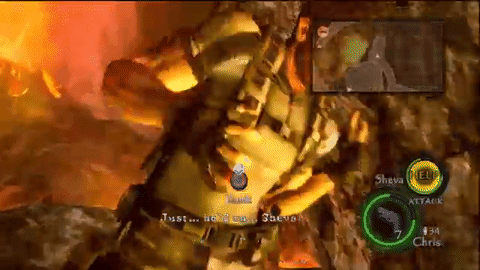
The release of Resident Evil 4 in 2005 revolutionized third-person action gaming, shifting the focus from slow-burn dread to tactical combat. While critically lauded, this momentum led the franchise down a more bombastic, action-oriented path with Resident Evil 5 (2009) and Resident Evil 6 (2012). While commercially successful, these titles alienated purists who missed the claustrophobic terror of the early games—culminating in Chris Redfield punching boulders and global bioweapon wars.
3. The Modern Renaissance & The RE Engine Era (2017–Present)
Seeking to recapture the series’ horror roots, Capcom took a massive gamble with Resident Evil 7: Biohazard, introducing Ethan Winters and a terrifying first-person Louisiana nightmare. Powered by the proprietary RE Engine, RE7 revitalized the brand. Capcom quickly paired this forward momentum with a massive nostalgia play: the 2019 Resident Evil 2 remake. This kicked off an ongoing crusade of modernization, treating games like Resident Evil 3 and Resident Evil 4 to breathtaking contemporary face-lifts.
Supporting Context & Metrics: The Mathematics of the Remake Pipeline
Capcom’s current production cadence is remarkably predictable, yet fiercely efficient. With a major remake dropping roughly every two years, the studio has carefully managed consumer appetite and development overhead.
The 12-Year Horizon: Assuming Capcom continues its current pace and tackles remaining legacy titles—including fan favorites like Code: Veronica and the controversial duo of Resident Evil 5 and Resident Evil 6—the existing catalogue of older games will sustain the remake initiative for approximately another decade.
The RE7 Turning Point: Capcom has explicitly noted that Resident Evil 7 was chosen as a soft reboot/turning point because it isolated the narrative while quietly planting seeds for older lore to bleed back in. What began as subtle nods and fan service in RE7 yielded overwhelmingly positive analytical engagement from the player base.
Fan Analysis Driving Development: According to Takeuchi, the development team was surprised by how deeply fans dissected minor lore drops, secret documents, and Easter eggs. This enthusiastic reception emboldened Capcom to lean harder into interconnected storytelling for Resident Evil Village and the subsequent Requiem project.
However, modernizing Resident Evil 5 and Resident Evil 6 presents unique developmental hurdles. Unlike the isolated, atmospheric horror of the Spencer Mansion or the tight urban sprawl of Raccoon City, RE5 and RE6 are massive, sweeping action blockbusters cooperative by design. Transforming these titles into experiences that satisfy modern horror standards without losing their identity will require a delicate balancing act from Capcom’s design teams.
Official Statements: Jun Takeuchi on the Future of the Franchise
The insights provided by Jun Takeuchi during the 30th-anniversary retrospective offer an unvarnished look at the strategic philosophy guiding Capcom’s boardrooms:
"The current ‘Resident Evil’ series is being developed along two tracks: the numbered titles allow players to experience the ongoing story of the series, while the remake series allows them to experience the past. Someday, the remake series will catch up with the era of the numbered titles, and we are already thinking about what we will do when that happens."
Takeuchi’s commentary illuminates a deliberate, long-game approach to franchise management. Rather than treating remakes as mere cash-in stopgaps, Capcom views them as narrative equalizers:
"In fact, we have been gradually preparing for that since around ‘Resident Evil Village.’ The appearance of names such as Umbrella and Spencer, as well as the return of Raccoon City in ‘Requiem,’ are also in preparation for a ‘crossover.’
One of the reasons we regard ‘7’ as a turning point for the series is that it was also the title where we began working on this kind of setup. At first, we included these elements with the sense that they were fan service, but users were far more delighted by them than we had imagined, and they even began analyzing the thoughts that the development team had privately kept to itself. So, as a series, we decided to respond to users’ expectations and pushed this setup further in ‘Village’ and ‘Requiem’."
These official remarks confirm that Capcom is orchestrating a massive narrative convergence. The wall separating the classic era (featuring Leon S. Kennedy, Chris Redfield, and Jill Valentine) and the modern era (epitomized by Ethan Winters and his successors) is slowly being dismantled.
Future Outlook: Beyond the Remakes
When the remake pipeline eventually exhausts its supply of legacy titles—perhaps leading to a hypothetical Resident Evil 7 remake two decades down the line—Capcom will face a blank slate. But history suggests the studio will not rest on its laurels.
While nostalgia is a powerful drug that ensures guaranteed opening-week sales, the true lifeblood of any creative medium is innovation. The global gaming community appreciates stepping back into the blood-soaked corridors of yesterday, but the real electricity in the room stems from asking: What’s next?
Resident Evil has continually reinvented itself over three decades, transitioning from fixed-angle survival horror to over-the-shoulder action, and subsequently into first-person dread and cinematic thrillers. By successfully freeing the franchise from the suffocating, predictable loops of the original Umbrella Corporation arc—while simultaneously preserving the franchise’s rich history—Capcom has built a universe robust enough to sustain itself for decades to come.
As the series looks toward its post-remake future, the prospect of a massive, franchise-wide crossover event uniting past and present heroes against a unified threat is no longer a fever dream—it is a carefully calculated corporate strategy. Whether Capcom chooses to forge completely new plotlines, introduce radical gameplay paradigms, or merge its timelines into an epic cinematic universe, one thing is certain: the nightmare is far from over, and Capcom holds all the keys to the laboratory.











Belum ada komentar. Jadilah yang pertama berkomentar!