

Executive Overview
The Wikimedia Foundation has officially expanded its interactive gaming footprint to the Apple ecosystem, bringing its popular daily historical trivia challenge, “Which came first?”, to the official Wikipedia iOS application. Following a successful rollout on Android devices, the feature is now integrated directly into the latest version of the app, giving iPhone and iPad users a fresh, gamified way to interact with global history.
Designed to blend education with casual entertainment, the feature challenges users with a sequence of five daily questions centered around historical events that share a thematic bond: they all occurred on the exact current calendar day in years past. By tasking players with ordering these milestones chronologically, Wikipedia is tapping into the booming market of daily, bite-sized puzzle games popularized by phenomena like Wordle.
Beyond just testing trivia, the feature serves as an ingenious gateway to the broader encyclopedia, encouraging users to fall down knowledge rabbit holes. With built-in tracking for gameplay streaks, average scores, and a robust archive of past rounds, “Which came first?” is poised to become a morning ritual for history buffs and casual learners alike. The update is rolling out globally and can be accessed directly through the Explore feed within the iOS app.
Detailed Chronology: From Android Debut to iOS Integration
The journey of “Which came first?” to the iPhone has been a calculated step in the Wikimedia Foundation’s ongoing strategy to modernize user engagement on mobile platforms. While mobile web traffic and app usage have historically focused on active information retrieval—such as looking up definitions, biographies, or scientific concepts—product teams across the tech industry have increasingly looked toward gamification to foster daily habits.
The Android Pilot
Prior to its arrival on iOS, the game debuted on Wikipedia’s Android client. Developers designed the feature to leverage the vast, crowdsourced temporal data already embedded within Wikipedia’s "On this day" archives. The Android launch served as a crucial testing ground, allowing engineers to refine the user interface, balance difficulty curves, and measure user retention metrics.
Feedback from the Android rollout highlighted an appetite for lightweight, educational games that do not demand long sessions. Users responded enthusiastically to the mechanic of comparing two or more seemingly unrelated historical moments to determine which unfolded first in the timeline of human civilization.
The iOS Arrival
Beginning today, the feature completes its cross-platform journey. iPhone users running the latest version of the Wikipedia app will find the game seamlessly integrated into the user experience. Rather than requiring a separate application download—a friction point that deters many casual users—the game lives natively inside the ecosystem of the primary Wikipedia app.
To access the game, users simply need to open the Wikipedia iOS application and navigate to the Explore feed, where the daily prompt for “Which came first?” awaits. The transition brings the fluid animations, haptic feedback integration, and polished aesthetic expectations of iOS design to the experience, ensuring it feels right at home alongside native Apple applications.
Gameplay Mechanics and Features: How “Which Came First?” Works
At its core, “Which came first?” is deceptively simple, yet it offers plenty of intellectual friction for even the most seasoned history buffs.
The Daily Five-Question Format
Each day, players are presented with a fresh set of five questions. Crucially, the events chosen for daily challenges are tied to the specific calendar date on which the user is playing. For instance, opening the game on any given day might surface events ranging from the signing of a medieval charter in 1215 to a breakthrough scientific discovery in 1945—all sharing the common thread of having occurred on that exact month and day.
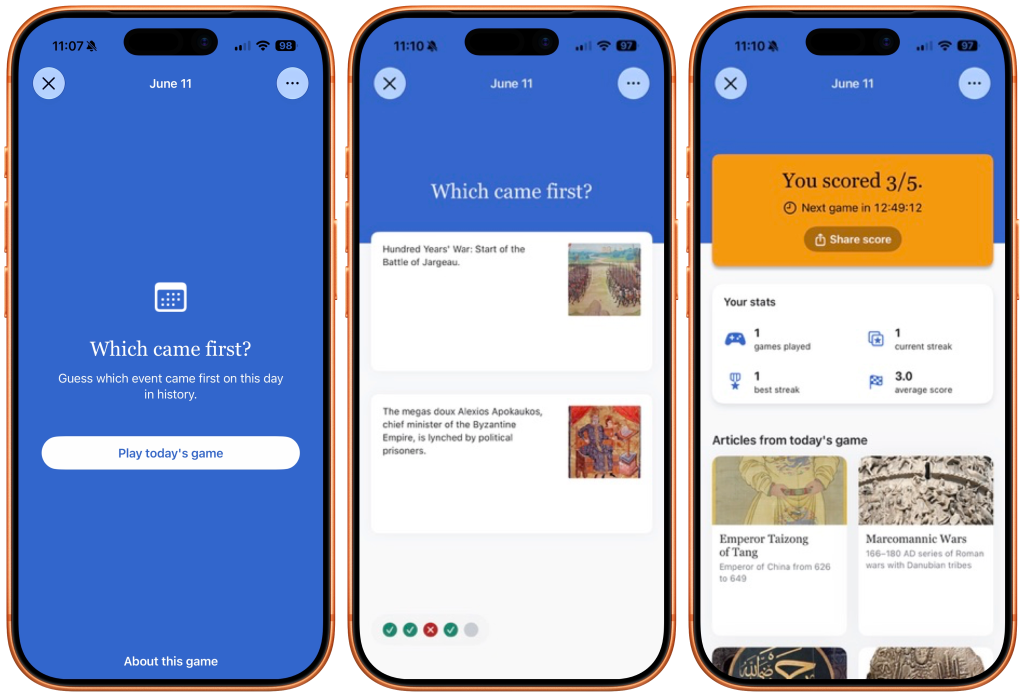
Players must deduce and arrange the events in chronological order. The mechanic challenges assumptions about historical progression; events that a user might intuitively associate with the modern era could turn out to have ancient roots, or vice versa, leading to moments of genuine surprise and cognitive realignment.
Tracking Progress and Retention
To encourage daily engagement, the game incorporates comprehensive stats tracking:
- Gameplay Streaks: Users can monitor consecutive days played, adding a psychological incentive to maintain the habit.
- Average Scores: Detailed analytics display overall performance metrics over time.
- The Archive: For players who discover the game late or wish to catch up on missed days, a fully accessible archive houses previous rounds, ensuring that historical curiosity is never artificially gated by a missed calendar day.
Supporting Context & Metrics: The Gamification of Knowledge
The introduction of “Which came first?” aligns with a broader industry-wide shift toward gamified micro-learning. In an era dominated by short-form video and rapid-fire social media content, cultural and educational institutions face stiff competition for user attention.
The Wordle Effect and Daily Rituals
Since the explosive popularity of Wordle in 2021 and 2022, digital consumers have demonstrated a profound appetite for once-a-day web and app-based challenges. These games succeed because they strike a delicate balance: they respect the user’s time by limiting gameplay to a few minutes a day, while stimulating the brain through puzzle-solving.
Wikipedia’s implementation is uniquely positioned in this landscape. While traditional word or number games test linguistic or mathematical intuition, “Which came first?” relies on cultural literacy, historical context, and deductive reasoning. It transforms passive encyclopedic data into an active playground.

Driving Encyclopedia Discovery
From an institutional standpoint, the game is a masterclass in organic traffic generation. When a player encounters an obscure historical event during a round—perhaps a geopolitical treaty from the 17th century or an early aviation milestone—the natural inclination is to tap for more information. By embedding the game directly within the Wikipedia app, the Wikimedia Foundation creates a frictionless pipeline from casual gaming to deep-dive reading. A player opens the app for a two-minute trivia fix and ends up spending twenty minutes reading interconnected articles about world history, biographies, and cultural movements.
Official Statements and Industry Reception
While the Wikimedia Foundation has maintained a measured approach to promotional rollouts, product teams have frequently emphasized the importance of making knowledge accessible, engaging, and enjoyable across all demographics.
Educational technology analysts have largely praised the move, noting that traditional educational platforms often struggle to shed dry, academic reputations. By wrapping historical data in a sleek, competitive format, Wikipedia is reaching younger audiences—particularly Gen Z and millennial cohorts—who heavily favor interactive digital experiences over static text.
Early user reviews on the App Store reflect high enthusiasm for the iOS integration, with many praising the cleanliness of the interface and the clever selection of historical dates. Educators, too, have pointed to the game as an innovative tool for sparking classroom discussions around historical causality and timeline awareness.
Future Outlook: What’s Next for Wikipedia on Mobile?
The successful deployment of “Which came first?” across both Android and iOS points toward a promising future for interactive learning features within the Wikipedia application ecosystem.

As mobile app development continues to prioritize personalization, micro-interactions, and community-driven features, industry watchers are speculating on what might come next from the platform. Could we see multiplayer trivia modes, user-submitted historical pairings, or specialized spin-off games focusing on science, literature, or art?
While the Wikimedia Foundation has yet to announce future roadmap expansions for the game, the overwhelmingly positive reception of “Which came first?” suggests that this is only the beginning of Wikipedia’s evolution into a more dynamic, game-adjacent digital companion. For now, millions of iPhone users have one more reason to check their Explore feeds every morning, armed with the desire to test their wits against the vast, sprawling timeline of human history.
To try the new game today, ensure your Wikipedia app is updated to the latest version, open the application, and look for “Which came first?” in your Explore feed.









Belum ada komentar. Jadilah yang pertama berkomentar!