

Executive Overview
In the realm of modern collectibles, high-end merchandise often bridges the gap between pop culture and high art. Yet, few releases manage to blend these worlds with the uncompromising cultural heritage and technical mastery seen in a new collaboration from Japanese ceramics brand Yoyoyo.
Titled "Sonic the Hedgehog Infinite Blue," this extraordinary figurine captures Sega’s hyperactive blue mascot—a character universally defined by perpetual motion—and freezes him in traditional Arita-yaki (Arita porcelain). Far from a standard vinyl or PVC toy, this 21.3-centimeter (8.4-inch) sculpture represents a tour de force of Japanese craftsmanship. It requires the specialized skill sets of three distinct Arita-based artisan organizations, traditional hand-painted glazing, and a high-stakes firing process where a single miscalculation can spell total structural failure.
![New Sonic the Hedgehog figure costs 1 million yen, is made of Arita ware Japanese porcelain [Vid]](https://soranews24.com/wp-content/uploads/sites/3/2026/10/50_70dfd4.jpg?w=580&h=305&crop=1)
Produced in an ultra-limited edition of just 50 units worldwide, the Infinite Blue figurine is positioned less as a mass-market video game accessory and more as a museum-grade investment piece. Priced at 1 million yen (approximately $6,300 USD) for buyers within Japan, and $7,000 USD for international collectors (exclusive of localized shipping and taxes), the piece is acquired via a strict lottery system.
This deep-dive investigative report explores the intersection of classic video game iconography and 400-year-old ceramic traditions. We examine the precise chronology of its production, the intricate engineering required to mold motion into clay, the economic and logistical framework of its release, and what this high-art crossover means for the future of licensed pop-culture artifacts.
![New Sonic the Hedgehog figure costs 1 million yen, is made of Arita ware Japanese porcelain [Vid]](https://soranews24.com/wp-content/uploads/sites/3/2026/10/0_878a58.jpg?w=640)
Detailed Chronology: From Digital Vector to Kiln-Fired Porcelain
To understand the extraordinary nature of the Infinite Blue figurine, one must trace its complex genesis across multiple specialized studios in Saga Prefecture and beyond. Transforming a pixel-born, dynamically fast video game character into a static, heavy ceramic medium is an exercise in engineering defiance.
Phase 1: Conceptualization and Digital-Physical Modeling
The project began when Japanese ceramics brand Yoyoyo approached the historic ceramics hub of Arita, located in Saga Prefecture. Arita holds the distinction of being the birthplace of Japanese porcelain production, with a history stretching back to the late 16th century.
![New Sonic the Hedgehog figure costs 1 million yen, is made of Arita ware Japanese porcelain [Vid]](https://soranews24.com/wp-content/uploads/sites/3/2026/10/2_e45462.jpg?w=640)
To tackle Sonic’s notorious geometry—a blend of soft, organic curves, razor-sharp quills, and asymmetric angles—Yoyoyo enlisted 224porcelain, a prominent Arita design and manufacturing studio. The team utilized a hybrid workflow combining advanced 3D digital modeling and traditional hand-sculpting techniques.
The primary design challenge lay in translating Sonic’s lower half. In the games, Sonic’s legs are a blur of motion when he reaches top speed. Instead of sculpting individual limbs, 224porcelain drew inspiration from this iconic visual shorthand, rendering his lower body as a continuous, dynamic infinity symbol ($).
![New Sonic the Hedgehog figure costs 1 million yen, is made of Arita ware Japanese porcelain [Vid]](https://soranews24.com/wp-content/uploads/sites/3/2026/10/3_508992.jpg?w=640)
Phase 2: Structural Engineering and Single-Piece Casting
One of the most astonishing technical feats of the Infinite Blue figurine is its construction: the entire 21.3-centimeter sculpture is composed of just two primary parts, with the main body formed as a single, continuous piece of clay.
Working with porcelain on this scale introduces severe logistical hurdles. As clay dries and fires, it shrinks. Long, thin sections—such as Sonic’s sweeping quills—and complex hollow loops—such as the infinity-shaped base—are highly prone to warping, sagging, or outright cracking under intense kiln temperatures.
![New Sonic the Hedgehog figure costs 1 million yen, is made of Arita ware Japanese porcelain [Vid]](https://soranews24.com/wp-content/uploads/sites/3/2026/10/4_046a0c.jpg?w=640)
224porcelain had to meticulously calculate and manually adjust the thickness of the clay walls throughout the figure. If the walls were too thick, the piece would trap moisture and explode during firing; if they were too thin, the structure would collapse under its own weight in the extreme heat of the kiln.
Phase 3: Glazing and Traditional Hand-Painting
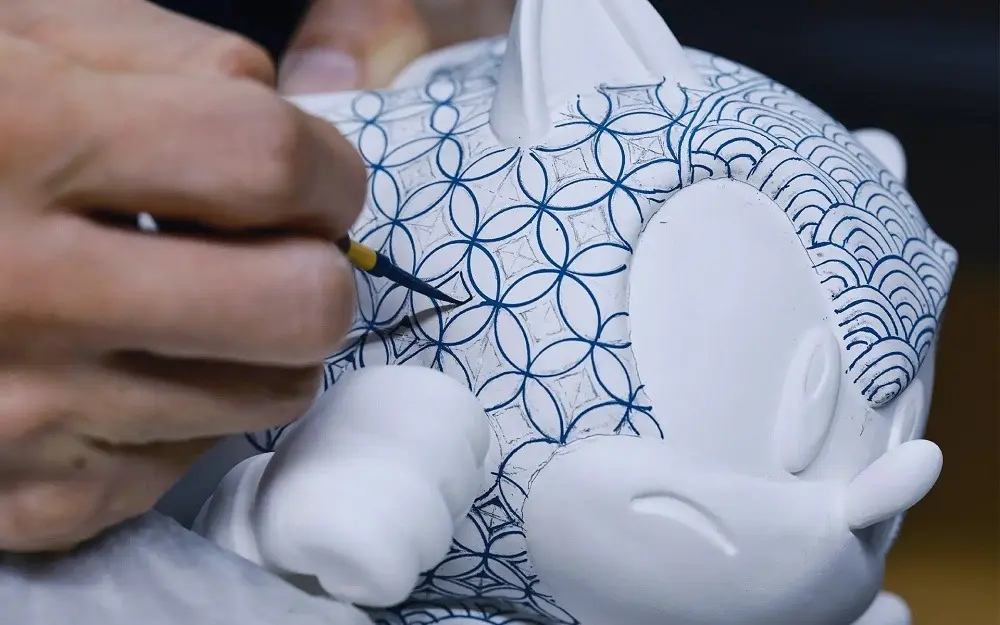
Once the raw porcelain underwent its initial biscuit firing, the fragile, stark-white work-in-progress was handed over to Riso Porcelain, a master glazing studio in Arita.
![New Sonic the Hedgehog figure costs 1 million yen, is made of Arita ware Japanese porcelain [Vid]](https://soranews24.com/wp-content/uploads/sites/3/2026/10/5_5ae240.jpg?w=640)
Here, artisans faced the monumental task of applying classic Japanese decorative motifs to a modern cartoon character without compromising either aesthetic. Riso Porcelain incorporated three traditional patterns into the design:
- Seigaiha: Layered, overlapping concentric circles representing tranquil ocean waves.
- Shippo: Interlocking circles featuring four-pointed stars at their centers, symbolizing the Seven Treasures of Buddhism.
- Yagasuri: Arrow-feather patterns traditionally associated with steadfastness and direct momentum.
Phase 4: Achieving Kinetic Light with Fukami Shoten Pigments
The defining visual characteristic of the Infinite Blue figurine is its mesmerizing coloration, achieved through a collaboration with Arita pigment producer Fukami Shoten.
![New Sonic the Hedgehog figure costs 1 million yen, is made of Arita ware Japanese porcelain [Vid]](https://soranews24.com/wp-content/uploads/sites/3/2026/10/6_f059e4.jpg?w=640)
Rather than coating the figure in a flat, uniform blue, Riso Porcelain utilized a proprietary cobalt blue glaze. By delicately modulating brush pressure and controlling pigment concentration across the curved surfaces of the sculpture, the artisans achieved a gradient effect. When exposed to ambient room light, the glaze creates luminous streaks that ripple across Sonic’s quills. The effect creates an optical illusion: even while standing completely still on a shelf, the porcelain figure appears to be sprinting at supersonic speeds.
Supporting Context & Metrics: The Art and Economics of Arita-Yaki
The Legacy of Arita Ware
Arita porcelain (Arita-yaki) is not merely a regional craft; it is a nationally designated Traditional Craft of Japan. Discovered in the late 1500s following the Korean potters’ campaigns, Arita became the epicenter of high-fired white porcelain (kakitsuke) in Japan. Historically, Arita wares were prized by European royalty and aristocracy during the Edo period through export trade via the Dutch East India Company.
![New Sonic the Hedgehog figure costs 1 million yen, is made of Arita ware Japanese porcelain [Vid]](https://soranews24.com/wp-content/uploads/sites/3/2026/10/7_f84fde.jpg?w=640)
By applying this centuries-old imperial medium to a Sega intellectual property, Yoyoyo is engaging in a deliberate juxtaposition of low-brow digital entertainment and high-brow aristocratic craft. This is part of an ongoing trend by Yoyoyo; earlier in the year, the brand launched a similarly exclusive, highly limited run of traditional Japanese porcelain Tachikoma robot spider tanks from the cyberpunk classic Ghost in the Shell (limited to just 50 units).
Production Metrics and Global Distribution
The sheer labor intensity and low yield rate of firing large-scale, complex porcelain sculptures dictate the extreme scarcity of the Sonic Infinite Blue project.
![New Sonic the Hedgehog figure costs 1 million yen, is made of Arita ware Japanese porcelain [Vid]](https://soranews24.com/wp-content/uploads/sites/3/2026/10/8_ed9296.jpg?w=640)
- Total Global Production: Exactly 50 units.
- Release Mechanism: Exclusive lottery system (no direct first-come, first-served open retail).
- Pricing Structure:
- Domestic (Japan): 1,000,000 JPY (approximately $6,300 USD), inclusive of consumption tax and domestic shipping.
- International: $7,000 USD (applicable to buyers in the U.S., Canada, England, Australia, Singapore, South Korea, Taiwan, Hong Kong, the European Union, Norway, and Switzerland), with local taxes, import duties, and international freight calculated separately.
- Production Lead Time: Estimated delivery takes up to 10 months from the close of the order window, reflecting the artisanal, slow-batch nature of kiln production.
Public Exhibition Schedule
For collectors unable to secure a winning lottery ticket—or those wishing to inspect the $7,000 craftsmanship in person before committing funds—Yoyoyo and Sega have arranged a public showcase.
Five finished figurines are currently on display at the "Sonic the Exhibition-Across Generations" event, hosted at the Ikebukuro Parco department store in Tokyo. The exhibition runs from October 9 through November 1, offering fans a rare glimpse into the tactile brilliance of the cobalt-glazed sculptures.
![New Sonic the Hedgehog figure costs 1 million yen, is made of Arita ware Japanese porcelain [Vid]](https://soranews24.com/wp-content/uploads/sites/3/2026/10/9_95809d.jpg?w=640)
Official Statements and Industry Impact
While Yoyoyo has kept direct executive commentary focused on the technical triumphs of 224porcelain and Riso Porcelain, the release speaks volumes about the maturation of video game merchandising.
Historically, video game collectibles were dominated by mass-produced PVC statues aimed at teenage demographics. Over the past decade, however, the primary demographic of gamers has aged into disposable-income-earning adults. Brands are increasingly pivoting toward "adult collector" tiers that utilize luxury materials—ranging from die-cast metals and genuine leather to traditional ceramics and fine art glass.
![New Sonic the Hedgehog figure costs 1 million yen, is made of Arita ware Japanese porcelain [Vid]](https://soranews24.com/wp-content/uploads/sites/3/2026/10/10_c226ae.jpg?w=640)
Industry analysts note that projects like the Infinite Blue Sonic serve a dual purpose for copyright holders like Sega. First, they generate high-margin revenue streams from ultra-wealthy collectors. Second, and perhaps more importantly, they elevate the cultural prestige of video game IPs, positioning digital characters alongside historical fine art in global media discourse.
Future Outlook: The Evolution of High-Art Video Game Crossovers
The success of Yoyoyo’s cultural crossovers—spanning both Ghost in the Shell and now Sonic the Hedgehog—signals a broader shift in how pop culture artifacts are preserved and reimagined.
![New Sonic the Hedgehog figure costs 1 million yen, is made of Arita ware Japanese porcelain [Vid]](https://soranews24.com/wp-content/uploads/sites/3/2026/10/12_836f05.jpg?w=640)
As artisanal craft industries in regions like Saga Prefecture face shrinking domestic markets and aging workforces, partnerships with global entertainment giants offer a vital economic and cultural lifeline. By fusing the cutting-edge character design of the 1990s video game boom with the 400-year-old lineage of Arita kilns, these projects ensure that traditional ceramic arts remain relevant to contemporary, global audiences.
For prospective buyers, the application window via Yoyoyo’s official web portal closed on October 18, 2026. With only 50 pieces slated for creation and a 10-month manufacturing backlog, the Sonic the Hedgehog Infinite Blue figurine is destined to become one of the most elusive and sought-after secondary-market grails in video game history. Whether it rests in a private gallery in Tokyo, a sleek penthouse in New York, or a dedicated display case in London, this porcelain masterpiece proves that even the fastest hedgehog in the world can occasionally sit still—provided he does so in timeless, royal blue elegance.








Belum ada komentar. Jadilah yang pertama berkomentar!