

Executive Overview
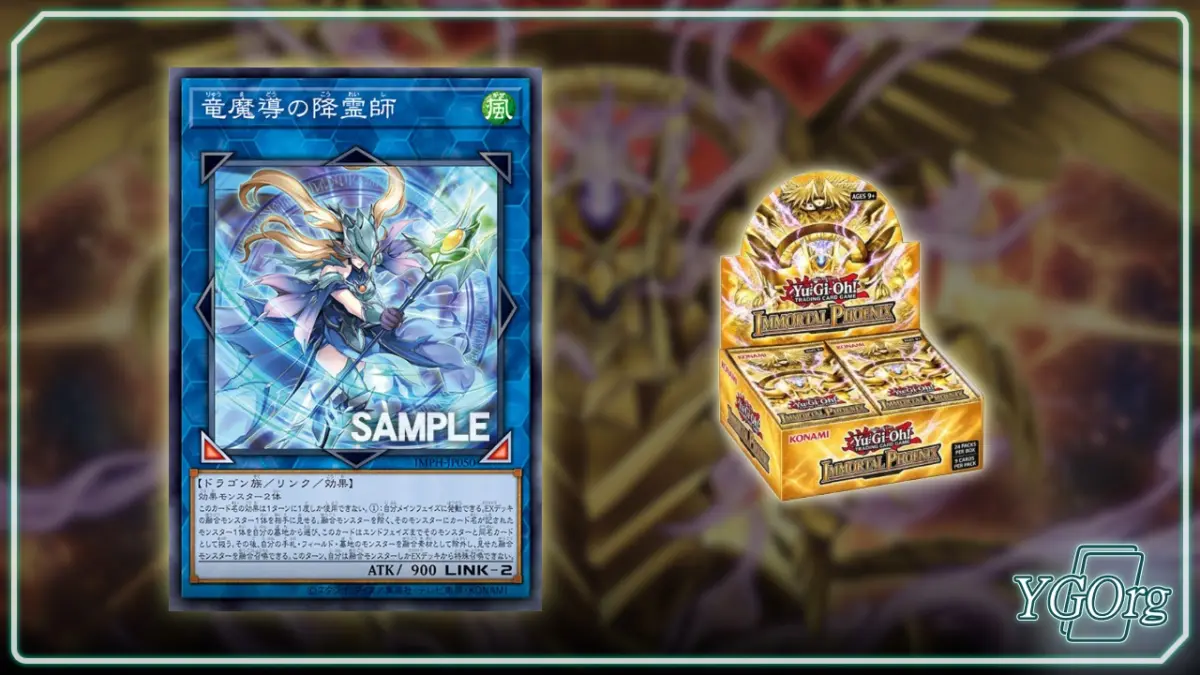
The landscape of the Yu-Gi-Oh! Official Card Game (OCG) is perpetually in motion, driven by Konami’s relentless pursuit of mechanical innovation, archetype synergy, and meta-game evolution. In a recent product reveal disseminated through official channels—specifically via the verified X (formerly Twitter) account @YuGiOh_OCG_INFO—players and duelists worldwide were introduced to a groundbreaking new card slated for release: IMPH-JP050, officially titled Ryuumadou no Koureishi (translated to English as Necromancer of Dragon Magic).
This newly unveiled card is a LINK-2 WIND Dragon Link Effect Monster boasting an ATK of 900, pointing diagonally downward to the bottom-left and bottom-right zones. While its physical statistics might initially suggest a utility-focused, low-investment board piece, its text tells a vastly different, highly explosive story. Necromancer of Dragon Magic bridges two historically disparate Extra Deck mechanics—Link Summoning and Fusion Summoning—in a manner that bypasses traditional logistical hurdles. By allowing a player to reveal a Fusion Monster from the Extra Deck, temporarily adopt the name of a non-Fusion material listed upon it from the Graveyard, and immediately perform a Fusion Summon using banished materials, this card instantly elevates itself to a premier combo starter and enabler.
This investigative report provides an exhaustive breakdown of Necromancer of Dragon Magic, analyzing its systemic impact on the OCG meta-game, detailing its chronological emergence, contextualizing its metrics within modern card design philosophies, evaluating official and community reactions, and forecasting its long-term viability in competitive tournament play.
Detailed Chronology of the Reveal
The Digital Genesis: Social Media as the Epicenter of Modern TCG News
The journey of Ryuumadou no Koureishi from conceptual design to public awareness exemplifies the modern era of Trading Card Game (TCG) information dissemination. Gone are the days of waiting for monthly print magazines like V-Jump to leak grainily photographed cards. Today, Konami’s digital pipeline relies on precisely timed, high-resolution social media drops designed to maximize community engagement, generate speculative hype, and dictate the discourse surrounding upcoming booster sets.
On the official X account @YuGiOh_OCG_INFO, the curtain was pulled back on IMPH-JP050. The post immediately sent shockwaves through competitive and casual communities alike. Within minutes of the initial tweet, independent translators, content creators, and competitive forums began dissecting the raw Japanese text, translating the intricate PSCT (Problem-Solving Card Text) into English and other major languages.
From Pixel to Playable: The Timeline of Discovery
- The Initial Drop: The official X post goes live, showcasing the card art, card number (IMPH-JP050), Japanese furigana title (Ryuumadou no Koureishi), and the localized English translation.
- Community Translation & Parsing: Within ten minutes, elite theory-crafters isolate the core mechanics: a LINK-2 WIND Dragon with universal Fusion-enabling properties tied to Graveyard name-copying.
- Initial Theorycrafting Phase: Duelists begin cross-referencing the card with legacy archetypes—specifically focusing on classic Fusion-heavy themes that rely on specific non-Fusion monsters tucked away in the Graveyard, such as Eyes-Restricted, Dark Magician, and various dragon-centric fusion lineages.
- Deep Meta Analysis: Competitive circles start evaluating the restriction clauses, specifically the restriction preventing Special Summons from the Extra Deck for the rest of the turn, except for Fusion Monsters.
Supporting Context & Metrics: Card Anatomy & Mechanical Breakdown
To fully understand the weight of Necromancer of Dragon Magic in the current and future meta-game, one must examine its raw structural data, statistical profile, and exact text phrasing.
Statistical Profile & Attributes
- Card Number: IMPH-JP050
- Japanese Name: 竜魔導の呪術師 (Ryuumadou no Koureishi)
- English Translation: Necromancer of Dragon Magic
- Card Type: Link Effect Monster
- Attribute: WIND
- Type: Dragon
- Link Rating: LINK-2
- ATK: 900
- Link Arrows: Bottom Left, Bottom Right
- Materials: 2 Effect Monsters
Text & Effect Analysis
“2 Effect Monsters
You can only use the effect of this card’s name once per turn.
(1) During your Main Phase: You can reveal 1 Fusion Monster in your Extra Deck, and if you do, this card’s name becomes the name of 1 non-Fusion Monster in your GY mentioned on it (until the End Phase), then you can Fusion Summon the revealed monster, by banishing its materials from your hand, field, and/or GY, also you cannot Special Summon from the Extra Deck for the rest of this turn, except Fusion Monsters.”
Deconstructing the Mechanics
- The Material Requirement: Requiring simply "2 Effect Monsters," Necromancer of Dragon Magic possesses one of the most generic summoning conditions in the game. Any deck capable of generating two effect monsters on the field can access this card without breaking a sweat. This universal accessibility ensures that it is not locked into a single niche archetype, but rather serves as a generic engine piece across multiple strategies.
- The Link Arrows: Pointing to the bottom-left and bottom-right zones, the card offers two downward-pointing arrows. In the post-Master Rule era, this allows the player to utilize these zones to summon additional monsters from the Extra Deck (specifically Fusion Monsters, per its restriction) without requiring prior extra-linking setups.
- The Name-Copying Conundrum: The core of the card’s effect relies on revealing a Fusion Monster from the Extra Deck and adopting the name of a non-Fusion Monster mentioned on that card residing in the Graveyard. This opens up staggering design space. For instance, if a Fusion Monster requires "Dark Magician" as material, and "Dark Magician" is resting in your GY, Necromancer of Dragon Magic can transform its identity into "Dark Magician" until the End Phase.
- The Integrated Fusion Summon: Crucially, the effect does not merely copy a name; it immediately triggers a Fusion Summon. By banishing the required materials from your hand, field, and/or Graveyard, the card acts as a built-in polymerization spell. The ability to utilize the Graveyard as a resource pool for banishment is exceptionally powerful, turning former board-state liabilities into active crafting materials.
- The Restriction Clause: To balance what would otherwise be an infinitely loopable, broken engine, Konami has attached a strict clause: "also you cannot Special Summon from the Extra Deck for the rest of this turn, except Fusion Monsters." While this effectively shuts down hybrid Link-spam or Synchro transitions after the effect resolves, it aligns perfectly with decks dedicated to Fusion-centric win conditions.
Official Statements & Community Reactions
The unveiling of Necromancer of Dragon Magic has sparked intense discourse across international communities, drawing commentary from competitive players, casual enthusiasts, and content creators alike.
The Competitive Perspective
High-level tournament players have immediately zeroed in on the versatility of the card’s material requirements and resource management. Industry analysts note that generic Link monsters with built-in summoning spells often redefine how decks access their boss monsters.
A prominent OCG-focused theorist noted in a community breakdown:
"The fact that Necromancer of Dragon Magic bypasses the need to physically draw your specific named materials—so long as you can get them into the Graveyard—fundamentally changes consistency metrics. Decks that mill or send cards directly from the deck to the GY can now leverage this Link-2 monster as a universal bridge to powerful Fusion boss monsters that were previously too brick-heavy to run efficiently."
The Casual & Fan-Service Angle
Beyond raw competitive metagaming, the casual community has praised the card for its thematic design. The visual aesthetic—blending draconic motifs with magical necromancy—resonates heavily with fans of classic Yu-Gi-Oh! lore. The ability to manipulate names and resurrect historical synergy pieces bridges older, beloved archetypes with modern mechanical pacing.
Konami’s Design Philosophy Shift
Industry observers have pointed out that Necromancer of Dragon Magic represents a continuation of Konami’s recent design trend: creating generic Link monsters that act as specialized catalysts for older Extra Deck mechanics. By lowering the barrier to entry for complex Fusion Summons, Konami encourages diverse deck-building experiments, breathing new life into forgotten archetypes that possess strict material naming conventions.
Future Outlook & Meta-Game Implications
As the release date for the set housing IMPH-JP050 approaches, the competitive community is already looking ahead to how Necromancer of Dragon Magic will alter tournament landscapes.
Synergistic Archetype Integration
- Graveyard-Heavy Fusion Strategies: Any deck that naturally dumps monsters into the Graveyard as part of its baseline combo can easily slide Necromancer of Dragon Magic into its Extra Deck. By turning the GY into a second hand for Fusion materials, resource loops become significantly more resilient against traditional disruption.
- Legacy Nostalgia Decks: Decks centered around iconic protagonists and historical boss monsters that require exact named materials (such as variations of classic dragon and spellcaster hybrids) receive a massive consistency boost. The ability to treat a generic Link-2 monster as the required vanilla or effect material directly from the Graveyard eliminates the historical fear of drawing unplayable high-level bricks.
Potential Bottlenecks and Counter-Play
While the card is undeniably powerful, competitive viability will also depend on how it interacts with prevailing side-deck options in the meta:
- Graveyard Interruption: Because the card relies heavily on banishing materials from the Graveyard (or interacting with cards stored therein), cards like Called by the Grave, D.D. Crow, or Abyss Dweller could serve as effective deterrents.
- Nibiru and Hand Traps: As a LINK-2 monster requiring two effect monsters, summoning it exposes the player to standard interruption vectors during the main phase before the Fusion effect can be successfully resolved.
- Extra Deck Locking: The restriction limiting Special Summons for the rest of the turn exclusively to Fusion Monsters means that players must carefully sequence their plays. Any setup requiring Link or Synchro extensions after the Fusion Summon is strictly prohibited, demanding precise tactical timing.
Conclusion
Ryuumadou no Koureishi (Necromancer of Dragon Magic) stands as a masterclass in modern card design—balancing explosive utility with carefully crafted restrictions. By bridging the gap between generic Link summoning and specialized Fusion requirements, it opens up a vast array of strategic pathways for both competitive gladiators and casual deck-builders. As the OCG meta continues to evolve, this WIND Dragon Link monster is poised to leave an indelible mark on tournament podiums and dueling tables across the globe.






Belum ada komentar. Jadilah yang pertama berkomentar!