

By Anna Heim
Executive Overview
For decades, the foundation of enterprise computing has rested on a strict architectural apartheid. Organizations have had to choose between two fundamentally distinct species of database management systems, each engineered for a singular, isolated purpose.
On one side stood operational databases (OLTP), the tireless workhorses designed to handle high-frequency, day-to-day transactions. These systems excel at processing individual writes and reads—recording every e-commerce checkout, every bank transfer, and every inventory update with uncompromising reliability.
On the other side stood analytical databases (OLAP), the heavy-duty engines built for data warehousing, business intelligence, and complex aggregations. These systems crunch massive historical datasets to help executives spot macro-trends, forecast demand, and answer multi-variable business questions.
For a long time, this division made logical sense. The hardware constraints of the past, combined with the distinct performance bottlenecks of reading versus writing, necessitated specialized storage layouts. But as enterprises race to deploy autonomous systems, real-time data pipelines, and natural-language-driven artificial intelligence, this rigid binary has become a monumental bottleneck.
Enter CedarDB, a high-performance database engine born out of the Technical University of Munich (TUM). Founded by a cohort of five elite researchers, CedarDB shatters the traditional wall dividing operational and analytical queries. By leveraging modern hardware architectures and an obsessive focus on efficiency, the Munich-based startup allows organizations to run lightning-fast analytics directly on live, transactional data without requiring bloated infrastructure or massive hardware overhauls.
As the tech industry transitions deeper into what data leaders are calling "the agentic era"—where large language models (LLMs) and autonomous AI agents require instant, conversational access to both transactional records and deep analytics—CedarDB’s unified approach has shifted from an academic curiosity to a critical enterprise necessity. Fresh off a €5.3 million ($6 million) seed funding round and stepping onto the global stage at TechCrunch Disrupt to announce the limited availability of CedarDB Cloud, the startup is positioning itself at the bleeding edge of modern data infrastructure.
Detailed Chronology: From Academic Research to Enterprise Production
The genesis of CedarDB spans a decade of rigorous academic research, strategic pivots, and technical breakthroughs. Its story is not merely one of sudden startup success, but the commercial realization of a decade-long quest to rewrite the rules of database engineering.
1. The Academic Roots: The Umbra Project
Long before CedarDB had a corporate registry or a venture capital backing it, its technological DNA was forged within the computer science labs of the Technical University of Munich. The core engine is built upon Umbra, an advanced database research project designed from the ground up to outperform legacy database engines.
While older database systems like PostgreSQL or MySQL were designed decades ago—when computer memory was measured in megabytes and multi-core processors were non-existent—Umbra was engineered to exploit modern hardware to its absolute limit. By reimagining how query compilation, memory management, and execution pipelines interact with modern multi-core CPUs and vast RAM pools, the Umbra research team proved that databases could process queries orders of magnitude faster without demanding exponential increases in server power.
2. Spindly Transition: Leaving Academia
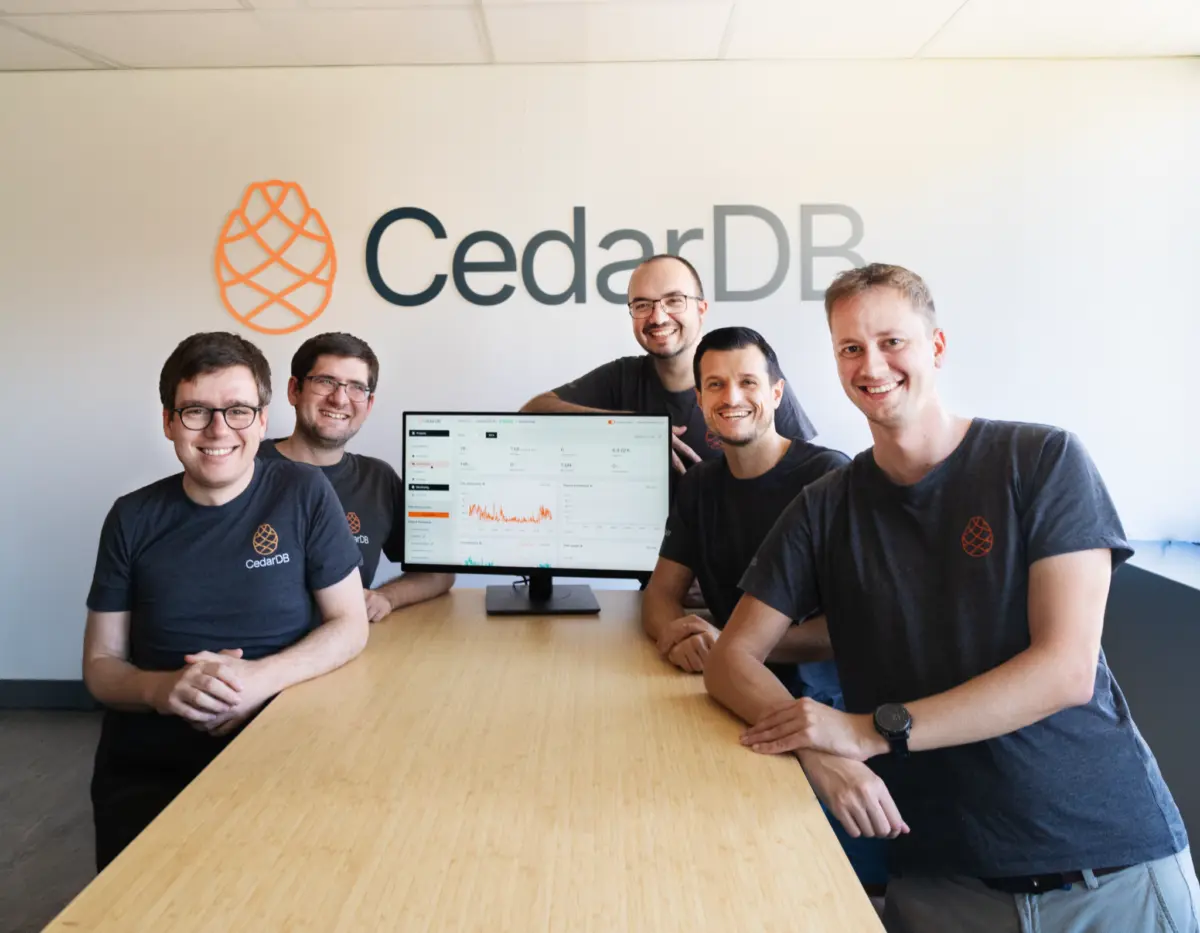
Recognizing the commercial viability of their research, five Umbra researchers—Moritz Sichert, Lukas Vogel, Philipp Fent, Dominik Durner, and Christian Winter—took the leap from academia to the commercial market, founding CedarDB.
Transitioning from a controlled academic environment to the unforgiving realities of enterprise production is notoriously difficult for university spinouts. In a detailed company blog post titled Research vs. Production, co-founder Christian Winter outlined the monumental shift in mindset required for the team. Academic projects often prioritize raw benchmark scores under ideal conditions; enterprise software demands relentless reliability, fault tolerance, and seamless compatibility with existing third-party tools.
During this foundational phase, the founding team engaged in intense strategic debates. Among the most contentious decisions was whether to launch a cloud-managed service immediately or focus first on an on-premise offering. Ultimately, the team opted for a pragmatic hybrid rollout.
3. The Commercial Debut and Seed Funding
In May of last year, CedarDB officially stepped out of stealth mode. The company announced a dual-pronged launch strategy:
- CedarDB Community Edition: A free version designed for developers, researchers, and small-scale deployments to encourage organic adoption.
- CedarDB Enterprise: A robust, on-premise offering tailored for corporate environments requiring enterprise-grade support and security.
Simultaneously, the startup closed a €5.3 million (approximately $6 million) seed funding round, validating its technological thesis and providing the financial runway necessary to scale engineering and business operations in Munich and beyond.
4. The Cloud Milestone at TechCrunch Disrupt
While the initial launch focused on on-premise deployments, the cloud offering was never abandoned—only deliberately delayed to ensure stability and incorporate feedback from an eager beta waitlist.
That waitlist culminated in a major milestone. On Wednesday, standing on stage at TechCrunch Disrupt as part of the elite Startup Battlefield cohort, CEO Moritz Sichert announced the limited availability of CedarDB Cloud. This fully managed, cloud-hosted iteration represents a critical inflection point, allowing the startup to dramatically lower the barrier to entry and capture a broader swath of the global market beyond traditional enterprise datacenters.
Supporting Context & Metrics: The Hybrid Database Revolution
To understand why CedarDB’s timing is so precise, one must examine the macro-economic and technical pressures currently reshaping the enterprise data stack.
The Rise of Agentic AI and Natural Language Queries
For years, companies built complex data pipelines known as ETL (Extract, Transform, Load) processes. Operational data was continuously extracted from transactional databases (like PostgreSQL), transformed to fit analytical schemas, and loaded into data warehouses (like Snowflake, Google BigQuery, or Amazon Redshift) so business analysts could run reports.
This latency-heavy pipeline was tolerable when human analysts were the primary consumers of insights; waiting a few hours—or even a day—for a batch report to update was acceptable. However, the rise of agentic AI has obliterated this operational model.
When an autonomous AI agent or an LLM-powered enterprise assistant is tasked with executing multi-step business workflows—such as checking real-time inventory, adjusting pricing models on the fly, and analyzing historical sales velocity—it cannot wait for overnight batch jobs. It demands immediate, real-time access to transactional truth married with analytical depth. Existing enterprise data stacks, which isolate transactions from analytics, struggle to provide conversational responsiveness without introducing massive synchronization overhead and data duplication.
Low Switching Costs Through PostgreSQL Compatibility
One of the most consequential technical choices the CedarDB team made early on was ensuring absolute compatibility with PostgreSQL, the world’s most popular open-source relational database management system.
According to CEO Moritz Sichert, embracing the PostgreSQL dialect was a masterstroke that drastically reduced friction for prospective enterprise customers. Because CedarDB speaks native Postgres, organizations do not need to rewrite their existing applications, retrain their engineering teams, or migrate away from trusted ORMs (Object-Relational Mappers).
Moreover, this compatibility offers a hidden, highly strategic advantage in the era of generative AI: LLMs are inherently trained on vast corpuses of PostgreSQL-compatible SQL syntax. Because CedarDB adheres strictly to the logic and query structures that AI models know best, it acts as a frictionless backend for AI agents generating complex database queries on the fly.
Industry Convergence: The Validation of LTAP
CedarDB is not entirely alone in its realization that the boundary between operational and analytical systems must fall. The broader data industry has begun migrating toward unified architectures.
At its Data + AI Summit, American data giant Databricks cited the exact same market forces—specifically, the arrival of the "agentic era"—as the primary catalyst for launching LTAP (Lake Transactional Analytical Processing). Databricks’ new architecture aims to unify transactions, analytics, streaming, and operational data into a single copy of storage within the data lake.
While Databricks operates at a massive, hyper-scale level, Sichert views industry validation from giants like Databricks not as an existential threat, but as definitive proof of massive, untapped market demand for unified database engines.
Official Statements and Industry Perspectives
The philosophy driving CedarDB is rooted in efficiency, hardware optimization, and pragmatism. In official communications, the leadership team has consistently emphasized that performance gains should not come at the expense of infrastructure bloat.
"CedarDB’s questioning of the divide between analytical and operational queries is a byproduct of its focus on efficiency. We are promising faster performance without requiring more CPUs, processing power, or memory — and requiring few changes from customers."
— Moritz Sichert, Co-founder and CEO of CedarDB
Reflecting on the grueling transition from academic theory to commercial reality, co-founder Christian Winter highlighted the deliberate choices that transformed a university research project into a viable enterprise product:
"Our primary priorities after leaving academia centered squarely on reliability, fault tolerance, and absolute compatibility with popular industry tools. Every architectural choice we made was measured against whether it could survive the brutal, unforgiving conditions of real-world production environments."
— Christian Winter, Co-founder of CedarDB
Commenting on the competitive landscape and the company’s future trajectory, Sichert noted that the startup has intentionally maintained a lean, agile posture:
"We plan to serve our first cloud users with our current team of 14 people. However, as traction accelerates with the rollout of CedarDB Cloud, we anticipate needing a larger team. And that is precisely the juncture where we will look to raise our next major funding round."
— Moritz Sichert, CEO
Future Outlook: Navigating the Competitive Horizon
As CedarDB steps out of the shadows of TechCrunch Disrupt and scales its newly minted cloud offering, the company faces a fascinating and high-stakes future.
Scaling Beyond Enterprise Silos
The launch of CedarDB Cloud represents a pivotal transition. While the on-premise Enterprise edition successfully captured the attention of risk-averse legacy enterprises with strict data residency requirements, the cloud-managed version opens the floodgates for digital-native companies, fast-growing startups, and developers looking for zero-maintenance infrastructure. By removing deployment friction, CedarDB can scale its user acquisition loops exponentially.
David vs. Goliath in the Data Infrastructure Wars
The road ahead will not be uncontested. CedarDB finds itself competing in a crowded, high-stakes arena alongside established cloud data warehouses, real-time analytics engines, and hyper-scale data platforms like Databricks and Snowflake.
However, CedarDB’s unique superpower lies in its roots: its unrelenting focus on raw hardware efficiency, its drop-in PostgreSQL compatibility, and its ability to handle both ends of the data spectrum without forcing users to choose between transactional integrity and analytical velocity.
If the tech industry’s pivot toward autonomous AI agents and real-time enterprise automation continues at its current breakneck pace, the traditional database divide will soon be consigned to the history books. And when that happens, Munich’s quiet academic spinout-turned-disruptor will be ideally positioned to claim a massive share of the modern data stack.









Belum ada komentar. Jadilah yang pertama berkomentar!