

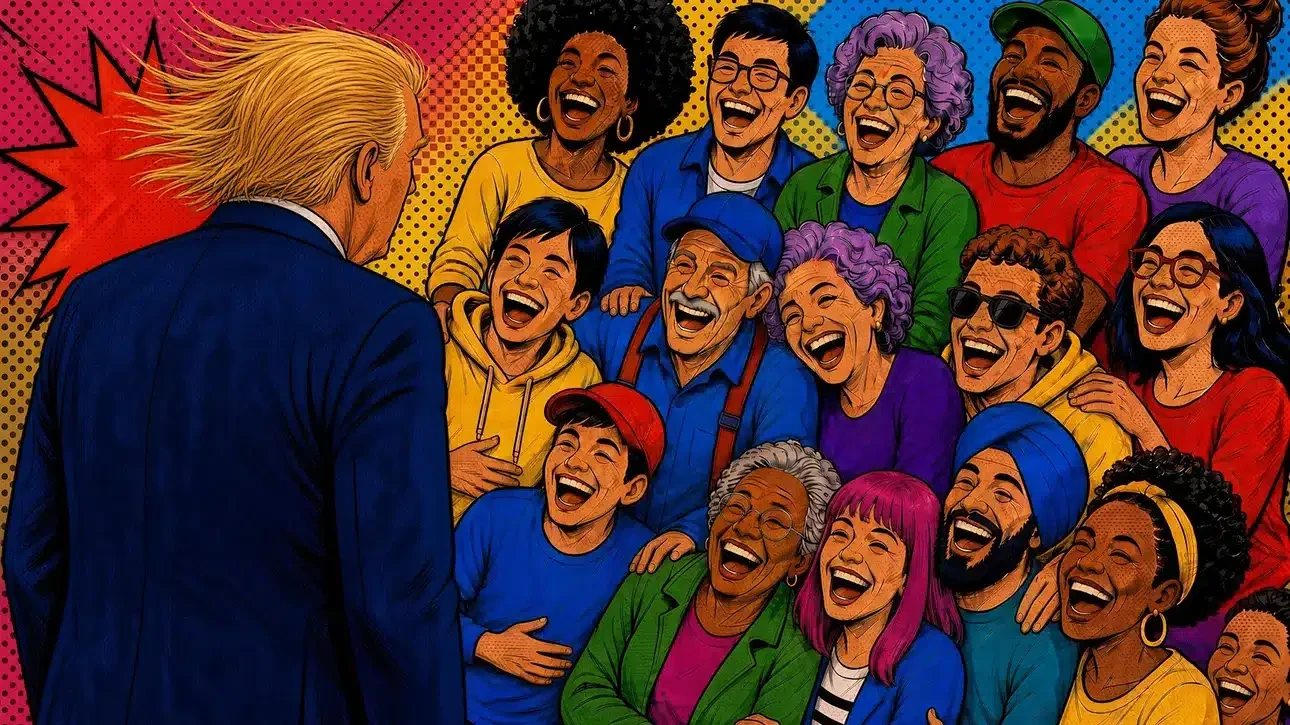
Executive Overview
In an era where democratic institutions face unprecedented strain, political opposition frequently stalls amid feelings of disorientation, institutional capture, and despair. With the executive branch, both chambers of Congress, and a compliant Supreme Court often aligned with authoritarian impulses, traditional avenues of legislative pushback have grown narrow. Yet, out of this civic paralysis, a resilient form of resistance has emerged from an unlikely arena: the soundstages of late-night television.
Satirical comedy has long served as an invaluable social corrective, but in the contemporary political landscape, it has evolved into a frontline defense against creeping autocracy. From grassroots street protests featuring inflatable animal costumes to prime-time monologues dissecting executive overreach, humor has proven uniquely capable of puncturing the carefully curated aura of infallibility demanded by aspiring strongmen.
This dynamic culminated in a high-stakes constitutional and cultural showdown: the brief suspension and triumphant return of ABC’s Jimmy Kimmel. Triggered by political pressure from the Federal Communications Commission (FCC) and corporate anxiety over pending media mergers, the suppression of late-night satire exposed the fragile boundary between state power and free expression. However, the ensuing public backlash—marked by plunging corporate stock values, widespread consumer boycotts, and cross-industry solidarity—demonstrated that when traditional journalism falters, the collective conscience of a democracy can successfully rally behind its comedians.
Detailed Chronology: The Anatomy of a Crackdown
The collision between modern authoritarianism and late-night satire did not happen in a vacuum. It was the culmination of a systematic campaign by the Trump administration to dismantle the traditional cultural and media checks that impede absolute executive dominance.
The Prelude: Silencing Colbert and Subduing the Networks
The pressure campaign began in earnest when the architecture of corporate media intersected with government oversight. In July 2025, CBS’s parent company, Paramount, found itself navigating a multi-billion-dollar business deal requiring explicit regulatory approval from the federal government. Sensing leverage, the administration applied quiet yet unmistakable pressure, resulting in the abrupt announcement of Stephen Colbert’s imminent cancellation. The message to the broader media landscape was clear: compliance with executive preferences was the baseline currency for corporate survival.
With Colbert sidelined, attention turned toward ABC and Jimmy Kimmel, who had emerged as a particularly sharp thorn in the administration’s side. Unlike journalists who frequently fell prey to the "access trap"—softening their inquiries to avoid exclusion from official press pools—Kimmel operated outside the traditional journalistic framework, bound by no allegiance other than to the moral clarity of his audience.
The Catalyst: The Charlie Kirk Shooting
The pretext for direct action arrived in September 2025 following the assassination of conservative figure Charlie Kirk. The tragedy ignited intense outrage within far-right information ecosystems, creating a wave of political fury that the administration quickly sought to harness.
During his September 25 monologue, Kimmel directly addressed the fallout from the shooting, criticizing the "MAGA gang" for weaponizing the tragedy to score immediate political points regardless of the facts. True to form, the broadcast triggered coordinated outrage across digital silos, swiftly drawing the attention of FCC Chairman Brendan Carr.
The Corporate Squeeze and the Suspension
Acting with uncharacteristic speed, Carr threatened immediate regulatory and punitive actions against ABC and its parent company, Disney, citing vague public interest standards. Simultaneously, Nexstar Media Group—fearing regulatory retaliation—pulled Jimmy Kimmel Live! from its network of ABC-affiliated stations.
Caught between its fiduciary responsibilities, ongoing corporate mergers, and the heavy hand of the federal government, Disney capitulated. The media conglomerate ordered ABC to suspend Kimmel’s broadcasts indefinitely. For a moment, it appeared the administration had successfully neutralized its most persistent critic through a classic exercise of backroom corporate coercion.
The Counter-Offensive: People Power and Corporate Retreat
The administration’s victory lap was short-lived. Rather than accepting the silencing of a prominent cultural voice, the public and the broader entertainment industry mobilized in a display of asymmetric resistance.
- Industry Solidarity: Rival late-night hosts and the broader comedy community instantly rallied around Kimmel, offering unreserved condemnations of the suspension and framing it as an existential threat to the First Amendment.
- Consumer Backlash: Years of built-up trust between Kimmel and his audience translated directly into civic action. Millions of viewers threatened immediate, broad-based boycotts of Disney products and services.
- Financial Fallout: Within days of the suspension, Disney’s stock value experienced a sharp decline, signaling to corporate leadership that appeasing an authoritarian executive carried a severe commercial price.
Faced with plummeting stock prices, unified cultural condemnation, and a mobilized citizenry, the administration, the FCC, and corporate leadership blinked. The suspension was lifted, and Jimmy Kimmel returned to the airwaves to soaring approval ratings, cementing the episode as a watershed moment in modern media resistance.
Supporting Context & Metrics: The Science of Satirical Resistance
To understand why humor occupies such a vital strategic space in the fight against autocracy, one must examine both historical precedent and cognitive science.
Historical Parallels of Subversive Laughter
Satire has historically been the weapon of the disenfranchised when formal political channels fail.
- Ancient Athens (6th Century BCE): Comic poets utilized public performance to steer democratic decision-making and hold magistrates accountable.
- Medieval Carnivals: Festivals served as sanctioned spaces where the peasantry could openly mock repressive feudal rulers, momentarily inverting oppressive social hierarchies.
- The American Tradition: From Benjamin Franklin’s political pamphlets and Mark Twain’s biting social critiques to modern late-night television, American history is anchored by the cultural clout of political satirists.
Cognitive Incompatibility: Fascism vs. Humor
Scholar John Morreall, author of Taking Laughter Seriously, notes that “[people] with a sense of humor can never be fully dominated.” Fascism relies on two primary emotional pillars: fear and uncritical hero-worship. It demands rigid obedience, absolute conformity, and a solemnity that brooks no dissent.
Humor directly subverts these pillars by highlighting incongruities, exposing hypocrisy, and fostering joy rather than rage. As Chaya Ostrower documented in her research on Holocaust survivors (It Kept Us Alive: Humor in the Holocaust), gallows humor and wit serve as essential psychological survival mechanisms, allowing individuals to mentally rise above hopeless circumstances and preserve their inner autonomy.
The Trust Deficit in Traditional Journalism
The rise of late-night satirists as primary news sources is a direct symptom of the failure of institutional journalism. In many established democracies, journalists maintain rigorous accountability through persistent questioning. In contrast, the contemporary American press corps has frequently struggled under the weight of executive intimidation, often dropping lines of inquiry out of fear of exclusion or professional reprisal.
According to media scholar Geoffrey Baym, late-night programs like The Daily Show and the monologues of hosts like Kimmel, Colbert, and Seth Meyers transcend traditional partisan cheerleading. By interrogating both politics and journalism itself, they offer a "rhetoric of challenge" that encourages civic engagement. They meet audiences on a moral plane rather than a strictly partisan one, providing an accurate, forthright counterweight to state-sanctioned talking points.
Official Statements and Responses
The confrontation over the suppression of late-night comedy drew sharp reactions from across the political and regulatory spectrum, highlighting the deep ideological fault lines surrounding free speech and executive power.
- The Administration’s Perspective: Celebrating the initial suspension, administration officials and supporters framed the move as a long-overdue check on media bias. A triumphant executive broadcasted his approval, viewing the removal of critical voices as a structural victory over hostile cultural entities. FCC Chairman Brendan Carr defended the agency’s posture as a defense of broadcasting standards, though critics widely recognized the move as a retaliatory enforcement of regulatory bodies.
- The Creative Community: The unified response from the entertainment industry underscored the gravity of the moment. Late-night hosts across competing networks broke unspoken industry taboos to condemn the intervention, characterizing the suspension not merely as a personnel dispute, but as a direct assault on the constitutional protections enshrined in the First Amendment.
- Civil Liberties Organizations: Watchdog groups issued stern warnings regarding the weaponization of independent regulatory agencies like the FCC to settle political grievances. Analysts noted that while an administration operating within a constitutional framework may lack the absolute decree powers of historical dictators, utilizing corporate monopolies and regulatory threats to silence critics represents a dangerous erosion of democratic guardrails.
Future Outlook: Guardrails and the Power of the Consumer
The resolution of the Kimmel-Kirk saga offers both a warning and a blueprint for the future of democratic resilience. It demonstrates that aspiring autocrats will continually test the boundaries of institutional compliance, targeting cultural touchstones that deflate their illusions of omnipotence. For narcissists and strongmen, public ridicule is uniquely intolerable because it shatters the carefully constructed image of infallibility upon which their political capital rests.
However, the episode also highlights the profound counter-power held by an engaged citizenry. The ultimate defeat of the administrative-corporate squeeze on ABC proved that consumer sovereignty remains a formidable check on authoritarian overreach. When citizens threaten to withdraw economic cooperation in defense of fundamental rights, corporate entities quickly calculate that the cost of appeasing autocracy outweighs the benefits of compliance.
As long as critical humor openly flourishes, and as long as citizens remain vigilant against the erosion of free expression, totalizing autocracy cannot take permanent root. The late-night talk show monologue—once viewed as mere pre-sleep entertainment—has cemented its status as an indispensable civic institution: a modern court jester reminding the powerful that, in a true democracy, no leader is ever above a laugh at their own expense.







Belum ada komentar. Jadilah yang pertama berkomentar!