

Executive Overview
In the contemporary landscape of ambient and experimental music, the boundary separating human composition from environmental audio has traditionally been one of curation. Sound designers and field recordists capture the rustle of canopies, the cadence of running streams, and the complex vocalizations of avian life, subsequently weaving these elements into studio-crafted backdrops.
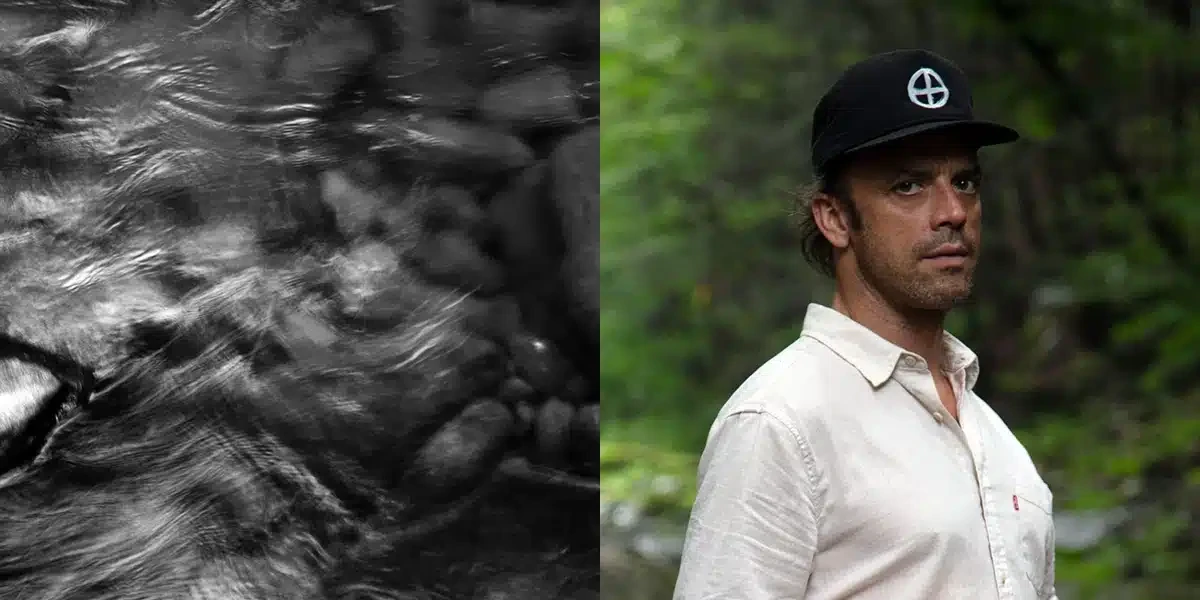
With his latest LP, Through to Us, multi-instrumentalist Matthew O’Neill fractures this conventional paradigm. Rather than treating the natural world as an aesthetic accent or a passive sample library, O’Neill treats his environment as a principal collaborator.
The record—a striking departure from his 2024 folk- and roots-inflected release, Ancestor’s Wheel—emerges from an open-door methodology. Recorded largely inside a woodland studio in the Catskill Mountains, the album dissolves the barrier between human-made instrumentation and the wild ecosystem outside.
Most radically, Through to Us codifies this relationship within its liner notes. Alongside O’Neill and double bassist Holden Arbey Silva Acosta, the album’s official credits enumerate its more-than-human contributors by species: Wood Thrush, Red-eyed Vireo, Raven, Wood Frog, Bullfrog, Cicada, Bear, and Humpback Whale.
This review-analysis explores the philosophical, technical, and structural dimensions of O’Neill’s work, examining how an album rooted in ecological reciprocity challenges both the listener’s perception of sound and the traditional conventions of music production.
Detailed Chronology: From Tradition to the Wild
To understand the radical nature of Through to Us, one must trace the trajectory of O’Neill’s recent output. His earlier 2024 release, Ancestor’s Wheel, occupied a well-traveled, venerated sonic terrain. Drawing heavily on the historical lineage of American roots music, traditional folk rock, and the expansive, exploratory ethos of heritage acts like the Grateful Dead and Pink Floyd, Ancestor’s Wheel was an album constructed primarily through traditional song-writing frameworks. It leaned on established blues progressions, narrative lyricism, and classic instrumentation to evoke a sense of deep time and communal memory.
Yet, even within that traditional framework, a psychedelic undercurrent hinted at O’Neill’s broader artistic ambitions. In the context of Ancestor’s Wheel, psychedelia manifested as an expansion of familiar forms—stretching song structures and dissolving boundaries through extended instrumental passages.
Through to Us, however, abandons those familiar harmonic signposts entirely. The transition represents a fundamental shift in methodology:
- The Studio Environment: While Ancestor’s Wheel was born of closed-room, traditional tracking sessions, Through to Us was forged in direct communion with its geography. O’Neill kept the doors and windows of his Catskills studio open during the recording process.
- Field-Sourcing on Demand: When a track demanded a specific sonic element or texture, O’Neill did not reach for a plugin or a synthesizer patch. Instead, he packed a field recorder, hiked deep into the surrounding mountain trails, and listened for what the landscape offered.
- The Dissolution of Song Form: Traditional verses, choruses, and strict time signatures recede. In their place stands an electronic haze punctuated by fleeting moments of piano, synthesizer, and upright bass. These human elements surface briefly before dissolving back into the environmental mix.
The resulting record operates less as a constructed landscape and more as an open acoustic portal. It presents an intimate, nocturnal ecosystem where synthetic drones and acoustic instruments blur seamlessly into the nocturnal cries of amphibians, insects, and birds.
Supporting Context & Metrics: The Ecology of Credits and Composition
The philosophical core of Through to Us is laid bare in its documentation. In the music industry, liner notes serve a standard economic and legal function: they catalog authorship, performance labor, copyright ownership, and technical contributions. O’Neill subverts this administrative framework by recognizing non-human entities as active participants in the creative process.
The Taxonomic Credits
By naming species alongside human collaborators, O’Neill raises vital questions about authorship and agency in the Anthropocene. The inclusion of the Wood Thrush, Red-eyed Vireo, and Humpback Whale—the latter featured via deep-sea recordings integrated into the track "Monhegan Reaches"—transforms the album credits from a logistical ledger into an ecological census.
| Contributor Category | Entities Involved | Primary Mode of Contribution |
|---|---|---|
| Human Personnel | Matthew O’Neill, Holden Arbey Silva Acosta | Multi-instrumentation, double bass, conceptualization, mixing |
| Avian Life | Wood Thrush, Red-eyed Vireo, Raven, Mourning Dove | Melodic motifs, rhythmic pulses, tonal textures |
| Amphibians & Insects | Wood Frog, Bullfrog, Cicada | Ambient drones, rhythmic foundations, cyclical textures |
| Mammalian Life | Black Bear, Humpback Whale | Low-end resonance, deep-sea vocalizations, spatial depth |
The Mechanics of "Owl Lit" and "Descent"
This collaborative methodology yields complex acoustic spaces. On "Owl Lit," a darkly luminous synthesizer motif is wrapped in the dense, layered sounds of a summer night. Rather than functioning as a literal postcard of nature, the track recreates the psychological reality of being inside the forest after dark. It captures the distinct intimacy of a midnight walk, where familiarity gives way to mystery as human vision fails and the auditory senses take over.
Conversely, tracks like "Descent" and "Ferocity Required" reveal the underlying tension of the project. "Descent," marked by swirling, dramatic textures, serves as a sonic translation of O’Neill’s physical descent from a mountain ridge. Meanwhile, "Ferocity Required" taps into his background in noise and heavy rock music. These moments serve as a vital reminder that Through to Us is not a passive field-recording archive. It is heavily composed, curated, and shaped by human hands. The album’s power lies precisely in the friction between intentional human composition and the unscripted intrusions of the wild.
Official Statements and Artistic Philosophy
O’Neill’s work is driven by an explicit philosophical objective: to make music "in reciprocity with the land and all the life around me." In interviews and project statements, the artist has emphasized that this approach requires shifting away from artistic extraction toward an ethic of listening.
Historically, Western popular music has frequently used nature and industrial environments as extractive samples. From the simulated train rhythms of early blues—which later inspired the locomotive momentum in classic rock and folk—to the simulated thunderstorms of ambient electronica, environmental sounds are typically deployed as illustrative metaphors. The blues artist used the freight train not merely for its sound, but as a cultural symbol of escape, sorrow, and liberation.
O’Neill’s work invites an evaluation of this historical precedent. Critics and listeners are left to ponder an enticing hypothetical: What would happen if musical composition took its structural cues directly from the irregular calls of a wood pigeon or the shifting cadences of a mountain stream?
Yet, O’Neill’s restraint suggests a deeper wisdom. To force a wood thrush’s complex, microtonal song into a rigid human time signature or a predictable pop structure would be to repeat the historical error of extraction—forcing the wild into a domesticated mold. By allowing the sounds of other species to retain their inherent strangeness, O’Neill practices a form of radical respect. The achievement of Through to Us is not that it tames the wilderness into music, but that it discovers what can be created when a human artist agrees to sit quietly in its company.
Future Outlook: Implications for Contemporary Sound Art
As ambient, experimental, and ecological music continue to converge in an era defined by climate crisis and ecological anxiety, Through to Us establishes an important methodological template for future artists.
The album raises profound questions for the future of sound design and ecological art:
- Redefining Authorship: How will copyright offices, streaming platforms, and musicologists adapt to albums that credit non-human species? While legal frameworks currently prohibit non-human copyright ownership, cultural shifts toward ecological accountability may force a rethinking of intellectual property in environmental art.
- Beyond Field Recording: As O’Neill demonstrates, the future of ambient music may lie not in pristine, high-definition captures of nature used as background color, but in genuine compositional dialogue—where human instruments answer, yield to, and build upon the acoustic cues of local ecosystems.
- The Listener’s Role: Records like Through to Us train the human ear to listen with greater acuity. By refusing to offer easy relaxation or predictable ambient loops, O’Neill challenges listeners to confront the complex, often unsettling polyphony of the living world.
Ultimately, Matthew O’Neill has opened a window—not simply onto the physical hills of the Catskills, but onto a new way of conceptualizing musical creation. Through to Us suggests that the most vital artistic breakthroughs of the coming decades will not come from inventing entirely new synthetic worlds, but from learning how to listen more deeply to the ones we are in danger of silencing.




Belum ada komentar. Jadilah yang pertama berkomentar!