

Executive Overview
In an era where democratic norms face unprecedented erosion, traditional institutional checks and balances often appear paralyzed. With executive, legislative, and judicial branches frequently deadlocked or co-opted by partisan actors, frustrated citizens have increasingly looked outside conventional political channels for accountability. Into this civic vacuum has stepped an unlikely vanguard: late-night television comedians and political satirists.
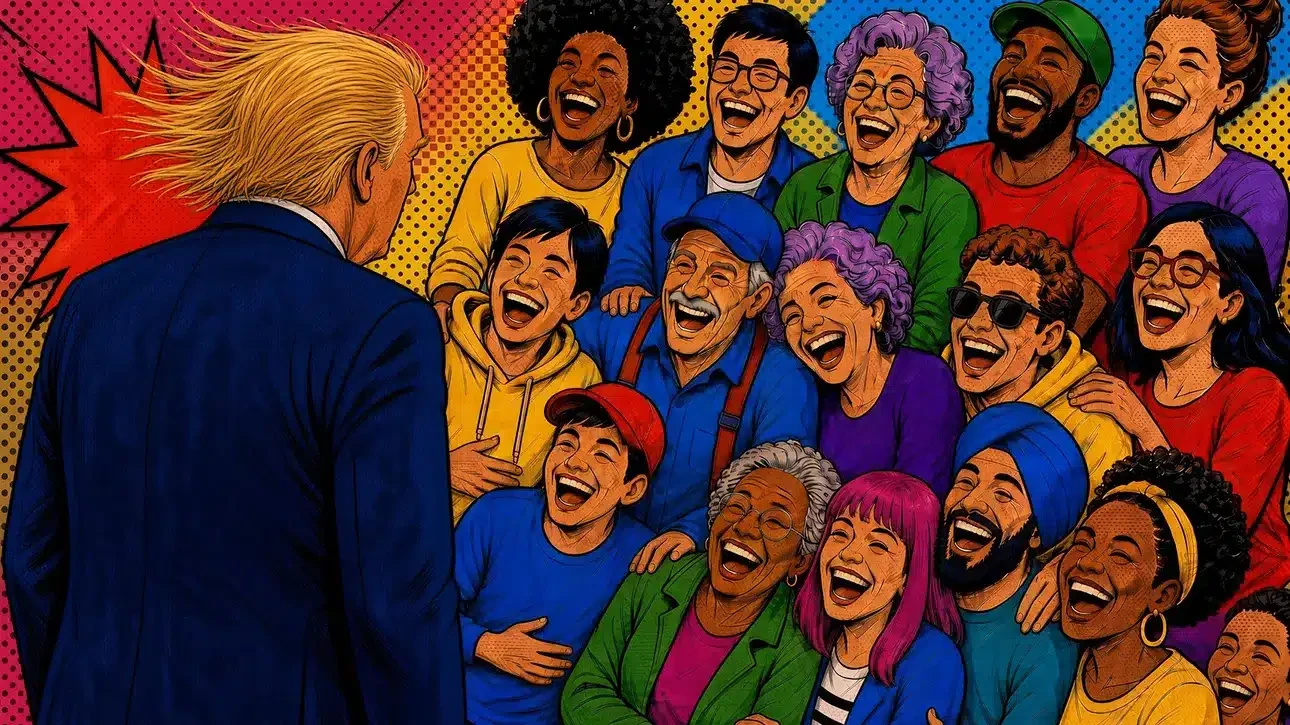
Humor has long served as a vital social corrective, but in contemporary American politics, it has evolved into a formidable weapon against creeping authoritarianism. As political figures attempt to consolidate power through fear, division, and demands for unthinking obedience, satirists like Jimmy Kimmel and Stephen Colbert have assumed the mantle of the public conscience. This phenomenon is not merely about entertainment; it represents a fundamental cognitive clash between the rigidity of autocratic control and the liberating, truth-seeking nature of laughter.
Recent high-stakes clashes between the current administration and late-night hosts—culminating in the dramatic suspension and subsequent triumphant reinstatement of Jimmy Kimmel—highlight a broader struggle over freedom of expression. When institutional journalism falters under the weight of political intimidation, late-night comedy has stepped forward to offer a "rhetoric of challenge." Ultimately, the resilience of public humor and consumer-driven pushback demonstrate that as long as critical satire flourishes, the absolute domination sought by aspiring autocrats remains out of reach.
Detailed Chronology: The Escalation of the War on Late-Night
The friction between the modern American presidency and the late-night comedy community reached a boiling point in late 2025, culminating in a sequence of events that tested the limits of the First Amendment and corporate media independence.
The Ousting of Stephen Colbert (July 2025)
The systematic targeting of critical voices began in mid-2025. Following a playbook reminiscent of historical crackdowns on free speech, the administration applied subtle yet intense pressure on corporate media conglomerates seeking federal regulatory approvals. In July 2025, CBS’s parent company, Paramount, was navigating a high-stakes business merger requiring government sign-off. Concurrently, the network announced the imminent cancellation of The Late Show with Stephen Colbert, effectively silencing one of the administration’s most eloquent and persistent critics under the guise of corporate restructuring.
The Catalyst: The Charlie Kirk Shooting (September 2025)
Buoyed by the ease with which Colbert’s platform was dismantled, the administration set its sights on ABC’s Jimmy Kimmel. The flashpoint arrived in September 2025 following the assassination of Charlie Kirk, an incident that ignited intense fury and a thirst for retribution within the MAGA movement and its media ecosystem.
On September 25, 2025, Kimmel delivered a searing monologue asserting that the "MAGA gang" was weaponizing the tragedy for political point-scoring, disregarding facts in their pursuit of vengeance. As expected, outrage surged through far-right information silos before spilling into mainstream discourse.
Regulatory Pressure and Corporate Capitulation
Seizing the moment, Federal Communications Commission (FCC) Chairman Brendan Carr swiftly deployed regulatory threats against ABC and its parent company, Disney. Nexstar Media Group immediately pulled Jimmy Kimmel Live! from its ABC-affiliated stations. Pressured by the administration over pending business mergers—in a maneuver critics likened to a classic mafia shakedown—Disney ordered ABC to halt broadcasts and suspend Kimmel indefinitely.
The Counter-Offensive and Reinstatement
Unlike previous concessions, the suppression of Kimmel triggered immediate, asymmetric pushback from the public and the entertainment industry. Late-night competitors rallied in a rare display of solidarity, condemning the suspension as a direct assault on free speech.
Leveraging years of earned trust, the American public mobilized. Consumers threatened widespread boycotts of Disney products, causing the company’s stock value to plummet. Faced with severe financial backlash and unprecedented public outrage, the administration, FCC leadership, and corporate executives retreated. Kimmel returned to the airwaves to rapturous applause, his national approval ratings soaring as he cemented his status as a defender of civic liberties.
Supporting Context & Metrics: The Mechanics of Laughter vs. Autocracy
To understand why authoritarian figures display such intense animosity toward comedians, one must examine the cognitive and historical mechanics of political satire.
The Cognitive Incompatibility of Humor and Fascism
Political scientist and philosopher John Morreall observed that "[people] with a sense of humor can never be fully dominated." Fascism demands two primary emotional responses from the populace: fear and hero-worship. It relies on manufactured anger and the scapegoating of out-groups to consolidate power.
Humor, by contrast, is fundamentally incompatible with both fear and uncritical adoration. Satire challenges the human mind to perceive hypocrisy, incongruities, and moral shortcomings. It dissolves the illusion of omnipotence that authoritarian leaders meticulously construct. Because narcissists and egotists require an environment of absolute obedience—a "humor-free zone"—the irreverence of a late-night monologue serves as their ultimate kryptonite.
Historical Precedents of Satirical Resistance
The weaponization of comedy against oppressive regimes is as old as civilization itself:
- Ancient Greece & Rome: Comic poets in the 6th century BCE utilized satire to guide Athenian democracy away from tyranny.
- Medieval Carnivals: Repressive feudal rulers were routinely subjected to public ridicule during carnivals, serving as an early safety valve for oppressed populations.
- American Revolution: Political cartoons provided the cultural momentum necessary to challenge the imposing authority of the British Crown, a tradition carried forward by Benjamin Franklin and Mark Twain.
- Totalitarian Extremes: In Nazi Germany and the Soviet Union, authoritarian regimes recognized the danger of independent wit. The Third Reich established "joke courts" to imprison citizens for minor slights, while Soviet authorities tightly controlled artistic output to ensure it served state interests.
The Failure of Traditional Journalism and the Rise of "Deliberative Democracy"
The necessity of late-night satire has been magnified by the retreat of traditional American journalism. Unlike in parliamentary democracies like the United Kingdom—where journalists routinely subject politicians to relentless cross-examination—mainstream American reporters have frequently capitulated to intimidation. Fearing exclusion from favored press corps or retaliation via dismissive insults, many journalists have abandoned rigorous lines of inquiry.
Consequently, millions of citizens have turned to late-night comedy programs not just for laughs, but for accurate, forthright reporting. As media scholar Geoffrey Baym argued in his analysis of The Daily Show, satirists utilize a "rhetoric of challenge" that merges journalism, criticism, and entertainment. By interrogating both politics and the media itself, these comedians foster a model of deliberative democracy that resonates on a deeply moral level.
Official Statements & Reactions
The standoff between the federal government and the late-night broadcasting industry elicited sharp responses from across the political and media spectrum:
- The Administration’s Perspective: Celebrating the initial suppression of critical voices, leadership framed the actions of regulatory bodies as victories for media accountability. Upon Kimmel’s initial suspension, a triumphant executive reportedly declared it "great news for America," viewing the removal of vocal critics as a restoration of order.
- Regulatory Defense: FCC Chairman Brendan Carr defended interventions against broadcasters by citing the necessity of maintaining public interest standards, though critics highlighted the transparently partisan nature of the regulatory threats.
- The Entertainment Industry: In the wake of Kimmel’s suspension, fellow talk-show hosts and entertainment guilds issued joint statements condemning the weaponization of federal agencies. Industry leaders emphasized that government-compelled censorship destroys the foundational principles of creative freedom.
- Civil Liberties Advocates: Legal scholars and First Amendment watchdogs warned that using regulatory leverage to silence comedians sets a dangerous precedent, effectively transforming public airwaves into state-sanctioned mouthpieces.
Future Outlook: The Resiliency of Free Expression
The tumultuous events surrounding late-night television in 2025 offer both a stark warning and an encouraging blueprint for the future of American democracy.
As aspiring autocrats continue to probe for weaknesses within democratic guardrails, the temptation to utilize state power against critics will remain high. The weaponization of regulatory bodies like the FCC against corporate media entities demonstrates that institutional protections are fragile when corporate leadership prioritizes short-term financial mergers over civic duty.
However, the rapid and decisive counter-offensive mounted by the American public against the suppression of Jimmy Kimmel signals a profound shift in the balance of power. The episode proved that consumer sovereignty—the willingness of citizens to withdraw economic support from complicit corporations—remains an exceptionally potent deterrent against overreach.
Ultimately, the enduring popularity of political satire confirms that no matter how tightly an administration attempts to control the narrative, the human spirit retains an inherent drive toward laughter, inquiry, and freedom. As long as comedians maintain the courage to speak truth to power, and as long as citizens are willing to defend that right, the foundations of an open society will endure.








Belum ada komentar. Jadilah yang pertama berkomentar!