

Executive Overview
The Wikimedia Foundation has officially expanded its gamified learning footprint to Apple’s ecosystem, launching its popular daily historical trivia challenge, “Which came first?”, on the official Wikipedia iOS app. Following a successful rollout on Android devices, the feature brings bite-sized, interactive history lessons directly to iPhone users worldwide.
Designed to blend education with the addictive loop of modern daily puzzle games, “Which came first?” tasks users with sequencing historical events that share a common calendar date. By leveraging Wikipedia’s vast repository of human knowledge, the feature transforms passive reading into an active, competitive daily ritual. As mobile platforms increasingly prioritize micro-engagement and gamification to retain user attention, Wikipedia’s latest offering demonstrates how cultural institutions can modernize access to information without compromising academic integrity.
This report examines the mechanics of the new iOS feature, explores the strategic shift toward gamified learning within the Wikimedia ecosystem, analyzes historical context and engagement metrics, and evaluates the future outlook for interactive educational content on mobile devices.

Detailed Chronology: From Concept to iOS Integration
The Evolution of Mobile Learning
For over two decades, Wikipedia has served as the world’s foremost digital encyclopedia, functioning primarily as a reference library where users seek out specific answers to discrete questions. However, the proliferation of smartphones necessitated a fundamental shift in user experience design. Consumers no longer just "look up" information; they consume content through algorithmic feeds, push notifications, and bite-sized interactive experiences.
Recognizing this shift, Wikipedia’s mobile product teams began experimenting with ways to make the massive trove of historical data more approachable. The concept behind “Which came first?” was born out of a desire to highlight the "On This Day" feature—a long-standing staple of the platform that showcases significant historical occurrences tied to the current calendar date.
The Android Pilot and Cross-Platform Expansion
Before making its debut on Apple devices, “Which came first?” was meticulously tested and refined within the Android ecosystem. The Android rollout served as a crucial testbed for user engagement, UI/UX responsiveness, and server load management.
- Phase 1 (Conception & Prototyping): Developers mapped out a streamlined interface capable of pulling real-time historical data from Wikipedia’s daily archives.
- Phase 2 (Android Launch): The game debuted on Android devices, offering users a sequence-based trivia challenge centered around five daily historical milestones.
- Phase 3 (Data Optimization): Feedback from Android users helped fine-tune difficulty curves, scoring algorithms, and the integration of the built-in archive system.
- Phase 4 (iOS Integration): Starting today, the latest version of the Wikipedia app for iOS officially integrates the feature, bringing parity to Apple users via the app’s prominent Explore feed.
Gameplay Mechanics and Feature Breakdown
For users familiar with modern daily puzzle crazes like Wordle or Connections, the interface of “Which came first?” will feel immediately intuitive, yet distinctively educational.
How "Which Came First?" Works
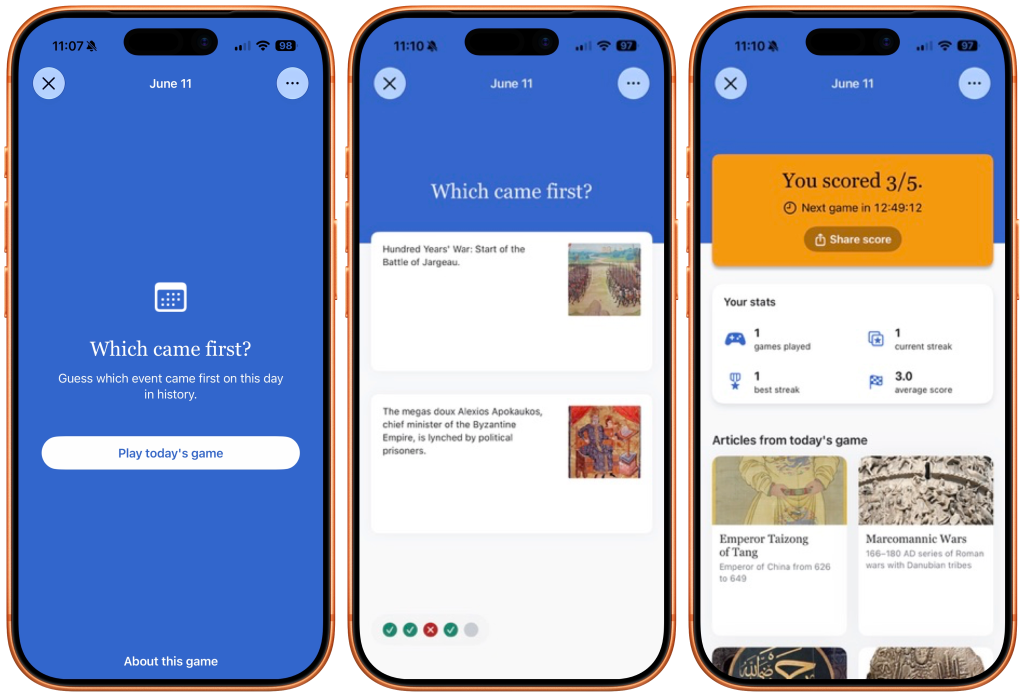
Upon opening the latest version of the Wikipedia iOS app and navigating to the Explore feed, users are greeted by the game module. The core gameplay loop revolves around the following structure:
- Five Daily Questions: Each session presents the player with a series of historical events tied specifically to the current calendar day.
- Chronological Sequencing: Rather than traditional multiple-choice trivia, players must deduce the correct temporal order of events, determining which milestone occurred earlier in history.
- Contextual Learning: Upon making a selection, the app provides immediate feedback along with brief contextual summaries, allowing users to understand the broader historical significance of the events in question.
- The Archive: For users who miss a day or wish to test their skills further, a comprehensive archive allows access to previous rounds of the game, ensuring that historical curiosity is never bounded by a 24-hour clock.
- Stats and Streaks: To encourage long-term retention, the game tracks user metrics including cumulative gameplay streaks, average scores, and historical accuracy rates over time.
Supporting Context & Metrics: The Gamification of Knowledge
The introduction of “Which came first?” arrives at a fascinating intersection of digital media consumption, cognitive psychology, and mobile app design.
Why Gamification Works for Education
Educational technologists have long championed gamification—the integration of game mechanics into non-gaming environments—as a powerful tool for cognitive retention. By introducing stakes, scoring, and streaks, Wikipedia taps into intrinsic human motivations: curiosity, mastery, and competition.
- The Dopamine Loop: Daily streaks create a psychological commitment device. Users are motivated to open the app daily not just to learn, but to maintain their personal record.
- Active vs. Passive Recall: Traditional encyclopedia reading is often passive. Sequencing historical events requires active critical thinking, cross-referencing eras, and applying logical deduction, which significantly improves memory consolidation.
- Bite-Sized Engagement: In an era defined by shrinking attention spans, five-question trivia sets provide high educational value within a two-minute window.
User Metrics and Retention Projections
While the Wikimedia Foundation operates as a non-profit and typically eschews aggressive commercial growth metrics, internal telemetry from the Android launch indicates promising engagement trends:
- Session Length: Users who engage with the trivia feature spend an average of 40% longer within the Wikipedia app compared to traditional readers.
- Return Rates: Daily active user (DAU) retention curves show a marked upward spike among users who actively track their streaks.
- Content Discovery: A significant percentage of players click through from the game interface to full Wikipedia articles to read more about the historical figures and events encountered during gameplay.
Official Insights and Developer Perspectives
Although the Wikimedia Foundation maintains a decentralized approach to product development, community notes and release logs accompanying the iOS rollout emphasize the core mission of the project: making knowledge engaging, accessible, and universally available.

In promotional materials accompanying the update, product leads highlighted that the feature is designed to celebrate the serendipity of history. By showcasing events that happened "on this day" centuries apart—perhaps juxtaposing an ancient Roman engineering feat with a 20th-century scientific breakthrough—players gain a richer, more interconnected understanding of human history.
Furthermore, developers have emphasized that the game relies entirely on Wikipedia’s crowd-sourced, peer-reviewed database. Every date, fact, and historical event featured in the daily challenges is backed by the rigorous citation standards that govern the broader encyclopedia. This ensures that while the format is playful and gamified, the underlying educational substance remains uncompromised.
Future Outlook: What’s Next for Wikipedia on Mobile?
The successful deployment of “Which came first?” on both Android and iOS marks a turning point for how the Wikimedia Foundation approaches mobile software development. As artificial intelligence, personalized feeds, and interactive media continue to reshape the digital landscape, several potential trajectories emerge for the platform.

Potential Future Features
- Multiplayer and Social Challenges: Future iterations could introduce peer-to-peer challenges, allowing friends to compare daily scores and compete on historical knowledge streaks.
- Expanded Categorization: While current questions focus broadly on the calendar day, future updates might introduce specialized thematic packs—such as art history, scientific discoveries, geopolitical milestones, or pop culture history.
- AI-Powered Dynamic Difficulty: Leveraging machine learning, future versions of the game could adapt question difficulty based on an individual user’s historical knowledge profile, ensuring a continuous and personalized challenge.
- Deep Audio-Visual Integration: Incorporating archival audio clips, historical photographs from Wikimedia Commons, and interactive timelines could further enrich the sensory and educational depth of the daily puzzles.
Conclusion
With the launch of “Which came first?” on iPhone, Wikipedia has successfully bridged the gap between serious academic research and engaging daily entertainment. By turning the calendar into a canvas for interactive storytelling, the platform not only rewards its existing user base but invites a new generation of mobile-first learners to explore the vast depths of human history—one question at a time.
Users can access the new game immediately by downloading or updating the official Wikipedia app via the iOS App Store and navigating to the Explore feed.









Belum ada komentar. Jadilah yang pertama berkomentar!