


Executive Overview
The video game industry has historically treated macOS as an afterthought. For decades, Mac users watched from the sidelines as triple-A (AAA) blockbusters debuted on Windows PCs and home consoles, arriving on Apple’s ecosystem months or years later—if they arrived at all. Ports were frequently plagued by performance bottlenecks, subpar optimization, and architectural incompatibilities that discouraged both developers and consumers.
However, the paradigm is shifting in real time.
Set to launch on March 19, Pearl Abyss’s highly anticipated open-world action-adventure game, Crimson Desert, will break convention by releasing on macOS on day one, alongside versions for Windows PC, PlayStation 5, and Xbox Series X|S.
This simultaneous launch represents more than just a major content drop for Apple’s desktop and laptop computers; it is a critical litmus test for Apple’s multi-year silicon strategy. Powered by Apple Silicon’s unified memory architecture, advanced ray-tracing engines, and MetalFX Upscaling, the Mac is finally positioning itself as a legitimate destination for high-end, next-generation gaming.

With Apple poised to unveil new MacBook hardware powered by the next generation of M-series chips, the arrival of Crimson Desert underscores a monumental turning point for personal computing performance.
Detailed Chronology: From Apple Silicon’s Genesis to Day-One AAA Releases
To understand the significance of Crimson Desert launching on macOS on day one, one must trace the deliberate, calculated evolution of Apple’s hardware and software strategy over the past several years.
The Silicon Transition (2020–2022)
When Apple announced its transition away from Intel processors to custom-designed Apple Silicon in late 2020, the gaming community remained largely skeptical. While the M1 chip astonished the tech world with its energy efficiency and impressive CPU performance, its integrated graphics capabilities were initially viewed through the lens of productivity and casual media consumption.
However, Apple’s architecture carried a hidden weapon: a unified memory system that allowed the CPU, GPU, and Neural Engine to share a single, high-bandwidth pool of memory. This drastically reduced data transfer overheads—a traditional pain point in PC gaming architecture.

The Software Foundation: Game Porting Toolkit (2023)
Recognizing that hardware alone does not attract players, Apple took a aggressive step at WWDC 2023 by introducing the Game Porting Toolkit (GPTK). This developer-facing suite allowed Windows game developers to evaluate how their existing DirectX 12 titles could run on macOS with minimal code modification.
By translating Windows graphics APIs to Apple’s proprietary Metal API in real time, developers could test performance, identify bottlenecks, and experience their games running on Apple Silicon in a matter of hours. This toolkit laid the groundwork for subsequent high-profile ports like Resident Evil Village, Death Stranding Director’s Cut, and Cyberpunk 2077 (via compatibility layers).
The Strategic Partnership Breakthrough (Summer 2025)
The trajectory of Mac gaming shifted dramatically last summer when Apple formally announced a massive influx of upcoming major releases. During a strategic showcase, Apple highlighted a lineup of nine heavy-hitting titles slated for macOS. Among them was Crimson Desert, developed by South Korean powerhouse Pearl Abyss—renowned globally for their work on the massively multiplayer online role-playing game (MMORPG) Black Desert Online.
Apple’s messaging during this showcase was explicit: the company was no longer content with relying on delayed, retroactive ports. Instead, Apple sought simultaneous parity with the console and PC markets.

By securing Crimson Desert for a day-one macOS launch, Pearl Abyss and Apple have signaled to the broader games industry that modern Mac hardware is robust enough to handle simultaneous multi-platform deployments of world-class, graphically demanding software.
Supporting Context & Metrics: The Technology Powering Crimson Desert on Mac
Crimson Desert is not a lightweight indie title or a retro-styled platformer; it is a graphically intensive, hyper-detailed open-world epic built using Pearl Abyss’s proprietary next-generation BlackSpace Engine. Delivering seamless exploration, dynamic weather systems, sprawling vistas, and complex, physics-driven combat requires an immense amount of processing power.
Harnessing MetalFX Upscaling and Ray Tracing
To ensure the game runs smoothly across Apple’s hardware lineup without sacrificing visual fidelity, Pearl Abyss has deeply integrated Apple’s proprietary graphics technologies:
- MetalFX Upscaling: By rendering the game at a lower native resolution and intelligently upscaling it using spatial and temporal algorithms, MetalFX reduces the computational load on the GPU. This allows for higher frame rates and fluid motion without compromising image sharpness.
- Hardware-Accelerated Ray Tracing: First introduced to the M3 family of chips and further refined in the M4 generation, hardware ray tracing allows for realistic light transport, dynamic shadows, and accurate reflections. In Crimson Desert, this technology brings the bleak, beautiful fantasy landscapes of Pywel to vivid life, rendering armor gleaming in the sun and torchlight flickering realistically across cavern walls.
Pricing and Editions
Gamers interested in securing their copy ahead of the March 19 launch can pre-order Crimson Desert now via Steam. The title is offered in two distinct digital tiers:
- Standard Edition: Priced at $69.99, featuring the base game and pre-order bonuses.
- Deluxe Edition: Priced at $79.99, bundling additional in-game cosmetic items, resource packs, and early-access perks.
System Requirements and Hardware Compatibility
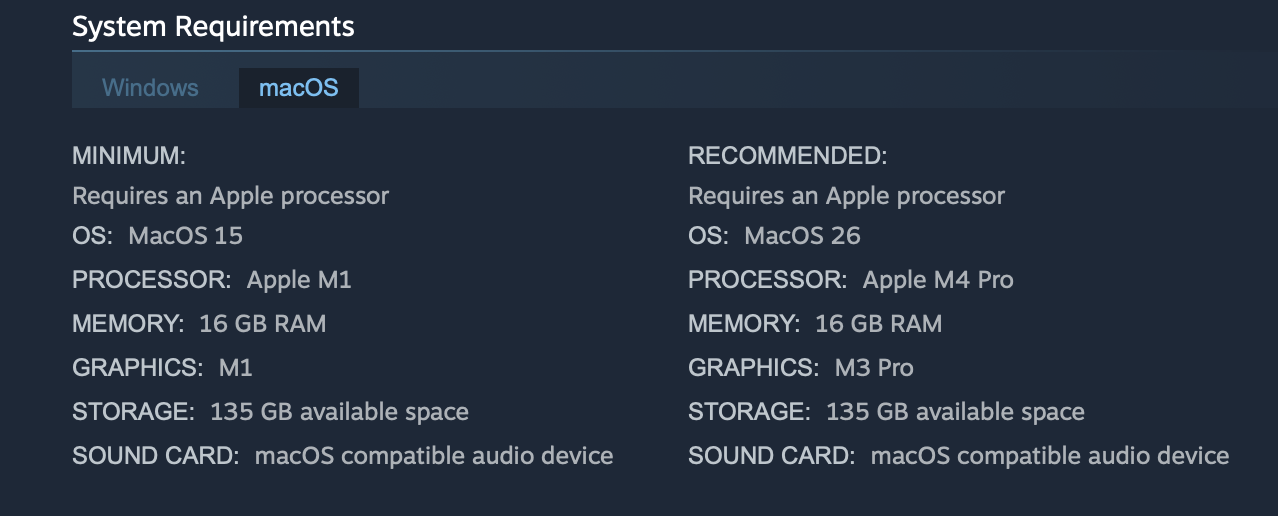
Running a game of this magnitude requires robust hardware. Reviewing the official system requirements highlights the specific hardware thresholds needed to experience Crimson Desert optimally on macOS:
- Processor (SoC): Apple M3, M4, or newer processor families equipped with integrated multi-core GPUs supporting hardware ray tracing.
- Unified Memory: A minimum recommendation of 16GB to 24GB of unified memory to handle asset streaming in the vast open world.
- Storage: High-speed SSD storage is mandatory to ensure rapid texture loading and asset streaming via Apple’s high-throughput storage controllers.
Given that Apple is widely expected to showcase new MacBook models featuring the upcoming M5 Pro and M5 Max chips, industry observers anticipate that Crimson Desert will serve as a premier benchmarking tool and promotional centerpiece for Apple’s next wave of silicon hardware.
Official Statements and Industry Impact
The announcement of a day-one macOS release for a major third-party AAA game has sent ripples through the video game industry. For years, game studios cited the small installed base of traditional Mac gamers as the primary deterrent against investing in macOS development. However, the ubiquity of Apple Silicon—spanning MacBook Air, MacBook Pro, iMac, Mac mini, and Mac Studio—has created a unified architectural target that makes porting far more economically viable.
Industry analysts note that Pearl Abyss’s decision to commit to a day-one macOS launch reflects growing confidence in Apple’s Metal developer toolchain.

Furthermore, game developers have praised Apple’s proactive approach in providing engineering support. Rather than simply dropping software development kits (SDKs) into the wild, Apple’s evangelism and engineering teams have actively collaborated with studios to optimize shader compilation, memory allocation, and thermal management on portable MacBooks.
Future Outlook: What Crimson Desert Means for the Future of Mac Gaming
As the gaming community counts down the days to March 19, the implications of Crimson Desert extend far beyond a single entertainment product.
If the game launches smoothly, maintains stable frame rates, and achieves strong commercial sales on macOS, it will establish a vital commercial precedent. Other major third-party publishers—who have historically hesitated to commit resources to the Mac ecosystem—will take notice. A successful launch could dismantle the long-standing stigma that "Macs aren’t gaming machines."
Apple’s ongoing hardware iterations, combined with mature graphics APIs like Metal and developer-friendly upscaling frameworks, are systematically dismantling the technical barriers that once isolated macOS from the wider gaming landscape.

The launch of Crimson Desert is not just an exciting milestone for open-world action-adventure fans; it may well be remembered as the exact moment macOS permanently transformed into a first-class citizen in the global gaming market.









Belum ada komentar. Jadilah yang pertama berkomentar!