

Executive Overview
For decades, Apple’s relationship with the PC and console gaming industries has been characterized by high ambitions and uneven execution. Despite persistent, multi-million-dollar efforts to position the Mac as a viable destination for AAA titles, mainstream gamers have historically treated Apple silicon as an afterthought. Ecosystem fragmentation, historical reliance on proprietary or legacy graphics APIs, and a relative shortage of native hardware-accelerated development tools have long relegated macOS to the sidelines of the global gaming market.
However, the debut of Metal 4 at Apple’s Worldwide Developers Conference (WWDC25) signals a potentially pivotal shift. Moving beyond generalized performance promises, Apple has introduced two deeply practical, hardware-conscious features integrated directly into its MetalFX graphics pipeline: frame interpolation and ray tracing denoising.
These technologies are not merely cosmetic tweaks; they are foundational rendering strategies designed to bridge the performance gap between power-hungry PC rigs and thin, thermally constrained Apple Silicon architectures. By allowing developers to bypass the traditional heavy lifting of rendering native high-resolution frames and complex ray-traced lighting models from scratch, Metal 4 aims to make porting and optimizing high-end AAA games for macOS more efficient than ever before.
This article explores the technical mechanisms behind Metal 4, evaluates its implications for developers and players alike, and analyzes whether these advancements can finally cement the Mac as a credible tier-one gaming platform.
Detailed Chronology of Apple’s Graphics Architecture
To understand the weight of Metal 4, one must trace the deliberate, step-by-step evolution of Apple’s proprietary graphics ecosystem over the past decade.
- 2014 — The Birth of Metal: Apple introduced Metal at WWDC2014, breaking away from OpenGL and OpenCL to give developers low-overhead, direct access to the GPU. This drastically reduced driver overhead and maximized hardware efficiency across iOS devices and Macs.
- 2020 — The Apple Silicon Transition: The launch of the M1 chip marked a structural revolution. By unifying system memory architecture (UMA) and combining high-performance CPU cores, a scalable GPU, and a dedicated Neural Engine onto a single SoC, Apple created a platform capable of high-fidelity graphics computation without the traditional separation of discrete desktop GPUs.
- 2023 — MetalFX Upscaling: Recognizing the massive rendering demands of modern AAA games, Apple introduced MetalFX at WWDC23. This spatial and temporal upscaling framework allowed games to render at lower native resolutions before scaling up, preserving frame rates without catastrophically degrading visual fidelity.
- 2025 — Metal 4 and the Next Generation: Unveiled at WWDC25, Metal 4 builds directly upon the foundation laid by MetalFX. By introducing built-in frame interpolation and ray tracing denoising directly into the API pipeline, Apple is directly addressing the two largest performance bottlenecks in modern gaming: fill rate limitations and expensive lighting computations.
Supporting Context & Metrics: Decoding Metal 4’s Core Technologies
The technical architecture of Metal 4 revolves around optimization, intelligent guesswork by the GPU, and algorithmic cleanup. To fully appreciate how these tools alter the Mac gaming landscape, we must examine the underlying components: MetalFX Upscaling, Frame Interpolation, and Ray Tracing Denoising.
The Baseline: MetalFX Upscaling
Before analyzing the new features of Metal 4, it is necessary to review how MetalFX upscaling operates, as both interpolation and denoising function as extensions of this upscaling pipeline.
As Apple explicitly detailed in its WWDC25 developer sessions:
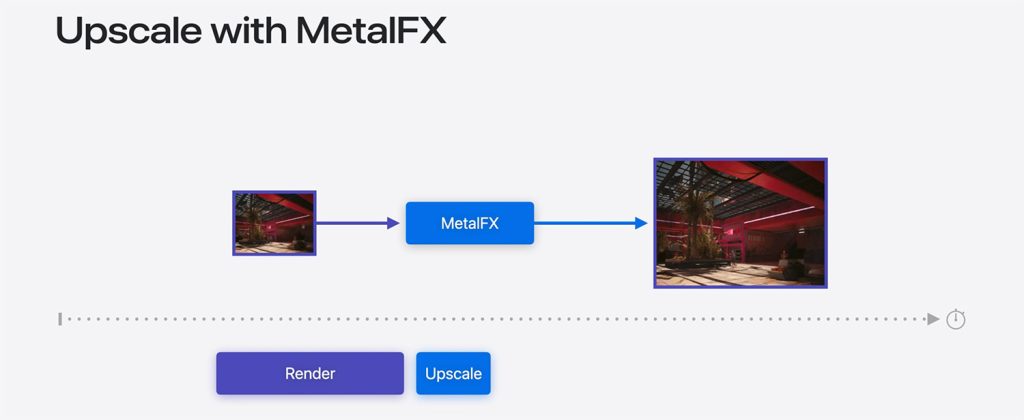
"Rendering high resolution images can consume the GPU for a significant period of time. Instead, your app can render low resolution images and use MetalFX to upscale them. The combined time to render your final image is reduced and that means your app can save time for each frame it renders. You can use the time saved to render the next frame sooner."
While upscaling technology is hardly revolutionary in the broader PC space—where competitors like NVIDIA DLSS, AMD FSR, and Intel XeSS dominate—its native integration into Apple’s graphics framework is crucial. It sets a performance baseline for Mac development, ensuring that developers targeting macOS do not have to reinvent the wheel when optimizing for heterogeneous hardware ranging from fanless MacBook Airs to fully loaded Mac Studios.
Frame Interpolation: Doing More With Less
If you have ever toggled on "frame generation" settings in modern PC titles, you are already familiar with the underlying concept of interpolation.
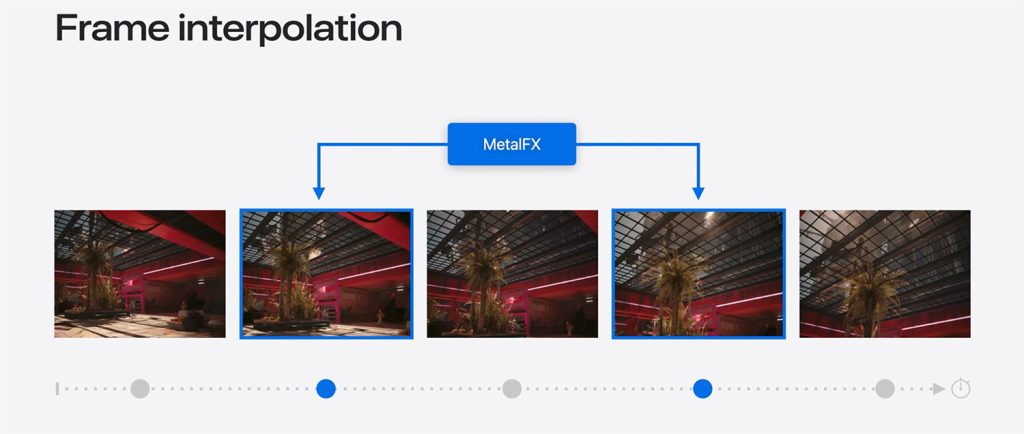
Instead of forcing the GPU to work overtime to calculate every single pixel of a brand-new frame from scratch, frame interpolation generates intermediate frames between real, rendered frames. It achieves this by aggressively analyzing motion vectors and scene depth data. By tracking how individual objects shift across the display space from frame $A$ to frame $B$, the algorithm predicts and paints the transitional state.
Apple’s official documentation for this new capability notes:
"This year, MetalFX adds support for frame interpolation. Your app can use it to generate intermediate frames in much less time than it would take to render each frame from scratch. You can use those intermediate frames to achieve even higher frame rates."
For the end user, this translates to significantly smoother animations and a higher perceived refresh rate, even if the underlying game engine is natively outputting a standard 30 or 60 frames per second. For developers, it represents an invaluable shortcut to delivering a fluid 90Hz or 120Hz experience on promotion displays without doubling the raw rendering workload on the GPU.
Ray Tracing Denoising: Clearing the Visual Speckle
Ray tracing has become the gold standard for realistic lighting, soft shadows, and accurate reflections in contemporary gaming. However, it is notoriously resource-intensive. The more light rays a game engine casts to simulate the chaotic physics of light interaction, the more pristine the visual output—and the lower the frame rate plummets.
To make ray tracing viable on consumer-tier hardware, game developers have long had to implement complex, custom denoising algorithms. These algorithms clean up the "noisy" or speckled artifacts that appear when a scene is rendered with an insufficient number of light rays per pixel.
With Metal 4, Apple has baked a native denoising feature directly into the MetalFX pipeline. The graphics pipeline now allows games to intentionally render scenes with fewer rays and subsequently clean up the resulting noise during the upscaling process. Because this happens natively within the framework, developers are freed from the burden of writing custom denoising code or taxing the host CPU with heavy auxiliary processing tasks.
Official Statements and Hardware Compatibility
Apple has confirmed that Metal 4 will enjoy wide systemic support across its hardware lineup. The framework will run natively on M1 chips and later, as well as A14 Bionic and later devices, ensuring that features like frame interpolation and ray tracing denoising are accessible to a massive installed base of iPads and iPhones alongside Macs.
Industry observers and developers looking to integrate these tools into upcoming pipelines have been directed by Apple to review specialized WWDC25 documentation, specifically sessions titled “Discover Metal 4” and “Go further with Metal 4 games.” These sessions provide deep-dive code examples and architectural guidance on how to migrate existing engines over to the upgraded pipeline.

Future Outlook: Can Metal 4 Change the Narrative for Mac Gaming?
The introduction of Metal 4 is a technical triumph, but the perennial question facing Apple remains structural rather than purely computational: Will major game publishers care?
For years, the hurdle preventing Mac adoption has been a chicken-and-egg dilemma. Publishers hesitate to invest engineering hours into porting complex, DirectX-reliant AAA engines to macOS because the installed gamer base on Mac is perceived as small. Conversely, gamers refuse to buy Macs as primary gaming platforms because the library of available AAA titles remains sparse.
Apple has attempted to break this cycle using automated porting toolkits (such as the Game Porting Toolkit), financial incentives, and high-profile developer outreach. Metal 4 represents the next logical step in this campaign: lowering the technical barrier to performance optimization.
If a game developer can take an existing PC title, implement MetalFX upscaling, utilize native frame interpolation to hit high refresh rates without breaking thermal limits, and rely on built-in ray tracing denoising to keep lighting smooth, the cost-benefit analysis of a macOS port shifts dramatically.
The Road Ahead
We are unlikely to see an overnight migration of the entire Steam library to macOS. However, as Apple Silicon continues to dominate the personal computer market share in terms of raw power-per-watt efficiency, tools like Metal 4 give developers the precise weaponry they need to deliver console-quality experiences on ultra-portable notebooks and desktop machines alike.

Ultimately, Metal 4 proves that Apple is no longer merely dabbling in gaming. By offering sophisticated, industry-standard rendering tools baked directly into the operating system, Apple is building an infrastructure robust enough to handle the future of interactive entertainment—waiting patiently for the software ecosystem to catch up to its hardware ambitions.









Belum ada komentar. Jadilah yang pertama berkomentar!