

Executive Overview
For decades, mainstream animated cinema has been dominated by a familiar American blueprint: heartwarming, family-friendly narratives packaged by Hollywood giants like Walt Disney, Pixar, and DreamWorks. While these studios have perfected the art of wholesome, universally accessible entertainment, a rich and vastly different tradition of animation thrives beyond U.S. borders. Across the globe, filmmakers have long utilized anthropomorphic animals not merely to sell merchandise or amuse children, but as a sharp, satirical vehicle to hold a mirror up to human society, interrogate political oppression, and subvert cultural norms.
Enter Deaf Crocodile, a Los Angeles-based boutique Blu-ray label dedicated to unearthing, restoring, and distributing overlooked and esoteric masterpieces of international animation. Through meticulously curated physical media releases, Deaf Crocodile is bridging a critical gap in film preservation, bringing vital works of adult-oriented world animation to Western audiences for the very first time.
At the center of this revival are two striking releases from vastly different corners of the globe: Hungary’s cult-classic Cold War spy spoof Cat City (Macskafogó) and its long-awaited sequel, alongside the Philippines’ neon-drenched, adult romantic comedy Hayop Ka! (You Son of a Bitch!). Far from innocent animal capers, these films use cats, dogs, and mice to deconstruct totalitarian control, corporate greed, and the dangerous allure of escapist fantasies. By stripping away the comforting gloss of American family animation, these international features expose the anxieties of their respective geopolitical landscapes, proving that cartoons have always been a formidable medium for political and social critique.
Detailed Chronology: From Golden Age Hollywood to the Iron Curtain and Beyond
The Evolution of Adult Animation and the American Blueprint
To fully appreciate the subversive nature of international animation, one must first understand how cartoons shifted from general adult entertainment to sanitized children’s fare. The classic Hollywood studio shorts produced by Disney, Warner Bros., Max Fleischer, and MGM in the 1930s and ’40s were never created exclusively for children. Instead, they played as standard components of an evening’s theatrical program, consumed by general audiences of all ages.
However, the advent of postwar television changed the paradigm entirely. Programmers packaged these legacy theatrical shorts for children’s television blocks, inadvertently sparking censorship campaigns and parental outrage over the bone-crunching slapstick, stylized violence, and ethnic stereotypes embedded within them.
- The iconic, chaotic adventures of Tom & Jerry embodied an endless, cruel cycle of feline aggression, ingenious defense, and retaliatory violence.
- Early black-and-white appearances of Mickey Mouse frequently indulged in surreal cruelty.
- Historical racial and ethnic caricatures—such as the originally unredubbed voice of the African-American maid chasing Tom—along with the frank, hyper-sexualized adult teasing of Max Fleischer’s Betty Boop, were systematically phased out.
As Hollywood steadily steered its theatrical animation divisions toward safe, homogenized family fare, international studios charted a radically different course. While Japanese anime and Eastern European surrealism carved out distinct artistic identities, their works remained frustratingly elusive to Western home video collectors for decades—a gap that specialty labels like Deaf Crocodile are now actively working to close.
Cat City (1986): The Cold War, Corporate Cops, and the Eternal War of Cat and Mouse
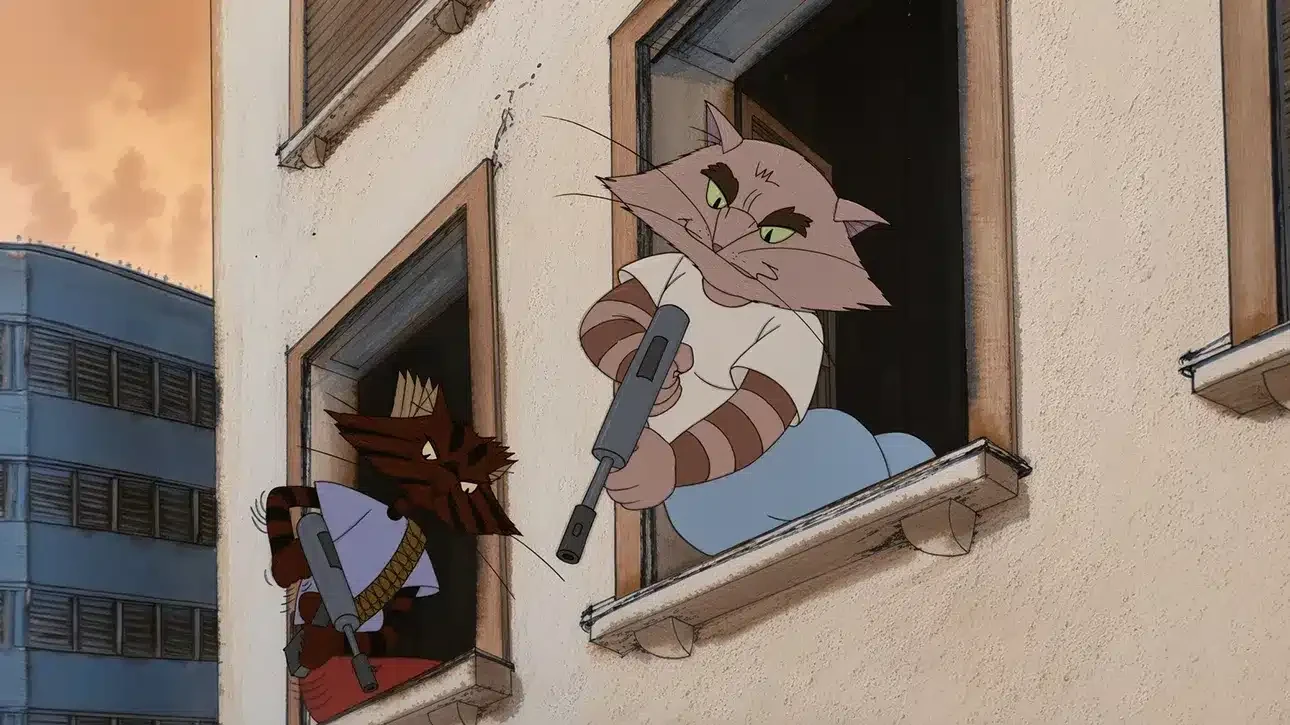
Directed by Béla Ternovszky and written by József Nepp at Hungary’s premier Pannónia Film Studio, the 1986 feature Cat City (Macskafogó) stands as a towering achievement of Eastern European satire. The film opens with a flurry of meta-textual irony, spoofing the MGM lion with a cat head that gets unceremoniously gonged by a mouse holding a mallet, before launching into an introductory text crawl that parodies George Lucas’s Star Wars. Set in the year 80 A.M.M. (After Mickey Mouse), the plot outlines an existential conflict where feral cats systematically drive mice to the brink of extinction, completely disregarding all peace treaties.
The narrative functions primarily as a high-octane James Bond spoof. The shadowy cat mastermind, Mr. Gatto, bears an uncanny resemblance to Ernst Stavro Blofeld’s white Angora cat, while his chief henchman, the scarred and eyepatch-wearing Mr. Teufel (whose first name is revealed to be Fritz), brandishes a mechanical hand that directly evokes Fritz Lang’s cinematic visions in Metropolis and Dr. Mabuse the Gambler.
The inclusion of such extensive Bond parodies in a 1980s Hungarian production is inherently fascinating. James Bond films—symbols of decadent, capitalist Cold War espionage—were not legally distributed behind the Iron Curtain. Yet, through illicit viewings and underground circulation, Western pop culture permeated the bloc, fueling a rich tradition of counter-cultural satire.
Beneath the slapstick violence and rapid-fire pop-culture nods lies a darker, distinctly political subtext. The film opens with a colossal cat-driven tank demolishing a mouse-operated bank. For Hungarian audiences living in the lingering shadow of the 1956 Soviet invasion and subsequent occupation, the imagery of tiny citizens crushed by an overwhelming, mechanized, and genocidal force carried undeniable resonance. While the production used anti-Nazi resistance tropes as a safe narrative alibi, the corporate-suited felines functioned as an effective stand-in for contemporary totalitarian oppression.
Despite its heavy thematic underpinnings, Cat City was a massive commercial success in Hungary and was even selected as the country’s official submission to the Academy Awards for Best Foreign Language Film. The film featured an eclectic cast of characters, including an incompetent assassin-rat pop quartet, a jungle-surviving "lazy" mouse, and Los Vampiros—a mariachi-playing band of Mexican-accented vampire bats residing within an Aztec pyramid.
Deaf Crocodile’s physical media release preserves this masterwork alongside a treasure trove of Pannónia short films directed by Ternovszky and Nepp. Shorts like Modern Training Methods (1970)—which imagines athletes achieving peak performance only when running from sharks or dodging grenade-launching tennis opponents—and Where Is the Limit? (1975) showcase the studio’s pitch-black, morbid sense of humor.
Catcher: Cat City 2 (2007): The Millennial Sequel
Expanding upon the legacy of the original cult classic, The Cat City Collection Blu-ray release introduces Western audiences to the long-belated 2007 sequel, Catcher: Cat City 2 (Macskafogó 2 – A sátán macskája). Set twenty years after the events of the original film, the sequel blends traditional hand-drawn animation with modern computer-generated techniques.
Opening in "Pafrica"—an over-the-top pastiche of colonial exploration tropes featuring a mouse explorer named Henry Morton Stanley—the narrative quickly pivots to the conjuration of the demonic feline entity Moloch. Drawing visual inspiration from the black-silhouetted Chernabog sequence in Disney’s Fantasia (1941) and Fritz Lang’s Metropolis, Moloch orchestrates an apocalyptic war between cats and rodents. The film maintains the frantic comedic pace of its predecessor, stuffing every frame with breathless references to Tarzan, Dumbo, Godzilla, Rambo, Japanese anime, and even Riverdance.
Hayop Ka! (2020): Deconstructing Escapist Romance in Manila
Shifting the geographical and tonal focus to Southeast Asia, Avid Leongoren’s Hayop Ka! (You Son of a Bitch!, 2020) brings a distinctly Filipino lens to adult anthropomorphic animation. Produced by Rocketsheep Studios, the film operates as a vibrant, neon-soaked parody of romantic telenovelas, soap operas, and escapist chick flicks.
Set in a bustling, anti-glamorous vision of Manila populated entirely by anthropomorphic cats and dogs, the story follows Nimfa (voiced by Angelica Panganiban), a feline department store perfume saleswoman. Nimfa is trapped in a mundane domestic routine with her underachieving, hulking janitor boyfriend, Roger (Robin Padilla). Consumed by fantasies of upward mobility culled from romance novels and cinematic tropes—most notably a clever parody of Wayne Wang’s Maid in Manhattan—Nimfa falls under the spell of Iñigo Villanueva (Sam Milby), a smooth-talking, wealthy property developer who embodies the archetype of the privileged, westernized elite.
Leongoren and co-writer Manny Angeles embed sharp social commentary beneath the campy exterior. While Nimfa loses herself in the glitz of her new lifestyle, the margins of the frame tell a vastly different story: Iñigo’s political corruption, bribery scandals, and the working-class protesters picketing his developments who are swiftly silenced by law enforcement.
The film’s stylized, anime-influenced "catfights" consciously channel the class-conscious melodrama of 1980s prime-time soap operas like Dallas and Dynasty. Ultimately, Hayop Ka! deconstructs the toxic mythology of the happily-ever-after fairy tale, favoring a grounded, whimsical resolution centered on working-class solidarity and personal autonomy over superficial wealth.
Supporting Context & Metrics: The Mechanics of World Animation Preservation
The commercial viability of releasing esoteric, non-American adult animation on physical media relies heavily on niche preservation models. Boutique labels like Deaf Crocodile operate at the intersection of film restoration and archival anthropology, utilizing state-of-the-art digital scans from original 35mm camera negatives and master prints to rescue films that would otherwise succumb to physical decay or obscurity in state vaults.
| Film Title | Country of Origin | Release Year | Primary Studio | Genre / Style | Key Thematic Focus |
|---|---|---|---|---|---|
| Cat City (Macskafogó) | Hungary | 1986 | Pannónia Film Studio | Spy Spoof / Action Comedy | Totalitarianism, Cold War Parody, Corporate Oppression |
| Catcher: Cat City 2 | Hungary | 2007 | Pannónia Film Studio | Hybrid 2D/3D Action Comedy | Ecological Apocalypse, Millennial Pop-Culture Satire |
| Hayop Ka! (You Son of a Bitch!) | Philippines | 2020 | Rocketsheep Studios | Adult Romantic Comedy | Class Struggle, Telenovela Deconstruction, Urban Gentrification |
Economic and Cultural Impact
The financial models supporting these restorations are heavily dependent on direct-to-consumer pre-orders, limited-edition slipcover releases, and partnerships with streaming curators specializing in cult and world cinema. Unlike major Hollywood studios that measure success in hundreds of millions of global box office receipts, boutique physical media labels measure success through preservation milestones, critical reassessment, and building passionate, dedicated collector communities.
Furthermore, these releases illuminate the globalized nature of animation labor. As Avid Leongoren has frequently noted, the Philippines possesses a rich, decades-long history in the animation industry, largely built on contract production and subcontracted labor for Japanese anime and American television studios. Works like Hayop Ka! represent a reclaiming of that institutional expertise, allowing local artists to tell distinctly indigenous stories using the very medium they spent decades refining for foreign conglomerates.
Official Statements and Critical Insights
The cultural importance of these restorations has drawn high praise from film historians and critics alike. Commentators specializing in global animation have continually emphasized the necessity of looking past the American studio hegemony to understand the true breadth of the medium.
Film critic Samm Deighan, whose commentary tracks accompany Deaf Crocodile’s releases, notes that works like Cat City are linguistic and cultural time capsules, packed with untranslatable Hungarian puns, localized political allegories, and layered cinematic cross-references that reward repeated viewings.
Similarly, visual essays included in the Hayop Ka! packages—such as analyses by critics like Celeste de la Cabra—unpack the complex socioeconomic realities underpinning the film’s candy-colored aesthetic. De la Cabra highlights how Leongoren’s body of work—including harrowing short films like Jepoy (2018), which follows a bullied boy seeking superpowers via the Fukushima nuclear disaster—consistently subverts the conventional happy ending to examine the psychological toll of societal trauma and dashed expectations.
Future Outlook: The Expanding Horizon of Global Animation
The ongoing preservation efforts by labels like Deaf Crocodile signal a promising shift in how Western cinephiles access international animation. By rescuing titles that slipped through the cracks of film history, these companies are democratizing access to global cinematic artistry.
Looking ahead, Deaf Crocodile’s upcoming slate promises to push these geographic and stylistic boundaries even further. Upcoming projects include Héctor López Carmona’s Roy del Espacio (1983), a Mexican animated feature so obscure that virtually no contemporary audiences saw it upon release, and Chris Huang’s Taiwanese martial arts fantasy Demigod: The Legend Begins (2022), which utilizes traditional glove puppetry in a manner that blurs the lines between live-action performance and animation.
Ultimately, these releases offer a vital antidote to the corporate uniformity of modern blockbuster entertainment. For viewers exhausted by predictable CGI spectacles and risk-averse family programming, the vibrant, dangerous, and politically charged animal worlds of Hungary, the Philippines, and beyond prove that animation remains one of the most powerful, subversive tools in human storytelling.






Belum ada komentar. Jadilah yang pertama berkomentar!