

Executive Overview
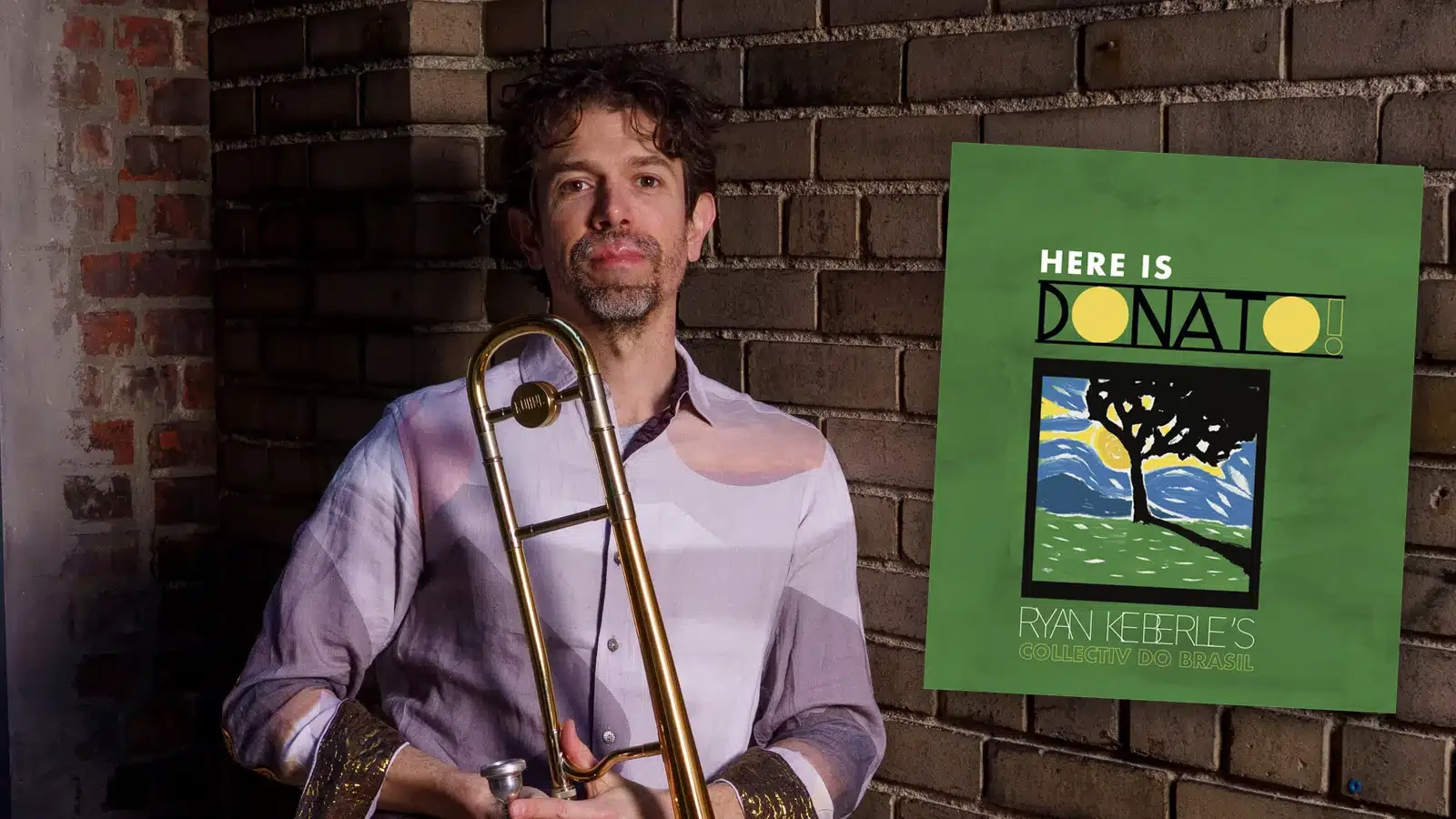
In the contemporary landscape of creative improvised music, few instrumentalists navigate stylistic borders with the fluency and fearlessness of virtuoso trombonist and composer Ryan Keberle. A fixture of New York’s modern jazz ecosystem—with a career spanning collaborations with indie-rock icon Sufjan Stevens, chamber experiments in European classical music with the ensemble Reverso, and the socio-political sonic excursions of his band Catharsis—Keberle has continuously challenged the boundaries of his instrument. Yet, his most recent fascination points southward, directly into the rhythmic, harmonic, and historical heart of Brazil.
With his cross-national quintet, Collectiv do Brasil, Keberle has spent years unearthing, processing, and reinterpreting the vast repertoires of Brazil’s foundational twentieth-century songsmiths. Following their critically acclaimed 2025 exploration of Ivan Lins’ catalog, Choro das Águas, the band returns with Here Is Donato!—an ambitious, deeply researched tribute to the late, inimitable maestro João Donato.
Donato, who passed away three years ago at the age of 88, remains one of Brazilian music’s most idiosyncratic architects. A peer of bossa nova titans like Antônio Carlos Jobim, Donato’s artistic trajectory pushed far beyond the pristine coasts of Rio de Janeiro. He absorbed the percussive urgency of Cuban salsa, collaborated with American salsa royalty like Eddie Palmieri (playing trombone, no less), and laid critical structural cornerstones for Música Popular Brasileira (MPB).
On Here Is Donato!, Keberle and his São Paulo-born rhythm section—keyboardist Felipe Silveira, bassist Felipe Brisola, drummer Paulinho Vicente, and percussionist Guegué Medeiros—execute a brilliant act of cultural and stylistic reverse engineering. By filtering classic MPB compositions through a contemporary jazz lens, the quartet extracts the enduring brilliance of Donato’s songcraft, establishing a dynamic playground for sophisticated harmonic exploration and visceral, high-energy improvisation.
Detailed Chronology: From Bossa Nova to MPB and the Rise of Samba Jazz
To understand the weight and resonance of Here Is Donato!, one must trace the evolutionary lineage of Brazilian popular music across the mid-to-late twentieth century—a timeline that mirrors the stylistic revolutions of American jazz.
The Bossa Nova Genesis and the Samba Jazz Counter-Movement
In the late 1950s, bossa nova captivated the global imagination with its hushed vocals, nylon-string acoustic guitars, and sophisticated, impressionistic harmonies borrowed from European art music and cool jazz. However, parallel to this gentle acoustic revolution emerged "samba jazz"—a more upbeat, high-energy movement spearheaded by artists like João Donato.
Forming the legendary Seu Trio with foundational drummer Milton Banana, Donato helped forge a Brazilian equivalent to American "hard bop." Just as hard bop was a soulful, driving reaction to the cerebral coolness of West Coast jazz, samba jazz injected a muscular, propulsive percussive swing and complex harmonic structures into Brazilian popular idioms.
Reflecting on this era, Keberle draws direct parallels to American jazz royalty:
"When I play Donato’s music, then, I feel like I’m playing music by Horace Silver. The Seu Trio was trying to create music that combined sophisticated rhythms and harmonies with accessible melodies."
The MPB Revolution: Brazil’s Bebop and Rock Rebellion
As the 1960s progressed, the socio-political climate in Brazil shifted, and a new generation of musicians sought to break away from the aesthetic constraints of early bossa nova. This gave birth to MPB (Música Popular Brasileira), a movement that Keberle compares directly to both the bebop rebellion of Charlie Parker and Dizzy Gillespie and the rock revolution in the United States.
While early MPB iterations occasionally sought to strip away some of bossa nova’s academic jazz complexity in search of a more direct, popular voice, the movement ultimately matured into a golden age of sophisticated songwriting. The undisputed zenith of this movement arrived in 1972 with the release of Clube da Esquina, a masterwork by Milton Nascimento and Lô Borges. This landmark record proved that popular appeal could coexist with advanced harmonic literacy, firmly establishing a Brazilian "Great American Songbook" tradition.
Donato’s International Odyssey: A Bad Donato
Donato’s career was defined by constant reinvention and geographical border-crossing. In 1970, residing in Los Angeles, he recorded the cult-classic psychedelic album A Bad Donato for the Blue Thumb label at A&M Studios. Backed by an all-star crew of American jazz luminaries—including saxophonists Bud Shank and Ernie Watts and trombonist Jimmy Cleveland—alongside Brazilian expatriates like Dom Um Romão and Oscar Castro-Neves, Donato blended tropical rhythms with funk, soul, and sci-fi mysticism. Tracks from this era, such as "Malandro" (reimagined on the new album as "Nana das Águas") and "Celestial Showers," showcase an artist entirely unbound by geographical or genre classifications.
Supporting Context & Metrics: Decoding the Cross-Cultural Collaboration
The brilliance of Here Is Donato! lies not merely in Keberle’s deep reverence for the material, but in the unique cultural and technical chemistry of Collectiv do Brasil.

The Dual-Language Musicianship of Collectiv do Brasil
Based in São Paulo, Keberle’s bandmates are young virtuosos in their early-to-mid thirties who effortlessly straddle disparate musical worlds. As Keberle notes, they are "dual-language musicians."
| Band Member | Primary Instrument | Background & Fluency |
|---|---|---|
| Felipe Silveira | Keyboards (Electric/Acoustic) | Deep immersion in both Oscar Peterson-style swing and thousands of traditional Brazilian tunes. |
| Felipe Brisola | Acoustic & Electric Bass | Extensive touring history across Brazilian pop acts and high-level jazz settings. |
| Paulinho Vicente | Drums | Grew up studying late-night live streams from New York’s Smalls Jazz Club while mastering complex Brazilian rhythmic cycles. |
| Guegué Medeiros | Percussion | Grounds the ensemble in the deep, traditional rhythmic foundations of African-rooted Brazilian grooves. |
This synthesis results in an uncanny rhythmic and harmonic intuition. While American jazz musicians often struggle to internalize the deeply personal, physical syncopation of Brazilian grooves, Collectiv do Brasil navigates the intersection of 4/4 swing and complex clavé-derived basslines with effortless authority.
Track-by-Track Breakdown of Here Is Donato!
Keberle’s meticulous curation of Donato’s vast catalog is evident in the ten tracks selected for the album. Rather than leaning exclusively on recognizable radio hits, Keberle dives deep into historical archives to find vehicles that reward jazz improvisation.
- "Tema Teimoso" (A Stubborn Theme): Originating from Donato and Seu Trio’s 1963 landmark album Muito à Vontade, this track sets the tone for the album with a funky, 1960s Cannonball Adderley-style groove straight out of formative-era Rio de Janeiro.
- "Não Tem Nada Não" (It’s Nothing, Really): Co-written by Donato, Eumir Deodato (famed in the US for his 1974 jazz-fusion hit "Also Sprach Zarathustra"), and Marcos Valle, this track showcases Valle’s funky, syncopated bass line. Keberle’s trombone acts as a deceptively simple "vocalist" while Silveira reinterprets the harmony from harmonic left-field using modern jazz voicings.
- " Nana das Águas" & "Celestial Showers": Drawn directly from the 1970 Los Angeles sessions of A Bad Donato, these tracks spotlight the electric piano and highlight Donato’s brief, astrology-curious, psychedelic L.A. period alongside bassist Ron Carter.
- "Até Quem Sabe": Featuring a set of tried-and-true romantic harmonies originally recorded with lyrics by Donato’s brother Lysias Ênio on the 1973 LP Quem É Quem, this piece allows Silveira to voice gorgeous piano chords before opening up into a fluid, swinging vamp for Keberle’s horn.
- "Cadê Jodel?": Closing the album, this upbeat, paradoxically joyful tune was written as a tribute to Donato’s daughter, addressing the physical distance between them with lyrics by Marcos Valle that famously brought legendary singer Elis Regina to tears.
Official Statements & Artist Perspectives
In extensive reflections on the creation of Here Is Donato!, Ryan Keberle illuminates the philosophy that guides his multi-faceted career as a bandleader, composer, and perpetual student:
On the nature of defining "jazz":
"I consider myself a jazz musician. But how do you define ‘jazz’? My favorite definition is: jazz is music played by jazz musicians. It’s not just about improvisation; it’s about fluency, listening, and how you express yourself through the instrument."
On the trombone’s unique structural role in jazz and composition:
"So many great composers/arrangers are trombonists: J.J. Johnson, Bob Brookmeyer, Nelson Riddle, Glenn Miller. The instrument tends to play the non-melodic parts in arrangements and carries the notes that define harmonies—the thirds and sevenths. A trombonist sits in the middle of the band and hears what everyone else is doing."
On his immersion-based creative process:
"Each project is an outgrowth of the eternal student in me. I love to immerse myself and feel new kinds of music… This project is about my love of songwriting, going as deep as possible into their histories, songs, and melodies. I sing it, write it, and play it on my trombone."
Future Outlook
With Here Is Donato!, Ryan Keberle and Collectiv do Brasil have established a masterclass in cross-cultural musical curation. By treating the sophisticated songcraft of Brazil’s MPB pioneers not as museum artifacts, but as living, breathing blueprints for spontaneous creation, the quintet has carved out a vital space in the contemporary jazz landscape.
Looking ahead, Keberle’s insatiable appetite for stylistic exploration shows no signs of slowing. Having effortlessly pivoted between the delicate impressionism of Claude Debussy with Reverso, the socio-political jazz of Catharsis, and the rich rhythmic traditions of Ivan Lins and João Donato, Keberle proves that creative longevity in modern music relies on curiosity without borders.
As Here Is Donato! makes its way to international audiences, it stands as both a loving monument to a departed Brazilian giant and a vibrant bridge connecting the jazz clubs of New York to the beating heart of São Paulo. For listeners willing to listen closely, the message is clear: the dialogue between American jazz and Brazilian songcraft is richer, deeper, and more alive than ever before.






Belum ada komentar. Jadilah yang pertama berkomentar!