In the contemporary landscape of PC gaming, the barrier to entry for comfortable hardware has arguably never been lower. While past eras of console and PC gaming required users to rely heavily on expensive, first-party proprietary hardware—often locking players into rigid ecosystems with steep price tags—the modern market is flooded with affordable third-party options. Value-focused gamepads like the GameSir Nova Lite have redefined what consumers can expect for under $30, offering reliable wireless connectivity, ergonomic contours, and responsive inputs without breaking the bank.
However, the relentless pursuit of affordability has recently transcended traditional manufacturing lines, entering the esoteric realm of extreme do-it-yourself (DIY) engineering. Enter the "Undercooked V0.4"—a minimalist, hyper-budget gamepad created by hardware enthusiast and community builder Lazy_Duck. Conceptualized, designed, and assembled in roughly six hours for a mere €10 (approximately $11.22 USD), this experimental peripheral challenges our fundamental assumptions about what constitutes a functional gaming controller.
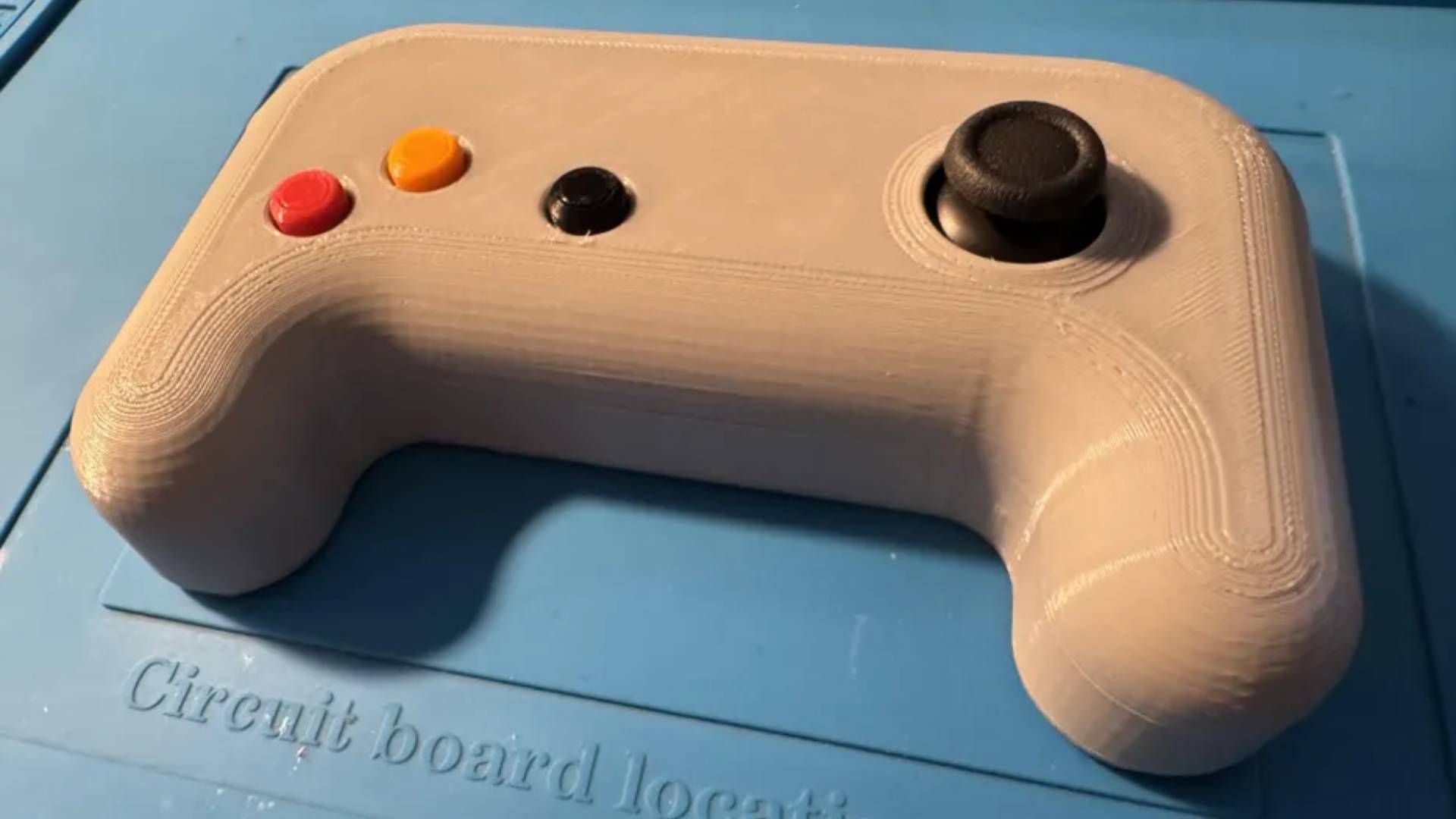
Trading standardized comfort, comprehensive button layouts, and sleek aesthetics for radical simplicity, the Undercooked V0.4 strips the traditional gamepad down to its bare anatomical essentials. It features a single analog stick, a pair of face buttons (‘X’ and ‘A’), a dedicated menu button, and a re-routed ‘B’ button cleverly integrated into the right shoulder. Built using accessible components found in even the smallest electronics shops—including a protoboard and an RP2040-Zero microcontroller—the device looks less like a modern piece of gaming technology and more like a relic of retro-futuristic industrial design.
This deep-dive investigative report examines the origins, engineering choices, architectural limitations, and cultural impact of the Undercooked V0.4. By analyzing the intersection of extreme budget engineering and open-source hardware philosophy, we explore whether ultra-cheap DIY controllers represent a viable frontier for accessibility, or merely a brilliant novelty for hardware tinkerers with a penchant for pain.
Detailed Chronology: The Evolution of Ultra-Budget Peripherals
To understand the contextual weight of the Undercooked V0.4 project, one must trace the historical trajectory of budget gaming peripherals. For decades, the philosophy governing game controllers was straightforward: you paid a premium for structural integrity, proprietary software integration, and ergonomic research. First-party controllers from console manufacturers set the gold standard, while third-party "budget" alternatives were often synonymous with sticky buttons, high input latency, and questionable build quality—colloquially known as the dreaded "Player 2 controller" handed to unsuspecting younger siblings.
The mid-2010s marked a shifting tide. The proliferation of open-source microcontrollers like the Arduino and Raspberry Pi ecosystem, paired with the democratization of 3D printing technology, lowered the threshold for hardware prototyping. Hobbyists began experimenting with custom input devices, initially focusing on arcade fight sticks and custom macro pads.
By the early 2020s, commercial manufacturers caught up to the demand for inexpensive yet functional PC gamepads. Devices hovering around the $25 to $30 mark began incorporating advanced features previously reserved for elite-tier hardware, such as Hall effect magnetic joysticks to prevent stick drift. Against this backdrop of increasingly sophisticated budget hardware, Lazy_Duck’s project moved in the exact opposite direction. Rather than packing more features into a cheaper shell, the creator asked a provocative counter-question: How much can we strip away while retaining baseline functionality?
The Development Timeline of the Undercooked V0.4
Phase 1: Conceptualization & Ideation: The core objective formulated by Lazy_Duck was to design a controller using components so ubiquitous that they could be sourced rapidly from virtually any small-town electronics hobby shop. The emphasis shifted toward extreme minimalism, reducing the physical footprint and internal wiring complexity.
Phase 2: Architectural Simplification: Abandoning the traditional printed circuit board (PCB) to save costs and fabrication time, the designer opted for a protoboard foundation. The control scheme was drastically pruned: eliminating the D-pad entirely, dropping half the face buttons, and relocating secondary inputs.
Phase 3: Prototyping & 3D Modeling: The outer shell was drafted for 3D printing, consuming approximately 150 grams of filament. To ensure durability without relying on injection-molded plastic snaps, the design incorporated heat-set threaded inserts for structural joining.
Phase 4: Assembly & Testing: Assembled in roughly six hours, the resulting peripheral was integrated with an RP2040-Zero microcontroller, bringing the total material cost down to the €10 milestone. Public documentation was subsequently published on maker platforms like Instructables, inviting peer review and community replication.
Supporting Context & Metrics: Anatomy of a Budget Freak-Show
Analyzing the Undercooked V0.4 requires looking past its jarring visual aesthetic to examine the raw metrics and engineering compromises that make its existence possible.
Bill of Materials and Cost Breakdown
Component
Function
Estimated Cost
Sourcing Difficulty
RP2040-Zero Microcontroller
Core processing and USB interface
~$4.00 USD
Extremely Low (Widely available)
Generic Protoboard
Circuit mounting base (replacing custom PCB)
~$1.50 USD
Extremely Low
Single Analog Stick Module
Directional and spatial input
~$2.50 USD
Low
Tactile Push Buttons (x4)
Input mapping (‘X’, ‘A’, Menu, etc.)
~$1.00 USD
Extremely Low
3D Printing Filament (150g)
Shell construction
~$2.22 USD
Dependent on printer access
Heat-Set Threaded Inserts & Hardware
Structural fastening
~$1.00 USD
Low
Total Estimated Cost
Complete Hardware Assembly
~$11.22 USD (€10)
Highly Accessible
Ergonomic and Structural Realities
While the bill of materials highlights the project’s financial efficiency, the physical ergonomics tell a much harsher story. Constructed from 150 grams of 3D-printed filament, the shell possesses an unexpected benefit: structural resilience. Thanks to the integration of heat-set threaded inserts, the gamepad is surprisingly durable. It can withstand drops, structural impacts, and the occasional frustrated toss across a room without shattering—a trait missing from many fragile, mass-market budget controllers.
However, durability comes at the steep expense of comfort. The raw, unrefined 3D-printed ridges across the body create abrasive friction points against the palms during extended sessions. Furthermore, the rear side of the controller is entirely flat, depriving the user of the natural curves and grip contours standard in modern gamepad design. Creator recommendations suggest heavy manual sanding of the outer shell prior to assembly, though structural flatness remains an inherent hurdle for prolonged play.
Official Insights and Maker Philosophy
The philosophy underpinning the Undercooked V0.4 mirrors a broader counter-culture movement within the maker community: functional minimalism as an artistic statement. In statements shared via documentation and community forums, Lazy_Duck emphasized that the project was never intended to dethrone commercial hardware giants, but rather to explore the absolute baseline requirements of human-computer interaction in gaming.
"The idea was to make it simple, affordable, and ensure that all components could be acquired even in the smallest electronics shop quickly and cheaply," notes the project documentation.
This design ethos rejects the planned obsolescence and feature bloat often associated with modern consumer electronics. By utilizing the RP2040-Zero—a microcontroller celebrated for its low cost, compact footprint, and robust programmable capabilities via CircuitPython or C/C++—the Undercooked V0.4 bridges the gap between raw computing power and severely constrained physical interfaces.
Industry analysts tracking the open-source hardware space note that such projects serve an invaluable educational role. They strip away the abstraction layers of commercial manufacturing, allowing novice makers to understand every single soldered connection, input register, and data packet flowing from thumbstick to USB port.
Future Outlook: Where Do We Go From Here?
As commercial budget controllers like the GameSir Nova Lite continue to prove that consumers can secure wireless connectivity, rumble motors, and Hall effect sensors for under $30, extreme DIY novelties like the Undercooked V0.4 occupy a unique, eccentric niche.
Is anyone going to win a Street Fighter tournament or complete an Ironman run in Elden Ring using a single analog stick, two face buttons, and a shoulder-mounted ‘B’ button? Almost certainly not. Your fingers will ache at the mere thought of gripping its flat, ridged polymer chassis for more than ten minutes.
Yet, the value of the Undercooked V0.4 extends far beyond practical gaming utility. It serves as a testament to human ingenuity, a charmingly utilitarian experiment in resourcefulness, and an entertaining reminder of how far hardware design has evolved. For electronics hobbyists seeking a cheap, engaging weekend project that sparks conversation—and perhaps a few bewildered laughs—investing six hours and ten euros into building your own dystopian, East-German-surplus-style gamepad is an unbeatable proposition.
Ultimately, the Undercooked V0.4 proves that while you can buy a remarkably competent PC controller for the price of a couple of fast-food meals, building a bizarre, minimalist thumb-torture device with your own soldering iron offers a unique brand of satisfaction that money simply cannot buy.












Belum ada komentar. Jadilah yang pertama berkomentar!