

Executive Overview
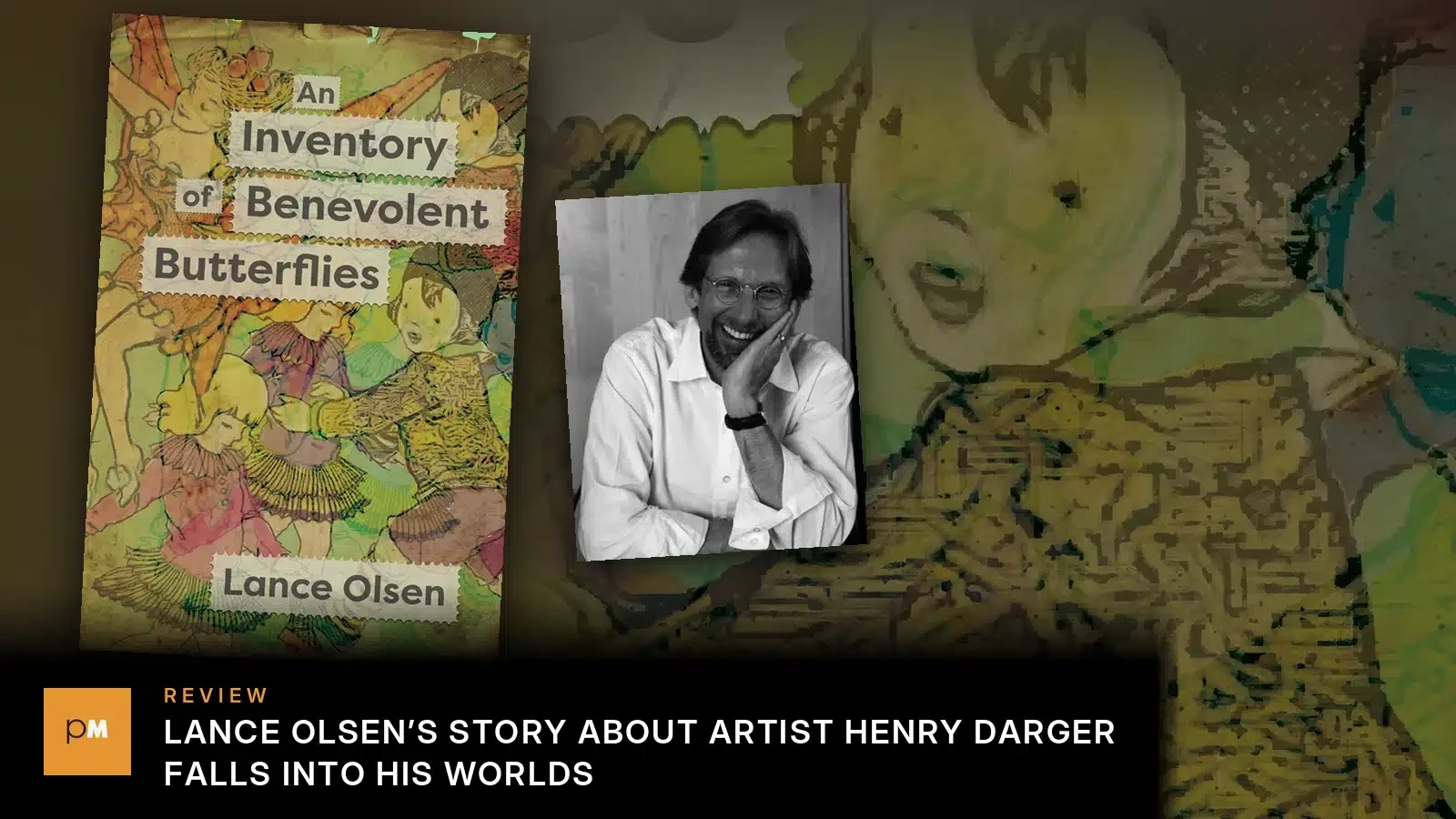
Literary innovation often finds its most fertile ground in the spaces left behind by monumental lives. Following his 2023 critically acclaimed novel Always Crashing in the Same Car: A Novel After David Bowie—a post-genre treatise on the elusive nature of identity and history through the lens of the pop chameleon—author Lance Olsen returns with a companion masterpiece of biographical reconfiguration. His latest work, An Inventory of Benevolent Butterflies: A Novel After Henry Darger, shifts its gaze from a towering icon of the "Before" to a figure who existed entirely as an "After."
Henry Darger, an obscure Chicago hospital custodian who died in anonymity in 1973, was utterly unknown to the world until his landlord cleared out his cramped, unkempt room. There, they uncovered a staggering trove of outsider art: massive watercolor-and-collage paintings and a 15,000-page epic manuscript titled In the Realms of the Unreal. Darger’s subsequent posthumous fame was entirely accidental.
In An Inventory of Benevolent Butterflies, Olsen captures the essence of this unintentional legacy. Rather than attempting a traditional, linear biographical novel, Olsen constructs a prismatic, fractured narrative voice that mirrors Darger’s internal landscape. Blending childhood trauma, adult poverty, and an overwhelming internal mythology populated by the besieged Vivian Girls, the novel is a brilliant meditation on alienation, trauma, and the refuge of art. Enhanced by haunting visual elements—including partially transparent photographic overlays by Andi Olsen—the book invites readers to fall into the kaleidoscopic, broken consciousness of one of the 20th century’s most enigmatic outsider artists.
Detailed Chronology: The Life and Margins of Henry Darger
To understand the architecture of Olsen’s novel, one must trace the tragic trajectory of Darger’s actual life, a chronology that forms the jagged foundation of the book’s narrative structure.
Early Trauma and Institutionalization
Henry Darger’s life was marked by loss almost from its inception. An ordered chronology of his early years reveals a trail of domestic devastation. His mother died giving birth to his sister—who was subsequently given away for adoption—eleven days short of Henry’s fourth birthday. Left in the care of his father, an aging and increasingly abusive alcoholic whom Darger would later describe with complex ambivalence as "a kind man he wasn’t," the young Henry endured a stifling and punishing home environment.
The breaking point arrived when his father caught him masturbating. Consequently, Darger was institutionalized at the Illinois Asylum for Feeble-Minded Children. Within those grim walls, the institutional machinery inflicted profound cruelties; as Darger’s retrospective voice notes in Olsen’s text, staff members "carefully folded the towels they choked us with to avoid telltale marks."
The Chicago Decades and the Quiet Sanctuary
Surviving his institutional upbringing, Darger spent the entirety of his adult life living in acute poverty on the fringes of Chicago society. He labored for decades as a menial hospital custodian, scrubbing floors and managing the chronic physical pain in his joints. This bleak, down-and-out existence was illuminated by very few personal connections, most notably his deep affection for an older man named Whillie, with whom he eventually lost touch but never forgot.
While the exterior world saw only a reclusive, eccentric hospital worker, Darger’s interior world was volcanic. Unbeknown to anyone, he spent hours every night in his tiny rented room sketching, writing, and conversing with the imaginary characters that crowded his mind. He was forever dislocated from the ordinary—a lumpenproletariat outcast who could not function within standard societal parameters. As Darger reflects in the novel on his inability to afford even a simple pet dog:
“I came to appreciate the extent to which such a notion would stay an abstraction for me, like trying to imagine how other people see the colour red.”
Discovery and Posthumous Legacy
Darger’s life reached its physical terminus in 1973. While lying dying in a Catholic hospital bed, his landlord, photographer Nathan Lerner, entered Darger’s tiny Chicago apartment. What Lerner discovered changed the trajectory of outsider art history forever.
He found thousands of pages of closely typed text, culminating in the monumental 15,000-page fantasy novel In the Realms of the Unreal (often cited as the longest novel ever written in English). Accompanying the manuscript were hundreds of panoramic, scroll-like watercolor paintings featuring collaged illustrations cut from magazines, depicting the harrowing adventures of the Vivian Girls—young princesses leading child slaves in epic wars against the Glandelinian empire. Darger never sought an audience; his creative output was a private fortress built against the ravages of his reality.
Supporting Context & Metrics: The Art of the Fragment
Olsen’s literary methodology in An Inventory of Benevolent Butterflies rejects the conventional comforts of narrative realism in favor of a fragmented, phenomenological style.
The Metrics of Marginalia
- 15,000 Pages: The astonishing length of Darger’s original manuscript, In the Realms of the Unreal, a masterwork of compulsive graphomania.
- 1 Author + 1 Visual Collaborator: Lance Olsen’s text is paired with the striking visual art of Andi Olsen, continuing a multi-media collaborative tradition seen in works like Sewing Shut My Eyes (2000).
- 1 Ghostly Archive: Every chapter features a page with partially transparent photographs where a child and an adult overlap in identical poses, serving as a visual metaphor for arrested development and temporal collapse.
Phenomenology and Felt Reality
Olsen’s narrative does not attempt to objectively reconstruct Darger’s perception—an epistemological impossibility. Instead, it utilizes language to evoke a felt reality that exists entirely outside objective truth. By employing truncated sentences, aphoristic gaps, and ellipses, Olsen plunges the reader directly into Darger’s tired, wild, scattered mind.
The prose moves fluidly across time, blending childhood memories with geriatric reflections, and treating invented characters with the same ontological weight as historical figures. Darger’s voice is remarkably wry, balancing an understated, sardonic beauty with a twisted grief born of lifelong trauma. Reflecting on his lost companion Whillie, the protagonist notes: “Give me more than the life I see. Is something I stopped saying the day I met him.”
Official Statements and Critical Perspectives
Literary critics and theorists have long grappled with the implications of outsider art, and Olsen’s novel directly engages with the ethics of representing those who could not—or would not—speak for themselves.
In evaluating the visual components of the novel, the ethos of cultural critic John Berger provides a vital interpretive framework. Berger famously argued that photographs do not translate from appearances, but rather quote from them: “Photographs do not translate from appearances. They quote from them.”
The ghostly, layered child-adult portraits embedded in Olsen’s book operate precisely in this manner. They are self-contained mysteries that, when planted within the novel, become symbols of Darger’s static, undeveloped life—a life locked in a singular, burdened posture that Olsen traces with the linguistic equivalents of crayon and watercolor.
Furthermore, literary analysts note the unique structural framing of the novel. The text occasionally hints at a one-sided conversation, functioning almost as a recorded spoken document or a therapy session in the twilight of Darger’s life. When Darger asks, "is this conversation being recorded?" or mockingly inquires, "how do you think I look?", the narrative acknowledges an unseen interlocutor—or perhaps reveals that Darger was merely conversing with the echoes of his own shattered psyche.
As the novel progresses toward its melancholic, Beckett-like conclusion, Darger embraces his status as an inhabitant of his own archaeological dig:
“The walls of my room are, were, who knows for sure, crowded with the me of my paintings since I had come to believe nothing makes you feel cozier, than residing in an archaeological dig composed of your own ruins.”
Future Outlook: The Expanding Horizon of the "After" Book
With An Inventory of Benevolent Butterflies, Lance Olsen has solidified a distinct subgenre within his expansive bibliography: the biographical excavation of cultural anomalies through post-genre, multi-media fiction.
Whereas his previous exploration of David Bowie utilized a kaleidoscopic shifting of lenses, voices, and genres to mirror a pop star whose career was defined by constant reinvention, the Darger project takes the opposite approach. Olsen stays resolutely inside Darger’s consciousness for the duration of the novel, effectively becoming Darger’s "Before"—giving narrative shape to a man who was previously defined solely by his posthumous "After."
As contemporary literature continues to push against the boundaries separating fiction, biography, and visual art, Olsen’s work points toward a provocative future. It demonstrates how experimental prose can honor historical trauma without exploiting it, transforming the margins of archival silence into vibrant, haunting architecture. For readers willing to fall into its worlds—real and unreal, actual and imaginary—An Inventory of Benevolent Butterflies offers an unforgettable journey into the mind of a man who built a universe out of his own ruins.






Belum ada komentar. Jadilah yang pertama berkomentar!