

Executive Overview
For over a century, the fundamental physics of aviation have been bound by a rigid constraint: fuel and battery capacity. Conventional aircraft, whether crewed commercial airliners or autonomous unmanned aerial vehicles (UAVs), carry their energy sources onboard. Once that fuel is exhausted or those batteries are depleted, the flight must end.
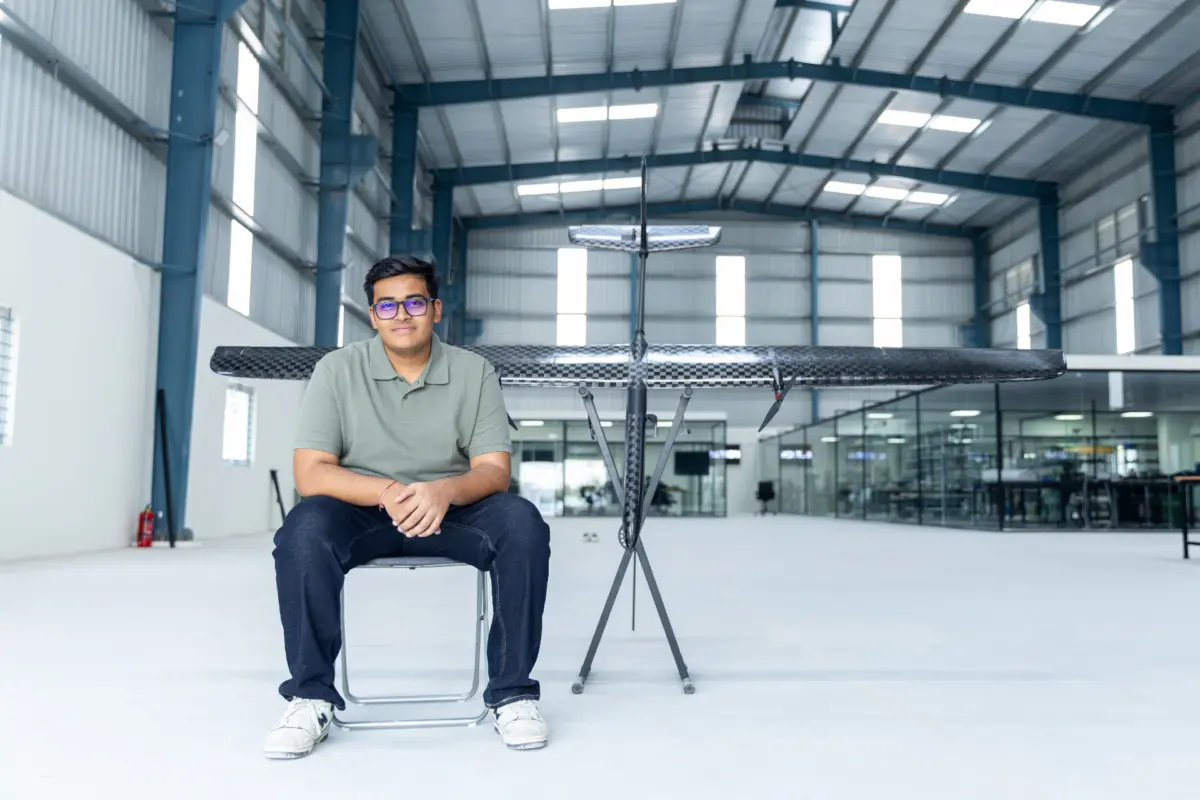
Now, a pioneering Bengaluru-based deep-tech startup named Alteon is attempting to rewrite the rules of aerial endurance. Founded by 20-year-old visionary Samay Sanghvi, Alteon is developing autonomous, fixed-wing aircraft designed to harvest energy directly from ocean winds, achieving what the company believes could be continuous flight lasting more than a year.
The aviation startup recently announced a $2.5 million pre-seed funding round led by prominent solo investor Lachy Groom, with participation from the Together Fund. Groom’s conviction in the startup was swift; Sanghvi revealed that the Silicon Valley investor decided to back the venture within the first 30 minutes of their initial meeting.
Alteon’s secret weapon is not a breakthrough in chemical battery density or miniature nuclear reactors, but rather an emulation of nature: dynamic soaring. By exploiting wind shear across shifting layers of air just above the ocean’s surface—the exact evolutionary technique mastered by albatrosses to cross oceans without flapping their wings—Alteon hopes to achieve perpetual, energy-neutral flight.
While the scientific principles are well-established, translating dynamic soaring from marine biology into a scalable, commercial aerospace application presents monumental engineering hurdles. Experts in aerospace engineering and flight dynamics remain both fascinated and skeptical. Yet, with a rapidly expanding facility in Bengaluru, a dedicated team of 20, and a rigorous testing cadence producing hundreds of flights a month, Alteon is diving headfirst into one of the most ambitious aerodynamic challenges of the modern era.
Detailed Chronology: From High School Prototype to VC-Backed Deep Tech
The genesis of Alteon is as unorthodox as its propulsion concept. Its story traces a path from a teenager’s backyard experiments to a heavily funded aerospace startup.
2023–2024: The DIY Era
Samay Sanghvi began working on the foundational concepts that would become Alteon straight out of high school in 2023. Without a formal background in aerospace engineering initially, Sanghvi adopted a hands-on, empirical approach: building and repeatedly crashing radio-controlled (RC) model aircraft. Through trial and error, he mastered the fundamentals of aerodynamics, stability, and flight control software.
2025: Formal Incorporation and Early Validation
By 2025, Sanghvi had refined his concepts into early functional prototypes, leading to the formal incorporation of Alteon. The young founder caught the attention of early-stage micro-VC funds, securing foundational backing from Emergent Ventures and 1517. This seed capital allowed Sanghvi to transition from a solo hobbyist builder to assembling a small engineering team.
Mid-2026: The Bay of Bengal Tests
Scaling its operations to a 10,000-square-foot R&D facility in Bengaluru, Alteon grew its team to 20 engineers and technicians. The company reached a critical development milestone in mid-2026, conducting rigorous flight trials over the Bay of Bengal.
During these tests, Alteon’s autonomous flight system successfully guided an aircraft through seven consecutive O-shaped cycles at speeds exceeding 62 miles per hour (100 km/h), maintaining a breathtaking proximity of within one meter of the water’s surface.
Late 2026: The $2.5 Million Pre-Seed Infusion
Buoyed by successful initial telemetry data from its autonomous flight control systems, Alteon secured its $2.5 million pre-seed round led by Lachy Groom. This capital injection has supercharged the startup’s manufacturing capacity, allowing the Bengaluru facility to pump out four to five aircraft per week dedicated entirely to accelerated stress testing. Sanghvi notes that the company has completed more than 200 test flights over a 30-day window, rapidly iterating on structural resilience and software logic.
Supporting Context & Metrics: The Science of Dynamic Soaring
To understand Alteon’s ambition, one must examine the physical phenomenon that makes it possible: dynamic soaring.
Defying the Battery Barrier
Standard electric UAVs used for environmental or maritime monitoring typically face severe endurance limits. Small multirotors rarely stay aloft for more than 30 to 45 minutes; even advanced fixed-wing solar drones struggle with seasonal sunlight variations, weight restrictions, and battery degradation over prolonged missions.
Alteon’s proposed aircraft completely alters this paradigm. As Sanghvi famously remarked:
"Once you build airplanes that can stay in the air for more than a year, there are millions of things you can do with them."
How Dynamic Soaring Works
Albatrosses can circumnavigate the Southern Ocean without ever touching land or expending significant metabolic energy. They achieve this through dynamic soaring by exploiting a natural aerodynamic phenomenon known as wind shear.
Close to the ocean surface, friction with the water slows the wind down, creating a gradient where air layers move significantly faster the higher you go.
- The Climb: An albatross (or Alteon’s aircraft) flies upward from the slow-moving air near the surface into the faster-moving air aloft.
- The Energy Harvest: Upon entering the faster air mass, the bird or plane gains kinetic energy relative to the ground without expending onboard power.
- The Turn & Dive: It turns downwind and dives back toward the ocean surface, extracting potential energy and converting it into high forward velocity.
- The Cycle: Upon re-entering the slow-moving boundary layer near the water, it turns back into the wind and climbs again, repeating the loop indefinitely.
Alteon’s Technical Architecture
Alteon’s current design centers around a fixed-wing aircraft featuring a three-meter wingspan.

- Phase 1 (Flight Control): The aircraft uses autonomous navigation algorithms to execute continuous wind-shear harvesting loops near the water surface.
- Phase 2 (Energy Generation): In future iterations, Alteon plans to run its propulsion propellers in reverse, utilizing them as miniature wind turbines. As the aircraft rushes through high-speed air streams, these turbine-propellers will spin, converting kinetic wind energy into electrical power to recharge onboard batteries.
Primary Commercial Application: Maritime Surveillance
Before tackling global consumer or logistics applications, Alteon has chosen a high-demand, high-value initial use case: maritime surveillance.
Oceans cover over 70% of the Earth’s surface, making continuous monitoring an astronomical expense for governments using conventional satellites, patrol boats, or long-range manned aircraft. Alteon’s aircraft could loiter indefinitely over exclusive economic zones (EEZs), international shipping lanes, or contested maritime borders, offering governments real-time, uninterrupted visibility into illegal fishing, smuggling, and naval movements at a fraction of current operating costs.
Official Statements and Industry Perspectives
Alteon’s bold claims have naturally elicited a spectrum of reactions from investors, founders, and veteran aerospace engineers.
Investor Conviction: Lachy Groom
Lachy Groom, known for backing high-risk, high-reward frontier technology companies, did not hesitate when evaluating Sanghvi’s pitch. Addressing the inherent technical dangers of the investment, Groom noted:
"Ambitious problems are always going to come with risks. For me, it came down to believing Samay and the Alteon team are the ones to figure them out."
Aerospace Engineering Analysis
While financial backers are enthusiastic, aerodynamicists point out that transitioning from theory to sustained autonomous execution is an uphill battle.
Dr. Gabriel Bousquet, a Silicon Valley aerospace and robotics engineer who focused on dynamic soaring during his PhD at MIT, evaluated Alteon’s recent Bay of Bengal trials:
"It’s a promising first result," Bousquet acknowledged.
However, he issued a note of caution regarding the extreme environmental variables of low-altitude ocean flight:
"The harder challenge will be proving that the aircraft can reliably extract enough energy from real-world winds to sustain flight for extended periods. Flying low enough to harvest that energy safely is particularly difficult. The aircraft would have to contend with turbulence, waves, spray, rain, and changing light conditions while continuously sensing and reacting to a moving ocean surface."
Dr. Bharath Swaminathan, an IIT Madras PhD alumnus who specialized in the stability of dynamic soaring, praised the startup’s foundational physics:
"The underlying physics is well established, and Alteon’s effort is commendable. Keeping an aircraft airborne for several days using dynamic soaring would itself be a very big step, and a big achievement."
Nevertheless, Swaminathan echoed Bousquet’s concerns about micro-meteorology:
"While large-scale wind conditions may be predictable, local wind shear and turbulence can vary substantially, complicating an aircraft’s ability to continuously extract energy from the wind. Some of those challenges may only emerge through real-world flight testing."
Future Outlook: The Road to Energy-Neutral Soaring
Alteon is not resting on the laurels of its pre-seed funding or its initial coastal tests. The company’s immediate roadmap focuses entirely on crossing its next monumental technical frontier: achieving what Sanghvi terms "energy-neutral dynamic soaring."
Milestones on the Horizon
- Proving Energy Neutrality: The primary near-term goal is to execute a flight profile where the aircraft’s onboard propulsion system can be completely switched off, yet the airframe maintains altitude and velocity indefinitely solely through wind-shear extraction.
- Scaling Flight Duration: Moving from minutes of autonomous dynamic soaring loops to hours, days, and eventually weeks.
- Turbulence Resilience: Upgrading the onboard computer vision and sensor suites to react instantly to sudden micro-gusts, sea spray, and unpredictable oceanic wave swells.
The Broader Paradigm Shift in Aviation
If Alteon succeeds, the implications extend far beyond maritime surveillance. An aircraft capable of remaining aloft for over a year without refueling opens up radical new possibilities for environmental monitoring (such as tracking hurricanes from within), telecommunications relay in remote oceanic zones, and global scientific research.
For Samay Sanghvi and his 20-person engineering team in Bengaluru, the path forward is paved with intense computational fluid dynamics, structural stress testing, and relentless flight iteration. As the startup pushes forward from its 10,000-square-foot R&D hub, the global aerospace community will be watching closely to see if human ingenuity—paired with the timeless wisdom of the albatross—can finally unshackle flight from the limits of fuel.








Belum ada komentar. Jadilah yang pertama berkomentar!