

Executive Overview
For over two decades, the Japanese convenience store shelf has served as an unexpected laboratory for some of the world’s most innovative ready-to-drink (RTD) coffee and tea beverages. Long before the global market embraced the concept of premium, grab-and-go café culture, Starbucks Japan introduced its chilled cup lineup, transforming everyday convenience store runs into moments of affordable indulgence. Continuing this legacy of seasonal experimentation, the coffee giant has announced its latest limited-edition masterpiece: the Joyful Harmony Tea Latte.
Hitting shelves nationwide starting October 13, this sophisticated autumn release moves away from the predictable pumpkin-spice paradigms that dominate Western markets during the fall season. Instead, Starbucks Japan has engineered a deeply complex, multi-layered beverage anchored by a robust black tea foundation, elevated by fragrant oolong and jasmine teas, smoothed with rich dairy, and punctuated by a distinct, sun-ripened apricot accent. Priced accessibly at 230 yen (approximately $1.46 USD), the Joyful Harmony Tea Latte is more than just a seasonal treat—it is a study in flavor architecture, carefully designed to encapsulate the sensory essence of Japanese autumn while meeting the rigorous demands of modern, fast-paced consumers.
Detailed Chronology: The Evolution of Starbucks Japan’s Chilled Cup Phenomenon
Origins and Global Pioneering
To understand the significance of the Joyful Harmony Tea Latte, one must look back over twenty years to when Starbucks first conceptualized its chilled cup range. Debuting in Japan well ahead of its global rollout, the chilled cup category was designed to bridge the gap between the premium, bespoke experience of a traditional Starbucks brick-and-mortar storefront and the ultimate convenience of the ubiquitous Japanese konbini (convenience store).
Over the decades, this product line has undergone continuous transformation. From classic café-style lattes to experimental, region-specific iterations—such as the celebrated Sakura-Raspberry Milk introduced during the spring thaw—Starbucks Japan has treated its RTD packaging as a canvas for cultural and culinary storytelling.
The Path to Autumn 2026
The lead-up to the autumn 2026 season saw a calculated build-up within Japan’s beverage market. Following a series of late-summer releases that emphasized tropical and refreshing profiles, Starbucks signaled a sharp pivot toward warmth, depth, and introspection as the country transitioned into cooler weather. The announcement of the Joyful Harmony Tea Latte follows a lineage of carefully timed seasonal rollouts, capitalizing on consumer psychological shifts toward comfort and sensory grounding as daylight hours shorten and foliage begins to turn.
Supporting Context & Metrics: Decoding the Anatomy of the Joyful Harmony Tea Latte
The Flavor Pyramid: Tea, Florals, and Fruit
At first glance, crafting an RTD milk tea seems straightforward. However, the formulation of the Joyful Harmony Tea Latte reveals a remarkably sophisticated approach to beverage engineering.
- The Foundation (The Triple-Tea Blend):
At the core of the drink is a robust black tea base, providing the heavy-bodied structure necessary to stand up to dairy. Rather than relying on black tea alone, Starbucks has integrated oolong tea for a subtle, earthy backbone, alongside jasmine tea to introduce an ethereal, aromatic lift. - The Creamy Finish:
Generous portions of high-quality milk are folded into the tea infusion, softening the tannins of the dark teas and creating a velvety mouthfeel that coats the palate without feeling heavy. - The Apricot Accent:
The true wildcard—and triumph—of the formulation is the inclusion of apricot. While fruit flavors in commercial teas often serve as faint, background whispers, Starbucks has engineered this element to deliver a distinctive, rich apricot aroma and a vibrant taste reminiscent of perfectly ripe fruit. This deliberate injection of acidity and natural sweetness cuts through the creaminess, offering a dynamic interplay between tart fruit and rich, botanical depth.
Visual Design and Cultural Resonance
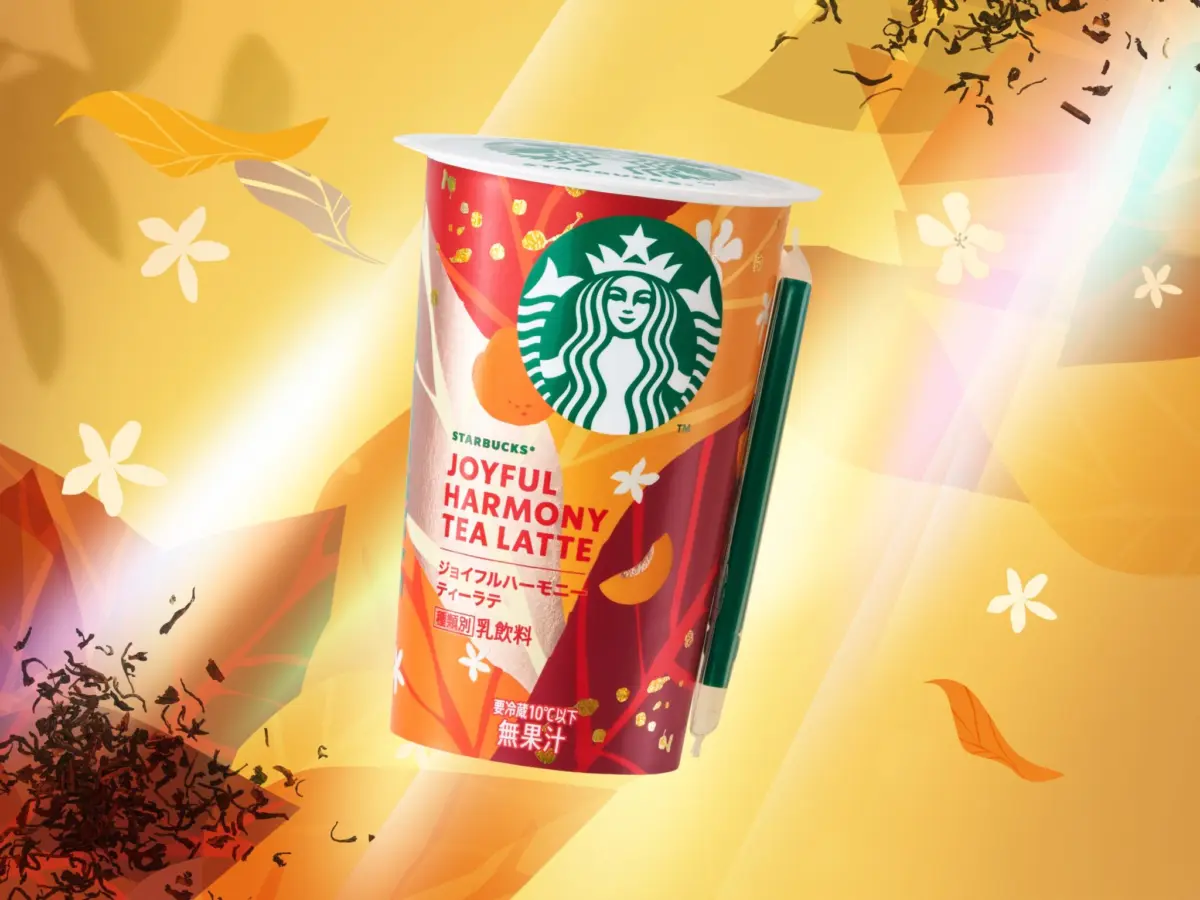
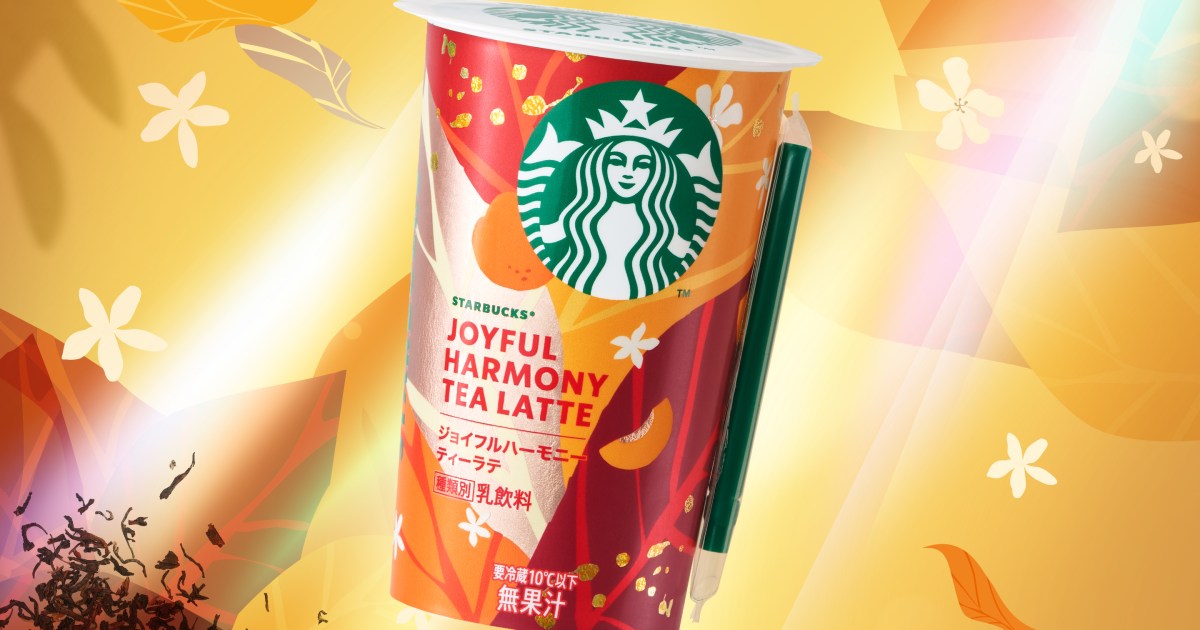
Packaging plays an outsized role in the success of Japanese consumer goods, where aesthetic harmony is deeply tied to perceived product quality. The cup design for the Joyful Harmony Tea Latte is an artistic homage to autumn. Rendered in warm-toned hues and gleaming gold accents, the exterior features delicate illustrations of jasmine flowers, tea leaves, and ripe apricots. This visual layering mirrors the flavor profile within, communicating luxury, warmth, and seasonal transition before the consumer even breaks the foil seal.
Culinary Pairings: The Sweet Potato Mont Blanc Connection
Starbucks Japan has gone a step further in guiding the consumer experience by officially recommending specific culinary pairings for the Joyful Harmony Tea Latte. The beverage is specifically designed to complement traditional autumn delicacies, most notably the Sweet Potato Mont Blanc.

The logic behind this pairing is rooted in flavor science. The gentle, earthy sweetness and dense, smooth texture of Japanese sweet potato desserts can sometimes overwhelm simpler beverages. However, the floral jasmine notes and vibrant apricot fruitiness of the Joyful Harmony Tea Latte act as a natural bridge, cutting through the richness of the pastry while amplifying its inherent autumnal character.
Official Statements and Industry Insights
While corporate announcements surrounding RTD beverages are often standard marketing boilerplate, the language used by Starbucks Japan regarding this release underscores a deliberate pivot toward experiential consumption.
Industry analysts note that Japanese consumers increasingly view convenience store purchases not merely as utilitarian grabs, but as micro-luxuries that punctuate the workday. By positioning the Joyful Harmony Tea Latte as a complex sensory experience—highlighting its "distinctive rich apricot aroma" and "harmonious interplay of floral and botanical notes"—Starbucks has successfully elevated a 230-yen convenience store item into a gourmet proposition.
Furthermore, the brand’s emphasis on the drink’s dual capability—enjoyed equally as a standalone refreshment or as an accompaniment to artisanal bakery items—demonstrates a sophisticated understanding of contemporary snacking habits.
Future Outlook: The Next Frontier for RTD Innovation
The launch of the Joyful Harmony Tea Latte offers a clear window into the future of the ready-to-drink market, both in Japan and globally. As consumer palates become increasingly sophisticated, the appetite for one-dimensional, overly sweet commercial beverages is rapidly declining. Shoppers are demanding complexity, authenticity, and narrative depth in their daily refreshments.
Key Takeaways for the Global Beverage Market:
- The Rise of Botanical Hybrids: The successful blending of black, oolong, and jasmine teas proves that consumers are ready for layered, multi-origin tea bases that move far beyond standard Earl Grey or green tea options.
- Elevated Fruit Pairings: Moving past artificial flavorings toward distinct, identifiable fruit profiles—such as ripe apricot—creates memorable taste experiences that linger long after the final sip.
- The Konbini as a Gourmet Channel: Japan continues to prove that convenience does not have to come at the expense of culinary integrity. The accessibility of high-end, limited-edition runs through widespread retail networks like 7-Eleven sets a benchmark that global markets are eager to emulate.
As the Joyful Harmony Tea Latte rolls out nationwide across Japan on October 13, it arrives not just as a seasonal novelty, but as a testament to how legacy brands can continually reinvent everyday routines. For fortunate consumers near a Japanese convenience store this autumn, a masterclass in flavor awaits—all for the price of loose change.








Belum ada komentar. Jadilah yang pertama berkomentar!