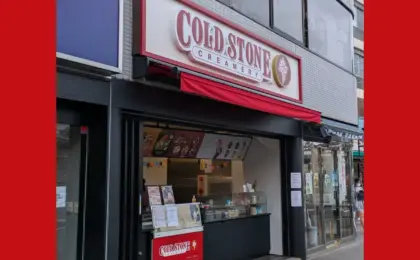
For dessert aficionados in eastern Japan, October 31 marked a day of bittersweet nostalgia and a definitive end of an era. Cold Stone Creamery, the American ice cream chain renowned for its theatrical approach to frozen treats—complete with singing staff, frozen granite stone mixing, and custom-folded waffle bowls—permanently closed its Kamakura Station branch. This abrupt shutdown effectively erased the brand from the entire eastern half of the country, leaving behind a trail of fleeting comebacks, devoted loyalists, and lingering questions about the cultural mismatch between American fast-casual dessert concepts and Japanese consumer habits.
Having first made landfall in Japan nearly two decades prior in 2005, Cold Stone’s trajectory has been nothing short of a retail rollercoaster. After experiencing an initial wave of massive popularity characterized by snaking queues and viral enthusiasm, the brand suffered a prolonged contraction, eventually vanishing from Tokyo entirely. Brief sparks of resurgence in the Tama district, Harajuku, and Tochigi Prefecture proved unsustainable. The recent July opening of the Kamakura outpost offered a renewed beacon of hope to fans in the capital region, only for that light to be extinguished by an unexpected closure announcement issued a mere 48 hours before the shutters came down for good.
This feature explores the timeline of Cold Stone’s turbulent Japanese venture, the cultural and economic factors underpinning its struggles in a market that otherwise deeply loves ice cream, and the poignant final visit paid to the Kamakura location by veteran Japanese culture reporter Mr. Sato. As of November 1, the brand’s presence in Japan has been reduced to a solitary survivor: an outlet-mall location in Mie Prefecture, sitting more than a three-hour bullet train ride away from Tokyo.
Detailed Chronology: A Rollercoaster Ride Across Two Decades
The 2005 Boom and the Early Promise
When Cold Stone Creamery opened its first Japanese storefront in 2005, it did not merely introduce a new product; it introduced a sensory spectacle. Japanese consumers, already enthusiastic adopters of iconic American culinary imports like McDonald’s and Starbucks, were instantly captivated by the novelty.
The core mechanics of the Cold Stone experience were tailor-made for word-of-mouth marketing:
The Granite Slab: Customers watched as scoopers vigorously folded mix-ins—ranging from fresh fruits to brownies and nuts—into custom ice cream bases on a frozen stone chilled to sub-zero temperatures.
The Musical Interlude: Employees famously burst into song while preparing orders, a display of high-energy hospitality that was both charming and uniquely polarizing in reserved Japanese retail culture.
For several years, the brand enjoyed a honeymoon phase. Lines stretched down the block, and the company aggressively pursued expansion plans. However, retail gravity soon caught up with the operation. As the initial novelty waned, the high operating costs of prime real estate, combined with shifting consumer preferences, began to freeze out the chain’s momentum. Gradually, locations nationwide went dark, until Tokyo itself was completely devoid of a Cold Stone presence.
Despite its retreat, the brand refused to fade quietly. In 2023, management engineered a calculated return to the capital, opening a branch in the suburban Tama district before launching a high-profile location in the trendy, youth-centric hub of Harajuku. This central Tokyo flagship even featured exclusive menu items tailored to the fashion-forward demographic.
Yet, the renaissance was short-lived. Economic headwinds, fierce domestic competition, and changing post-pandemic consumer habits crippled the return. By April 2025, Tokyo had once again been entirely scrubbed of Cold Stone locations. The brand’s final eastern bastion retreated to an outlet shopping mall in Tochigi Prefecture—a location that managed to survive for only one additional month before folding in May 2025.
The Kamakura Flash-in-the-Pan
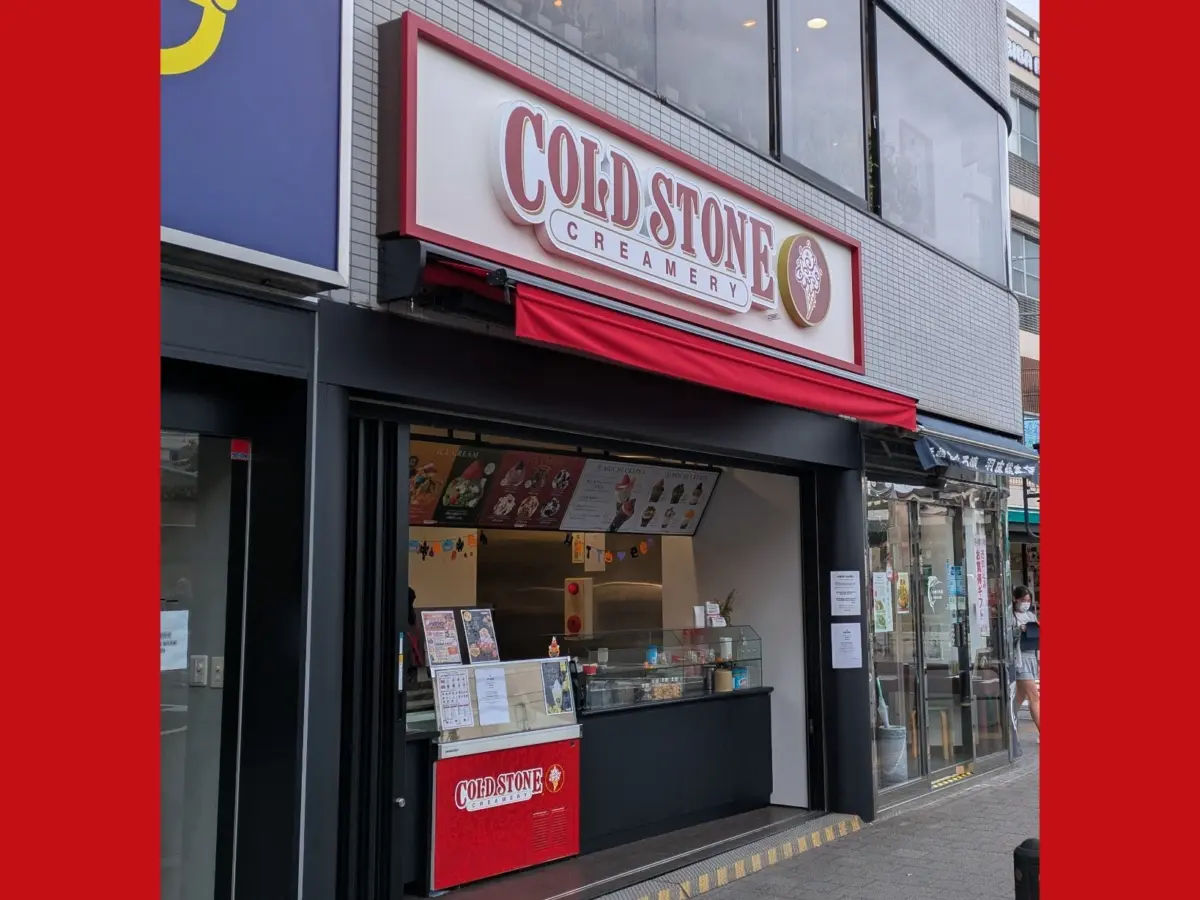
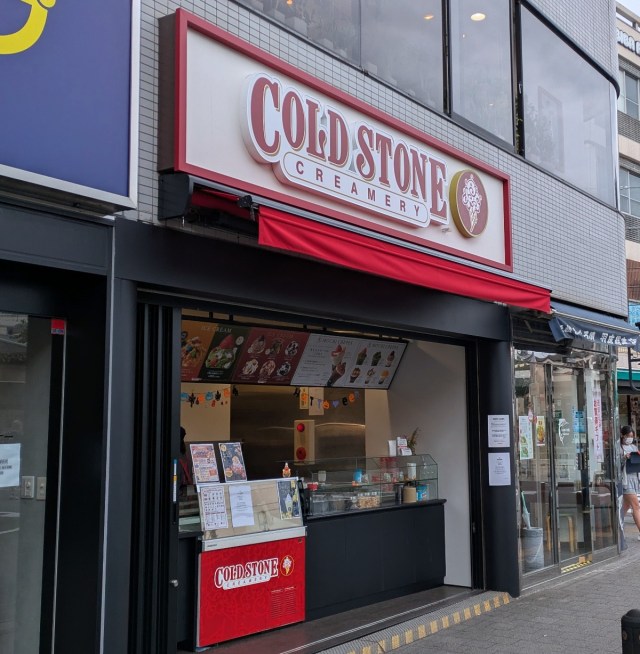
Just as eastern Japanese fans had prepared to mourn the brand permanently, a ray of hope pierced the gloom. On July 30, a brand-new Cold Stone branch opened its doors in Kamakura, Kanagawa Prefecture.
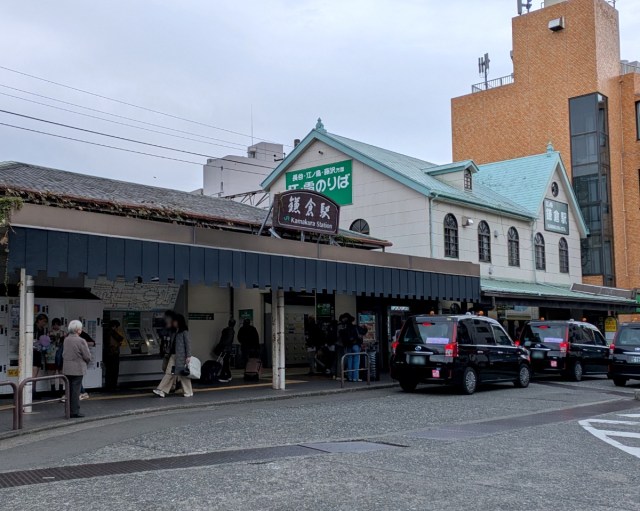
Situated just an hour south of Tokyo by train, Kamakura is a prime domestic and international tourist destination, drawing millions of visitors annually to its historic temples, shrines, hiking paths, and scenic coastline. The location outside the west exit of JR Kamakura Station—near the transfer gates for the picturesque Enoden railway line—appeared to offer a steady stream of foot traffic. For fans like Mr. Sato, the return of the chain within striking distance of the capital was cause for celebration.
The celebration, however, was shockingly brief. On October 29, Cold Stone Japan utilized its official Instagram account to drop a bombshell announcement: the Kamakura branch would be closing its doors permanently in precisely 48 hours, on October 31. Caught completely off guard, patrons and even the store’s own staff were left scrambling to process the sudden termination.
Supporting Context & Metrics: Why Does Japan Love Ice Cream, But Not Cold Stone?
To understand Cold Stone’s systematic contraction in Japan, one must examine the broader, highly lucrative Japanese frozen dessert market. Japan is, by all metrics, an obsessive consumer of ice cream.
The Ice Cream Landscape in Japan
Baskin-Robbins (Thirty One): The brand boasts over 1,000 thriving locations across the archipelago, deeply embedded in neighborhoods, shopping centers, and transit hubs.
Global and Domestic Giants: From ubiquitous convenience store refrigerators stocked with Häagen-Dazs and Morinaga’s Pino to year-round fast-food soft serve offerings, frozen treats are a staple of daily Japanese life regardless of the season.
Given this insatiable national appetite, Cold Stone’s inability to secure a stable foothold highlights a profound misalignment between its business model and Japanese dining culture.
The Cultural Mismatch of Consumption Styles
Industry analysts and consumer behavior studies point to two distinct acceptable paradigms for eating ice cream in Japan:
The Casual, On-the-Go Approach: Consumers are comfortable purchasing modest, easily managed portions—such as a single scoop in a paper cup from Baskin-Robbins or a compact personal-size tub of Häagen-Dazs—to eat while walking or commuting.
The Savoring Café Experience: Conversely, when Japanese consumers desire a large, decadent, heavy dessert—such as a towering fruit parfait—they expect to sit down leisurely in a cozy, fashionable café setting, taking their time to appreciate both the presentation and the ambiance.
Cold Stone’s model fits comfortably into neither category. The portions are substantial, rich, and prone to rapid melting, making them messy for casual street-walking. Yet, Cold Stone outlets have historically prioritized high-turnover, fast-casual counter service and takeout rather than spacious, sit-down café seating where customers can linger. This structural incongruity alienated a broad consumer demographic, restricting the brand to a narrow niche of deeply dedicated superfans.
Official Statements and On-the-Ground Realities
Upon learning of the impending closure, veteran SoraNews24 reporter Mr. Sato dropped his daily schedule, rushed to the station, and boarded a southbound train to Kamakura to bear witness to the final hours of the prefecture’s sole Cold Stone outpost.
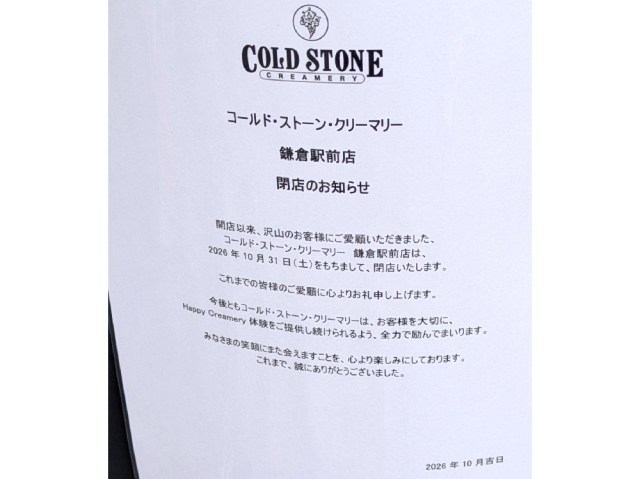
Upon arriving at the west exit of Kamakura Station, any lingering hope that the social media announcement was a cruel hoax was instantly dispelled. Posted directly at the counter was a formal, poignant notice from management:
Cold Stone Creamery Kamakura Station Notice of Closure
We are deeply grateful for the support shown by so many visitors since our opening. As of October 31, Cold Stone Creamery Kamakura Station will be closing.
We wish to take this opportunity to sincerely thank all of our customers. We will continue to do our best to provide all of you with Happy Creamery experiences.
We look forward to seeing all of your smiles again someday. Thank you so much for everything.
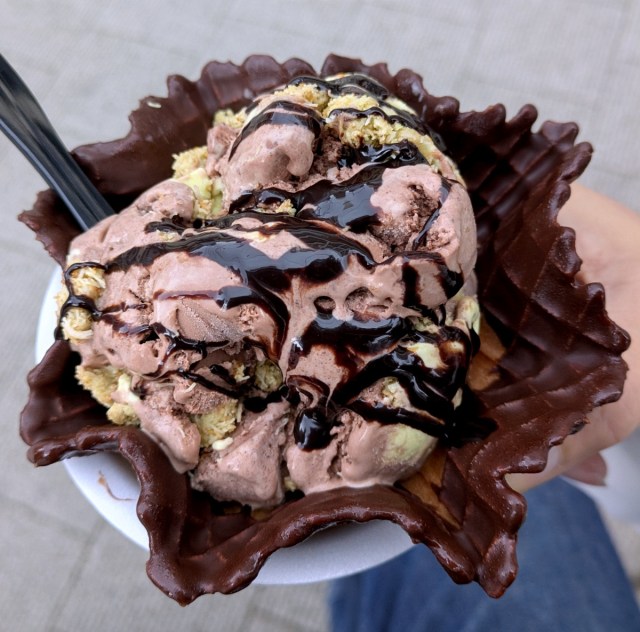
Refusing to let the final visit pass quietly, Mr. Sato ordered a grand finale fitting for the occasion: a rich Dobai chocolate ice cream served in a chocolate waffle bowl, thoroughly smothered in extra chocolate sauce.
True to the brand’s legendary customer service ethos, the staff members maintained their signature upbeat demeanor. When asked if they could perform their traditional song, the crew cheerfully agreed. After the performance, a staff member revealed to Mr. Sato that the employees themselves had only learned of the shutdown two days prior, confirming that the corporate decision was executed with abrupt finality from the top down.
Future Outlook: The Solitary Survivor in Mie Prefecture
With the sunset of the Kamakura shop on October 31, the corporate geography of Cold Stone in Japan underwent a drastic contraction. As of November 1, the brand’s footprint is officially down to a single remaining location: the Cold Stone Creamery branch situated within the Mitsui Outlet Park Jazz Dream Nagashima in Mie Prefecture.
For regional loyalists in the greater Tokyo metropolis, reaching the final outpost is no casual undertaking. Even when utilizing Japan’s high-speed Shinkansen network, travelers must endure a journey of approximately three hours each way.
What Lies Ahead?
For Fans: Dedicated enthusiasts like Mr. Sato are left holding out a faint, long-shot hope that corporate management will regroup, reassess their operational strategy, and attempt a more sustainable, seated-café-focused comeback in the capital region.
For the Brand: Without a structural pivot that aligns with local dining customs—such as emphasizing sit-down café environments or right-sizing portions for the Japanese palate—future expansion in the world’s most competitive dessert markets remains a steep uphill battle.
Until then, the memory of the singing scoopers, the frozen granite slabs, and the sweet choruses of customer farewells will live on solely in the hearts of Japan’s most devoted ice cream traditionalists—and at a lone outlet mall three hours south of Tokyo.
Location Reference: The Final Outpost (Mie Prefecture)
Store Name: Cold Stone Creamery (Mitsui Outlet Park Jazz Dream Nagashima)
Location: Nagashimachō Urayasu, Kuwana, Mie 511-1135, Japan
Access: Accessible via transit connections from Nagoya Station.








Belum ada komentar. Jadilah yang pertama berkomentar!