

Executive Overview
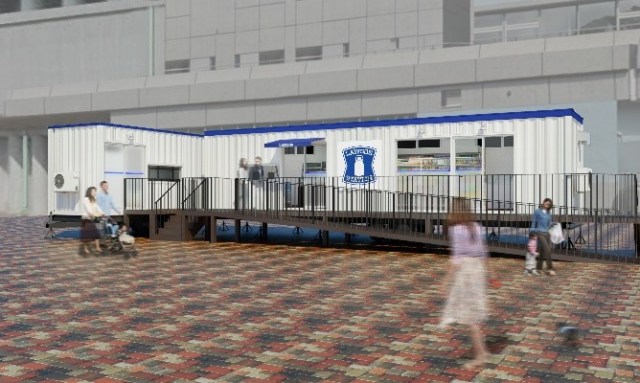
Japan’s ubiquitous konbini—the neighborhood convenience store that serves as an economic, social, and logistical lifeline for millions—is undergoing a radical evolution. On August 27, major Japanese retail chain Lawson officially launched a pilot program that could permanently alter the landscape of urban planning, retail distribution, and emergency preparedness. Situated on the southern perimeter of the gymnasium at Ebina Sports Park in Kanagawa Prefecture, this new venture is not housed in a traditional brick-and-mortar storefront. Instead, it is built entirely on wheels: a sleek, highly functional, trailer-style mobile convenience store.
Scheduled to operate as a market viability test through March 31, the Ebina project represents a paradigm shift for the convenience store industry. By shedding the heavy capital expenditure and physical permanence of traditional real estate, Lawson is exploring how retail footprints can dynamically adapt to underserved geographic pockets, seasonal tourist spikes, and temporary event spaces. More importantly, this mobile retail model carries profound implications for national security and civil defense. Designed for rapid deployment and easy relocation, the trailer-style konbini is viewed by corporate executives and disaster management officials alike as a vital prototype for emergency relief logistics. In a seismically volatile nation where natural disasters can instantly devastate local infrastructure, a fully stocked convenience store that can be towed directly into a disaster-stricken zone is more than a commercial experiment—it is a humanitarian asset.
Detailed Chronology & Operational Genesis
The journey toward Lawson’s mobile convenience store concept did not happen overnight; it is the culmination of years of logistical problem-solving, shifting demographic trends, and an urgent need to address vulnerabilities in Japan’s retail and emergency infrastructure.
The Blueprint and Initial Rollout
Planning for the Ebina Sports Park pilot accelerated in early 2024, driven by Lawson’s internal innovation division. The primary objective was to test whether a mobile commercial unit could maintain the high operational standards of a fixed store while overcoming the inherent limitations of a confined, vehicular space. Selected for its diverse foot traffic—ranging from families attending weekend sporting events to local residents utilizing the park’s recreational facilities—Ebina Sports Park provided the ideal controlled environment to monitor consumer behavior, supply chain replenishment efficiency, and structural durability.
On August 27, the trailer opened its doors to the public. The rollout was met with immediate curiosity and strong patronage from park visitors, who quickly adapted to the novel shopping experience. Throughout the trial period leading up to March 31, Lawson engineers and corporate strategists are collecting exhaustive data on energy consumption, inventory turnover, customer satisfaction, and the logistical challenges of daily restocking.
Inside the Mobile Konbini: Engineering and Layout
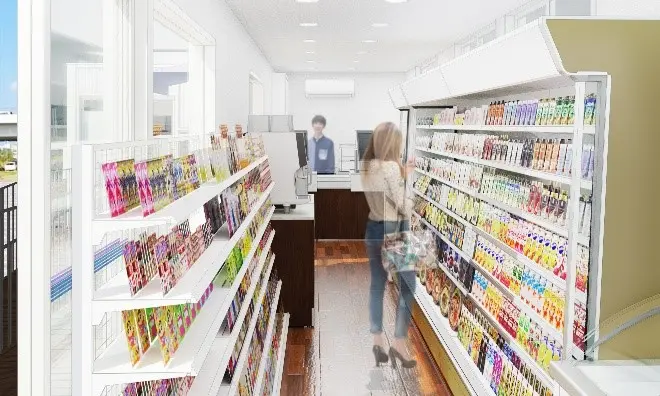
Constructed within a heavy-duty 12.2-meter (40-foot) long trailer, the mobile store is a marvel of spatial efficiency. The interior layout spans a snug 33.60 square meters (roughly 361.7 square feet), making it approximately one-fifth the size of a standard, urban Lawson location.
Despite its compact footprint, the store manages to stock an impressive inventory of roughly 500 distinct items carefully curated for maximum consumer utility. Shoppers stepping inside will find core convenience store staples:
- Ready-to-Eat and Fresh Foods: A robust selection of bento (boxed lunches), onigiri (rice balls), freshly made fried foods, and popular Japanese desserts.
- Beverages: Refrigerated cases stocked with green tea, soft drinks, energy drinks, and alcoholic beverages.
- Daily Essentials: Basic toiletries, over-the-counter pharmaceuticals, stationery, and emergency supplies.
To support the sale of fresh and hot foods, the unit features a dedicated 6.1-meter (20-foot) long attached kitchen and administrative office space. Here, staff can manage inventory, handle point-of-sale transactions, and maintain food preparation standards that rival permanent locations.
However, the physical constraints of a trailer necessitate certain compromises. Regular patrons of Japanese konbini will notice the conspicuous absence of several multi-service terminals typically found in standard stores. The mobile unit does not house automated teller machines (ATMs), multi-copy printing/scanning machines, or Loppi ticketing kiosks. These digital and financial services require stable, high-bandwidth dedicated lines and spatial overhead that are difficult to reliably maintain in a temporary roadside trailer. Nevertheless, for pure retail and sustenance, the mobile unit punches well above its weight class.
Supporting Context & Metrics: The Japanese Konbini Ecosystem and Disaster Logistics
To fully grasp the significance of Lawson’s mobile initiative, one must understand the unique cultural and economic weight of the convenience store industry in Japan, as well as the perpetual shadow of natural disasters.
The Oversaturated Konbini Market
Japan is home to one of the densest convenience store markets in the world. Dominated by the "Big 3"—Seven-Eleven, Lawson, and FamilyMart—the industry boasts over 55,000 stores nationwide. In major metropolitan areas like Tokyo, Osaka, and Fukuoka, it is not uncommon to find competing konbini brands located within direct sight of one another.
This hyper-competition, combined with a shrinking and aging national population, has forced major chains to look beyond traditional urban expansion. Suburban depopulation, rural "food deserts" (areas where elderly residents lack access to grocery stores), and remote tourist destinations present untapped markets that are economically unviable for a permanent, multi-million-yen brick-and-mortar storefront. The trailer-style mobile store offers a low-risk, high-mobility solution to test these marginal markets, allowing Lawson to establish a temporary presence, gauge local demand, and pivot locations as consumer migration patterns shift.
The Lifeline Paradigm: Konbini in Times of Crisis
Beyond commercial viability, the most compelling argument for Lawson’s mobile model lies in disaster resilience. Japan is one of the most seismically active nations on earth, perpetually bracing for the anticipated "Nankai Trough mega-earthquake" or major tremors in the Tokyo metropolitan area, alongside frequent typhoons and torrential flooding.
During major disasters—such as the 2011 Great East Japan Earthquake—fixed convenience stores played a critical, albeit often heroic and improvised, role in relief efforts. Store managers and corporate headquarters frequently distributed food, water, and emergency supplies directly from damaged or grid-locked stores long before official government relief convoys could reach isolated communities.
Traditional stores, however, are vulnerable to structural damage, prolonged power outages, and severed supply lines. Furthermore, if a disaster strikes an area devoid of commercial infrastructure, residents are left entirely dependent on rationed emergency supplies.
A trailer-style mobile konbini fundamentally changes this calculus. Because it is built on wheels, it can be pre-positioned safely outside disaster-prone zones or rapidly dispatched to emergency evacuation centers within hours of a catastrophic event. Equipped with its own onboard generators and satellite communication capabilities (currently being integrated into advanced disaster-response prototypes), a mobile store can serve as an immediate distribution hub for hot meals, drinking water, flashlights, batteries, and sanitation products. It transforms retail logistics into frontline humanitarian aid.
Official Statements and Industry Perspective
Lawson corporate representatives have been transparent about the experimental nature of the Ebina Sports Park project, emphasizing that the venture is designed to test both commercial and societal boundaries.
"The future of convenience retail requires unprecedented flexibility," noted a senior logistics strategist within Lawson’s corporate planning division during the launch briefing in Kanagawa. "By decoupling our inventory from permanent real estate, we open up entirely new avenues for customer engagement. We are no longer waiting for customers to come to the store; we are engineering the store to go where it is needed most—whether that is a weekend sports festival in Ebina or an emergency evacuation zone following a natural disaster."
Retail analysts have similarly praised the initiative, framing it as a necessary evolutionary step for an industry facing labor shortages and shifting demographic realities. With Japan’s convenience store sector grappling with a severe labor crunch—making it increasingly difficult to staff round-the-clock, permanent locations in remote areas—a scalable, deployable unit requires a streamlined operating model that can be managed by lean teams during peak demand windows.
Industry observers also point to the potential for public-private partnerships. Municipal governments across Japan, increasingly burdened by the costs of maintaining public infrastructure in depopulated rural towns, have expressed keen interest in mobile retail concepts. By partnering with chains like Lawson, local governments could subsidize the deployment of mobile konbini to public parks, community centers, and elderly housing complexes, effectively solving municipal food security challenges without the capital outlay of building permanent public markets.
Future Outlook: Are Wheels the Future of Retail?
As the Ebina Sports Park pilot approaches its scheduled conclusion on March 31, all eyes in the Japanese retail sector will be on Lawson’s final performance metrics. Will the trailer prove economically sustainable? Can the supply chain maintain fresh food delivery to a moving target without excessive waste? Early indicators from the summer and autumn months suggest strong local acceptance, but the true test will lie in winter operations, when heating demands and adverse weather complicate logistics.
If the pilot is deemed a success, the implications will stretch far beyond Kanagawa Prefecture. We could soon witness a proliferation of mobile konbini fleets operated not just by Lawson, but across the entire "Big 3" oligopoly.
Imagine a near future where:
- Pop-Up Retail Zones: Mobile konbini materialize at massive summer music festivals, marathon routes, and seasonal cherry blossom viewing sites, disappearing the moment the event concludes.
- Rural Circuit Riders: A single mobile unit services three or four remote mountain villages on a rotating weekly schedule, bringing fresh bento and daily necessities to elderly residents who would otherwise have to travel hours for groceries.
- Seamless Disaster Response: Fleet management centers coordinate the emergency deployment of dozens of mobile convenience trailers within 24 hours of a major earthquake, providing an instant, secure lifeline of sustenance and morale to affected citizens.
The traditional Japanese convenience store—with its bright automatic sliding doors, ubiquitous chime upon entry, and dependable neon signage—will undoubtedly remain a cornerstone of urban Japanese life. But as Lawson’s innovative trailer in Ebina demonstrates, the next great frontier of convenience retail is no longer anchored to the concrete. It is mobile, adaptable, and rolling steadily toward the horizon.







Belum ada komentar. Jadilah yang pertama berkomentar!