

Executive Overview
The landscape of historical strategy and political simulation gaming has long been dominated by grand scale conflicts—the sweeping territorial maps of Hearts of Iron, the global maneuverings of Victoria, and the broad electoral cycles of modern democracy simulators. Yet, a distinct sub-genre has begun to carve out a passionate niche: micro-historical simulations that zoom in on the fragile, blood-soaked birth pangs of early 20th-century social democracy and radical left movements. Following in the conceptual footsteps of titles like Social Democracy: An Alternate History, independent developer Morningrise Games is preparing to launch Red Echoes: Berlin in the first quarter of next year.
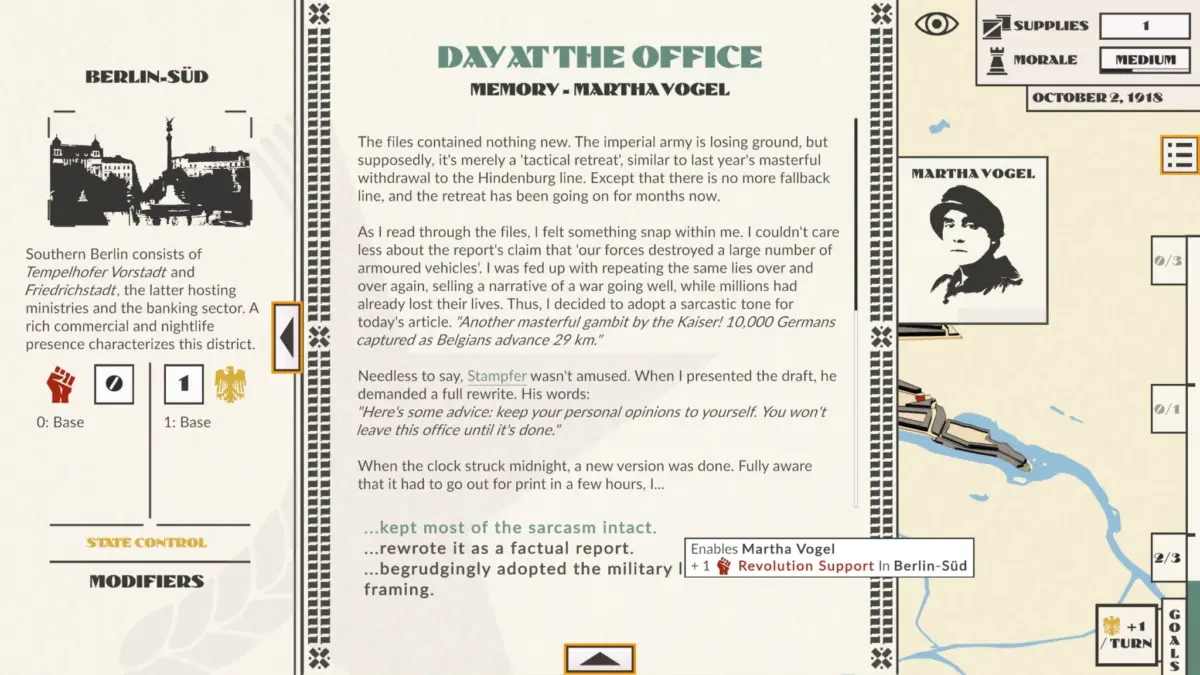
Positioned at the volatile intersection of visual novels and strategic board games, Red Echoes: Berlin drops players directly into the chaotic epicenter of the January 1919 Spartacist uprising. This suppressed communist revolt in post-World War I Weimar Germany serves as the dramatic backdrop for a title that refuses to view history through the lens of detached generalship. Instead of casting the player as high-ranking revolutionaries like Rosa Luxemburg or Karl Liebknecht, the game breathes life into the perspectives of the working-class hoi polloi—dockworkers, radicalized journalists, and war-weary mothers.
Currently available as a playable demo on Steam, the title merges narrative choice with tactical board-management mechanics. As players navigate the escalating tensions of a war-broken capital, they must balance ideological purity with pragmatic compromises. While early indicators suggest a forgiving difficulty curve in the demo’s opening hours, the game’s striking Weimar-era constructivist art direction and sharp, non-expositional writing point toward a deeply immersive experience. Scheduled for a tight, narrative-focused runtime of three to four hours upon its full release, Red Echoes: Berlin invites history enthusiasts and strategy veterans alike to ask a dangerous question: Can the digital proletariat succeed where real-world history failed?
Detailed Chronology: The Anatomy of the Spartacist Uprising
To understand the narrative weight of Red Echoes: Berlin, one must contextualize the historical pressure cooker it simulates. The Spartacist uprising—known in German as the Spartakusaufstand—was a major general strike and subsequent armed rebellion that erupted in Berlin between January 5 and January 12, 1919.
[November 1918: German Revolution & Armistice]
       │
       ▼
[December 1918: Founding of the KPD (Communist Party)]
       │
       ▼
[January 5, 1919: Outbreak of the Spartacist Uprising]
       │
       ▼
[January 11-15, 1919: Freikorps Suppression & Assassinations]
The roots of the revolt stretched back to the collapse of the German Empire in November 1918, following the exhaustion of World War I. Amid naval mutinies and mass strikes, Kaiser Wilhelm II abdicated, and a provisional government—the Council of People’s Deputies, led by the moderate Social Democratic Party (SPD) under Friedrich Ebert—took power. However, the revolutionary left viewed the moderate SPD leadership as having betrayed the socialist cause by preserving the capitalist state apparatus and collaborating with the old military command.
In December 1918, radical leftists, including the Spartacist League led by Rosa Luxemburg and Karl Liebknecht, formally established the Communist Party of Germany (KPD). By early January, fueled by economic destitution, demobilized soldiers, and revolutionary fervor, spontaneous protests and armed seizures of newspaper districts broke out in Berlin.
The provisional government responded with brutal swiftness. Unable to rely on regular army units whose loyalty was suspect, Ebert and his Defense Minister, Gustav Noske, mobilized the Freikorps—right-wing paramilitary units composed of disgruntled frontline veterans. By January 12, the uprising was ruthlessly crushed. Days later, on January 15, Luxemburg and Liebknecht were captured, brutally beaten, and murdered by Freikorps officers, effectively decapitating the German communist movement and setting a dark, violent precedent for the Weimar Republic’s fragile existence.
Red Echoes: Berlin places the player squarely in this hyper-compressed window of history, transforming the cascading failures and desperate gambits of January 1919 into playable mechanics.
Supporting Context & Metrics: Mechanics, Design, and Perspective
Red Echoes: Berlin accomplishes its narrative goals by marrying two distinct genres: the branching dialogue choices of a visual novel and the spatial resource-allocation of a tabletop strategy game.

Gameplay Structure and Character Perspectives
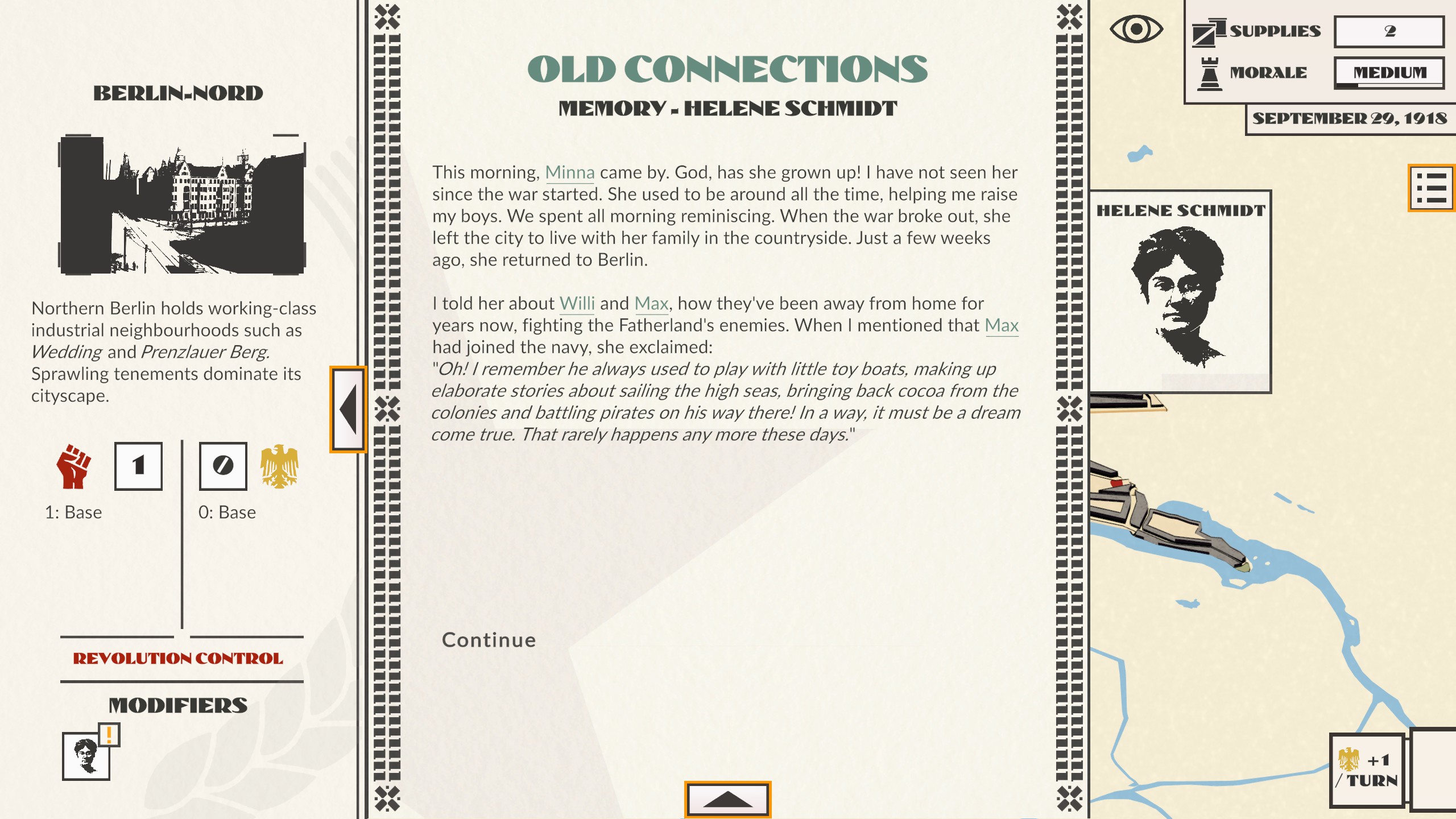
Rather than controlling the grand architects of the revolution, players view the unfolding crisis through the eyes of three distinct protagonists:
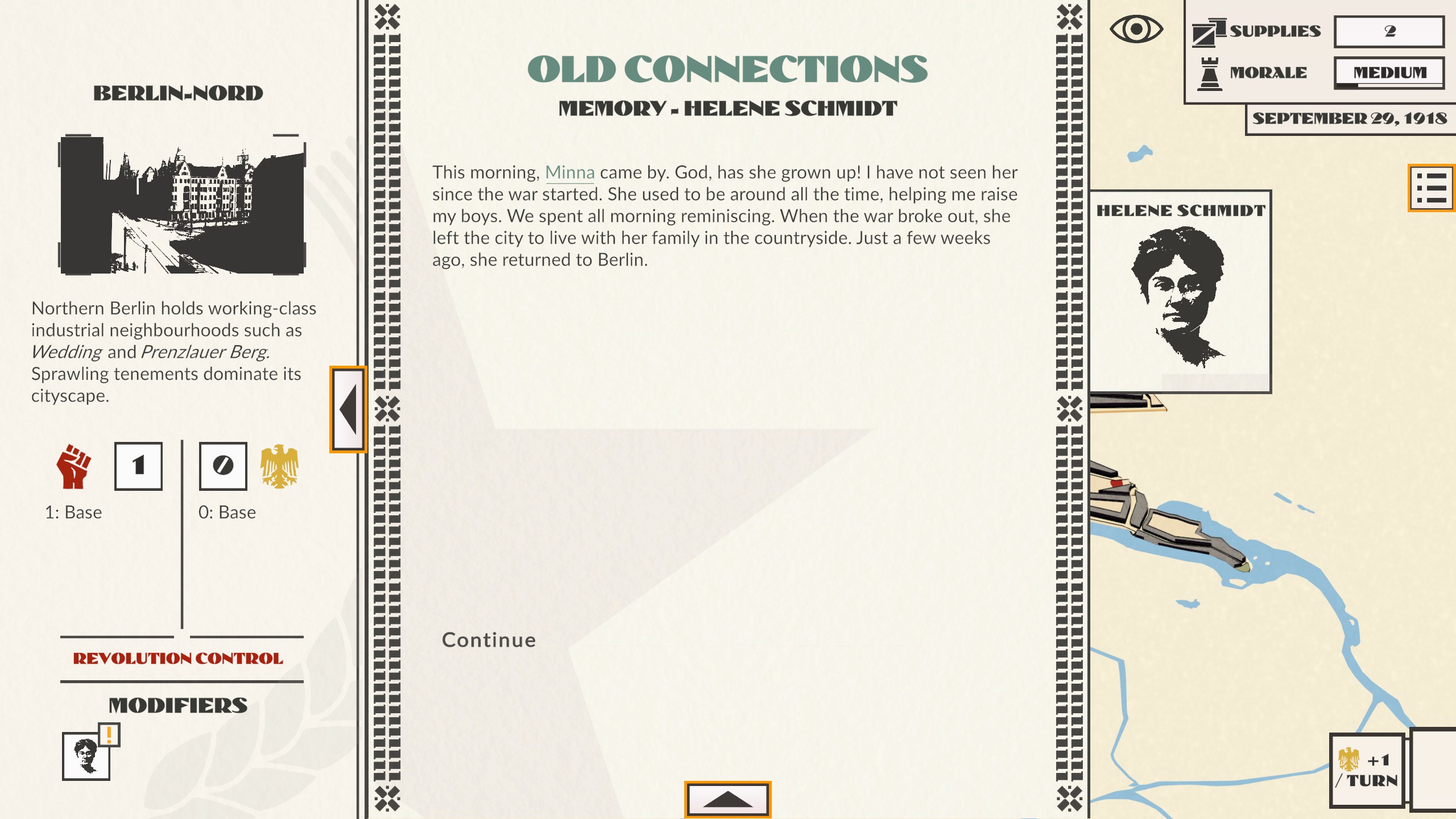
- Helene, a radically inclined journalist whose pen can inflame or steady public consciousness.
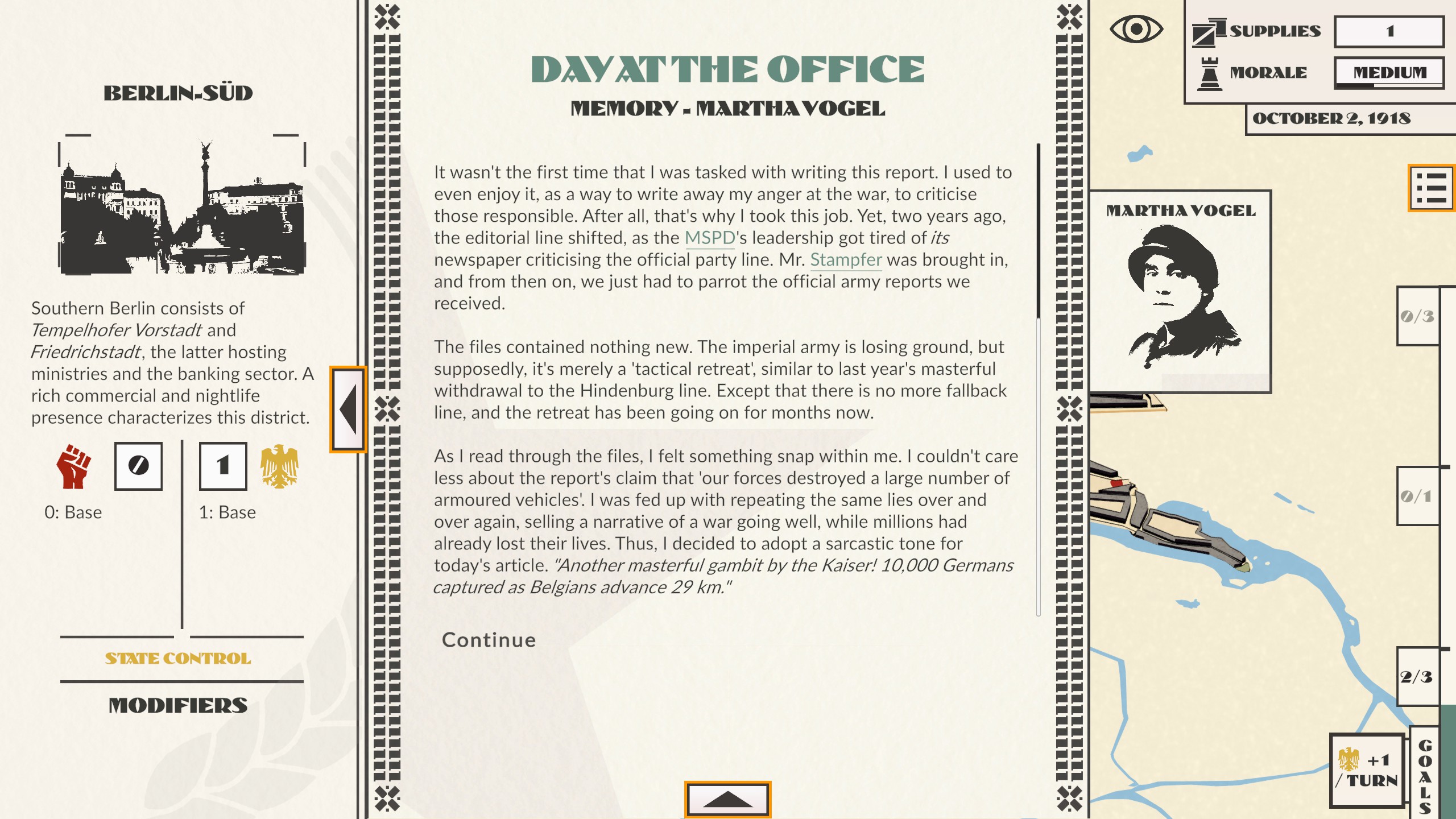
- Martha, a mother whose sons were consumed by the Kaiser’s war, representing the deep, visceral war-weariness of the domestic front.
- A third protagonist—such as a dockworker—capable of mobilizing industrial heartlands.
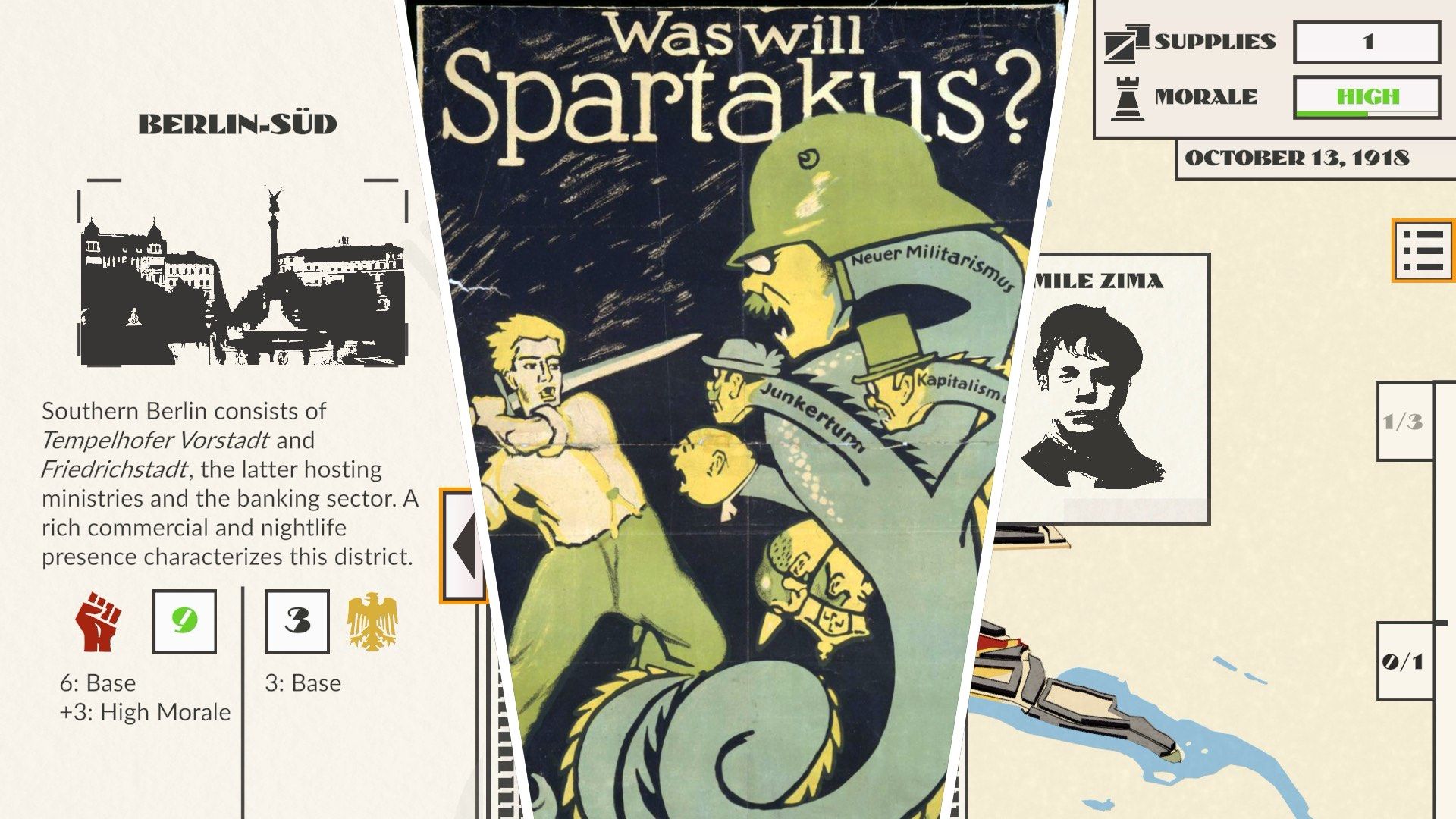
Each character possesses unique operational abilities. One might increase revolutionary fervour in the city sector where they are stationed, another caps the spread of reactionary zealotry, and a third alleviates the psychological and political pressure weighing on allied characters. The core gameplay loop requires players to maneuver these pieces across a map of Berlin, optimizing their positions before the turn concludes.
The Dilemma of Pragmatism vs. Morality
Every decision made during the visual novel segments directly impacts the state of the game board. A conciliatory remark in a union hall might lower revolutionary fervour in one district while dampening reactionary pushback in another. Players are forced to confront a classic Marxist-Leninist dilemma: Should one prioritize immediate moral purity, or make cold, calculating sacrifices that temporarily allow right-wing reaction to fester in exchange for long-term strategic advantages?
Design Aesthetic and Writing Quality
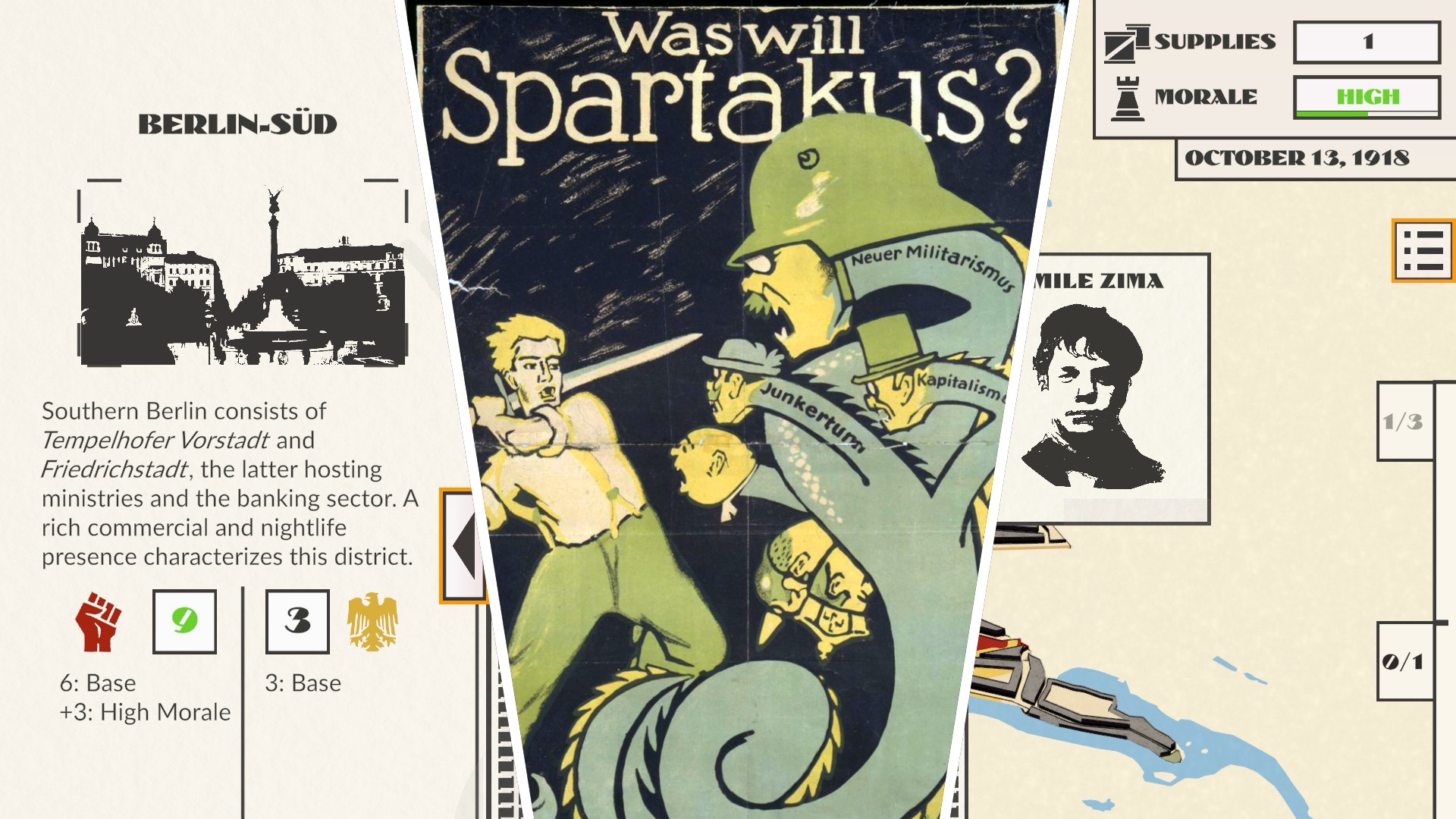
Visually, Morningrise Games has opted for a stark, evocative aesthetic heavily inspired by Weimar-era graphic design and constructivism. As turns progress and Germany’s societal contradictions sharpen, the map steadily fills with pools of crimson red representing the spread of revolutionary sentiment, contrasting sharply against the encroaching yellow tide of political reaction.
Crucially, the game avoids the trap of heavy-handed historical exposition. The dialogue is grounded, believable, and reflective of a populace that is exhausted, frightened, and desperate for change. While the demo indicates that the early game may be somewhat forgiving for players exercising basic forethought, the systemic depth promises a steeper challenge as the historical timeline accelerates toward its violent climax.
Official Statements and Developer Insights
While Morningrise Games has maintained a focused, independent development cycle ahead of the game’s Q1 release, early access previews and developer logs emphasize a commitment to historical authenticity stripped of textbook dryness.
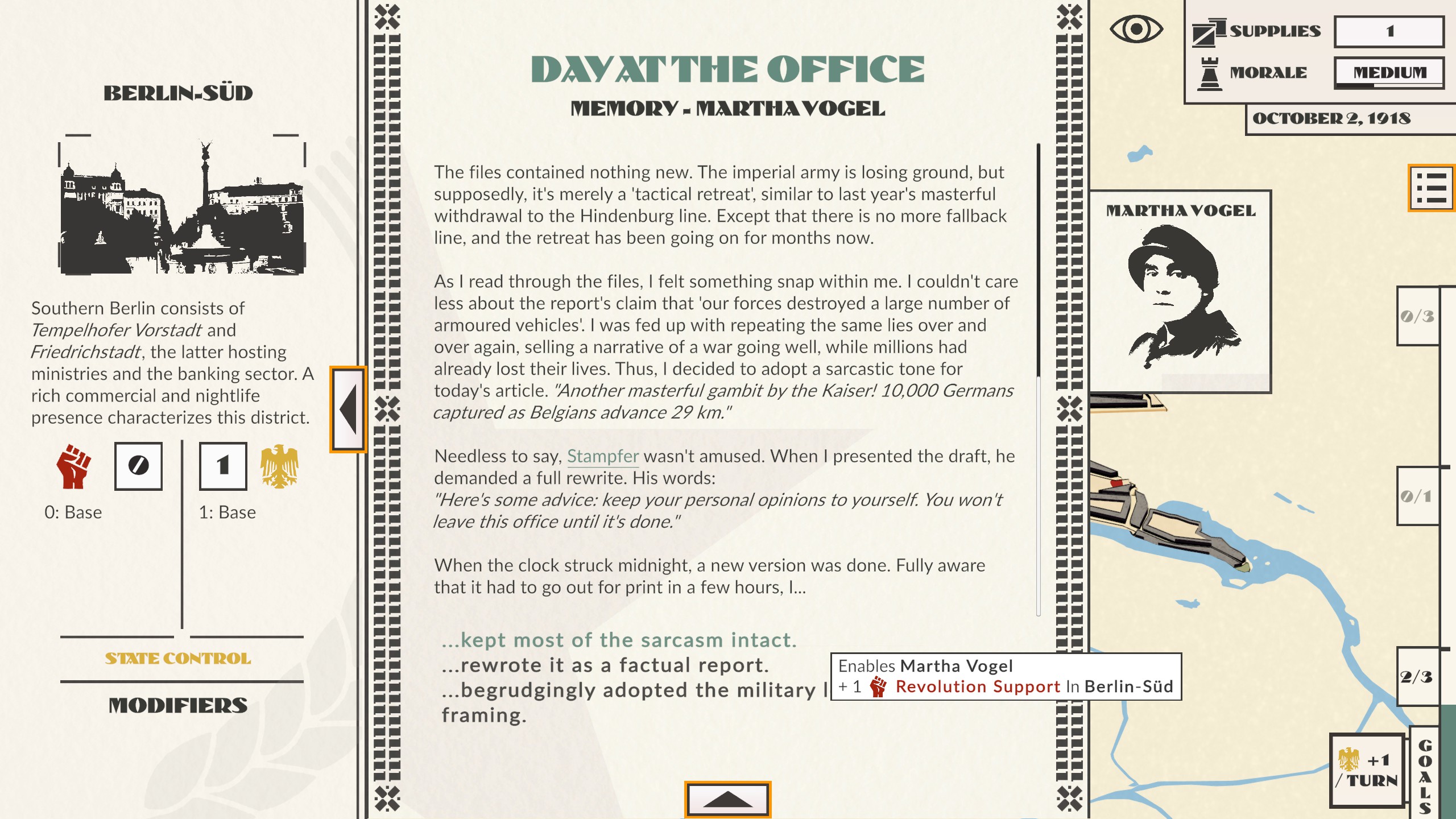
In commentary surrounding the title’s conceptual foundation, the design team has highlighted the importance of shifting focus away from "Great Man history." By sidelining the omnipresent figures of Luxemburg and Liebknecht—at least in terms of direct player control—the developers aimed to capture the claustrophobia and raw vulnerability of ordinary citizens caught in the gears of macro-history.
Early previewers, such as PC Gamer’s Joshua Wolens, have noted the uncanny precision with which the game treats its historical source material, observing that the title operates with a narrative voice "that knows what the Zimmerwald Conference was." This dedication to deep-cut historical literacy suggests that Red Echoes: Berlin is not merely an aesthetic pastiche, but a thoroughly researched examination of revolutionary theory and failure.
Furthermore, Morningrise Games has structured the title to be a tightly paced, highly replayable experience. Rather than demanding dozens of hours of grinding campaign progression, Red Echoes: Berlin is engineered to be completed in a focused three-to-four-hour timeframe, encouraging players to experiment with different ideological strategies, risk profiles, and character positioning tactics across multiple playthroughs.
Future Outlook: What Lies Ahead for Red Echoes: Berlin
As Red Echoes: Berlin sprints toward its scheduled Q1 release window next year, anticipation within the historical strategy and visual novel communities is steadily building. The immediate availability of the Steam demo has allowed prospective players to test the waters of its card-based, territory-control mechanics, providing the developers with valuable feedback regarding game balance and difficulty curves.
Several key milestones remain for Morningrise Games prior to launch:
- Balancing the Late Game: While the demo showcases a forgiving early-game ramp, players will be watching to see how the full release handles the inevitable escalation and brutal crackdown phases of the January 1919 uprising.
- Narrative Branching: The ultimate test of Red Echoes: Berlin will be the breadth of its alternate-history outcomes. Can a player genuinely secure a "red dawn" for Germany, or are they doomed to reenact the tragic compromises of the Weimar era?
- Pacing and Replayability: Maintaining tension across a tight, three-to-four-hour runtime will be crucial for cementing the game’s reputation as a narrative powerhouse.
For fans of narrative strategy, interactive historical fiction, and political simulations, Red Echoes: Berlin represents a breath of fresh, albeit smoke-filled, air. It proves that video games can successfully tackle dense, politically charged historical episodes without sacrificing entertainment value or emotional resonance.
The historical Rosa Luxemburg and Karl Liebknecht met a tragic and untimely end on the freezing streets of Berlin over a century ago, and the German Revolution was drowned in the blood of the Freikorps. But as the gaming community prepares to dive into Morningrise Games’ upcoming creation, a tantalizing proposition hangs in the balance: Given the right cards, the right positioning, and a touch of revolutionary resolve, perhaps history doesn’t always have to repeat itself.









Belum ada komentar. Jadilah yang pertama berkomentar!