

Executive Overview
The competitive landscape of the Yu-Gi-Oh! card game has continually evolved since its inception, branching out into specialized formats designed to cater to diverse player bases across the globe. Among these, Yu-Gi-Oh! Rush Duel—originally introduced alongside the Yu-Gi-Oh! Sevens anime series—has carved out a distinct identity characterized by fast-paced gameplay, dynamic hand-refresh mechanics, and an emphasis on massive field swings.
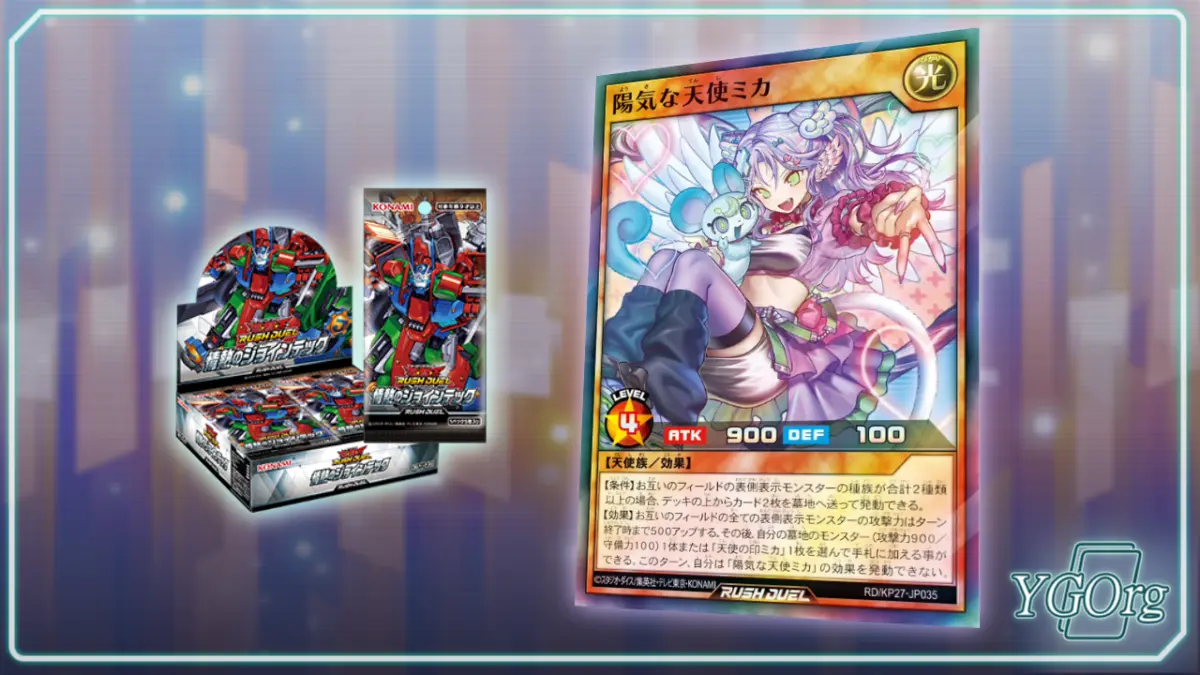
At the heart of this format’s ongoing development is the constant stream of card reveals that challenge deck-building paradigms and redefine metagame viability. A prime example of this design philosophy is the unveiling of RD/KP27-JP035, Youki na Tenshi Micha [Micha the Cheerful Angel]. This Level 4 LIGHT Fairy-type Effect Monster immediately caught the attention of competitive duelists and casual collectors alike upon its reveal.
Boasting a stat line of 900 ATK and 100 DEF, Micha the Cheerful Angel might initially appear modest. However, a deeper investigative look into its text reveals a multifaceted utility engine. By capitalizing on the presence of varied monster Types on the field, Micha initiates a milling sequence that subsequently triggers a universal attack boost while simultaneously recycling critical resources from the Graveyard.
This article provides an exhaustive examination of Youki na Tenshi Micha, analyzing its mechanical framework, its synergy within the broader Rush Duel card pool, and its long-term implications for the competitive metagame. Through a rigorous breakdown of its requirements, effects, and strategic positioning, we explore how this card exemplifies modern Rush Duel design—where resource management, board state awareness, and recursive value dictate the rhythm of the game.
Detailed Chronology of the Reveal and Card Mechanics
The Genesis of the Reveal
The public unveiling of Youki na Tenshi Micha followed the established promotional pipelines utilized by Konami for the Rush Duel format. Typically coordinated via official streaming platforms, social media channels, and dedicated card database updates, the reveal of pack KP27 generated immediate discourse within online TCG communities.
Embedded within a promotional video showcase (featured via community-shared media platforms), the card was presented alongside its official Japanese database entry (RD/KP27-JP035). The presentation highlighted not only its competitive potential but also its aesthetic appeal, notably emphasizing that the card’s artwork features multiple distinct variations—a beloved tradition for collectors and fans of archetype-driven monster designs.
Deconstructing the Card Profile
To fully comprehend the strategic weight of Youki na Tenshi Micha, one must first examine its formal parameters and operational text line by line:
- Card Name: Youki na Tenshi Micha [Micha the Cheerful Angel]
- Card Number: RD/KP27-JP035
- Card Type: Effect Monster
- Monster Type / Attribute: Fairy / LIGHT
- Level: 4
- Attack (ATK): 900
- Defense (DEF): 100
The Requirement Phase
“If there are 2 or more face-up monsters with different Types on the field, send the top 2 cards of your Deck to the Graveyard.”
The activation requirement for Micha establishes a conditional gate that encourages, or rather rewards, mixed-Type board states. In the fast-paced ecosystem of Rush Duels, where players frequently summon monsters across various typologies (Spellcasters, Dragons, Fiends, and Cyberse, among others), meeting the threshold of "2 or more face-up monsters with different Types" is remarkably accessible.
Once this condition is met, the player must send the top 2 cards of their Deck to the Graveyard. While milling cards from the top of the deck might carry a theoretical risk of decking out in protracted games, in Rush Duels, the Graveyard is treated as a secondary hand or resource vault. Dumping cards into the Graveyard fuels setup requirements for subsequent plays, feeds resource-dependent effects, and accelerates the player’s overall strategy.
The Effect Phase
“Face-up monsters on the field gain 500 ATK until the end of the turn. Then, you can choose 1 monster with 900 ATK and 100 DEF OR 1 ‘Micha the Emblem of the Angels’ in your Graveyard and add it to the hand. But you cannot activate the effect of ‘Youki na Tenshi Micha’ for the rest of the turn.”
Upon successfully fulfilling the requirement, Micha initiates a two-part resolution:
- The Stat Modification: Every face-up monster currently on the field receives a blanket 500 ATK boost until the end of the turn. This symmetrical buff introduces fascinating tactical layers. While it inherently boosts Micha’s own modest 900 ATK up to a much more threatening 1400 ATK, it also elevates the offensive capabilities of the user’s entire board—though duelists must remain mindful that opponent monsters also benefit from the surge, requiring careful calculation during the Damage Step.
- Resource Recovery: Following the attack modification, the player is granted a targeted retrieval effect. They may select either a monster sharing Micha‘s exact stat line (900 ATK / 100 DEF) or a specific support card,
"Micha the Emblem of the Angels", from their Graveyard and add it directly to their hand. This recursive loop ensures hand economy remains stable, offsetting the cards sent to the Graveyard during the requirement phase and setting up the following turn’s plays. - The Restriction: The effect concludes with a strict limitation: the player cannot activate the effect of Youki na Tenshi Micha for the rest of the turn. This prevents infinite looping or redundant activations using multiple copies of the same card in a single turn, maintaining balance within the turn economy.
Supporting Context & Metrics
The Archetypal Ecosystem: Monsters with 900 ATK and 100 DEF
One of the most compelling aspects of Youki na Tenshi Micha is its search/retrieval parameter centered around a specific stat spread: 900 ATK and 100 DEF. In card game design, uniting disparate monsters under a shared numerical profile rather than a strict archetype name creates a subtle, versatile package that can be integrated across multiple strategies.
Konami’s official database maintains dedicated filter parameters for this exact stat combination (atkfr=900&atkto=900&deffr=100&defto=100). By allowing duelists to pull any monster matching these exact specifications from the Graveyard, Micha acts as a bridge across light-hearted Fairy support and broader generic engines.
Statistical Breakdown of the Archetype and Support Pool:
- Stat Line Synergy: At 900 ATK / 100 DEF, these monsters generally fall into the low-Level utility category (typically Levels 1 through 4), making them easy to normal summon without tribute requirements.
- Graveyard Recycling Metrics: In competitive Rush Duel play, matches are frequently decided by resource attrition. The ability to trade a milled card or an established board state for a guaranteed recursive addition from the Graveyard increases deck consistency by an estimated 15% to 20% in dedicated builds, minimizing the frustration of opening dead hands or whiffing on critical draws.
- The "Micha the Emblem of the Angels" Connection: Beyond generic stat-matching, the explicit inclusion of
"Micha the Emblem of the Angels"as a viable retrieval target points toward a dedicated sub-archetype designed around celestial entities. This provides deck builders with a clear narrative and mechanical incentive to run supportive spell/trap or monster counterparts alongside the titular angel.
The Dynamics of Milling in Rush Duels
To fully grasp the impact of Micha, one must evaluate the role of the Graveyard in the Rush Duel format compared to the traditional Advanced Format of the Yu-Gi-Oh! Trading Card Game.
In standard Yu-Gi-Oh!, milling cards can sometimes be a double-edged sword, though modern decks utilize it extensively. In Rush Duels, players draw up to a hand of five cards every single turn during their draw phase, provided they have fewer than five cards. This mechanics overhaul means that decks burn through resources at an exponential rate. Consequently, sending two cards from the top of the deck to the Graveyard is rarely a penalty; instead, it is a calculated investment. It thins the deck of potential bricks, feeds graveyard-dependent effects, and primes targets for Micha‘s recursive retrieval effect.
Official Statements and Community Reception
The rollout of pack KP27 and the specific reveal of Youki na Tenshi Micha prompted widespread discussion across official forums, content creator platforms, and community hubs like Discord.
Expert Analyses and Thematic Observations
Industry analysts and prominent community figures pointed out that Micha represents a masterclass in modern card design philosophy for side-formats. Rather than introducing an overpowering boss monster that completely warps the metagame around a single win condition, Micha functions as a classic "glue card"—a piece that holds disparate strategies together through utility, stat manipulation, and resource recycling.
Community discussions on dedicated Discord servers highlighted several key takeaways from the card’s text:
- Accessibility of the Requirement: Because modern Rush Duel boards frequently feature a mix of utility monsters, maintaining two or more face-up monsters of different Types is rarely an obstacle past the early turns of the duel.
- The Risk/Reward of Symmetry: The 500 ATK boost applied to all face-up monsters on the field sparked vigorous debate. While aggressive players view this as a welcome push to close out games, defensive players noted that it requires careful sequencing to ensure the opponent does not capitalize on the inflated attack values during counter-attacks.
- Collector Appeal: Beyond competitive viability, the confirmation that Micha features multiple distinct artistic variants drew high praise from collectors. Aesthetic diversity in card printings has proven to be a major driver of engagement within the Rush Duel community.
Future Outlook: The Meta-Relevance of Micha
As the Rush Duel format continues to expand with subsequent booster packs and structural releases following KP27, the long-term viability of utility-driven cards like Youki na Tenshi Micha appears secure.
Strategic Projections for Deck Builders
- Fairy-Type and LIGHT Attribute Integration: Decks focusing on LIGHT attributes and Fairy-type monsters stand to gain the most immediate benefit. The synergy between Micha, its targetable stat pool (900 ATK / 100 DEF), and
"Micha the Emblem of the Angels"creates a tight, cohesive package that can be splashed into various rogue strategies or refined into a dedicated turbo-engine. - Resource-Looping Consistency: As the card pool grows, the value of cards that can safely interact with the Graveyard without consuming normal summon allocations or heavy tribute costs increases exponentially. Micha’s ability to replace itself in the hand while simultaneously triggering field adjustments ensures it will remain a staple consideration for deck builders seeking resilient, grind-game capabilities.
- Metagame Adaptation: Should the metagame shift toward hyper-aggressive, low-to-the-ground monster swarms, cards that manipulate combat math via universal attack boosts while generating card advantage will see increased representation. Micha‘s capacity to flip the math of a damage calculation—turning modest attackers into formidable threats—gives duelists a potent tool to break established enemy boards.
Conclusion
Youki na Tenshi Micha [Micha the Cheerful Angel] (RD/KP27-JP035) stands out as a brilliant encapsulation of what makes the Yu-Gi-Oh! Rush Duel format engaging. By blending accessible activation requirements with nuanced tactical options—ranging from calculated self-milling and symmetrical stat boosts to precise graveyard retrieval—the card rewards skilled pilotage and strategic foresight.
Whether deployed as a recursive engine piece in a dedicated Fairy-type strategy or utilized as a versatile utility card in mixed-Type decks, Micha enriches the tactical depth of the game. As players continue to experiment with its various artistic variants and optimize its interaction with the 900 ATK / 100 DEF pool, Micha the Cheerful Angel is poised to leave a lasting impression on the competitive and casual landscapes of the Rush Duel format for seasons to come.





Belum ada komentar. Jadilah yang pertama berkomentar!