

Executive Overview
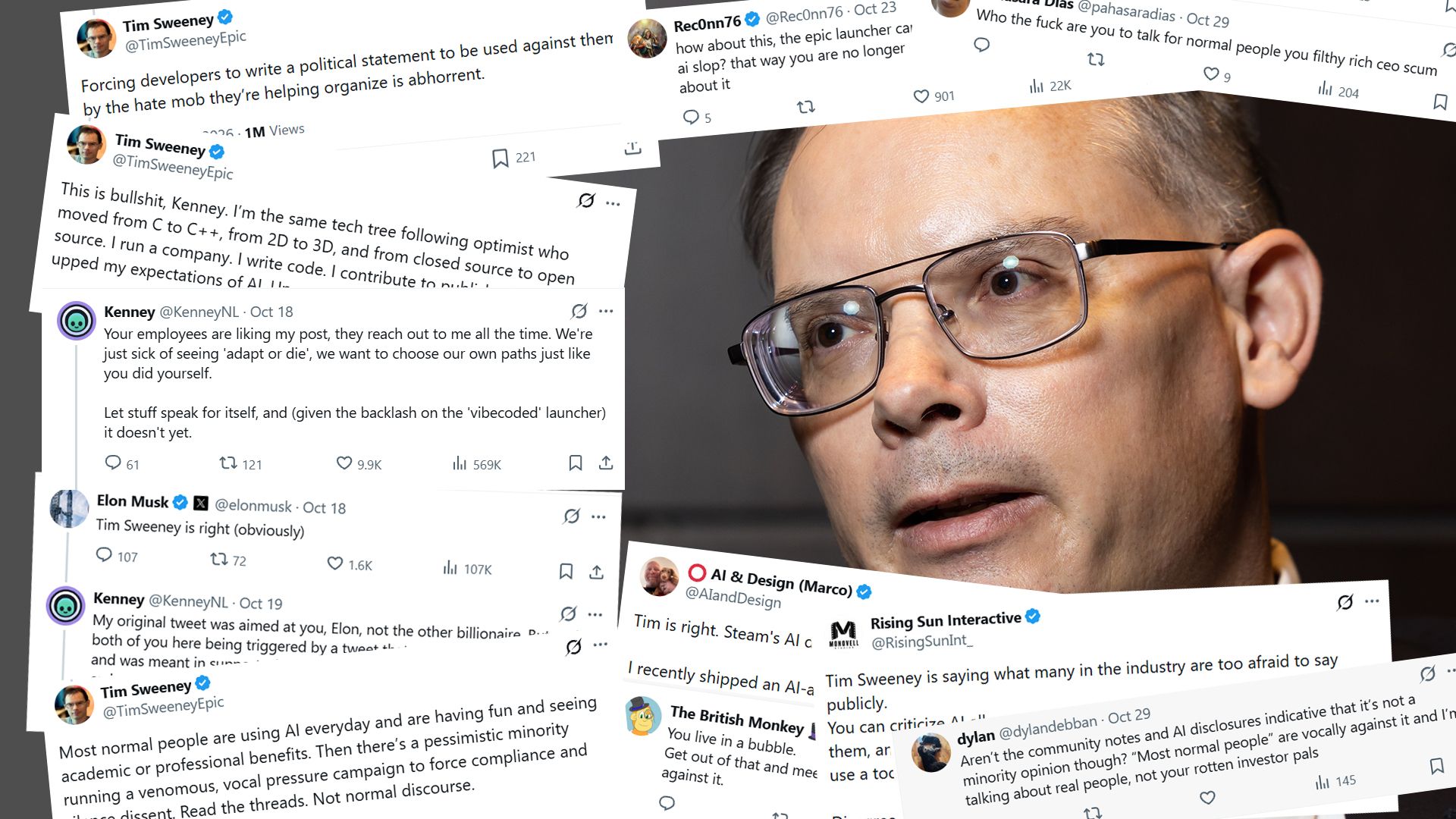
The fault lines dividing the video game industry over generative artificial intelligence have widened from quiet developer forums into a public battleground involving some of the sector’s most prominent figures. What began as a routine social media post by independent asset creator Kenney—urging artists to resist industry-wide pressure to adopt generative AI tools—unexpectedly snowballed into a direct confrontation with Epic Games CEO Tim Sweeney and, subsequently, the world’s wealthiest individual, Elon Musk.
This high-profile clash encapsulates a fundamental ideological war at the heart of modern game development. On one side stand corporate executives and tech billionaires who view generative AI as an essential, non-negotiable productivity multiplier—a 2x to 4x efficiency engine required to keep game development economically viable in an era of skyrocketing budgets. On the other side stand independent creators, artists, and traditionalists who view the technology as an existential threat: an environmental burden, a vehicle for intellectual property theft, and an artistic cheapening of the medium that prioritizes corporate profit margins over the love of the craft.
As Epic Games goes "all-in" on integrating AI-assisted tools into the upcoming iterations of Unreal Engine and championing relaxed distribution standards, the resistance is digging in its heels. This report examines the mechanics of the Sweeney-Kenney feud, the wider economic realities governing generative AI in gaming, consumer sentiment versus vocal online dissent, and what this deep philosophical divide means for the future of interactive entertainment.
Detailed Chronology: From a General Critique to a Billionaire Brawl
The flashpoint occurred on X (formerly Twitter), where Kenney—widely respected in the indie community for distributing tens of thousands of free game assets over the past decade—published a pointed warning directed at fellow creators.
The Catalyst
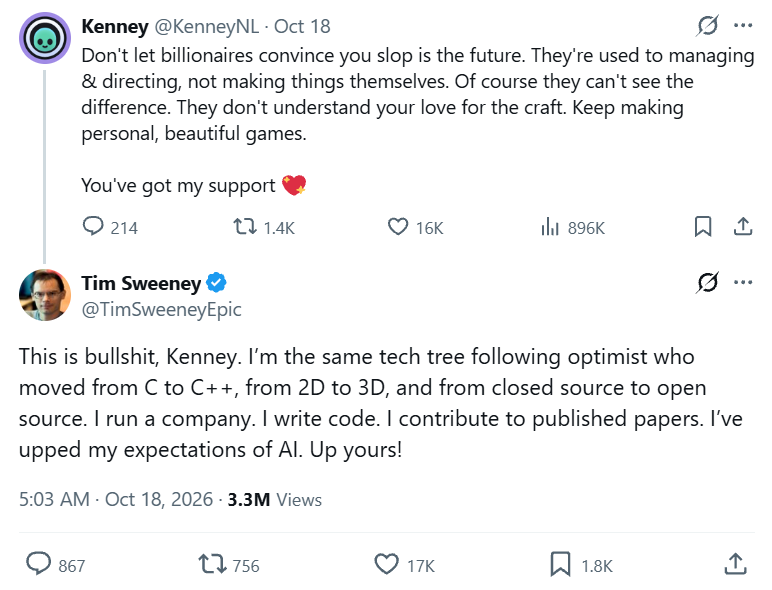
Frustrated by what he perceived as a top-down push by tech elites to normalize low-effort, procedurally generated content, Kenney wrote:
"Don’t let billionaires convince you slop is the future. They’re used to managing & directing, not making things themselves. Of course they can’t see the difference. They don’t understand your love for the craft. Keep making personal, beautiful games. You’ve got my support."
The message was not targeted at any single individual; rather, it was meant as a morale boost for artists feeling alienated or coerced by industry trends. However, because it directly addressed the executive class, it immediately drew heavy hitters into the conversation.
Tim Sweeney’s Rebuttal
Hours later, Epic Games CEO Tim Sweeney entered Kenney’s mentions. Unhappy with the blanket dismissal of tech leaders and the characterization of generative AI as mere "slop," Sweeney fired back:
"This is bullshit, Kenney."
Sweeney concluded his public defense of the technology with a sharp double entendre: "I’ve upped my expectations of AI. Up yours!"
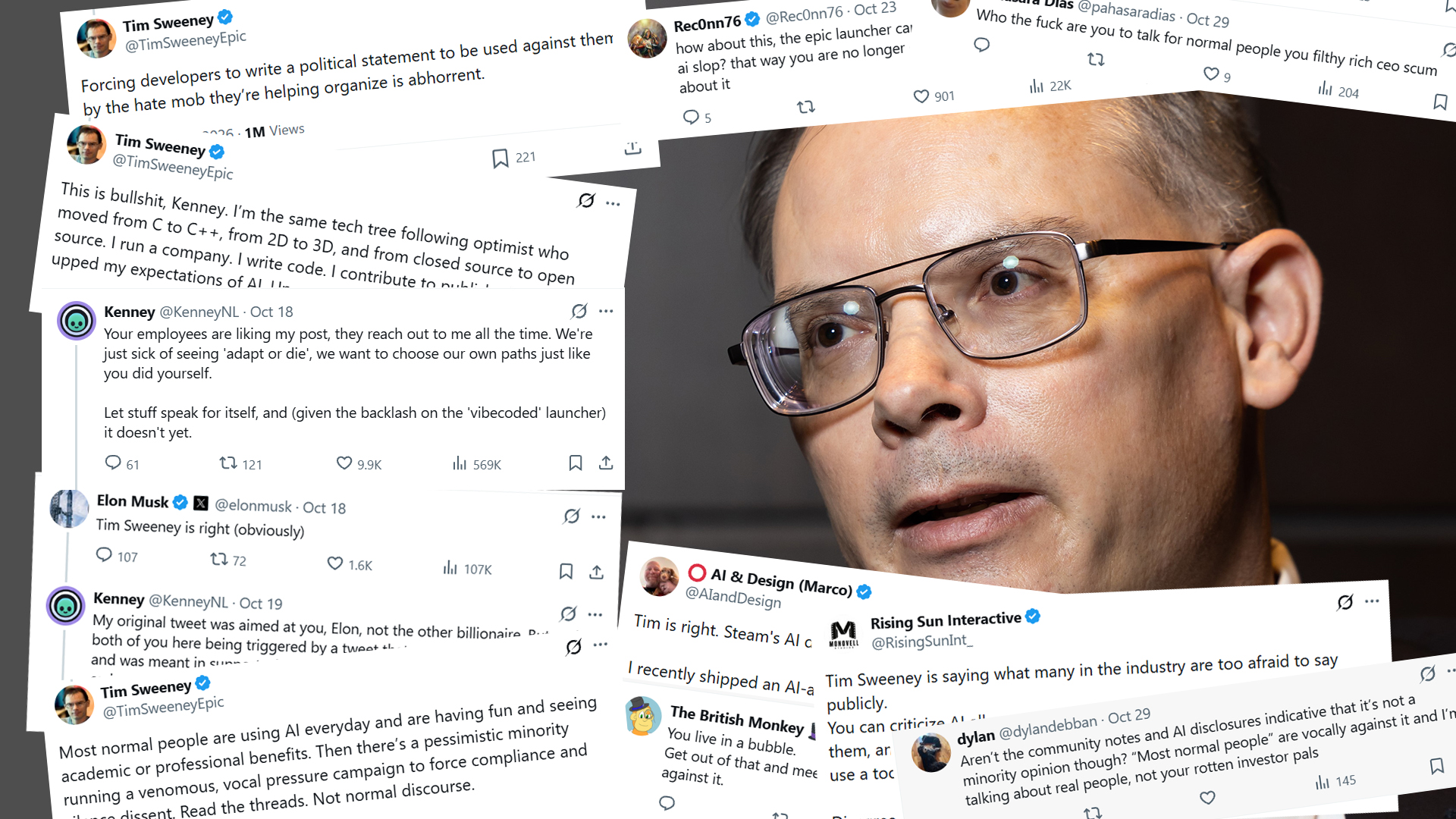
The exchange quickly metastasized as Elon Musk chimed in to support Sweeney’s stance. Within hours, the thread was inundated with hundreds of replies, transforming into a microcosm of the broader internet culture war surrounding artificial intelligence.
The Developer Backlash and Fallout
While Sweeney viewed Kenney’s statements as anti-competitive fear-mongering, the indie development community rallied around the asset creator. The friction quickly bled out of social media and into business decisions. Notably, indie studio Dead Teapot publicly announced the cancellation of their upcoming Epic Games Store release, stating explicitly that they refused to be associated with a platform whose leadership champions tools they find fundamentally objectionable.
In subsequent interviews, Kenney clarified that his opposition is rooted in structural objections: data center environmental impacts, intellectual property appropriation during model training, and the systemic devaluation of human labor across creative sectors.
Supporting Context & Metrics: Where the Industry Actually Stands
While high-profile social media dustups make for dramatic headlines, the actual integration of generative AI into commercial video games reveals a complex picture of corporate adoption, consumer apathy, and regulatory friction.
Developer Sentiment: A Deep Divide
The apprehension within the developer community is measurable. According to the most recent Game Developers Conference (GDC) industry survey, more than 50% of game developers now believe that generative AI is bad for the industry—a dramatic sentiment shift representing a massive increase in skepticism compared to just two years prior. Many developers echo Kenney’s visceral reaction, with a significant cohort openly stating they would rather leave the industry entirely than build games using generative AI.
Consumer Acceptance vs. Vocal Outrage
Conversely, the consumer marketplace tells a more nuanced story. While anti-AI rhetoric dominates social media spaces like X and Reddit, player purchasing habits suggest a high degree of tolerance—or outright indifference—toward AI integration in commercial releases.
- Commercial Success of AI-Disclosed Titles: High-profile titles that have disclosed or utilized generative AI features continue to post massive financial numbers. For instance, games leveraging AI-assisted development or text generation—ranging from large-scale extraction shooters like Arc Raiders (which sold over 1.6 million copies despite review bombing over AI) to established franchises like Call of Duty and numerous indie hits on Steam—continue to thrive commercially.
- The Steam User Survey: A comprehensive study conducted by analytics firm GameDiscoverCo regarding Steam users and AI disclosures found that approximately 69% of surveyed PC gamers are either "neutral," "fine with," or "have absolutely no problem with" purchasing games that openly disclose the use of generative AI in their development pipelines.
- The Desire for Transparency: Interestingly, while the majority of players are willing to buy AI-touched games, transparency is heavily favored. The same survey indicated that the vast majority of players check Valve’s mandatory AI disclosure tags before purchasing, and over 55% believe Steam should enforce even stricter rules regarding AI usage.
This consumer profile explains why platform holders like Epic Games and Valve find themselves formulating vastly different strategies.
Official Statements & Industry Philosophies
The ideological chasm between Tim Sweeney and creators like Kenney highlights two fundamentally incompatible visions for the future of game development.
Tim Sweeney: The Productivity Imperative
Sweeney has adopted a vocal, frontline defense of generative AI, positioning himself and Epic Games as technological educators who must drag a reluctant industry into the future.
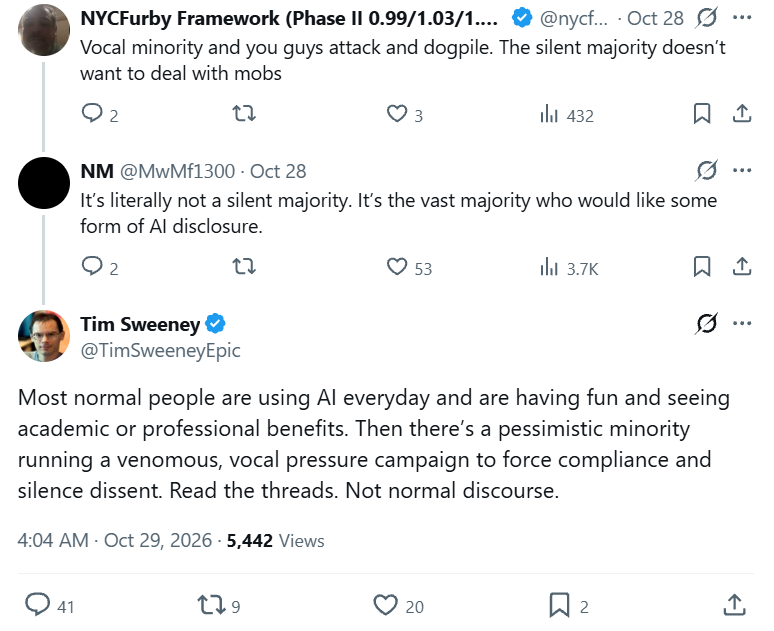
- The Anti-AI "Mob": Sweeney has repeatedly characterized the anti-AI movement as "a pessimistic minority running a venomous, vocal pressure campaign to force compliance and silence dissent." He has further asserted that much of the organized pushback is fueled by "astroturfed anti-AI influence campaigns."
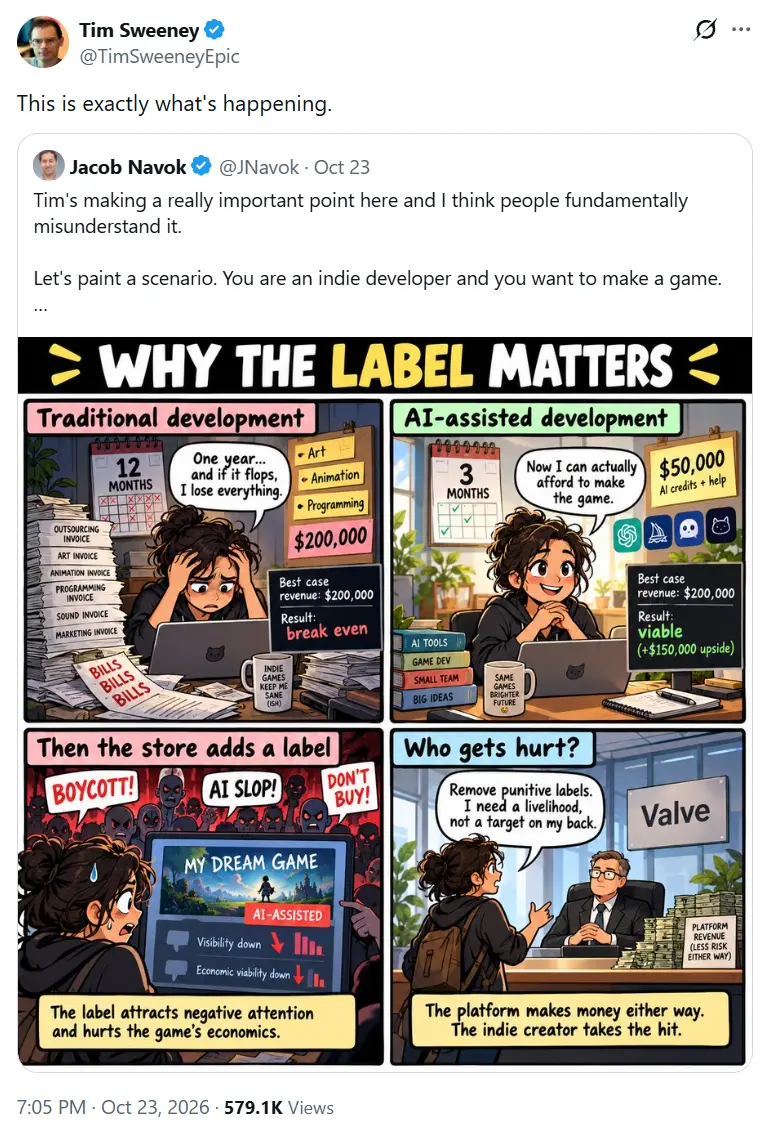
- Economic Survival: According to Sweeney, refusing to adopt generative AI tools is an economic death sentence for studios. In statements to the press, he noted: "I’m concerned that development studios swept up in these anti-AI campaigns will make decisions that render themselves uncompetitive in the global market for games." He predicts that studios leveraging AI properly will experience productivity gains ranging from 2x to 4x, making the technology an absolute baseline requirement for fiscal solvency.
- The War on Disclosures: Sweeney has been deeply critical of Valve’s mandatory AI disclosure policies on Steam, calling them "abhorrent" and arguing that they function as political tripwires designed to subject developers to "cancel campaigns and public struggle sessions."
Kenney: The Defense of Human Craft
On the other side of the aisle, Kenney and his supporters argue that the push for hyper-efficiency is eroding the very soul of interactive art.

- The Grift vs. The Craft: Kenney views the corporate embrace of AI not as an inevitable wave of progress, but as a cash grab orchestrated by executives who have never understood the meticulous, personal nature of making games. "I’m worried that the part of the industry I love is going to disappear or be taken over by people who aren’t in it for the love of the craft, but rather for the grift," he warned.
- Embracing Obsolescence: Addressing Sweeney’s warning that anti-AI developers will be left behind by the global market, Kenney offered a resolute and defiant response: "Please, leave me behind. I’m pretty happy here." Rather than chasing exponential growth metrics, Kenney remains committed to sustainable, community-driven art production, funding his work through direct donations and modest bundles of his 60,000+ hand-crafted assets.
Future Outlook: Where Do We Go From Here?
The clash between Sweeney and Kenney is unlikely to resolve anytime soon because it touches on existential questions with no easy compromises.
- The Tool vs. The Product Schism: As tools like Epic’s Unreal Engine become more deeply intertwined with generative models, developers will face a stark choice. They can either adopt these workflows to compete with AAA production speeds or intentionally position their projects as "artisanal", human-made alternatives.
- Platform Polarization: The divergence between the Epic Games Store (which leans aggressively into AI-forward developer ecosystems and minimal restriction) and Valve’s Steam (which mandates transparent disclosures while maintaining a neutral marketplace stance) will likely accelerate. Studios and players will increasingly self-segregate based on their platform loyalties and philosophical alignments.
- The Sustainability Crisis: Underlying both arguments is the brutal economic reality of modern game development, where ballooning budgets and multi-year development cycles are breaking traditional studio models. Whether generative AI will serve as the financial lifeline that saves studios from bankruptcy—or the standardization engine that flattens creative diversity into algorithmic homogenization—remains the defining question of this console generation.
Ultimately, the public sparring match between a billionaire tech CEO and a beloved indie asset creator has brought an industry-shaping debate out from behind closed doors. As the lines are drawn, the ultimate arbiter will be the consumer, whose willingness to purchase—or reject—AI-driven entertainment will dictate the financial reality of the games we play tomorrow.






Belum ada komentar. Jadilah yang pertama berkomentar!