

Executive Overview
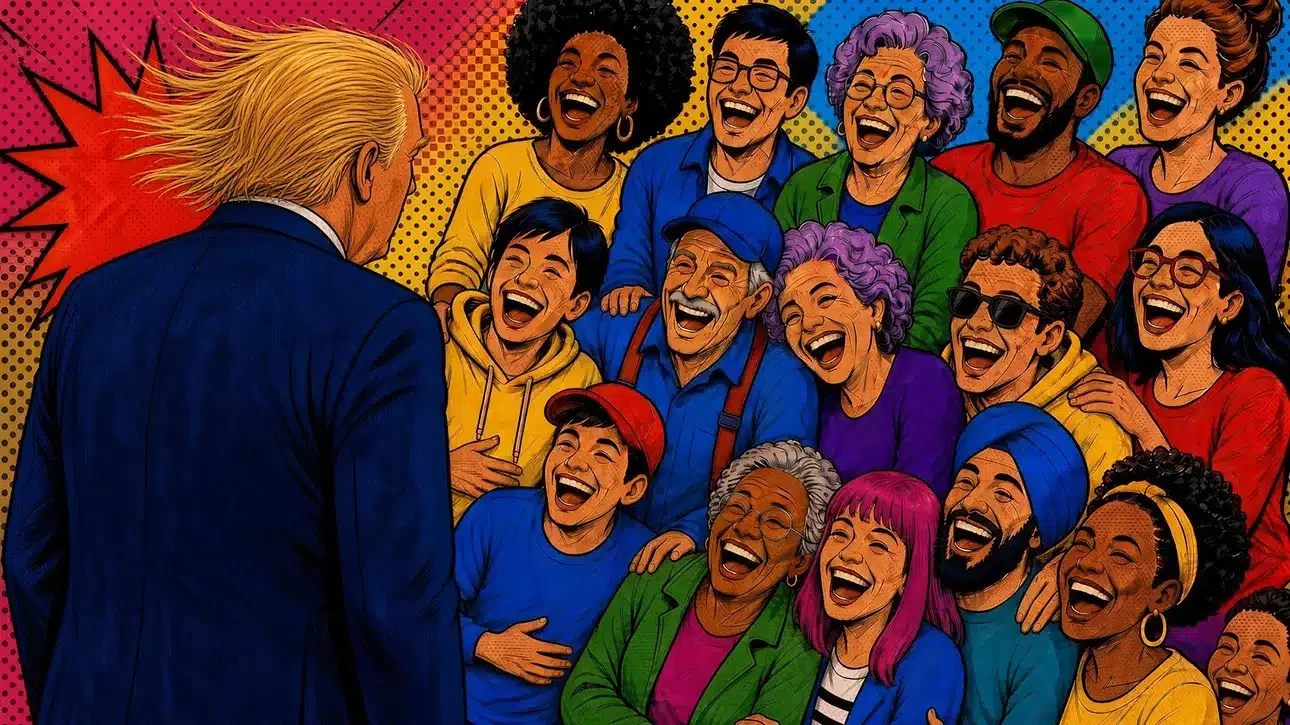
In an era where democratic norms face unprecedented strain and institutional guardrails buckle under the weight of rising autocracy, political resistance has undergone a profound transformation. With traditional legislative checks weakened—exacerbated by partisan control of Congress and a compliant judiciary—frustrated citizens have pivoted from despair to pragmatic mobilization. Increasingly, the vanguard of this resistance is not found in traditional political halls, but on the comedy stage and late-night television.
From mass street protests featuring inflatable amphibians and absurdity-driven performance art to the biting, prime-time monologues of late-night satirists, humor has emerged as a formidable weapon against creeping authoritarianism. This dynamic came to a head in late 2025, culminating in a high-stakes standoff between the Trump administration and late-night host Jimmy Kimmel. The resulting collision—featuring federal regulatory threats, corporate capitulation, and subsequent consumer-driven backlash—revealed a stark political reality: as conventional journalism struggles to hold unchecked power accountable, late-night comedy has stepped into the breach, acting as a crucial proxy for the public conscience and a lightning rod for the defense of the First Amendment.
Detailed Chronology: The Escalating War on Late-Night Satire
The systematic friction between aspiring autocrats and the comedy community is rooted in a fundamental intolerance for dissent, but the timeline leading to the autumn of 2025 marked an aggressive escalation in state pressure against media institutions.
The Groundwork: Corporate Compliance and Preemptive Censorship
For decades, an unspoken social contract dictated that American presidents accepted public ridicule as an occupational hazard. From Johnny Carson’s wry jabs at Richard Nixon to David Letterman’s sharp wit, late-night television operated as a cultural pressure valve. However, as populist authoritarianism took deeper root in the mid-2020s, that contract dissolved.
The strategy to neutralize late-night critics shifted from mere verbal denunciation to economic and regulatory coercion. In July 2025, this strategy materialized when CBS’s parent company, Paramount, sought lucrative business mergers requiring federal regulatory sign-off from the Trump administration. Amid these negotiations, Stephen Colbert’s long-running program faced sudden cancellation—a casualty of corporate self-preservation in the face of political leverage.
Buoyed by this success, the administration turned its crosshairs toward ABC and its most prominent late-night voice, Jimmy Kimmel.
The Catalyst: The Charlie Kirk Shooting and the September 2025 Crisis
The flashpoint arrived in September 2025 in the wake of the Charlie Kirk assassination—an event that ignited intense fury within far-right information ecosystems. Sensing an opportunity to weaponize the tragedy for political retribution, the administration and its allies mobilized.
During his September 25 monologue, Kimmel directly addressed the fallout, pointing out that the "MAGA gang" was exploiting the tragedy to extract political capital regardless of the facts. The ensuing manufactured outrage followed a now-familiar playbook: grievances percolated within far-right media silos before spilling over into official state pressure.
Seizing the moment, Federal Communications Commission (FCC) Chairman Brendan Carr deployed regulatory threats against ABC and its parent company, Disney. Nexstar Media Group promptly pulled Jimmy Kimmel Live! from its ABC-affiliated stations. Under heavy pressure from a potential corporate merger pending federal approval, Disney executives instructed ABC to suspend Kimmel indefinitely.
[Triggering Event: Charlie Kirk Shooting]
       │
       ▼
[Far-Right Media Outrage & Weaponization]
       │
       ▼
[FCC Threat of Regulatory Action (Brendan Carr)]
       │
       ▼
[Corporate Capitulation: Disney/ABC Suspends Jimmy Kimmel]
       │
       ▼
[Public Backlash, Boycotts, & Stock Plunge]
       │
       ▼
[Administration Retreat & Kimmel's Triumphant Return]
The Asymmetric Counter-Offensive and Corporate Retreat
Trump declared a triumphant victory, signaling that the comedy world’s most persistent critic had finally been silenced. Yet, the administration gravely miscalculated the resilience of public sentiment and the mechanics of modern consumer power.
Unlike previous isolated actions, the comedy community rallied immediately around Kimmel in an unprecedented display of professional solidarity. More importantly, years of trust between late-night hosts and their audiences catalyzed a massive public backlash.
Citizens weaponized their consumer power, threatening widespread boycotts of Disney products. Within days, Disney’s stock value plummeted, exposing the financial peril of corporate compliance with authoritarian overreach. Faced with severe economic fallout, the Trump administration, the FCC, and Disney all retreated. Kimmel returned to the airwaves to a hero’s welcome, his approval ratings soaring as the administration’s vindictive maneuver collapsed under the weight of public resistance.
Supporting Context & Metrics: The Cognitive and Historical Power of Humor
To understand why authoritarian figures react so violently to comedians, one must examine the psychological and historical mechanics of political humor.
The Cognitive Antidote to Authoritarianism
Philosopher and scholar John Morreall, author of Taking Laughter Seriously, notes that “[people] with a sense of humor can never be fully dominated.” Authoritarian regimes demand unthinking obedience, absolute conformity, and intense hero worship, relying heavily on manufactured fear and anger directed at scapegoated "others."
Humor is fundamentally incompatible with these demands. Satirical humor challenges the human mind to perceive hypocrisy, incongruities, and moral shortcomings. It replaces the rigid, joyless solemnity required by fascist movements with flexibility, shared humanity, and joy. As Chaya Ostrower documented in her research on Holocaust survivors (It Kept Us Alive: Humor in the Holocaust), humor even functions as a vital psychological survival mechanism, enabling individuals to rise above hopeless, oppressive circumstances.
Historical Precedents of Comic Resistance
The weaponization of comedy against tyranny is as old as civilization itself:
- Ancient Greece: Comic poets in the 6th century BC utilized satire to steer Athenian democracy away from despotism.
- Medieval Carnivals: Citizens used public ridicule and carnivalesque inversions to mock repressive feudal rulers.
- The American Revolution: Political cartoons provided vital cultural momentum against monarchical rule, a tradition sustained by figures from Benjamin Franklin to Mark Twain.
- The 20th-Century Totalitarian State: In both Stalin’s Soviet Union and Nazi Germany, authoritarian regimes established literal "joke courts" to punish citizens who dared mock the state—illustrating that dictators understand the corrosive power of laughter better than anyone.
The Failure of Traditional Journalism and the Rise of the Comic Reporter
The necessity of late-night satire has been exponentially magnified by the systemic failure of the mainstream American press. Unlike British journalism, where political figures face relentless, rigorous cross-examination, American journalism has frequently succumbed to a culture of appeasement. Fearing professional exclusion from favored press corps, reporters routinely drop crucial lines of inquiry at the first sign of a dismissive insult.
This institutional weakness has driven citizens away from traditional evening broadcasts and toward late-night satirists. As media scholar Geoffrey Baym argued in his seminal analysis of The Daily Show, late-night comedians offer a "model of deliberative democracy" and a "rhetoric of challenge." By interrogating both politics and journalism itself, they expose the false equivalencies of "objective" media reporting and meet audiences at a moral, rather than purely partisan, level.
Official Statements and Industry Reactions
The standoff between the Trump administration and late-night television drew sharp condemnations from civil liberties advocates, media analysts, and political figures alike.
-
On the FCC’s Regulatory Interventions:
Civil rights organizations and media watchdogs immediately condemned FCC Chairman Brendan Carr’s actions. The American Civil Liberties Union (ACLU) released a statement characterizing the suspension of Jimmy Kimmel Live! as "a chilling, state-directed assault on the First Amendment that transforms regulatory agencies into enforcers of political conformity." -
The White House Defense:
Defending the administration’s stance, White House surrogates argued that broadcast airwaves are a public trust subject to community standards. Speaking on condition of anonymity, a senior administration official claimed that "networks have a responsibility to foster national unity rather than allowing late-night platforms to be weaponized for relentless partisan attacks during times of national grief." -
Corporate Retrenchment:
Following the severe market correction and consumer boycotts, Disney issued a carefully worded press release emphasizing its commitment to free expression: "As a company built on creative storytelling, Disney deeply values diverse perspectives and the foundational American principle of free speech. We look forward to welcoming Jimmy Kimmel back to the air." -
Industry Solidarity:
Fellow late-night hosts united across network lines during the crisis. Stephen Colbert, speaking from his remaining platform prior to his own corporate-induced departure, remarked: "When a government tries to pick who gets to make us laugh, they aren’t showing strength—they are terrified of the mirror."
Future Outlook: The Fragility of Autocratic Overreach
The resolution of the Kimmel-Kirk saga offers both a sobering warning and a beacon of hope for democracies in peril. It demonstrates that while aspiring autocrats will continually seek to dismantle the institutional pillars of a free society—leveraging corporate dependencies, regulatory bodies, and manufactured crises—their power remains fundamentally fragile.
As long as citizens retain the agency to push back against corporate cowardice and mobilize their consumer and political power, authoritarian overreach can be checked. The defense of free speech in the 21st century may no longer rest solely within traditional journalistic institutions; instead, it has found an unlikely, resilient champion in the late-night comedy studio.
Ultimately, the events of late 2025 reaffirm a timeless truth: tyrants can censor news reports, shutter opposition offices, and intimidate politicians, but they can never legislate away a population’s shared laughter. And so long as the jester continues to speak truth to power, the autocrat’s house of cards remains perpetually at risk of collapse.






Belum ada komentar. Jadilah yang pertama berkomentar!