

Executive Overview
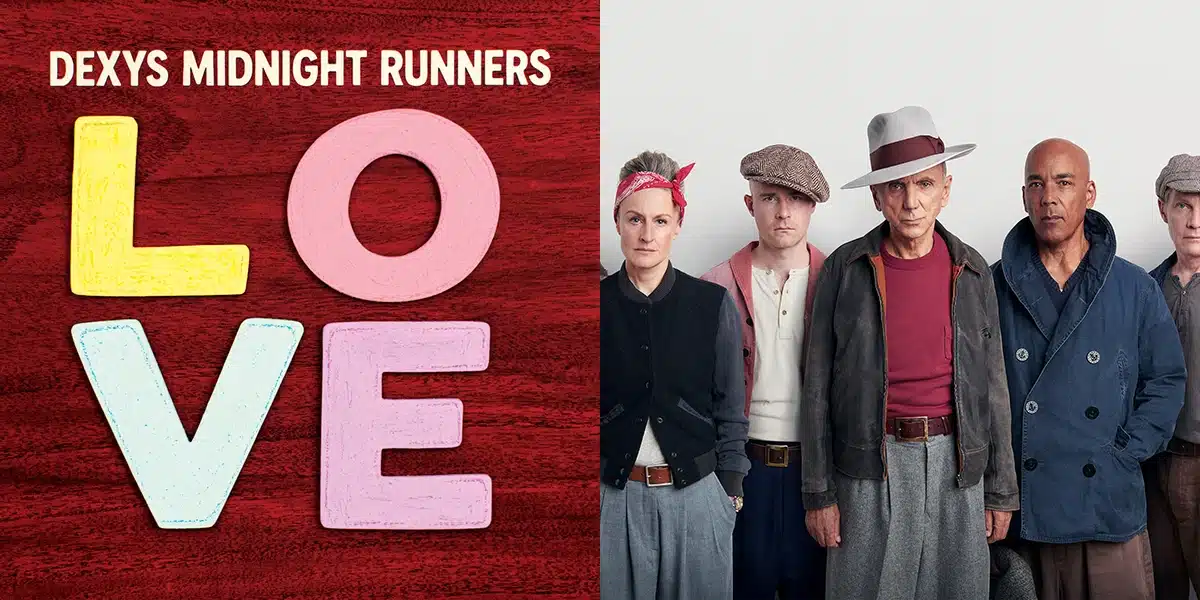
Nearly four decades after the definitive cultural footprint left by their 1980s output, Kevin Rowland and Dexys Midnight Runners have returned with a project that bridges past and present with breathtaking vulnerability. Titled LOVE—and notably bearing the original moniker Dexys Midnight Runners for the first time since 1985—this release serves as both a profound artistic reckoning and a spiritual continuation of their misunderstood 1985 masterpiece, Don’t Stand Me Down.
Throughout the 1980s, the band issued three seminal records, each fiercely interrogating Rowland’s identity as an Irish immigrant navigating Margaret Thatcher’s Britain. LOVE revisits these foundational themes, maintaining the poetic voice and confessional urgency of its predecessor while filtering them through the wisdom of maturity. Produced by Belfast native David Holmes and featuring contributions from long-standing collaborators like Sean Read, Mike Timothy, and Jim Paterson, the album is a masterclass in cross-cultural synthesis. It explores the emotional dichotomy of being caught between nations—the fiery passion of Ireland and the intuitive, restrained landscape of England—while leaning heavily into the Northern soul and classic pop traditions that have always anchored Rowland’s musical ethos.
This comprehensive piece explores the historical weight of Rowland’s discography, the intricate cross-cultural sonic architecture of LOVE, its thematic deep dives into diaspora and identity, and what this triumphant return means for the future of one of British pop music’s most uncompromising auteurs.
Detailed Chronology: From Soul Rebels to LOVE
To understand the magnitude of LOVE, one must trace the winding, often tumultuous timeline of Kevin Rowland’s career—a trajectory defined by reinvention, commercial triumphs, and critical rediscoveries.
The 1980s: The Crucible of Identity
Dexys Midnight Runners burst onto the scene in the early 1980s with an explosive blend of punk energy, Celtic folk, and American Northern soul. Their 1980 debut, Searching for the Young Soul Rebels, established Rowland as a fierce lyricist and vocal stylist, featuring definitive covers like Chuck Wood’s “Seven Days Too Long.”
As the decade progressed, Rowland’s work shifted inward. Across three defining 1980s releases, he explored what it meant to be an Irish man coming of age in a hostile British sociopolitical climate. This era culminated in 1985’s Don’t Stand Me Down. Initially met with critical bafflement and commercial indifference due to its sprawling, uncommercial song structures and theatrical monologues, the record was later reevaluated as a peerless avant-garde rock opera. It served as a sonic autobiography of Rowland’s formative experiences in Connaught and his subsequent displacement in England.
Following the collapse of that era, Rowland spent decades navigating solo projects and sporadic iterations under the shortened banner "Dexys," including the critically acclaimed One Day I’m Going to Soar (2012) and Let the Record Show: Dexys Do Irish and Country (2016).
The Resurgence: Reclaiming the Moniker
The decision to release LOVE under the full legacy banner—Dexys Midnight Runners—is far more than a nostalgic marketing ploy. It is an apposite, deliberate gesture that signals a direct thematic lineage back to Don’t Stand Me Down. While it would be incorrect to label LOVE a direct sequel in the vein of commercial pop follow-ups, the two records share an unmistakable poetic DNA.
Rowland splits the emotional anchor of the album, “My Life In England,” into two parts, bookending the project with incisive, unflinching insights into his personal milieu. By doing so, he closes a generational loop, confronting the ghosts of his past with the hard-earned grace of an elder statesman of song.
Supporting Context & Metrics: The Cross-Cultural Architecture of LOVE
LOVE does not exist in a vacuum; it is the product of a rich transatlantic and cross-island lineage. Rowland belongs to a rare, influential cohort of British-Irish songwriters who drew their musical and literary lifeblood from both sides of the Irish Sea—a stylistic lineage that also boasts iconic guitarists Bernard Butler and Johnny Marr. Furthermore, the selection of producer David Holmes—a native of Belfast, a city uniquely shaped by complex sectarian histories and diverse cultural crosscurrents—infuses the project with a subtle, deeply understanding sonic palette.
Musical Influences and Hybridity
The album’s sonic landscape is a tapestry woven from multiple geographic and cultural threads:
- The Irish-English Divide: On tracks like "I’ll Always Love You," Rowland explicitly acknowledges the national traits that have shaped him: Ireland as a nation governed by passionate expression, and England as a country rooted in understated intuition. Howling lines like "You want me begging on my knees," he sheds the psychological shackles of his immigrant background.
- Classic British Pop Tropes: Conversely, “Strange Feelin’” leans into an impressively British aesthetic. Its laconic, understated keyboard arrangements pay subtle homage to lazy Sunday afternoon radio staples like Paul McCartney’s “Let ‘Em In” or Queen’s “You’re My Best Friend.”
- American Soul and R&B: True to his lifelong devotion to Northern soul, tracks like “Once a Man, Twice a Child” function as muscle memory fulfilled. Set against a sparse, evocative piano backdrop, Rowland delivers a soulful meditation on cross-generational care and the eternal human need for connection, echoing the emotional resonance of 1960s soul icons like Chuck Wood.
Official Statements & Artistic Vision
Throughout the rollout of LOVE, Rowland and his collaborators have emphasized that the album relies not on technical wizardry or modern sonic trickery, but on raw honesty, narrative purpose, and emotional truth.
The supporting musicians—including Sean Read, Mike Timothy, and Jim Paterson—exercise remarkable restraint. Their contributions act as a delicate sonic paintbrush, tidying up the edges but always deferring to Rowland’s soaring, impassioned vocal stylings. Rather than overpowering the mix, the instrumentation acts as a crusade in support of the frontman’s lyrical missions.
On tracks like “You’re Alright,” the album adopts a distinctly warmer, poppier sheen heavily influenced by the harmonic warmth of Carl Wilson. Here, Rowland uses his platform not to air grievances, but to espouse the radical, healing virtues of kindness above all else in life.
Addressing his critics directly on the confessional rocker “Old Love,” Rowland stares down those who obsess over numerical age rather than vocal timbre and emotional resonance. Simultaneously, on “I’ll Always Love You,” he turns outward to salute the resilient audiences who bought his singles, anthems, and experimental expressions of intent across a turbulent half-century.
Future Outlook: The Legacy of Migration and Universal Humanity
The emotional and thematic apex of LOVE resides within its central diptych: “My Life in England, Pt. 1” and “My Life in England, Pt. 2.” In these tracks, Rowland looks back directly at the power-ballad intensity of Don’t Stand Me Down highlights like “Reminisce Part Two” and “Knowledge of Beauty.” However, he updates the narrative to reflect the realities of an Irish émigré settling into a society that historically marginalized and mocked his working-class roots and ethnic identity.
Vocalizing with every ounce of his remaining physical and spiritual power, Rowland belts out the phrase "that’s my life" with a fierce, unyielding commitment to his melody that rivals Frank Sinatra’s definitive delivery on “My Way.”
In an era defined increasingly by division, nationalist posturing, and closed borders, LOVE stands as a timely reminder that modern culture is built upon the foundational engine of immigration. Human civilization continually benefits from the exchange of cultures, ideas, and struggles. Kevin Rowland’s latest masterpiece is not merely a personal catharsis; it is a testament to that universal, life-affirming transaction. As LOVE takes its rightful place in the Dexys canon, it proves that true soul rebels never truly fade away—they simply find deeper, more resonant ways to tell their stories.








Belum ada komentar. Jadilah yang pertama berkomentar!