

Executive Overview
In an extraordinary turn of events that has left the live-service gaming landscape reeling, Bungie and parent company Sony have officially reversed their decision to place Destiny 2 into end-of-life maintenance. Just over three months after announcing that the seminal sci-fi shooter would be quietly put out to pasture—halting all future content updates and content expansion to let the title live out its days on a metaphorical "farm upstate"—Bungie has executed a stunning volte-face. Management now declares that Destiny remains "foundational" to the studio’s long-term future.
As an immediate gesture of good faith to a bruised yet fiercely loyal player base, development has already begun on restoring previously removed, paid content via the infamous Destiny Content Vault (DCV). This dramatic about-face was not born of corporate benevolence; rather, it stands as a testament to one of the most aggressive, sustained, and unified grassroots campaigns in modern gaming history.
Players, content creators, lore masters, and streamers waged a relentless digital offensive against Sony and Bungie, spamming live showcase chats, driving a Change.org petition past the 400,000-signature mark, and ensuring that Destiny 2’s concurrency numbers dwarfed Bungie’s nascent extraction shooter, Marathon. While the community celebrated on platforms like YouTube and Twitch with triumphant "We Won" broadcasts, veteran players and industry observers are rightly exercising caution.
Questions remain regarding how a depleted Bungie workforce—battered by recent layoffs and loss of institutional knowledge—will solve the technical and logistical nightmares of game bloat, file size management, and rapid content development. Nevertheless, the return of Destiny 2 from the precipice of execution marks a watershed moment in the relationship between gamers and corporate executives, proving that even in an era of corporate consolidation, an organized player base can rewrite a publisher’s playbook.
Detailed Chronology: From the Brink of the Vault to a Shocking Reversal
To truly understand the magnitude of this week’s announcement, one must trace the rapid, turbulent timeline that brought Destiny 2 to the edge of the abyss and miraculously pulled it back.
The June Announcement: Preparing for the Long Sleep
Roughly three months ago, the gaming world received what was framed as the definitive death knell for one of the defining first-person shooters of the decade. Bungie formally announced that Destiny 2 would be entering its final operational phase. Live-service content updates were slated to cease entirely, locking the game into a perpetual static state. For an online multiplayer ecosystem reliant on seasonal loops, narrative progression, and a rolling endgame, this maintenance-mode sentence was effectively an execution order. The news sent shockwaves through the community, particularly coming on the heels of turbulent corporate restructuring within Bungie and increased oversight from Sony, which acquired the studio in 2022.
The Summer of Defiance: Organizing the Resistance
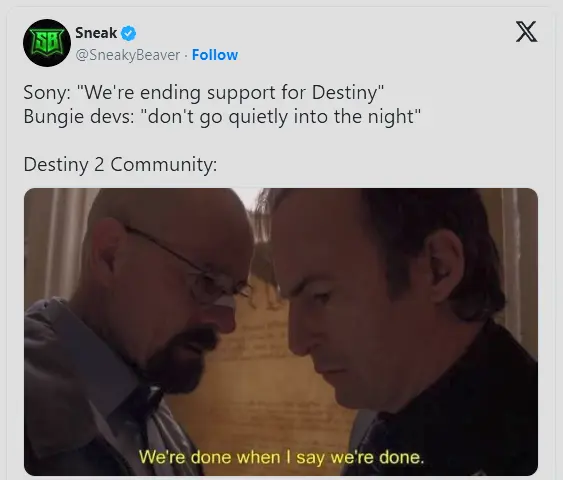
Instead of quietly packing up their digital gear and bidding farewell to their Guardians, the Destiny community mobilized. Drawing inspiration from a post by Bungie principal communications manager dmg04—who famously quoted Dylan Thomas’s "Do Not Go Gentle Into That Good Night" around the time of the mothballing announcement—players weaponized their digital presence.
The strategy was simple yet pervasive: flood every available channel associated with Sony and Bungie. Whenever Sony hosted a hardware showcase, a financial briefing, or a marketing stream, the chat feeds were instantly overwhelmed with synchronized messaging demanding Destiny 3. Concurrently, a Change.org petition demanding Sony spearhead the development of a true sequel rapidly gained momentum, comfortably clearing 400,000 signatures.
Perhaps most damning for Sony’s corporate ledgers, player concurrency metrics for the effectively abandoned Destiny 2 stubbornly remained at roughly six times that of Marathon, Bungie’s heavily pushed new intellectual property. Even external communities, such as fans of Digital Extremes’ Warframe, stepped across genre lines to lend moral and digital support, recognizing an existential threat to the live-service model as a whole.
The Reversal: A New Dawn for the Guardian Class
Yesterday, the dam broke. Bungie released a landmark update conceding that Destiny is, in fact, "foundational" to the studio’s identity and future profitability. The end-of-life status was officially rescinded. More importantly, to appease a skeptical audience, the studio confirmed that it is actively working on reversing one of the most controversial decisions in the game’s history: the Destiny Content Vault. Plans are underway to systematically restore old planets, raids, and historical narrative campaigns that had previously been excised to manage game client sizes. For millions of players, the impossible had happened.
Supporting Context & Metrics: The Anatomy of a Grassroots Victory
The corporate decision to un-cancel a live-service game three months after signing its death warrant is practically unprecedented in the games industry. To comprehend why Sony and Bungie blinked, one must examine the hard metrics and cultural pressure points that dictated the outcome.
The Power of Engagement Metrics
Sony’s acquisition of Bungie was valued at $3.6 billion, intended not just for Destiny’s revenue stream, but to leverage Bungie’s live-service expertise across PlayStation’s broader first-party portfolio. However, shuttering Destiny 2 risked alienating the very audience that justified that astronomical valuation.
While Bungie attempted to pivot player attention toward upcoming projects like Marathon, the market voted with its player-hours. Destiny 2, even on life support, maintained a concurrent player base dwarfing its stablemate. Sony executives, already facing scrutiny from investors and physical-media consumer resistance, quickly realized that killing their most reliable golden goose was compounding PR disasters rather than solving structural expenses.
The Content Creator Ecosystem as a Vanguard
The mobilization of prominent content creators served as the spearhead of the resistance. Figures such as My name is Byf, Mactics, and Aztecross utilized their massive platforms to keep the pressure white-hot. Aztecross, known for having reliable industry channels, had been teasing behind-the-scenes shifts for weeks, expertly managing community morale.
Meanwhile, streamers like Llama captured the raw, unfiltered emotional whiplash of the community, broadcasting live reactions that transitioned from stunned disbelief to joyous tears upon hearing the news. For these creators, whose livelihoods are inextricably linked to the health of the game, the victory felt deeply personal—a David-versus-Goliath triumph over corporate oversight.
Official Statements and Community Reactions
Reactions across the community spectrum ranged from jubilant victory laps to sober, guarded skepticism.
The Celebratory Front
Leading lore historian My name is Byf titled his celebratory breakdown video "We did NOT go quietly. We Won," cementing the cultural narrative of a coordinated resistance. Mactics echoed the sentiment with "DESTINY IS BACK… WE DID IT!"
The most resonant response, however, came from Aztecross: "Destiny Community, You Did It." These creators recognized that the corporate shift was a direct result of relentless, unyielding public pressure that made the cost of cancellation far higher than the cost of continuation.
The Skeptics and the Realists
Conversely, a significant portion of the player base—tempered by years of broken promises, heavy microtransactions, and content sunsetting—urged caution. Threads on the r/DestinyTheGame subreddit, such as "Please keep expectations in check," highlighted a collective PTSD among veterans.
Prominent figures within the community also distanced themselves from unconditional optimism. Veteran community pillar Datto made it clear on social media that he would not be unretiring or returning for sunset content, writing:
"To anyone wondering: i am not unretiring from destiny. happy for y’all though! but i am gonna keep trying to do something new :)"
Similarly, long-time community competitor Gladd offered a stark warning to hopeful fans:
"Here we go. Now everyone’s hopes are up. Most likely more unfulfilled promises. The ‘I-told-you-so’ people are gonna spam ‘We Won!’ And the folks with a single personality trait are gonna be let down… again. This seems like another repeated cycle."
These warnings point to a harsh reality: enthusiasm alone cannot patch underlying structural vulnerabilities within the studio.
Future Outlook: The Road Ahead and Unanswered Questions
While the immediate mood is celebratory, the resurrection of Destiny 2 opens a Pandora’s box of logistical, technical, and financial challenges that Bungie must navigate under intense scrutiny.
The Technical Debt of Un-Vaulting Content
The original justification for the Destiny Content Vault was game bloat—the sheer technical impossibility of updating, optimizing, and patching a monolithic game client across multiple console generations without crippling load times and file sizes. Reversing this means Bungie must now solve the very infrastructural problems that led them to vault paid expansions in the first place. How will the engine handle these restored assets? Will PC and console players face crippling storage demands? These technical hurdles have not vanished simply because the game is no longer in maintenance mode.
Corporate Realities and Workforce Limitations
Compounding these technical challenges is the state of Bungie itself. The studio has suffered devastating layoffs over the past year, resulting in the departure of an enormous amount of institutional knowledge and veteran developer talent. Producing high-cadence, high-quality content requires a robust, well-resourced workforce. Can a leaner, post-layoff Bungie deliver the scale of content that a ravenous, newly invigorated fanbase now expects?
Furthermore, the behind-the-scenes calculus of Sony’s executive suite remains an enigma. It is rare for a major publisher to reverse a live-service shutdown so abruptly. This suggests severe friction between corporate financial models and consumer demand—friction that could easily flare up again at the first sign of financial underperformance.
Conclusion: A Historic Precedent
The un-canceling of Destiny 2 will be studied in business and gaming schools for years to come. It demonstrates that while modern publishers hold immense power over digital products, the collective will of a passionate player base—backed by unified content creators and undeniable engagement metrics—can force corporate entities to alter course.
Whether this resurrection marks a true renaissance for the Guardians or merely a temporary reprieve before the inevitable remains to be seen. For now, however, the Tower lights are back on, the music is playing, and in the immortal words of the community: We did not go quietly.








Belum ada komentar. Jadilah yang pertama berkomentar!