


Executive Overview
The landscape of personal computing and high-end digital entertainment has long maintained a rigid, unwritten boundary. For decades, Windows PCs and dedicated home consoles served as the undisputed colosseums for AAA gaming. Apple’s Mac lineup, while celebrated for creative workflows, software development, and professional productivity, was perpetually sidelined when it came to major, high-fidelity interactive releases. Ports were frequently delayed by months or years, poorly optimized, or omitted entirely.
That historical narrative is experiencing a seismic shift.
Set for release on March 19, Crimson Desert—developed by industry heavyweight Pearl Abyss—is breaking the mold. In a rare and monumental win for Apple’s silicon ecosystem, the sprawling, graphically intensive open-world action-adventure title will launch on macOS day-and-date alongside versions for Windows PC, PlayStation 5, and Xbox Series X|S.
This simultaneous debut is more than just a win for early adopters; it represents a watershed moment for Apple’s multi-year crusade to transform the Mac into a viable, first-class gaming platform. With advanced graphics API integration, proprietary hardware upscaling, and next-generation silicon pushing the boundaries of thermal efficiency and graphical fidelity, Crimson Desert serves as the ultimate litmus test for whether macOS can finally stand shoulder-to-shoulder with traditional gaming powerhouses.
Detailed Chronology: From Silicon Announcements to a Day-One Global Launch
To fully understand the gravity of Crimson Desert’s arrival on macOS, one must trace the deliberate, methodical steps Apple and its development partners have taken over the past several years.

The Silicon Revolution and Early Teasers
The foundation for high-end Mac gaming was quietly poured with the introduction of Apple Silicon. Transitioning away from Intel processors allowed Apple to design chips with unified memory architectures and increasingly powerful integrated graphics engines. However, hardware alone is insufficient; developers require software tools to bridge the gap between custom architecture and standard game engines.
Enter the Game Porting Toolkit and iterative improvements to Metal, Apple’s proprietary graphics API. Last summer, Apple signaled a profound shift in its gaming strategy by showcasing a curated pipeline of major titles destined for macOS. Among the standout announcements was Crimson Desert, positioned as a flagship showcase for what Apple Silicon could achieve when unshackled from traditional porting bottlenecks.
The Build-Up to March 19
As production on Crimson Desert finalized at Pearl Abyss, rumors swirled regarding whether the macOS version would suffer the traditional "delayed port" fate. Those concerns were emphatically put to rest when global release dates were locked in for March 19.
Pre-orders opened globally on platforms like Steam, confirming that Mac users would gain access to the game on the exact same second as players on Windows, PlayStation 5, and Xbox Series X|S. Standard editions are priced at $69.99, with Deluxe tiers commanding $79.99, placing the macOS release on absolute parity with its console and PC counterparts in terms of pricing, content, and availability.
The Immediate Hardware Horizon
The launch of Crimson Desert next month intersects strategically with Apple’s hardware roadmap. Industry insiders and supply chain reports heavily indicate that Apple

is preparing a sweeping wave of new MacBook and desktop announcements, prominently featuring the incoming M5 Pro and M5 Max chips. As consumers weigh upgrades, the prospect of playing a cutting-edge AAA open-world game natively out of the box provides an unprecedented marketing and practical synergy for Apple’s retail ecosystem.
Supporting Context & Metrics: Breaking Down the Tech and the Title
What makes Crimson Desert such a demanding, yet rewarding, target for macOS optimization? To understand the technical achievement, one must examine both the game itself and the hardware architecture required to render its breathtaking vistas.
The Anatomy of Crimson Desert
Developed by South Korean studio Pearl Abyss—globally renowned for the massively multiplayer online phenomenon Black Desert Online—Crimson Desert began life as an MMORPG concept before pivoting into a deeply immersive, single-player open-world action-adventure.
Set on the war-torn continent of Pywel, players step into the boots of Kliff, a mercenary fighting for survival amidst shifting political alliances, monstrous threats, and sweeping landscapes. The title has generated immense critical buzz across international gaming exhibitions due to its lightning-fast combat system, cinematic storytelling, and an astonishingly detailed open world that reacts dynamically to player choices and environmental physics.
Leveraging Apple Silicon: MetalFX and Ray Tracing
Running a game of this magnitude requires robust technological scaffolding. When Apple previewed Crimson Desert last year, it explicitly highlighted how the game utilizes advanced software technologies built directly into macOS:
- MetalFX Upscaling: By utilizing spatial and temporal upscaling algorithms, MetalFX allows the game to render at a lower internal resolution before intelligently reconstructing the image to crisp, high-definition outputs. This dramatically reduces GPU overhead while maintaining visual fidelity, ensuring smoother frame rates on portable hardware.
- Hardware-Accelerated Ray Tracing: The M3 and M4 families of Apple Silicon introduced dedicated hardware acceleration for ray tracing. Crimson Desert harnesses these capabilities to produce realistic reflections, dynamic global illumination, and sophisticated shadow mapping across Pywel’s diverse biomes—from sun-scorched badlands to dark, atmospheric dungeons.
System Requirements and Pricing
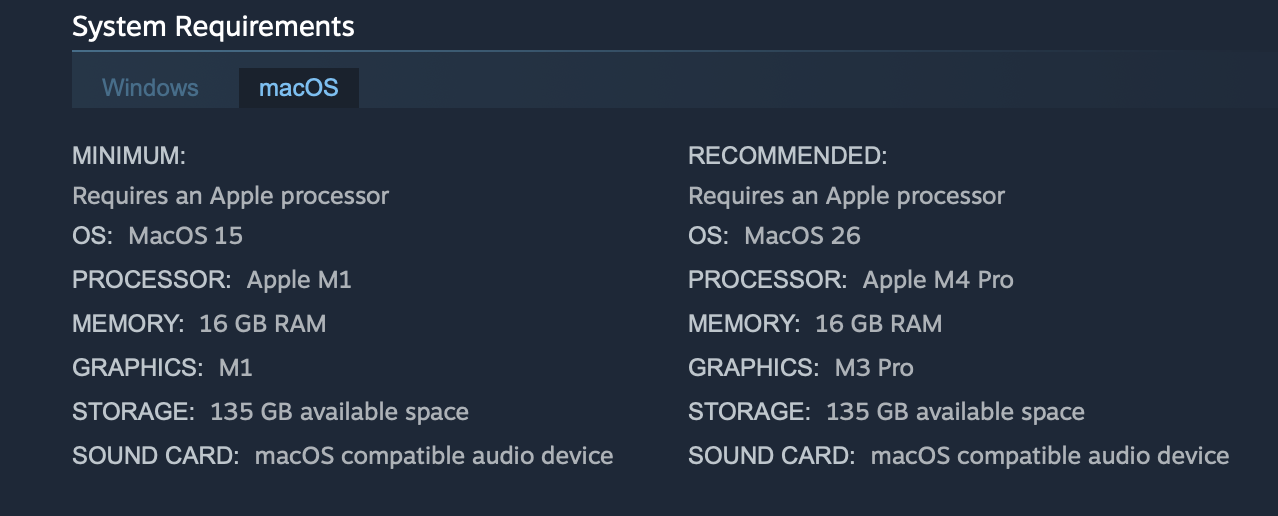
For Mac users eyeing the Steam store page, preparation is key. While exact macOS-specific spec sheets mirror the high-end demands of modern PC architecture—requiring robust unified memory pools and capable Apple Silicon GPUs—the optimization work done by Pearl Abyss ensures that compatible MacBooks and desktop units will not feel like second-class citizens.
Standard and Deluxe editions are available for pre-order now, signaling to third-party publishers that Mac users are willing to pay standard market rates for uncompromised, day-one AAA experiences.
Official Statements & Industry Perspectives
The convergence of high-end PC development and macOS deployment has not occurred in a vacuum. It is the result of years of dedicated developer evangelism, software development kit (SDK) enhancements, and structural shifts in how game studios view the Apple ecosystem.
Apple’s Vision for Silicon Gaming
During previous Worldwide Developers Conferences (WWDC) and special hardware showcases, Apple executives have repeatedly emphasized that the GPU architecture inside the M-series chips is inherently designed to scale from thin-and-light MacBook Airs up to powerhouse Mac Studios.
"Our goal has always been to provide developers with the tools they need to bring their most ambitious visions to every Apple platform with minimal friction," notes internal developer documentation regarding Metal. By streamlining the pipeline through APIs that closely mirror modern graphics standards, Apple has successfully minimized the engineering hours required to build robust Mac ports.

Pearl Abyss’s Technical Ambition
For Pearl Abyss, bringing Crimson Desert to macOS alongside traditional platforms reflects a broader philosophy of multi-platform accessibility. Crafting a game on the proprietary BlackSpace Engine required immense scalability. Adapting that engine to harness MetalFX and Apple’s unified memory architecture proved to be a challenging yet deeply rewarding engineering endeavor.
Industry analysts point out that AAA developers are taking notice of Apple Silicon’s growing install base. With millions of active users wielding powerful, highly efficient GPUs embedded in their daily productivity machines, the untapped market for native gaming is simply too large to ignore.
Future Outlook: What Crimson Desert Means for the Future of Mac Gaming
The launch of Crimson Desert on March 19 is an isolated headline, but its implications echo far beyond a single release. It serves as a stress test for the entire macOS gaming ecosystem.
A Template for Future Studios
If Crimson Desert achieves commercial success and technical stability on macOS, it will write the blueprint for other major studios hesitant to invest in Apple ports. Historically, publishers feared that Mac users wouldn’t buy AAA games, or that the porting costs would outweigh the returns. A successful day-one global launch for a multi-million-dollar IP shatters that self-fulfilling prophecy.
Furthermore, Apple’s ongoing pipeline—which includes several other high-profile titles slated to arrive in the wake of previous announcements—suggests that Crimson Desert is the tip of the iceberg rather than an isolated anomaly.

Hardware Integration and the Road Ahead
As consumers look toward the next generation of Mac hardware—typified by impending M5 Pro and M5 Max releases—the synergy between bleeding-edge silicon and cinematic gaming experiences becomes an increasingly vital selling point. Consumers no longer need to choose between a machine optimized for creative professional workflows and one capable of handling the most demanding entertainment software on the market.
Whether you are scaling the craggy peaks of Pywel on a sleek MacBook Pro while traveling, or rendering cinematic vistas on a maxed-out Mac Studio at home, March 19 will mark the day the traditional boundaries of platform exclusivity began to crumble. For Mac gamers who have waited decades for their hardware to be taken seriously, the desert is finally blooming.







Belum ada komentar. Jadilah yang pertama berkomentar!