Date: September 6, 2026 Location: Shizuoka Prefecture, Japan
Executive Overview
Nestled at the sprawling, verdant foothills of Japan’s most iconic landmark, Fuji Safari Park in Shizuoka Prefecture offers an experience found nowhere else on earth: the thrilling juxtaposition of untamed, exotic wildlife and the snow-capped majesty of Mount Fuji. As one of Japan’s premier and largest safari installations, the park spans a vast natural landscape housing approximately 800 animals representing 60 distinct species.
While travelers frequently flock to the region for standard mountain vistas, Fuji Safari Park elevates the sightseeing paradigm by integrating panoramic viewpoints into its animal habitats, dining plazas, and transit hubs. Whether observing free-roaming predators from the safety of an armored jungle bus, trekking the perimeter forest paths on foot, or photographing majestic herbivores set against a backdrop of Japan’s highest peak, visitors are treated to an ever-evolving visual masterpiece.
However, capturing the perfect view of Mount Fuji requires careful planning. Due to regional weather patterns, visibility fluctuates dramatically between seasons and even throughout the day. This comprehensive guide details the park’s layout, analyzes optimal weather conditions for peak mountain viewing, and breaks down twelve of the most spectacular photography and observation points across the expansive grounds.
Detailed Chronology and Seasonal Dynamics of Mount Fuji Visibility
Understanding the climatic rhythm of the region is essential for any traveler hoping to catch a clear glimpse of Mount Fuji. The mountain is notoriously shy, frequently cloaking its summit in dense blankets of clouds, high humidity, and atmospheric haze.
The Winter Window: Peak Clarity (December to February)
For optimal viewing conditions, winter reigns supreme. Between December and February, the region experiences lower rainfall and crisp, dry atmospheric conditions. Statistics indicate a remarkable 50% to 70% probability of catching a clear view of Mount Fuji during these winter months. Furthermore, the mountain’s iconic snow crown is typically visible from November through May, offering the classic postcard aesthetic that travelers worldwide yearn to witness.
The Summer Challenge: Humidity and Haze (June to August)
Conversely, the summer season presents significant obstacles for mountain sightseers. From June through August, high humidity and frequent monsoon rains plague the region. During these months, clear views of Mount Fuji may occur on only two to three days per month. Even on days that break with a clear early-morning sky, rising ground temperatures quickly generate thermal updrafts, creating afternoon clouds that obscure the summit by midday.
Seasonal Transformation of the Park
As the calendar turns, the landscape of Fuji Safari Park undergoes drastic transformations that directly impact visibility:
Spring (Late April – Early May): Vibrant blooms, including expansive fields of tulips in front of the park’s central restaurant, provide dazzling foregrounds for mountain photography.
Autumn to Early Spring (November – April): Deciduous trees shed their foliage, temporarily opening up sightlines through zones like the Lion and Bear areas that are otherwise heavily forested during the summer months.
Supporting Context & Metrics: Navigating the Park’s Zones
Fuji Safari Park is thoughtfully divided into distinct sectors to balance wildlife immersion with visitor safety.
The Safari Zone: Spanning the larger portion of the park, this area is designed for vehicular exploration. Visitors can drive their own automobiles or book a tour on the iconic Jungle Bus. This zone is compartmentalized into specific habitats, including the Bear Zone, Lion Zone, Cheetah Zone, Elephant Zone, and a sprawling Herbivorous Zone.
The Interaction Zone: Dedicated to pedestrian exploration, this area allows guests to walk freely, interact with smaller mammals, and access various guest amenities, including the central restaurant plaza, Safari Shop, and second parking lot meadows.
The Walking Safari: A dedicated forest trekking path running along the perimeter of the Safari Zone, offering hikers a unique, immersive vantage point to observe wildlife from an elevated perspective.
The 12 Premier Mount Fuji Viewpoints at Fuji Safari Park
To maximize your visit, conservationists and park veterans recommend seeking out these twelve exceptional vantage points, each offering a unique perspective of Mount Fuji framed by different elements of the park’s ecosystem.
1. The Bear Zone (Latter Half Course)
As visitors navigate the initial leg of the Safari Zone, the Bear Zone transitions from dense woodlands into a clear corridor in its latter half. Despite the heavy tree cover characteristic of this sector, strategic openings provide dramatic, framed glimpses of the mountain towering above the timberline.
2. The Lion Zone (Winter Sightlines)
Home to the park’s apex predators, the Lion Zone is heavily wooded, largely obscuring background vistas during the lush summer months. However, between November and April, once broadleaf trees shed their canopies, sharp-eyed visitors can spot the snow-dusted summit peering directly through the branches.
3. The Cheetah Zone Grasslands
In stark contrast to the Lion Zone, the Cheetah Zone features an open, expansive grassland topology reminiscent of an African savanna—with a distinctly Japanese twist. Because vegetation is sparse, visitors enjoy an unobstructed, full-panoramic view of Mount Fuji, though summer travelers should note the absence of seasonal snow cover between July and early October.
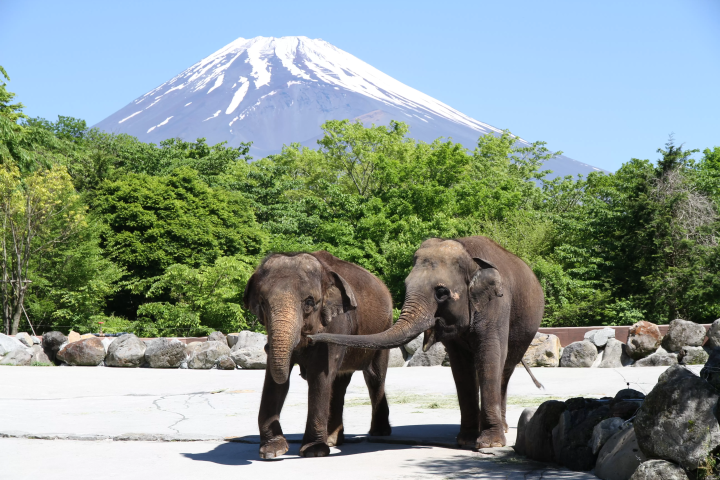
4. The Elephant Habitat
Scale meets scale at this magnificent viewpoint. Here, visitors can capture framing that places Earth’s largest land mammals—the magnificent Asian and African elephants—in the immediate foreground, with Japan’s tallest mountain rising majestically in the distance.
5. The Herbivorous Zone Panoramas
Sprawling and open, the herbivorous zone offers sweeping views of Mount Fuji from virtually every angle. This is the premier location for wildlife photography enthusiasts, allowing guests to capture compositions featuring giraffes, zebras, rhinos, and camels roaming peacefully against the iconic backdrop.
6. The American Bison Territory
Deep within the Safari Zone, the rugged enclosures housing the American bison provide a stark, wild landscape. The wide-open terrain mirrors the expansive prairies of North America, creating a surreal visual dialogue when paired with the snow-capped peak of Fuji.
7. The Second Parking Lot Meadow
For those not currently on safari tracks, the spacious meadow situated near the second parking lot is a hidden gem. Featuring an entirely unobstructed horizon, this open grass field reveals the majestic mountain all the way down to its sweeping base.
8. The Kangaroo and Capybara Enclosure
Blending relaxation with scenic beauty, the area dedicated to kangaroos and capybaras offers a tranquil environment. Visitors can watch these gentle animals lounge while framing shots that capture the mountain rising dramatically behind their habitats.
9. The Restaurant Plaza (Spring Tulip Gardens)
Located directly in front of the central dining facility, this public square transforms into a riot of color from late April to early May as thousands of tulips burst into bloom. It stands out as one of the park’s most beloved seasonal photo spots, pairing vibrant floral arrangements with the timeless grandeur of Mount Fuji.
10. The Safari Shop Forecourt
Conveniently located near retail and guest services, the paved plaza outside the Safari Shop provides an accessible, wide-angle viewing platform for visitors picking up souvenirs or preparing for their next park excursion.
11. The Jungle Bus Terminal
A favorite among families and children, the Jungle Bus boarding area doubles as an exceptional photo destination. As visitors queue up for their guided feeding tours—where they can hand-feed lions and bears through reinforced mesh windows—they are greeted by an inspiring view of the mountain peak.
12. The Main Parking Lot
Proof that adventure begins the moment you arrive, the main parking lot offers surprisingly clear, wide-angle vistas of Mount Fuji, particularly during the crisp winter months of December through February.
Official Statements & Visitor Guidelines
Park management emphasizes that experiencing Fuji Safari Park requires a respect for both wildlife safety and the unpredictability of local weather systems.
"Mount Fuji is a living, breathing part of our park’s ecosystem," notes a senior park representative. "She changes her expression with every hour of the day and every shift of the season. We encourage our guests to take their time—to look beyond the animals and let the grand scale of nature sink in. Whether you visit when the cherry blossoms bloom in spring or when the winter snows carve stark white lines against the sky, every trip offers an entirely original experience."
Park officials strongly advise visitors utilizing private vehicles to check their fuel levels, adhere strictly to safety protocols (which forbid opening windows or exiting vehicles in predator zones), and monitor hourly weather forecasts to time their outdoor walks for optimal mountain visibility.
Future Outlook: Enhancing the Ecological and Visual Experience
Looking ahead, Fuji Safari Park continues to invest in sustainable infrastructure and guest education initiatives. Plans are underway to improve pedestrian pathways around the Interaction Zone and expand viewing decks to accommodate the growing number of international travelers seeking eco-tourism adventures near Mount Fuji.
As conservation efforts expand and habitat management practices evolve, the park remains committed to maintaining a delicate balance between animal welfare and world-class tourism. By offering unobstructed appreciation points for Japan’s cultural and natural crown jewel, Fuji Safari Park ensures that every visitor leaves with memories—and photographs—that will last a lifetime.
Practical Access Information
Traveling by Car
From Tokyo: Approximately 120 minutes via the Tomei Expressway. Exit at the Susono IC; the park is located approximately 10 km (about 15 minutes) from the interchange.
From Nagoya: Approximately 180 minutes via the Shin-Tomei Expressway. Exit at the Shin-Fuji IC; the park is located approximately 18 km (about 30 minutes) from the interchange.
Traveling by Public Transportation
Via Mishima Station: Take the Tokaido Shinkansen from Tokyo or Shinagawa Station to Mishima Station (approx. 50 minutes). From Nagoya, take the Shinkansen to Mishima Station (approx. 110 minutes). From Mishima Station, board a local direct bus to Fuji Safari Park (approx. 50 minutes).
Via Gotemba Station: Take the Odakyu Line Romancecar from Shinjuku Station to JR Gotemba Station (approx. 100 minutes), then transfer to a local bus bound for Fuji Safari Park (approx. 35 minutes).


![[Breathtaking views] Introducing the Mt. Fuji viewpoints at Fuji Safari Park!](https://resources.matcha-jp.com/resize/720x2000/2025/04/05-230280.webp)
![[Breathtaking views] Introducing the Mt. Fuji viewpoints at Fuji Safari Park!](https://resources.matcha-jp.com/resize/200x2000/2025/04/06-230283.webp)
![[Breathtaking views] Introducing the Mt. Fuji viewpoints at Fuji Safari Park!](https://resources.matcha-jp.com/resize/720x2000/2025/06/08-235738.webp)
![[Breathtaking views] Introducing the Mt. Fuji viewpoints at Fuji Safari Park!](https://resources.matcha-jp.com/resize/200x2000/2024/12/10-214444.webp)
![[Breathtaking views] Introducing the Mt. Fuji viewpoints at Fuji Safari Park!](https://resources.matcha-jp.com/resize/200x2000/2025/01/22-220567.webp)
![[Breathtaking views] Introducing the Mt. Fuji viewpoints at Fuji Safari Park!](https://resources.matcha-jp.com/resize/720x2000/2025/06/08-235761.webp)
![[Breathtaking views] Introducing the Mt. Fuji viewpoints at Fuji Safari Park!](https://resources.matcha-jp.com/resize/720x2000/2025/06/08-235757.webp)
![[Breathtaking views] Introducing the Mt. Fuji viewpoints at Fuji Safari Park!](https://resources.matcha-jp.com/resize/720x2000/2025/06/08-235739.webp)
![[Breathtaking views] Introducing the Mt. Fuji viewpoints at Fuji Safari Park!](https://resources.matcha-jp.com/resize/720x2000/2025/06/08-235741.webp)
![[Breathtaking views] Introducing the Mt. Fuji viewpoints at Fuji Safari Park!](https://resources.matcha-jp.com/resize/720x2000/2025/06/08-235754.webp)
![[Breathtaking views] Introducing the Mt. Fuji viewpoints at Fuji Safari Park!](https://resources.matcha-jp.com/resize/720x2000/2025/06/08-235763.webp)
![[Breathtaking views] Introducing the Mt. Fuji viewpoints at Fuji Safari Park!](https://resources.matcha-jp.com/resize/720x2000/2025/06/08-235752.webp)
![[Breathtaking views] Introducing the Mt. Fuji viewpoints at Fuji Safari Park!](https://resources.matcha-jp.com/resize/720x2000/2025/06/08-235743.webp)






Belum ada komentar. Jadilah yang pertama berkomentar!