

Executive Overview
For the international traveler, Japan’s multifaceted bathing culture offers one of the most culturally immersive and restorative experiences available. However, navigating the country’s rich water-based traditions can occasionally intimidate the uninitiated. Terms such as onsen (hot spring), sento (public bathhouse), daiyokujo (large public bath), and ofuro (general bath) are frequently used interchangeably by casual observers, yet they represent distinct legal classifications, architectural formats, and cultural histories.
Understanding these differences elevates a simple vacation activity into a profound cultural exchange. Furthermore, Japanese bathing is governed by a strict, albeit unwritten, code of communal etiquette designed to maximize hygiene, mutual respect, and shared tranquility. This article provides an authoritative breakdown of Japanese bathing classifications, regulatory standards, step-by-step etiquette, and recommendations for destinations such as Gero Onsen in Gifu Prefecture—empowering travelers to partake in this timeless tradition with confidence and grace.
The Taxonomy of Japanese Bathing: Understanding the Terminology
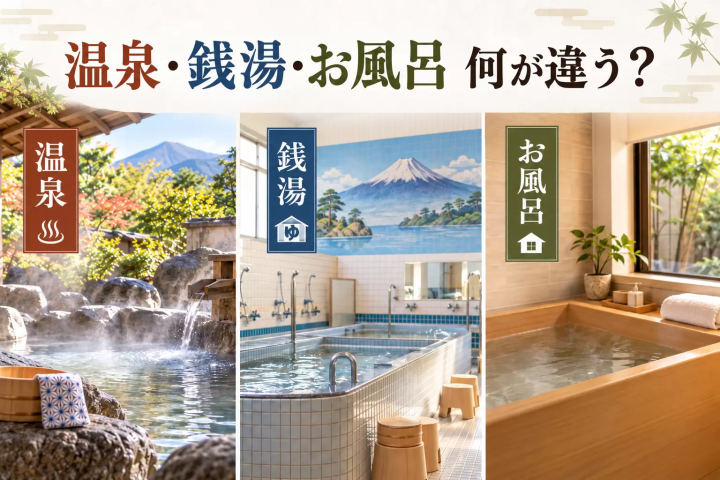
When journeying across Japan, visitors encounter a variety of venues dedicated to soaking in warm water. While they all center on the act of immersion, their underlying definitions differ significantly.
Core Definitions at a Glance
| Term | Meaning | Defining Characteristic |
|---|---|---|
| Ofuro (Bath) | Bathing and the bathroom/bathtub in general | A broad term that includes domestic residential bathrooms. |
| Onsen (Hot Spring) | Water springing from underground that meets national legal standards | Describes the geological properties, mineral content, and source temperature of the water. |
| Sento (Public Bath) | A local, commercial public bathhouse accessible to anyone for a fee | Represents a functional civic facility historically integrated into urban neighborhoods. |
| Daiyokujo (Large Public Bath) | A spacious communal bathroom capable of accommodating many people | Found predominantly in hotels and ryokan (inns); the water is not necessarily natural hot spring water. |
| Super Sento | A sprawling, modern facility offering baths, saunas, dining, and relaxation zones | A lifestyle entertainment complex; some facilities utilize natural hot spring water, while others use treated tap water. |
The most critical distinction for travelers to grasp is that "hot springs" and "public baths" are fundamentally classified by entirely different criteria. An onsen is defined by the geological origin and chemical composition of the water itself, whereas a sento is defined by its operational category as a public bathhouse. Consequently, certain urban sento pipe in natural hot spring water, while sprawling hotel daiyokujo may simply circulate heated municipal water.
Decoding the Science: What Makes a True Onsen?
Not every source of warm subterranean water in volcanic Japan automatically qualifies as an onsen. Under the strict stipulations of Japan’s Hot Spring Law (Onsen-hō), enacted to protect consumers and regulate industry standards, a fluid source must satisfy at least one of two baseline criteria to legally bear the
- Temperature Threshold: The water must emerge from the earth at a temperature of 25°C (77°F) or higher at the source.
- Mineral Composition: Alternatively, regardless of its natural temperature, the water must contain a designated minimum threshold of at least one of 19 specified chemical and mineral components—such as lithium ions, sulfur, free carbon dioxide, or iron ions.
Interestingly, this means a certified hot spring does not necessarily gush forth boiling water. Cool mineral springs (cold mineral springs or reisen) sitting below 25°C can still be legally classified as hot springs if their chemical profiles match statutory requirements. Conversely, pure municipal water heated artificially cannot be called an onsen, regardless of how soothing it feels.
Furthermore, Japan’s diverse topography ensures that no two hot spring regions are identical. From the milky, sulfurous waters of Kusatsu Onsen to the clear, alkaline skin-smoothing waters of Gero Onsen, the unique geochemical makeup of each spring imparts distinct colors, aromas, viscosities, and therapeutic properties.
Historical Evolution: From Daily Necessity to Cultural Sanctuary
To fully appreciate Japanese bathing, one must look beyond the luxury ryokan and examine the social history of the sento.
The Evolution of the Sento
While hot springs have historically functioned as destinations for healing, pilgrimage, and elite leisure, public bathhouses (sento) emerged out of sheer urban necessity. During feudal times and well into the post-war Showa era, private residential bathrooms were a luxury few ordinary citizens possessed. Sento served as the vital communal hubs of urban neighborhoods in cities like Tokyo, Osaka, and Kyoto.
Beyond merely scrubbing away the grime of daily labor, these bathhouses fostered egalitarian social bonds. In the steamy expanse of a sento, social hierarchies melted away. Neighbors conversed, children splashed, and news was exchanged.
The Modern Re-Imagining
Today, while nearly all modern Japanese homes feature fully equipped private bathrooms, sento and modern "super sento" continue to thrive. For the contemporary traveler, visiting an authentic neighborhood sento offers an unfiltered glimpse into everyday Japanese urban life—an intimate cultural experience that standard tourist itineraries cannot replicate.
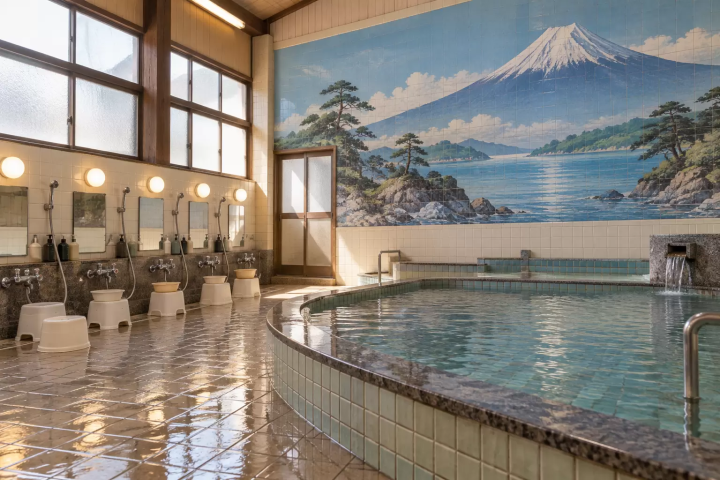
Step-by-Step Etiquette Guide: Mastering the Japanese Bathing Ritual
Sharing communal bathwater requires strict adherence to hygiene and etiquette. Japanese bathing rules are not arbitrary restrictions; they are rooted in a collective commitment to ensuring that every subsequent guest enjoys pristine water.
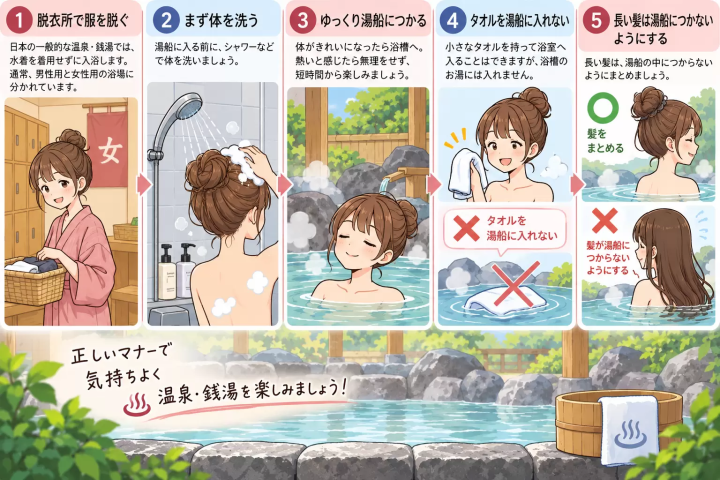
1. Preparation in the Changing Room (Datsuijō)
- Total Nudity: Swimwear is strictly prohibited in traditional Japanese hot springs and public baths. Bathers enter the bathing area completely naked.
- Modesty Towels: You are provided with (or should bring) a small modesty towel (tenugui). While you may use this towel to cover yourself while walking through the changing room and washing area, it must never touch the communal bathwater. Most bathers place it on top of their heads or fold it neatly on the edge of the tub while soaking.
- Tattoos: Historically associated with organized crime (yakuza), tattoos remain a sensitive subject in Japan. While attitudes are slowly shifting to accommodate international tourists, many traditional onsen and sento still ban visible tattoos. Travelers with body art should research tattoo-friendly facilities in advance, utilize waterproof cover seals if permitted, or seek out private booking options (kashikiri).
2. The Golden Rule: Wash Before You Soak
This is the most critical operational rule in any Japanese bath: You must thoroughly wash and rinse your body before entering the communal bathtub.
- Upon entering the washing area (arai-ba), you will find low plastic stools and handheld showerheads, accompanied by liquid soap and shampoo.
- Sit down on a stool to wash your hair and scrub your body. Never stand while showering, as soapy water may splash onto nearby bathers.
- Rinse away every trace of soap before stepping foot toward the hot water. The communal bathtub is strictly reserved for soaking and relaxing after you are completely clean.
3. Entering the Water
- Acclimatization: Japanese hot spring water is often kept quite hot (frequently between 40°C and 42°C, or 104°F to 108°F). Lower your body into the water slowly to allow your skin to adjust. Do not splash or swim, as the atmosphere is meant to be meditative and tranquil.
- Hair Management: If you have long hair, tie it up securely to prevent any stray strands from floating into the shared bathwater.
- Electronics Ban: Smartphones, cameras, and recording devices are strictly forbidden inside the bathing areas to protect the privacy and comfort of all patrons.
Choosing Your Experience: Rural Onsen Retreats vs. Urban Sento Culture
Travelers to Japan generally face two distinct bathing pathways, each offering a fundamentally different pace and aesthetic:
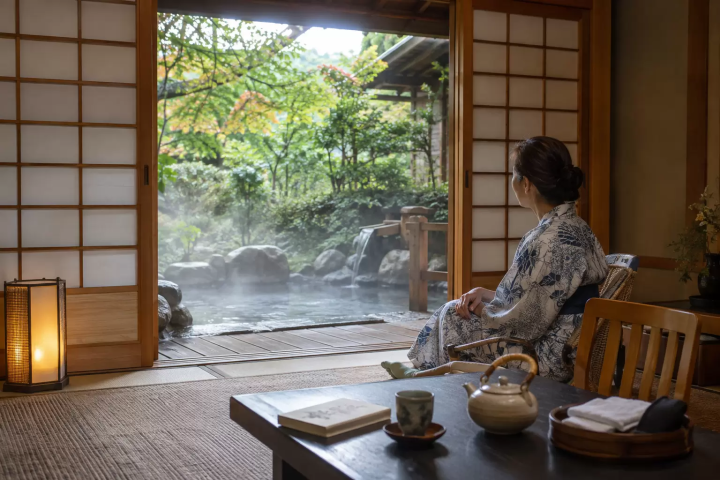
Option A: The Rural Onsen Ryokan Retreat
For those seeking deep relaxation and escapism, venturing outside the major metropolitan hubs is essential.
- The Experience: Staying at a traditional ryokan nestled in a mountainous valley or coastal village. Days are spent strolling through historic hot spring towns in a traditional cotton robe (yukata), soaking in outdoor baths (rotenburo) surrounded by nature, and feasting on locally sourced kaiseki multi-course dinners.
- Pacing: This style of travel embraces the traditional Japanese concept of tōji—therapeutic, extended stays where guests soak multiple times a day to melt away travel fatigue.
Option B: The Urban Sento Immersion
For the city explorer or repeat visitor wanting to scratch beneath the surface of Japanese society:
- The Experience: Visiting a neighborhood sento after a day of pounding the pavement in Tokyo, Kyoto, or Osaka.
- Pacing: Fast-paced, localized, and deeply authentic. You will find yourself shoulder-to-shoulder with local residents winding down their evenings, offering an immediate connection to the pulse of everyday Japanese life.
Spotlight on Gero Onsen: One of Japan’s Three Legendary Springs
For travelers looking to anchor their journey in world-class hot spring heritage, Gero Onsen in Gifu Prefecture stands out as an exceptional destination. Alongside Arima Onsen (Hyogo) and Kusatsu Onsen (Gunma), Gero Onsen is historically celebrated as one of Japan’s Nihon Sanmeisen (Three Great Hot Springs).
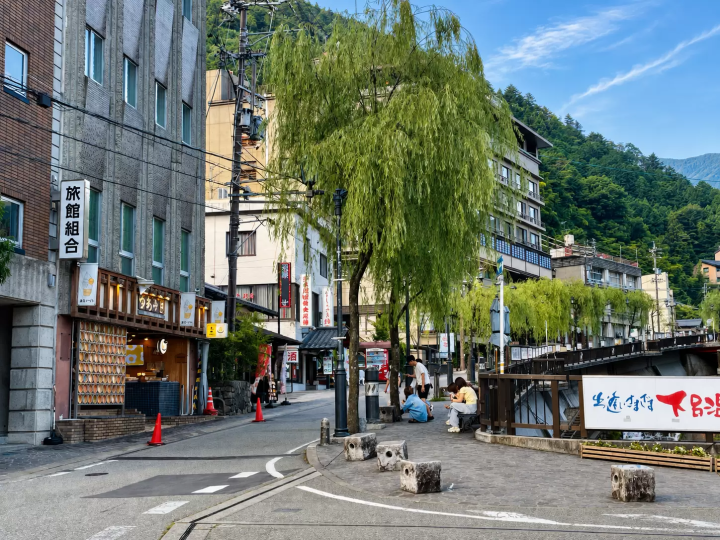
Renowned since the Edo period for its crystal-clear, alkaline simple thermal waters, Gero Onsen is famously celebrated for its velvety texture, which leaves skin feeling remarkably smooth—earning it the affectionate moniker bijin-no-yu ("bath of beauty"). Visitors can explore the charming riverside town on foot, sampling local delicacies, visiting public footbaths (ashiyu) scattered freely across the streets, and staying in centuries-old ryokan that honor the pinnacle of Japanese hospitality.
Future Outlook: Preserving Tradition in a Globalized Era
As Japan continues to welcome record numbers of international visitors, the nation’s bathing culture faces both opportunities and challenges. Balancing the preservation of sacred communal customs with the demands of global tourism requires proactive education.
Forward-thinking municipalities and hot spring associations are increasingly investing in multilingual signage, digital guides detailing proper washing etiquette, and clear policies regarding inclusivity. By fostering mutual understanding, Japan ensures that its ancient bathing traditions remain vibrant, welcoming, and restorative for generations of locals and global travelers alike.
Ultimately, whether you are unwinding in a cedar-lined mountain bath in Gifu or chatting with local residents in a retro Tokyo sento, embracing Japan’s bathing culture offers a masterclass in mindfulness, hygiene, and shared humanity.




Belum ada komentar. Jadilah yang pertama berkomentar!