

Executive Overview
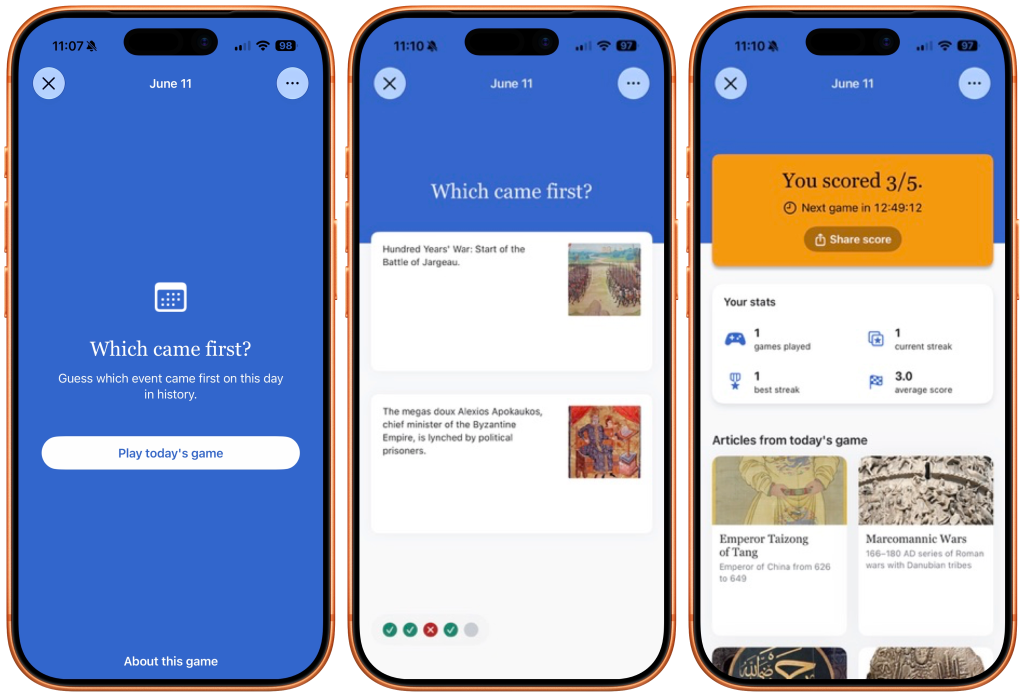
In an era where digital engagement is increasingly dictated by bite-sized, gamified content, the Wikimedia Foundation is finding new ways to make human knowledge interactive. Following a successful rollout on Android devices, Wikipedia has officially brought its daily historical facts mini-game, "Which came first?", to the iPhone ecosystem.
Integrated directly into the latest update of the official Wikipedia iOS app, the feature invites users to test their chronological reasoning through a series of five daily questions. Each puzzle is uniquely curated based on historical events that occurred precisely on the current calendar day in history. By blending edutainment with the vast archival power of the world’s largest crowdsourced encyclopedia, "Which came first?" transforms passive reading into an active, competitive, and educational daily ritual.
This strategic expansion underscores Wikipedia’s ongoing evolution beyond a static reference library into a dynamic, community-driven platform that meets users on their preferred devices. With built-in tracking for gameplay streaks and average scores, alongside a comprehensive archive of past rounds, the feature aims to capture the daily habit-forming appeal popularized by viral word and trivia games—all while grounding its mechanics in verified, historical fact.
Detailed Chronology: From Android Genesis to iOS Integration
The journey of "Which came first?" from a conceptual interface tweak to a cross-platform mobile staple reflects a deliberate shift in how the Wikimedia Foundation approaches user retention and informal learning.
The Android Pilot
Long before iPhone users could test their historical acumen, the feature made its debut on Android devices. Developers and product managers within the Wikimedia mobile ecosystem recognized a gap in the app experience: while millions of users opened the app to look up specific queries, spontaneous, exploratory reading was largely confined to the "Explore" feed.
The Android rollout served as a testing ground for user engagement metrics. By introducing low-friction, high-interest trivia tied to real-world dates, the development team sought to measure whether gamification could successfully drive daily app opens. The experiment yielded positive results, proving that users enjoyed the daily challenge of deducing which of two or more historical milestones preceded the other.
The iOS Expansion
Beginning today, the feature transitions to Apple’s ecosystem. Integrated seamlessly into the latest version of the Wikipedia iOS application, "Which came first?" leverages native iOS design frameworks to deliver a smooth, responsive interface.
To access the game, users simply need to open the Wikipedia app and navigate to the Explore feed, where the daily prompt is prominently featured. The gameplay loop is straightforward yet intellectually stimulating: players are presented with a series of historical events and must correctly determine their chronological sequence. Because the questions are anchored to the calendar day—reflecting events that transpired on "this day in history" centuries or decades ago—no two days offer the exact same challenge.
Furthermore, the game accommodates players who might miss a day or wish to push their historical knowledge further. A dedicated archive allows users to revisit and play through previous rounds, ensuring that the feature remains endlessly accessible rather than strictly fleeting. To foster a sense of personal achievement and friendly competition, the app tracks comprehensive game statistics, including rolling average scores and active gameplay streaks.
Supporting Context & Metrics: The Mechanics of Gamified Learning
To understand the significance of Wikipedia’s new feature, it is helpful to examine the broader intersection of mobile gaming, digital education, and user psychology.
The Rise of "Daily Habit" Games
In recent years, the digital landscape has been profoundly shaped by the "Wordle effect"—the phenomenon wherein minimalist, once-a-day web and mobile games capture global attention. Users have shown a massive appetite for low-stress, high-reward cognitive challenges that can be completed in under five minutes during a commute or morning routine.
By adopting this cadence, Wikipedia is tapping into a proven psychological framework. Daily streaks and score tracking create a gentle psychological incentive to return to the app day after day. However, unlike traditional puzzle games that rely on vocabulary or spatial reasoning, "Which came first?" leverages the unmatched breadth of human history cataloged within Wikipedia’s millions of articles.
Edutainment and Information Retention
Cognitive science consistently demonstrates that active recall and gamified testing dramatically improve information retention compared to passive reading. When a user incorrectly guesses whether a specific political treaty was signed before or after a groundbreaking scientific invention, the subsequent reveal creates a "curiosity gap." Driven by this innate desire to resolve the discrepancy, the user is far more likely to tap through to the full Wikipedia article, deepening their understanding of the era.
Metrics and Engagement Goals
While the Wikimedia Foundation operates as a non-profit and does not chase commercial advertising metrics in the traditional sense, user engagement remains critical to its mission of spreading knowledge. Key performance indicators for the rollout of "Which came first?" on iOS include:
- Daily Active Users (DAU) Uplift: Measuring whether the game successfully brings users back to the app outside of active search intent.
- Explore Feed Interaction Rates: Evaluating how effectively the game drives traffic to broader, undiscovered Wikipedia articles.
- Streak Retention: Analyzing how many users maintain multi-day gameplay streaks over a 30-day window.
Early indicators from the Android version suggest that the feature successfully bridges the gap between casual browsers and dedicated trivia enthusiasts, laying a strong foundation for its success on the iPhone.

Official Perspectives and Product Design Philosophy
The introduction of "Which came first?" aligns with a broader philosophical shift within the Wikimedia ecosystem regarding mobile-first user experience. For years, mobile apps were viewed primarily as portable mirrors of the desktop encyclopedia—functional tools designed to retrieve specific facts as quickly as possible.
However, modern product design philosophy recognizes that mobile users consume information differently. They look for curated feeds, serendipitous discovery, and interactive touchpoints. By embedding "Which came first?" directly into the Explore feed, Wikipedia’s product team is signaling that the app should be a destination for exploration, not just a utilitarian search engine.
Industry analysts have praised the integration for its subtlety. Unlike many modern applications that aggressively monetize or clutter their interfaces with intrusive pop-ups and notifications, Wikipedia’s game remains an organic, opt-in experience. It respects the user’s intelligence and time while subtly reinforcing the immense value of the underlying repository of human knowledge.
Future Outlook: What’s Next for Wikipedia Mobile?
As Wikipedia continues to refine its mobile offerings, the successful cross-platform deployment of "Which came first?" opens the door to a myriad of exciting possibilities.
Potential Feature Enhancements
Looking ahead, community members and product watchers have speculated on how the daily history game could evolve:

- Social Sharing Integration: Expanding native sharing capabilities so users can boast about their correct chronological deductions and streaks on social media platforms without spoiling the answers for others.
- Thematic Expansion: Introducing specialized historical categories—such as art history, technological breakthroughs, geopolitical milestones, or pop culture history—allowing users to tailor their daily challenges.
- Multiplayer and Collaborative Modes: Exploring peer-to-peer challenges where friends or family members can compare daily scores or compete in real-time chronological showdowns.
- Tablet and Desktop Optimization: Scaling the interface smoothly across iPadOS and web browsers to ensure desktop power users can partake in the daily ritual.
Sustaining the Mission Through Engagement
At its core, Wikipedia’s primary mission remains unchanged: to bring free, verified, and comprehensive knowledge to every human on the planet. By making history fun, accessible, and interactive, "Which came first?" serves as a brilliant gateway drug to deeper learning.
Whether you are a seasoned history buff looking to test the limits of your chronological memory or a casual mobile user looking for a smart way to spend five minutes of downtime, the new game offers a compelling reason to check your iPhone every morning.
The updated Wikipedia app, complete with the "Which came first?" game, is available for download and update now via the iOS App Store.






Belum ada komentar. Jadilah yang pertama berkomentar!