

Executive Overview
In an era where digital engagement is increasingly defined by bite-sized, gamified learning experiences, the Wikimedia Foundation is leaning further into interactive education. Following a successful rollout on Android platforms, Wikipedia has officially brought its daily historical trivia game, "Which came first?", to the iPhone ecosystem. Integrated directly into the latest version of the official Wikipedia iOS application, the feature introduces a fresh, habit-forming way for users to test their chronological acumen and absorb nuggets of world history.
The game challenges players to sequence historical events correctly, anchoring its daily puzzles to milestones that occurred precisely on the current calendar day throughout history. Available now via the app’s Explore feed, "Which came first?" joins a growing lineage of daily puzzle formats popularized by media giants—ranging from The New York Times’ Wordle to various trivia applications—seeking to turn casual screen time into micro-learning opportunities. This article examines the mechanics of the new iOS feature, its development path following the Android release, the broader strategy behind gamifying open-source knowledge, and what this expansion signifies for the future of mobile reference applications.
Detailed Chronology: From Android Debut to iOS Integration
The journey of "Which came first?" from an experimental concept to a cross-platform staple reflects a deliberate shift in how the Wikimedia Foundation approaches user retention and content discovery. For years, the primary entry point to Wikipedia’s vast repository of human knowledge was through active, search-driven queries or passive browsing of its standard "On This Day" feeds. While effective, these traditional formats lacked the active feedback loops that modern mobile audiences increasingly expect.

The Android Prototyping Phase
The foundational concept for the game first materialized on Android devices, where developers and product managers tested user appetite for interactive history puzzles. The core design philosophy was simple: rather than forcing users to sift through long-form biographical articles or dense historical accounts, present them with a clean, low-friction interface that poses a deceptively difficult question: Which of these two (or more) historical events happened first?
By tying the puzzles directly to occurrences on "this day in history," the development team ensured a dynamic, rotating pool of content that never repeats in the exact same configuration. Following positive engagement metrics, user retention boosts, and constructive feedback from the Android community, the engineering teams greenlit the iOS port, ensuring feature parity for Apple device users starting today.
How the Game Works on iOS
For iPhone and iPad users running the latest version of the Wikipedia app, accessing the game requires minimal effort:
- Navigation: Open the official Wikipedia app and navigate to the Explore feed.
- Launch: Locate the "Which came first?" module, which presents a fresh set of daily challenges.
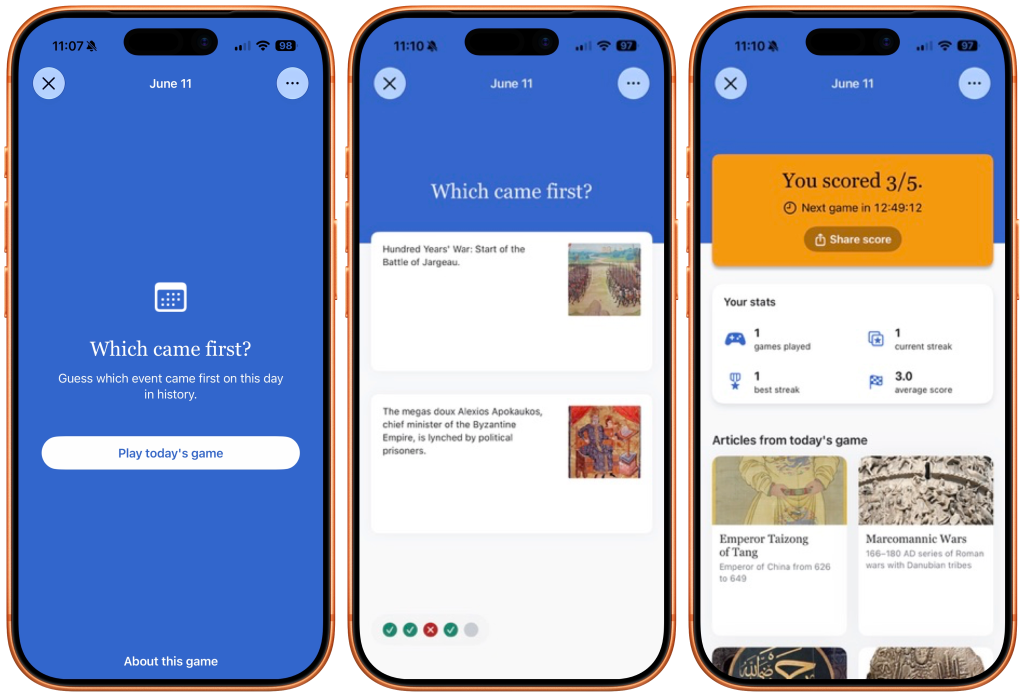
- Gameplay Loop: Players are presented with five daily questions based on historical events tied to the current calendar date. The objective is to correctly order or identify chronological precedence between historical milestones.
- Tracking Progress: The app records comprehensive gameplay statistics, including personal average scores and ongoing daily streaks, encouraging users to return day after day.
- The Archive: For those who miss a day or wish to continue playing beyond the daily allotment, a built-in archive provides access to previous rounds of the game.
Supporting Context & Metrics: The Gamification of Knowledge
To understand the strategic significance of "Which came first?", one must look at the broader landscape of digital publishing and mobile app design. Modern users—particularly younger demographics—exhibit a strong preference for gamified interfaces. By transforming encyclopedia entries into interactive challenges, Wikipedia is addressing a fundamental challenge of the digital age: combating information fatigue through playful engagement.
Micro-Learning and Cognitive Retention
Educational psychologists have long noted that active recall and game-based testing significantly enhance long-term memory retention compared to passive reading. When a user incorrectly guesses whether the invention of the printing press preceded a specific geopolitical treaty, the ensuing revelation creates a cognitive "gap" that cements the correct date in their memory.
Wikipedia’s implementation of "Which came first?" leverages this psychological principle. Instead of dry chronology, the game turns history into a narrative puzzle where players act as detectives piecing together the timeline of human civilization.
Engagement Metrics and Mobile Strategy
While the Wikimedia Foundation operates as a non-profit organization focused on the dissemination of free knowledge, maximizing the utility and reach of its mobile applications remains a top priority. Mobile apps serve as primary gateways for millions of users worldwide. Features like "Which came first?" serve multiple critical functions:
- Driving Daily Active Users (DAUs): Streak counters and daily resets create a natural psychological incentive to open the app every single day.
- Expanding Content Discovery: A user playing the history game might encounter an obscure historical figure or event, prompting them to tap through to the full Wikipedia article for a deeper dive.
- Fostering Brand Loyalty: By positioning the Wikipedia app not just as a utilitarian dictionary or encyclopedia, but as a source of daily entertainment, the platform deepens its emotional connection with its audience.
Official Perspectives and User Reception
Although the Wikimedia Foundation maintains a decentralized approach to product announcements—often rolling out features iteratively through app store updates rather than grand press conferences—early user response to the iOS release has been overwhelmingly enthusiastic.
Early adopters on social platforms and tech forums have praised the clean aesthetic of the iOS implementation, noting that it matches the minimalist design language expected of high-end Apple applications. Furthermore, educators and history enthusiasts have highlighted the feature as a valuable tool for quick mental stimulation during commutes or breaks.

Industry analysts point out that this move aligns with a broader industry trend where reference and productivity tools are integrating casual gaming elements to sustain user interest. By bridging the gap between education and entertainment (often referred to as "edutainment"), Wikipedia is successfully future-proofing its mobile presence against competing entertainment apps that vie for user attention during leisure hours.
Future Outlook: What’s Next for Wikipedia on Mobile?
The successful deployment of "Which came first?" on both Android and iOS raises an intriguing question: what other interactive features might the Wikimedia Foundation introduce to its mobile ecosystem?
Potential Roadmap Developments
- Expanded Game Modes: Future updates could introduce thematic categories (e.g., Science & Technology, Art & Literature, Ancient History) alongside the current calendar-based daily mix.
- Social Sharing and Competitive Elements: While individual streak tracking is currently available, introducing privacy-friendly options to share daily scores with friends could amplify viral growth.
- Localization and Global Expansion: As a global platform supporting hundreds of languages, adapting historical trivia games to regional and cultural histories represents a massive opportunity for deeper international engagement.
Conclusion
Wikipedia’s introduction of "Which came first?" to the iPhone is more than just a minor software update; it represents a thoughtful evolution in how humanity’s collective knowledge is presented and consumed. By making history tactile, competitive, and fun, the Wikimedia Foundation has ensured that exploring the past remains relevant in a fast-paced digital future.

Users can download or update to the latest version of the official Wikipedia app via the App Store today to start building their historical streaks and testing their knowledge from the Explore feed.









Belum ada komentar. Jadilah yang pertama berkomentar!