Hokkaido, Japan’s northernmost prefecture, is globally renowned for its breathtaking wilderness, pristine national parks, world-class powder snow, and culinary heritage. However, beneath the veneer of its natural landscapes lies a sophisticated, highly resilient, and dynamic commercial ecosystem. From century-old merchant arcades in Sapporo to state-of-the-art transit-oriented indoor shopping complexes in Asahikawa and Chitose, Hokkaido’s retail sector reflects a seamless blend of historical continuity and contemporary urban planning.
Navigating this vast landscape requires strategic insight, particularly given the prefecture’s formidable winter climate, which has necessitated the creation of extensive underground pedestrian networks and weather-resistant architectural marvels. This comprehensive journalistic investigation examines the premier retail destinations across Hokkaido. It provides travelers, urban analysts, and retail investors with an authoritative breakdown of key commercial districts, luxury department stores, lifestyle centers, and major outlet malls that define northern Japan’s consumer economy.
Detailed Chronology and Architectural Evolution of Hokkaido’s Retail Hubs
The evolution of retail in Hokkaido mirrors the prefecture’s rapid modernization, transitioning from open-air trade routes established during the early Meiji era to climate-controlled, multi-functional megastructures of the 21st century.
1. Tanukikoji Shopping Street: A 150-Year Commercial Legacy
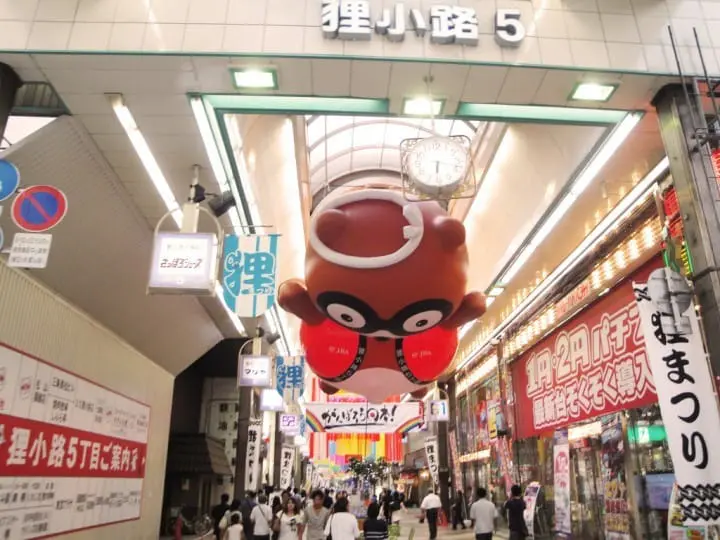
Established in the late 19th century—roughly 150 years ago—Tanukikoji Shopping Street stands as one of Hokkaido’s oldest and most historically significant commercial corridors. Spanning several blocks in Chuo Ward, Sapporo, the street evolved from a makeshift gathering of merchants into a covered, rain-and-snow-proof arcade that serves as the heartbeat of everyday Sapporo life. Strategically accessible via the Sapporo Municipal Subway (Odori and Susukino stations) and the Sapporo Streetcar (Tanukikoji Station), the street bridges historical commerce with modern convenience. Today, it features a dense concentration of traditional pharmacies, contemporary drugstores, independent eateries, fashion boutiques, and entertainment venues, retaining its populist charm amidst rapid urbanization.
2. The Underground Transformation: POLE TOWN and AURORA TOWN
As Sapporo expanded upward and outward, subterranean urban planning became a necessity to combat heavy winter snowfall. The development of the POLE TOWN and AURORA TOWN underground shopping networks transformed pedestrian transit. Connecting Sapporo Station to Odori and Susukino, these climate-controlled corridors allow residents and visitors to traverse the city core entirely shielded from sub-zero temperatures. Housing an array of fashion boutiques, specialty cafés, and general merchandise stores, these subterranean corridors act as both transit arteries and vibrant retail destinations that capture the daily rhythm of urban life in northern Japan.
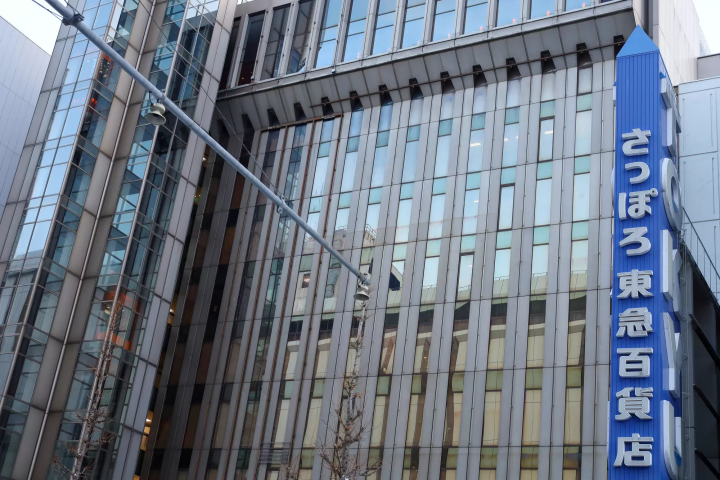
3. The Modern Era of Department Stores: Sapporo Mitsukoshi, Daimaru, and Tokyu
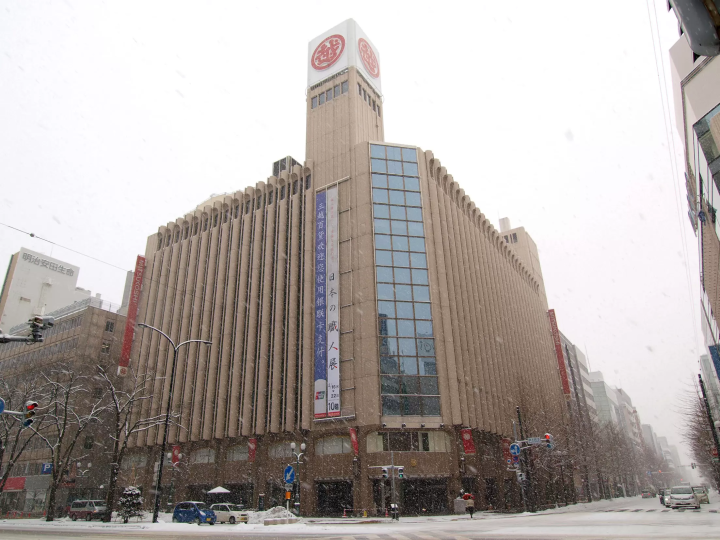
The latter half of the 20th century cemented Sapporo Station and Odori as the prefecture’s premier luxury epicenters. Sapporo Mitsukoshi, strategically positioned by Odori Station and directly linked to POLE TOWN, opened as a bastion of high-end consumerism. Spanning ten stories above ground and two basement levels across a 21,560-square-meter footprint, it remains the go-to destination for elite luxury brands and high-grade Japanese omiyage (souvenirs).
Concurrently, Daimaru Sapporo, anchored directly to JR Sapporo Station, capitalized on transit-oriented development (TOD). Its prime positioning caters directly to inbound travelers seeking seamless transitions between rail transit, luxury shopping, and airport departures. Adding to this station-area triad, Tokyu Department Store—also directly connected to the Sapporo Subway Station—reinforced consumer accessibility by integrating comprehensive basement food halls (depachika), cosmetics, and apparel under one roof, while offering streamlined tax-free shopping services for international tourists.
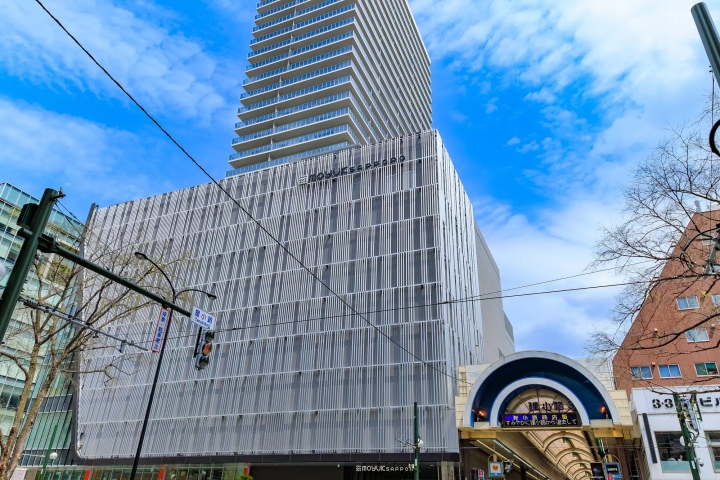
4. 21st-Century Mixed-Use Megastructures: moyuk SAPPORO and SAPPORO FACTORY
In recent decades, Hokkaido’s commercial architecture shifted toward experiential retail, entertainment, and urban regeneration. Opened in July 2023, moyuk SAPPORO redefined central Sapporo’s urban landscape by merging high-density retail, dining, and an innovative indoor aquarium within a single transit-adjacent complex near Tanukikoji.
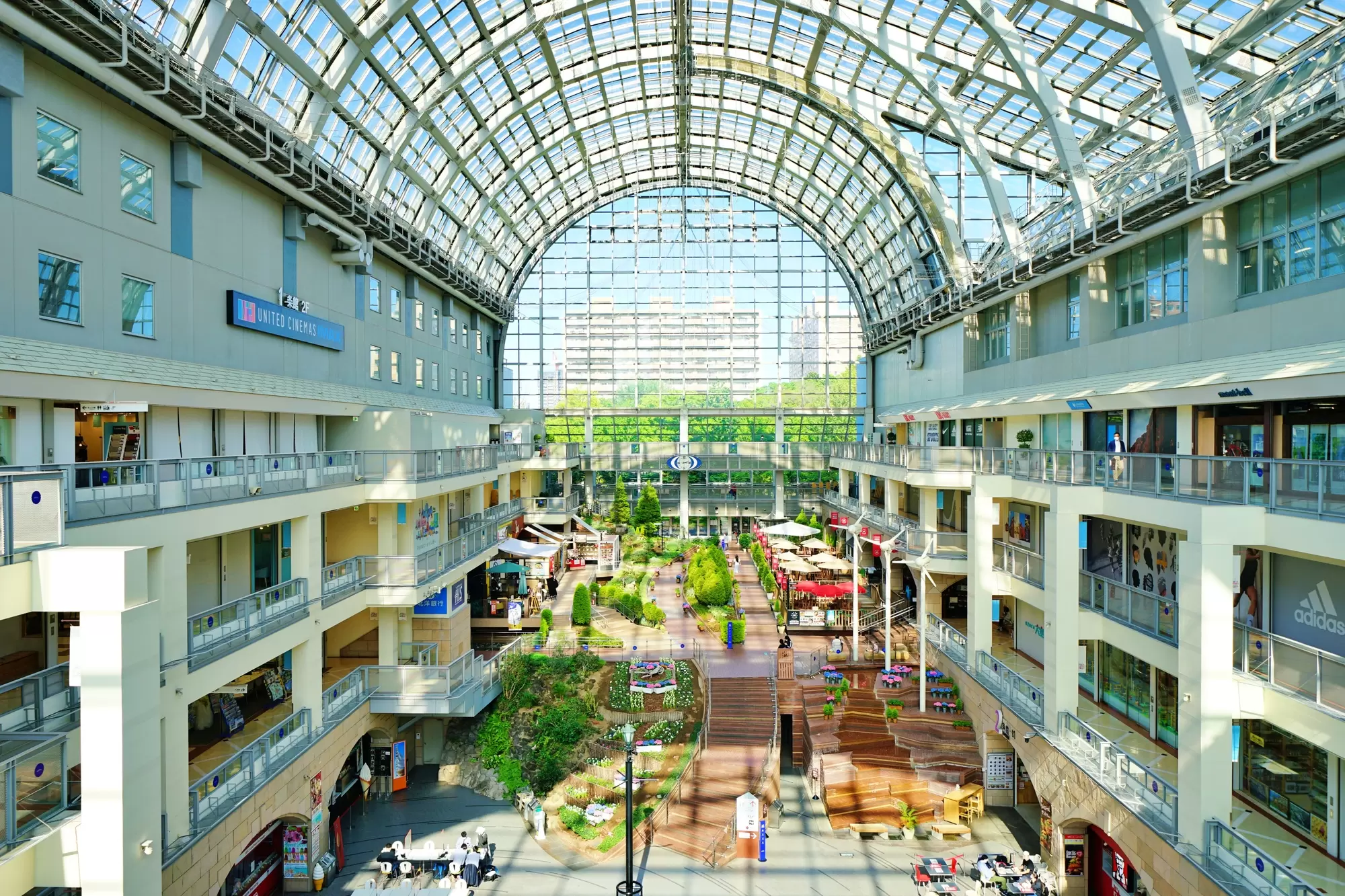
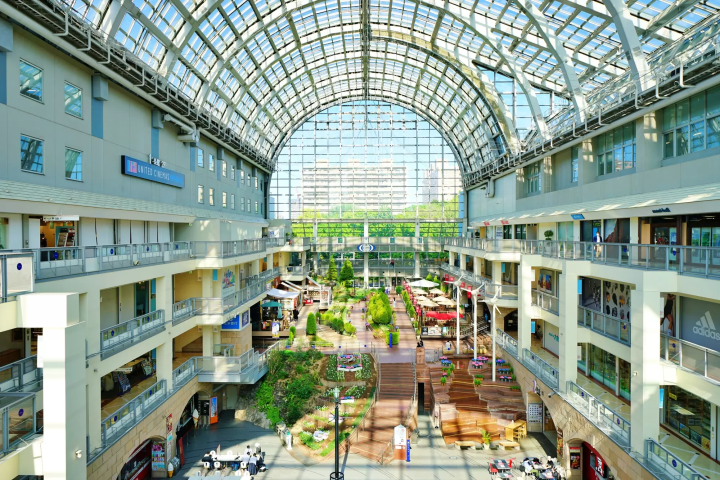
Similarly, SAPPORO FACTORY represents a triumph of industrial heritage reuse. Developed on the historic grounds of a pioneering Meiji-era beer brewery, this expansive commercial complex utilizes a sweeping glass-controlled atrium. By insulating shoppers from inclement weather while preserving industrial aesthetics, SAPPORO FACTORY demonstrated how large-scale retail could thrive outside traditional department store footprints.
5. Regional Expansion and Outlets: Asahikawa, Chitose, and Kitahiroshima
Beyond Sapporo, decentralization spurred major retail milestones in Asahikawa and the Chitose transit corridor. AEON MALL Asahikawa Station, integrated directly into the northern transportation hub of Hokkaido’s second-largest city, eliminated the friction of winter travel for regional shoppers. Meanwhile, the establishment of Chitose Outlet Mall Rera near New Chitose Airport and Mitsui Outlet Park Sapporo Kitahiroshima—one of the region’s largest fully indoor outlet malls—provided large-scale, weather-proof brand shopping designed specifically to capture pre-departure tourist spending and regional suburban markets.
Supporting Context & Key Metrics
To fully comprehend the scale and economic impact of Hokkaido’s retail sector, it is necessary to examine key structural metrics regarding accessibility, architectural capacity, and consumer infrastructure.
Comparative Infrastructure and Access Matrix
Retail Destination
Location / Ward
Primary Access Method
Core Architectural Feature
Key Consumer Demographic
Tanukikoji Shopping Street
Chuo Ward, Sapporo
Odori / Susukino Subway
150-year-old covered arcade
General public, tourists, bargain hunters
POLE TOWN & AURORA TOWN
Chuo Ward, Sapporo
Sapporo / Odori Subway
Subterranean climate-controlled corridors
Commuters, transit passengers
Sapporo Mitsukoshi
Chuo Ward, Sapporo
Odori Station / POLE TOWN
12-story luxury department store (21,560 sqm)
Luxury shoppers, souvenir buyers
Sapporo PARCO
Chuo Ward, Sapporo
Near Odori Station
Multi-level youth fashion complex
Youth, contemporary trendsetters
Daimaru Sapporo
Chuo Ward, Sapporo
Direct JR Sapporo Station link
Premium transit-hub department store
Travelers, high-end consumers
Tokyu Department Store
Chuo Ward, Sapporo
Direct Sapporo Subway link
Comprehensive department store with tax-free focus
International tourists, families
moyuk SAPPORO
Chuo Ward, Sapporo
Near Tanukikoji / Streetcar
Mixed-use complex featuring an indoor aquarium
Families, entertainment seekers
SAPPORO FACTORY
Chuo Ward, Sapporo
3-min walk from Bus Center-mae
Industrial reuse glass atrium complex
All-weather leisure shoppers
AEON MALL Asahikawa Station
Asahikawa City
Direct Asahikawa Station link
Transit-integrated regional mall
Regional residents, tourists
Chitose Outlet Mall Rera
Chitose City
Minami-Chitose Stn / Airport Bus
Open-air outlet village near airport
Pre-departure travelers
Mitsui Outlet Park Kitahiroshima
Kitahiroshima
Direct bus from Sapporo / Chitose
174-store fully indoor mega-outlet
Bulk shoppers, international tourists
Climatic Adaptability Metrics
Hokkaido experiences an average annual snowfall exceeding 5 meters in major urban centers like Sapporo, with winter temperatures frequently dropping below freezing. Consequently, commercial real estate valuation in the prefecture correlates directly with weather-mitigation infrastructure:
Subterranean Integration: Sapporo’s underground network connects over 1 kilometer of continuous commercial floor space, insulating retailers from seasonal retail slumps.
Indoor Microclimates: Facilities like SAPPORO FACTORY and Mitsui Outlet Park Kitahiroshima employ high-tensile glass and climate control to maintain stable internal foot traffic year-round, mitigating the traditional winter retail downturn experienced in open-air strip malls.
Official Statements and Industry Perspectives
Urban planners, retail executives, and tourism boards have consistently emphasized the strategic importance of integrated transit and weather-resilient design in sustaining Hokkaido’s commercial vitality.
"The strength of Sapporo and broader Hokkaido commerce lies in our ability to merge high-density transit nodes with lifestyle destinations. Whether it is the underground pedestrian arteries linking Sapporo Station to Odori or modern complexes like moyuk SAPPORO, our infrastructure is deliberately engineered to defy harsh winters while maximizing consumer accessibility."
— Regional Urban Planning Directorate, Sapporo Municipal Government
Commercial real estate analysts tracking the northern market have similarly highlighted the evolution of tourist-centric retail hubs:
"The post-pandemic recovery of international travel has catalyzed significant reinvestment in transit-adjacent properties such as Daimaru Sapporo and Mitsui Outlet Park Kitahiroshima. Retailers are no longer just selling goods; they are curating seamless, tax-free, end-to-end shopping experiences that cater directly to inbound travelers before their departures at New Chitose Airport."
— Hokkaido Commercial Real Estate Research Group
Tourism development authorities further note that regional hubs like AEON MALL Asahikawa Station play a crucial role in distributing economic benefits beyond the capital city:
"By anchoring major retail developments directly to regional railway terminals, we ensure that visitors exploring central and northern Hokkaido—from the Asahiyama Zoo to national parks—can easily access local craft goods, regional agricultural products, and world-class confectionery without logistical friction."
— Hokkaido Tourism Organization Policy Brief
As Hokkaido enters a new era of infrastructure development—most notably marked by the anticipated extension of the Hokkaido Shinkansen bullet train line to Sapporo—the retail landscape is undergoing profound transformation. Several key trends are projected to dictate the trajectory of the prefecture’s commercial sector over the next decade:
1. Shinkansen-Driven Transit-Oriented Development (TOD)
The impending arrival of the bullet train to Sapporo Station will drastically reduce travel times between Honshu and Hokkaido, triggering a wave of station-area redevelopment. Department stores such as Daimaru Sapporo and Tokyu Department Store are expected to modernize their floor plans further to accommodate higher volumes of high-speed rail passengers, luxury travelers, and commercial executives.
2. Deepening Sub-Surface and Skyway Integration
With climate change intensifying unpredictable weather patterns, urban developers are placing a premium on uninterrupted pedestrian mobility. Future commercial projects in Sapporo will likely expand underground and skyway connections, ensuring that retail complexes remain entirely accessible without requiring patrons to brave outdoor elements during severe blizzards.
3. Experiential Retail and Domestic-International Synergy
Traditional retail models relying solely on apparel sales are giving way to multi-functional hubs that blend entertainment (such as moyuk SAPPORO’s urban aquarium), dining, and cultural curation. Furthermore, retailers are refining tax-free processing frameworks—exemplified by Tokyu Department Store’s handling-fee-free policies—to capture high-value international spending while simultaneously catering to local generational shoppers through localized agricultural showcases and craft markets.
Conclusion
Hokkaido’s commercial sphere is far more than a supplementary amenity for tourists; it is a sophisticated, highly engineered economic engine. From the 150-year-old cobblestones of Tanukikoji to the ultra-modern transit malls of Asahikawa and Kitahiroshima, the region demonstrates how urban resilience, historical preservation, and forward-thinking architecture can converge to create a world-class retail destination. Travelers visiting the north are advised to dedicate ample itinerary time beyond the natural scenery to explore an urban retail network as rich and diverse as the landscape surrounding it.











Belum ada komentar. Jadilah yang pertama berkomentar!