

Executive Overview
The landscape of Indian retail is undergoing a high-speed revolution, fundamentally altering how hundreds of millions of consumers acquire everyday essentials. For years, domestic startups cultivated a demanding consumer base that grew accustomed to having groceries, fresh produce, and household goods delivered to their doorsteps in a matter of minutes. Today, legacy e-commerce heavyweights are aggressively closing the gap.
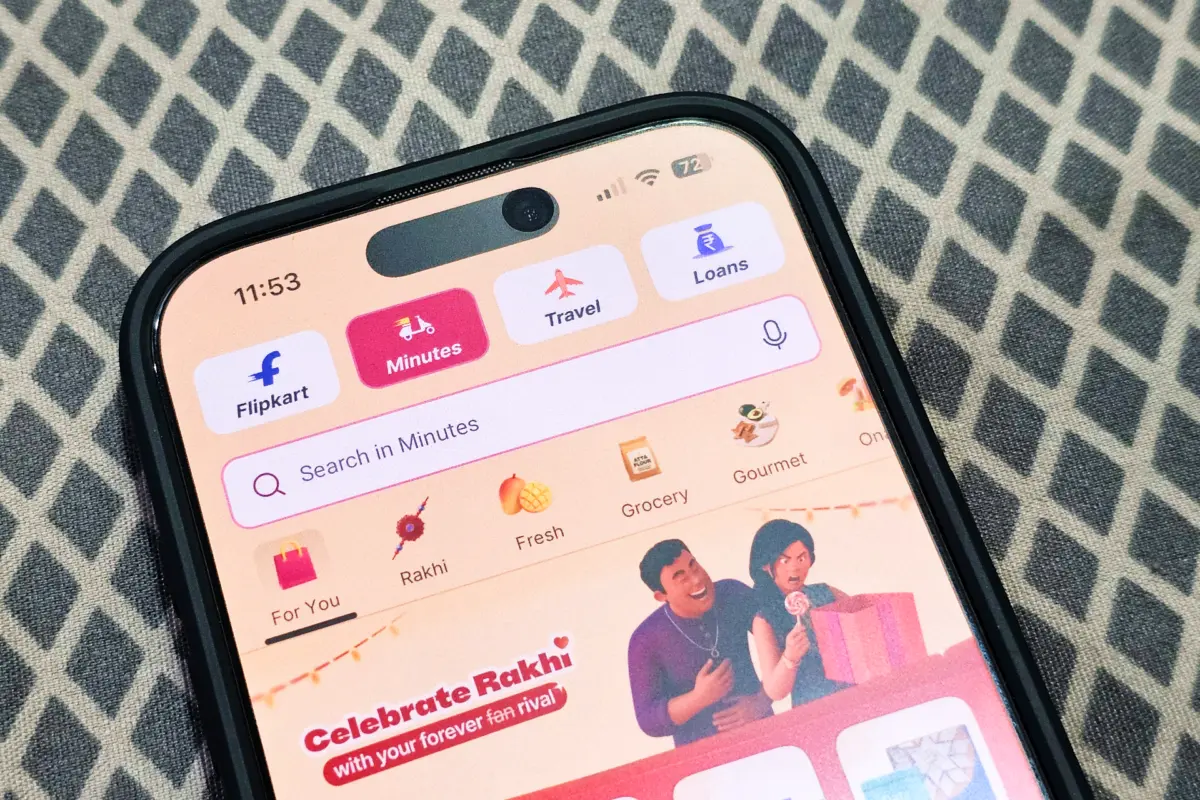
At the vanguard of this movement is Flipkart Minutes. Launched in August 2024 as the Walmart-backed e-commerce giant’s decisive entry into the quick-commerce arena, the service has scaled at an astonishing velocity. Industry insiders reveal that Flipkart Minutes is now processing between 1.1 million and 1.2 million orders a day—a dramatic leap from the 390,000 to 400,000 daily orders recorded late last year.
This meteoric rise brings Flipkart dangerously close to overtaking established market pioneers like Swiggy Instamart, which currently processes roughly 1.4 million daily orders. While nimble startups such as Blinkit (backed by Eternal/Zomato) and Zepto continue to command the upper echelons of the market, Flipkart’s late-game surge signals a tectonic shift. It is no longer a question of whether traditional e-commerce giants can adapt to the instant-delivery mandate, but how quickly they can completely reinvent their logistics chains to capture India’s hyper-accelerated digital shoppers.
Concurrently, global rival Amazon is mounting its own robust assault on the segment through Amazon Now. As traditional scheduled delivery models for groceries face structural obsolescence, the battle lines are drawn. For Flipkart and Amazon, this high-stakes race is both an aggressive market expansion strategy and a defensive necessity to prevent their existing multi-billion-dollar user bases from defecting to quick-commerce specialists.
Detailed Chronology: From Pandemic Novelty to Mainstream Infrastructure
To understand the gravity of Flipkart’s recent ascent, one must trace the evolutionary arc of India’s quick-commerce sector. The phenomenon was born out of pandemic-era lockdowns and shifting urban behaviors, rapidly maturing into a multi-billion-dollar retail battleground.
- 2013: The seeds of modern online grocery delivery are planted with the founding of Grofers, an online delivery platform that would later pivot and rebrand to shape the future of urban convenience.
- 2020: Food-delivery giant Swiggy launches Instamart, initially promising grocery deliveries within 45 minutes in select metropolitan areas like Gurugram. The COVID-19 pandemic supercharges demand for contactless, rapid home delivery.
- 2021: Zepto bursts onto the scene, popularizing the ultra-competitive "10-minute grocery delivery" model and raising massive capital rounds that force incumbents to rethink fulfillment times. Concurrently, Grofers officially rebrands as Blinkit, pivoting hard toward ultra-fast dark store logistics.
- August 2024: Recognizing that the traditional e-commerce next-day or two-day delivery model is losing its monopoly on consumer habits, Flipkart officially debuts Flipkart Minutes, its dedicated quick-commerce service.
- Late 2024 to Mid-2025: Flipkart aggressively scales its infrastructure. Daily order volumes jump from under 400,000 in November to over 1.1 million. Meanwhile, Amazon doubles down on Amazon Now, expanding its micro-fulfillment blueprint across hundreds of Indian cities.
- Mid-2026 Projections: Flipkart cements its trajectory toward operating 1,500 dark stores by the end of 2026, challenging Instamart for the number-three spot nationally while snapping at the heels of category leaders Zepto and Blinkit.
This chronology highlights a brutal truth of modern retail: speed is no longer an optional luxury feature; it is the fundamental baseline upon which modern consumer loyalty is won or lost.
Supporting Context, Metrics, and Financial Dynamics
The economics of quick commerce are notoriously complex, balancing high operational overheads against shrinking delivery windows and tight margins. Yet, the sheer volume of transactions moving through these micro-networks demonstrates an insatiable consumer appetite.
Market Share and Volume Breakdown
Recent market intelligence reports from research firm Datum Intelligence paint a clear picture of the current pecking order in India’s quick-commerce hierarchy:
- Blinkit: Continues to dominate the market with an estimated 3.4 million to 3.6 million daily orders.
- Zepto: Securely holds the second-tier position, processing 2.4 million to 2.6 million daily orders.
- Swiggy Instamart: Manages roughly 1.4 million daily orders, supported by a massive infrastructure of over 1,200 dark stores spanning more than 130 cities.
- Flipkart Minutes: Rapidly closing in on Instamart with 1.1 million to 1.2 million daily orders, establishing itself as a formidable tier-one contender within less than two years of operation.
Infrastructure Expansion: The Dark Store Arms Race
Flipkart’s growth has been directly fueled by an aggressive, capital-intensive expansion of its delivery infrastructure. Minutes currently operates between 1,020 and 1,050 micro-fulfillment centers—strategically placed urban warehouses designed to pack and dispatch orders within minutes.
This represents an extraordinary scaling effort:
- A year ago: ~340 dark stores
- January: ~600 dark stores
- Current: ~1,050 dark stores
- Target (End of 2026): 1,500 dark stores, with the company currently adding roughly 100 new facilities every single month.
According to Satish Meena, an industry adviser at Datum Intelligence, Flipkart’s primary superpower lies not just in real estate acquisition, but in its legacy asset: an enormous, pre-existing customer base. "Flipkart is already a serious player," Meena notes. "Once you open 1,000 dark stores and are doing a million orders per day, it’s serious enough." Having spent years and billions of dollars acquiring e-commerce shoppers, Flipkart possesses a built-in audience ready to adopt Minutes without the friction of initial brand discovery.
Customer Economics and Basket Composition
The metrics coming out of Flipkart Minutes point to deep consumer integration:
- Retention: Between 65% and 70% of monthly transacting users are repeat buyers.
- Engagement: Transactions per customer have surged by 50% to 60% year-over-year.
- Basket Size: Average order values hover between ₹400 and ₹500 (approx. $4.20 to $5.20).
- Product Mix: While daily essentials—fruits, vegetables, staples, dairy, and meat—drive initial volume, Flipkart is intentionally scaling higher-margin categories, including organic, artisanal, and premium gourmet items.
- Speed Optimization: Remarkably, even as order volume has more than doubled, Flipkart has trimmed its average delivery time down to 11 minutes, an improvement from 13 minutes the previous year.
Official Statements and Industry Perspectives
Major players across the board are treating quick commerce not as a passing urban trend, but as the permanent architecture of retail.
Swiggy recently announced ambitious financial targets, aiming for ₹10,000 crore in adjusted EBITDA by FY31, heavily anchored by its differentiated Instamart strategy. Notably, Swiggy reported that over 45% of its dark-store network is now contribution-margin positive, proving that ultra-fast delivery can achieve sustainable unit economics at scale.
Meanwhile, Amazon’s global leadership has signaled an unwavering commitment to the Indian instant-delivery market. During a high-profile visit to India, Amazon CEO Andy Jassy highlighted Amazon Now as the company’s fastest-growing business segment in the country, noting that order volumes have doubled every single quarter since inception. Amazon’s blueprint involves scaling Amazon Now to over 300 cities, underpinned by a network of more than 1,000 micro-fulfillment centers designed to handle multi-category instant deliveries.
Despite requests for comment, representatives from Flipkart, Amazon, Swiggy, Zepto, and Blinkit parent company Eternal declined to provide official statements for this report—a silence that speaks volumes about the cutthroat competitive secrecy governing the sector.
Future Outlook: The Irreversible Shift in Consumer Behavior
As the dust settles on the initial phase of the quick-commerce gold rush, market analysts agree that there is no turning back. The expansion into instant delivery is as much a defensive bulkhead as it is an offensive weapon.
As Satish Meena observes, consumer psychology has permanently shifted. When asked if the retail market could ever revert to scheduled, multi-day grocery deliveries, his response is absolute: "Can you go back to scheduled delivery now in grocery? No. You will not go back."
For legacy giants like Flipkart and Amazon, failing to conquer the quick-commerce paradigm meant risking the slow erosion of their core retail dominance. By deploying thousands of micro-fulfillment centers, optimizing supply chains down to the minute, and leveraging multi-billion-dollar customer funnels, Flipkart Minutes has proven that late-stage entrants can disrupt entrenched monopolies.
As the battle intensifies through 2026, the ultimate winners will not simply be those who deliver the fastest, but those who can master unit economics, expand high-margin product verticals, and sustain unwavering logistical precision across hundreds of millions of households. The 10-minute basket is no longer the future of Indian retail—it is the present battleground.







Belum ada komentar. Jadilah yang pertama berkomentar!