

Executive Overview
For years, the public imagination has been captivated by viral demonstrations of humanoid robots. From Elon Musk’s Tesla Optimus to the astonishingly agile acrobatics of Boston Dynamics’ Atlas, the concept of a mechanical bipedal helper has moved firmly from the realm of science fiction into the crosshairs of industrial reality. Beneath the glossy marketing hype, however, a fundamental technical shift is underway. The convergence of hardware maturation and breakthroughs in "embodied AI"—specifically the application of large language models (LLMs) to physical machinery—has convinced researchers and corporate executives alike that general-purpose robots are finally on the cusp of mastering arbitrary physical tasks.
While Silicon Valley pioneers and venture-backed startups have long dominated the narrative, a massive, heavily capitalized new wave of competitors has entered the arena: global automakers. Facing razor-thin profit margins in traditional electric and internal combustion vehicle markets, legacy car manufacturers are aggressively pivoting toward robotics. Leading this charge is an unexpected vanguard of Chinese automotive giants. Backed by state-level enthusiasm, deep supply chains, and unprecedented private funding rounds, these companies are positioning humanoid robotics not as a futuristic side project, but as the core engine of their long-term commercial survival.
Yet, this is far from a purely regional phenomenon. Traditional automotive players across South Korea, the United States, and Europe are racing to secure their own footholds in the embodied AI economy. From multi-million-dollar venture acquisitions to factory-floor deployments, the global automotive sector is orchestrating a high-stakes migration of capital, talent, and manufacturing might into humanoid robotics. The central question for the industry is no longer whether humanoid machines will enter the workforce, but whether traditional automakers possess the software prowess to beat pure-play AI giants at their own game.
Detailed Chronology: The Accelerated Rise of Automotive Robotics
The transition of automakers from car manufacturing to humanoid robotics has accelerated at a breathtaking pace, shifting from experimental R&D labs to high-stakes commercial investments within a remarkably tight window.
Late 2025: The Blueprint for Spinouts and Specialized Units
Throughout late 2025, the writing on the wall for traditional automotive margins became too stark to ignore. In November 2025, American EV manufacturer Rivian signaled its diversification strategy by spinning out a dedicated robotics entity dubbed Mind Robotics. Unlike competitors pursuing classic bipedal forms, Rivian’s early foray pointed toward specialized automation, yet it underscored a broader industry-wide realization: automotive engineering teams possessed transferable skills desperately needed in the robotics sector. Simultaneously, venture-backed humanoid startups like Apptronik began demonstrating foundational strides toward self-manufacturing, proving that machines could soon assist in building their own mechanical lineages.
Early 2026: The Billion-Dollar Acquisition Wave
The opening weeks of 2026 transformed humanoid robotics from a speculative bet into an institutional asset class through a series of blockbuster transactions.
- January 5, 2026: In a move that signaled deep technological integration, Hyundai announced a landmark partnership leveraging Google’s DeepMind AI research lab DNA to supercharge the development of its Boston Dynamics Atlas robot.
- January 6, 2026: Advanced driver-assistance system (ADAS) giant Mobileye stunned the market by acquiring humanoid robot startup Mentee Robotics for a staggering $900 million, instantly bridging the gap between autonomous vehicle perception systems and bipedal robotic mobility.
Spring to Summer 2026: China’s Capital Floodgates Open
As global players consolidated their software partnerships, Chinese automakers engineered a historic financial surge in the domestic "embodied AI" sector.
- August 2026: Chery Automobile’s robotics affiliate, AiMOGA, reportedly initiated preparations for an initial public offering (IPO), setting its sights on aggressive overseas expansion. Meanwhile, rival BYD pulled back the curtain on its own proprietary humanoid creation, dubbed Xiao Di, joining a crowded domestic field that already included Changan, GAC, Li Auto, SAIC, and Seres.
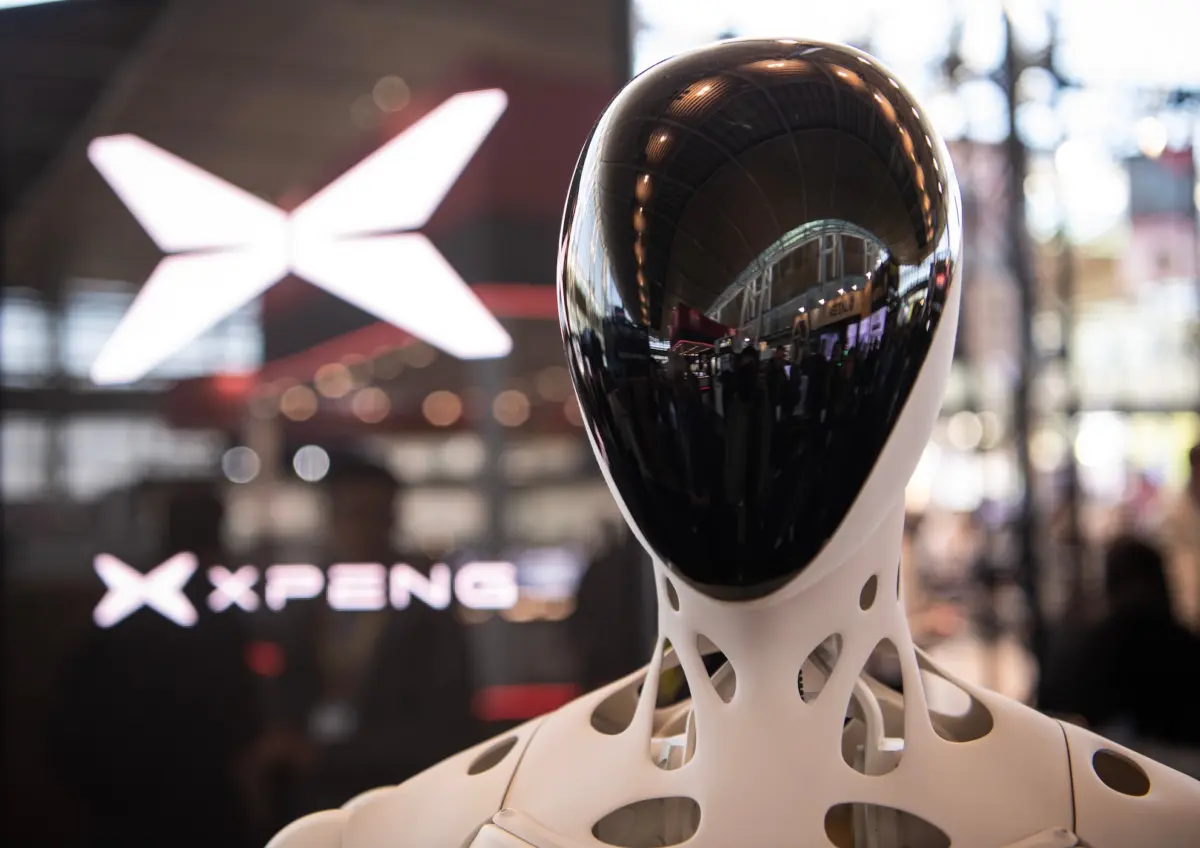
- Mid-August 2026: The definitive financial watershed arrived when Xpeng’s robotics division closed a jaw-dropping financing round, pulling in more than $900 million at a post-money valuation exceeding $6.3 billion. The round—spearheaded by IDG Capital with heavyweight participation from Gaorong Ventures, Tencent, and Alibaba—shattered records as the largest single-round private financing ever recorded in China’s embodied AI sector.
Supporting Context & Metrics: Economics, Manufacturing, and the AI Divide
To understand why traditional automakers are willing to divert billions of dollars away from core vehicle architectures and into bipedal mechanics, one must examine the macro-economics of the modern automotive industry.
The Margin Squeeze and the Robotics Premium
For decades, traditional automotive manufacturers have operated under intense margin pressure. Global price wars, fierce competition in the Electric Vehicle (EV) sector, and skyrocketing supply chain costs have driven vehicle profit margins to razor-thin levels. According to industry analysts, executives are acutely aware that passenger vehicles are increasingly becoming commoditized hardware.
Humanoid robots, by contrast, represent a virtually limitless total addressable market (TAM). Capable of operating in unstructured environments designed for humans—spanning manufacturing floors, logistics warehouses, construction sites, and eldercare facilities—general-purpose robots promise recurring software-as-a-service (SaaS) revenues alongside high-margin hardware sales.
The Xpeng Blueprint: Following the Tesla Playbook
Among Chinese automakers, Xpeng has emerged as the most explicit mimic of Tesla’s strategic evolution. Michael Dunne, CEO of San Diego- and Singapore-based advisory firm Dunne Insights, notes that Xpeng’s leadership structure uniquely primes the company for radical pivots.
"It’s the most focused on autonomy, it’s the first to commit in a big way to humanoid robots," Dunne explained in interviews with tech media. Pointing to Xpeng founder He Xiaopeng—a tech billionaire renowned for his corporate agility—Dunne highlighted the core motivation: "He sees razor-thin profit in cars on the near horizon. Robots look much more promising."
The financial commitment from Xpeng’s executive suite matches this rhetoric. Founder He Xiaopeng and Xpeng Co-President Brian Gu demonstrated profound skin-in-the-game confidence by personally investing approximately $100 million of their own capital into the company’s record-breaking $900 million funding round. Their flagship platform, "Iron," is a human-shaped humanoid meticulously engineered for immediate commercial deployment rather than academic curiosity.
The Manufacturing Edge vs. The AI Gap
Automakers possess a distinct superpower that pure-play Silicon Valley robotics startups often struggle to replicate: world-class manufacturing infrastructure, supply chain mastery, and mechatronic scaling capabilities.
As Dunne bluntly summarizes: "They have all the hardware to get the job done. Question is if they can catch Tesla on the AI side of the equation."
While companies like Xpeng, Chery, and BYD can rapidly prototype actuators, lightweight carbon-fiber frames, and high-density battery packs leveraging their existing automotive supply chains, the cognitive architecture—the embodied AI neural networks capable of reasoning, perception, and real-time adaptation—remains the ultimate differentiator. This explains why Korean giant Hyundai is deliberately fusing Google DeepMind’s foundational AI DNA with Boston Dynamics’ decades of hardware expertise, creating a hybrid model designed to bypass purely in-house software limitations.
Official Statements and Industry Perspectives
The rapid convergence of automotive engineering and artificial intelligence has prompted outspoken commentary from industry titans, highlighting a deep philosophical split over how robots should be built, deployed, and monetized.
Leadership Conviction: Betting Personal Fortunes
The decision by Xpeng executives He Xiaopeng and Brian Gu to contribute $100 million of their personal wealth to the company’s robotics unit serves as a powerful indicator of executive sentiment. This level of insider funding transcends standard corporate diversification; it reflects an internal belief that the enterprise value of their robotics division could eventually eclipse their traditional automotive operations.
The Factory Floor Realities: Hyundai’s Robot Metaplant
While software startups theorize about generalized robots operating in home environments, traditional automakers are focusing on immediate, highly controlled commercial use cases where Return on Investment (ROI) can be mathematically guaranteed.
Hyundai’s operational roadmap for Boston Dynamics exemplifies this pragmatic approach. The South Korean conglomerate is executing a multi-year integration plan:
- 2026 Facility Launch: Opening the U.S.-based "Robot Metaplant Application Center," a specialized facility dedicated to teaching Atlas how to map complex physical movements, such as heavy lifts and precise turns.
- Factory Deployment: Integrating Atlas into its state-of-the-art manufacturing plant in Georgia.
- Full-Scale Scaling: Systematically deploying humanoid units for grueling, repetitive industrial tasks—such as parts sequencing—by the year 2028.
Competing Philosophies: Are We Doing Robots "All Wrong"?
Not all automotive-adjacent players are following the bipedal blueprint. Rivian’s cautious approach through its Mind Robotics spinout highlights a lingering skepticism within certain engineering circles regarding whether humanoids are the optimal form factor for industrial productivity. Rivian CEO RJ Scaringe has publicly voiced skepticism about prevailing industry trends, suggesting that many contemporary robotics initiatives are "doing robots all wrong"—implying that task-specific form factors often outperform general-purpose humanoids in constrained industrial environments.
Despite these dissenting voices, the stampede toward humanoids continues unabated. Competitors such as Agility Robotics, Apptronik, and Figure are racing neck-and-neck with automotive giants, all converging on the ultimate finish line: achieving reliable commercial deployment at global scale.
Future Outlook: The Road to 2030 and Beyond
As the dust settles on the historic funding rounds of 2026, the trajectory of automotive-backed robotics over the remainder of the decade points toward several definitive trends:
1. The Battleground Shifts from Hardware to Embodied Intelligence
With Chinese manufacturers successfully weaponizing their manufacturing supply chains to produce lightweight, cost-effective humanoid chassis—and Western automakers leveraging advanced mechatronic platforms—the hardware bottleneck is rapidly dissolving. By 2028, the competitive moat will no longer be mechanical dexterity, but software sophistication. Companies that successfully license or develop advanced foundation models capable of zero-shot learning (the ability to perform a brand-new physical task without prior training data) will dominate the market.
2. The Factory Floor as the Ultimate Training Ground
Before humanoid robots can successfully fold laundry or stock grocery shelves in consumer households, they must survive the unforgiving crucible of the automotive assembly line. Facilities like Hyundai’s Robot Metaplant in Georgia and Xpeng’s manufacturing hubs will serve as intensive training grounds. By utilizing real-world factory data to train embodied AI models, automakers hold a distinct advantage over pure software startups lacking physical production environments.
3. IPO Waves and Industry Consolidation
Following Chery affiliate AiMOGA’s path toward an initial public offering, the next several years will likely witness a massive wave of public market listings among automotive robotics spinouts. As capital requirements escalate to support massive neural network training clusters and scaled hardware production, weaker startups will either be absorbed by deep-pocketed automakers—akin to Mobileye’s acquisition of Mentee Robotics—or squeezed out of existence.
Conclusion
The narrative that automakers build only cars is officially dead. Driven by compressed automotive margins and catalyzed by revolutionary leaps in artificial intelligence, traditional transport titans have officially transformed into robotics conglomerates. Whether the ultimate victor emerges from the venture-backed enclaves of Silicon Valley, the high-velocity boardrooms of Shenzhen, or the legacy industrial centers of Seoul and Detroit, one reality remains certain: the factories of the near future will be built, maintained, and operated by the mechanical progeny of the global auto industry.









Belum ada komentar. Jadilah yang pertama berkomentar!