


Executive Overview
The landscape of personal computer gaming has long treated the macOS ecosystem as a secondary afterthought—if it considered Apple silicon at all. For decades, Mac users looking to experience high-end, graphically intensive AAA titles faced an uphill battle characterized by delayed ports, non-existent optimization, or the clunky workaround of third-party emulation layers. However, a seismic shift is quietly reshaping the digital entertainment ecosystem.
On March 19, Pearl Abyss’s highly anticipated open-world action-adventure epic, Crimson Desert, will break tradition by launching simultaneously on macOS alongside PC, PlayStation 5, and Xbox Series X|S.
This day-one multiplatform deployment is not merely a win for early adopters of Apple hardware; it represents a watershed moment in Apple’s multi-year, highly calculated campaign to turn the Mac into a legitimate powerhouse for AAA gaming. Arriving hot on the heels of Apple’s heavily rumored Spring 2026 hardware refresh—which is expected to introduce next-generation MacBooks powered by cutting-edge M5 Pro and M5 Max chips—Crimson Desert serves as the ultimate litmus test for the graphical prowess, thermal efficiency, and developer viability of modern Apple silicon.
Priced at $69.99 for the Standard Edition and $79.99 for the Deluxe Edition via digital storefronts like Steam, the title demands serious hardware specifications, throwing down the gauntlet for Apple’s desktop and laptop lineup. This comprehensive report explores the technological implications of Crimson Desert’s macOS release, the evolution of Apple’s gaming strategy, the hardware requirements needed to run this next-generation title, and what this milestone means for the future of the platform.

Detailed Chronology: From Apple Silicon Genesis to Day-One AAA Release
To understand the magnitude of Crimson Desert arriving on the Mac on March 19, one must examine the calculated sequence of events that laid the groundwork for this achievement over the past several years.
The Turning Point: Apple Silicon and the Metal 3 Architecture
The journey toward day-one AAA parity began in earnest at Apple’s Worldwide Developers Conference (WWDC) in 2022. Recognizing that integrated graphics on custom-built silicon had evolved far beyond traditional mobile architectures, Apple introduced Metal 3. This proprietary graphics API was engineered from the ground up to minimize CPU overhead, accelerate resource loading, and introduce advanced developer tools such as MetalFX Upscaling—Apple’s answer to NVIDIA’s DLSS and AMD’s FSR.
Subsequent hardware iterations featuring the M3 and M4 families of system-on-chips (SoCs) added hardware-accelerated ray tracing and mesh shading. These architectural additions fundamentally changed the conversation around Mac gaming. Suddenly, ultra-slim notebooks and silent desktop units possessed the raw computational muscle to handle complex ray-traced lighting models and dense geometric rendering without melting under pressure.
Summer 2025: The Nine-Game Showcase
The momentum accelerated dramatically in the summer of 2025. During a major software showcase, Apple formally announced an aggressive lineup of nine blockbuster titles slated to bridge the gap between traditional console/PC ecosystems and macOS. Among the marquee announcements was Crimson Desert, developed by South Korean powerhouse studio Pearl Abyss.

During the preview, Apple executives and engineers explicitly highlighted how Pearl Abyss’s proprietary next-generation game engine would harness MetalFX Upscaling to maintain high frame rates at elevated resolutions. Furthermore, the presentation demonstrated how the title would utilize hardware-accelerated ray tracing on M3 and M4 chips to deliver hyper-realistic lighting and shadows across the sprawling continent of Pywel.
Early 2026: Pre-Orders and the March Launch Window
As winter turned to spring, expectations reached a fever pitch. In February 2026, Pearl Abyss officially locked in the global release date: March 19, 2026. Alongside the announcement, digital storefronts went live, opening pre-orders for the PC and Mac versions via Steam.
Simultaneously, leaks and industry whispers pointed to a massive impending hardware drop from Apple in the subsequent weeks, aligning the release of Crimson Desert with the rollout of brand-new MacBooks equipped with M5-series processors. This synchronization points to a tightly coordinated partnership between Apple’s hardware marketing division and major third-party game publishers, aimed at proving that modern Macs can handle the heaviest computational workloads in the industry right out of the box.
Supporting Context & Metrics: The Technical Anatomy of Crimson Desert on Mac
Crimson Desert is not a casual indie title or a retro port; it is a sprawling, high-budget, graphically demanding masterpiece designed to push modern hardware to its absolute limits.
Gameplay and World Design
Developed by Pearl Abyss—renowned globally for the massively multiplayer online role-playing game Black Desert—Crimson Desert has evolved during its development cycle into a single-player open-world action-adventure game infused with multiplayer elements. Players step into the shoes of Kliff, a mercenary fighting for survival across the war-torn, breathtaking landscapes of the continent of Pywel.
The title features dynamic real-time combat that blends brutal melee weapon play, grappling, wrestling moves, and environmental interactions. Complemented by high-fidelity motion capture, cinematic storytelling, and seamless traversal across vast terrains (including horseback riding and aerial gliders), the game requires vast amounts of memory bandwidth, streaming assets, and compute power.
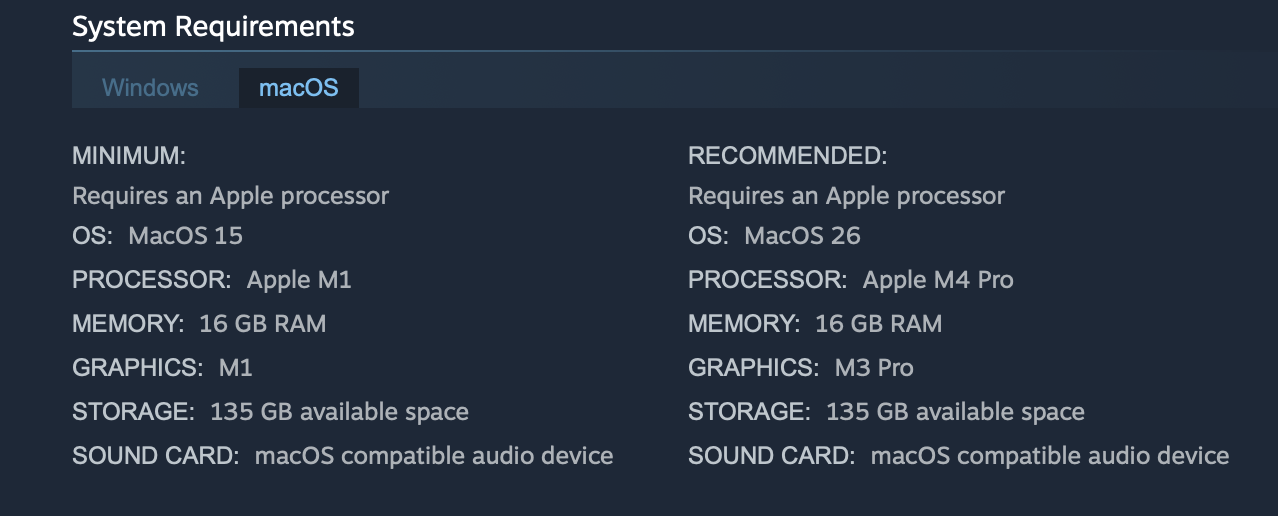
Decoding the System Requirements for Mac
Running a world of this scale natively on macOS requires deep integration with Apple’s low-level graphics APIs. While traditional PC builds rely on DirectX 12 and dedicated graphics cards from NVIDIA and AMD, the macOS version of Crimson Desert is built to extract maximum efficiency from unified memory architectures.
- Unified Memory Advantage: Because Apple silicon utilizes a unified memory architecture—where the CPU, GPU, and Neural Engine share a single high-bandwidth memory pool—assets for Crimson Desert can be streamed seamlessly without the traditional bottlenecks associated with PCIe bus transfers between system RAM and dedicated VRAM.
- MetalFX Upscaling Integration: To achieve high fidelity without sacrificing fluid motion, the game heavily leverages MetalFX Upscaling. This allows users on mid-tier MacBooks and Mac Studios to render the game at a lower native resolution and upscale it intelligently with minimal artifacting, preserving visual sharpness while slashing GPU rendering loads.
- Ray Tracing Support: On machines equipped with M3, M4, and upcoming M5 chips featuring hardware ray-tracing cores, global illumination and reflections transform the gritty, dust-swept deserts and moody medieval fortresses of Pywel into stunningly realistic vistas.
Official Statements and Industry Implications
The decision by Pearl Abyss to launch Crimson Desert on macOS on day one has sent ripples through the gaming industry, prompting analysts and developers to re-evaluate the commercial viability of the platform.

Industry observers note that historical friction points for Mac development—specifically the transition from OpenGL to Metal, the deprecation of 32-bit architecture, and the historical lack of a unified gaming community on macOS—are slowly dissolving. Tools like Apple’s Game Porting Toolkit have drastically reduced the time and capital required for developers to audit, translate, and optimize existing PC codebases for Apple silicon.
While Pearl Abyss has kept proprietary development details under wraps, past technical briefs from Apple’s engineering teams shed light on the collaborative nature of these high-profile ports. By working directly with game engines like Unreal Engine and proprietary solutions like Pearl Abyss’s custom engine, Apple has provided engineering support to ensure that day-one parity is no longer a logistical impossibility.
Furthermore, consumer advocacy groups and gaming journalists have praised the pricing consistency. Unlike historical eras where Mac ports carried a "tax" or arrived months later at budget prices, Crimson Desert commands the standard $69.99 AAA price point across Steam for both PC and Mac users, signaling that publishers view macOS gamers as full-paying, mainstream consumers rather than an afterthought niche.
Future Outlook: What Crimson Desert Signals for the Next Era of Mac Gaming
As the gaming community counts down the days to March 19, 2026, the broader implications of Crimson Desert extend far beyond a single product launch.

A Catalyst for Future Publishers
The true test for Apple will not be whether Crimson Desert runs well on a maxed-out M5 Max Mac Studio, but how gracefully it scales down to mainstream consumer hardware—such as the ubiquitous M-series MacBook Air and base-model MacBook Pro units that populate classrooms, offices, and creative studios worldwide. If the title delivers a stable, visually arresting experience across a wide spectrum of Apple silicon configurations, it will serve as concrete proof-of-concept for other major publishers hesitant to allocate resources to macOS development.
The Hardware Synergy: M5 Pro and M5 Max
The timing of Crimson Desert’s release alongside Apple’s spring product cycle creates a powerful marketing flywheel. Prospective buyers looking to upgrade their computing gear ahead of the spring launch will no longer have to choose between a productivity machine and a gaming rig. By marketing upcoming MacBooks as capable of handling both heavy creative workflows (like 8K video editing and 3D rendering in Blender) and cutting-edge AAA gaming, Apple is closing the psychological gap that once separated the Mac from the Windows PC gaming master race.
Conclusion
Crimson Desert arriving on macOS on March 19 is more than just a date on a calendar; it is a milestone in computing history. It marks the convergence of advanced silicon engineering, sophisticated low-level graphics APIs, and a shifting industry mindset that recognizes the untapped potential of Apple’s user base. Whether you are a long-time Mac loyalist starved for high-end entertainment or a curious PC gamer eyeing the sleek efficiency of Apple silicon, March 19 will mark the day the desert winds of Pywel begin to blow across the Mac ecosystem—ushering in a new, unchartered era of gaming on macOS.









Belum ada komentar. Jadilah yang pertama berkomentar!