

Executive Overview
In the sprawling landscape of contemporary documentary filmmaking, few works challenge the boundaries of form and collective memory quite as radically as Lana Daher’s Do You Love Me. Spanning 75 minutes of pure audiovisual collage, the film is a formally audacious, emotionally punishing attempt to reconstruct the modern history of Lebanon solely from its scattered media remains. Eschewing traditional narrative structures, linear timelines, and authoritative talking heads, Daher has crafted a cinematic experience without stable dates, distinct protagonists, or clear causal lines. Instead, the film plunges the viewer into a dizzying vortex of fiction films, archival news broadcasts, television commercials, private photographs, radio transmissions, popular music, and fragile home movies.
The genesis of this project lies in a profound national void. Lebanon possesses no unified, accessible national audiovisual archive, nor does it share a singular, agreed-upon school curriculum regarding its modern conflicts. Beginning her research in 2018, Daher navigated a fractured landscape of scattered public collections, neglected private stashes, and abandoned vaults. Sifting through an initial pool of more than 20,000 potential sources, the director and her team ultimately drew upon seven decades of material and over 100 independent works of Lebanese cinema.
Yet, Do You Love Me refuses to arrange these archival fragments into a politically legible history. An opening text card explicitly warns the audience that "disorientation is part of the journey"—a preemptive framing that hangs over the entire viewing experience. Working in tandem with editor and co-writer Qutaiba Barhamji, Daher cuts at a relentless pace between staged cinematic violence and raw documentary wreckage, between glossy public broadcasts and intimate private celebrations. The resulting friction renders the boundary between performance and historical record unstable.
While initially startling and witty, this deliberate disorientation eventually hardens into mass-produced fatigue. A film about a country trapped in cyclical trauma ultimately risks trapping its audience in the unyielding repetition of its own methodology. By withholding stable coordinates, dates, and political actors, Daher makes recurrence perform the work that rigorous historical differentiation would normally handle. Foreign interventions, factional militias, and shifting geopolitical power dynamics blur into a suffocating, inescapable atmospheric haze.
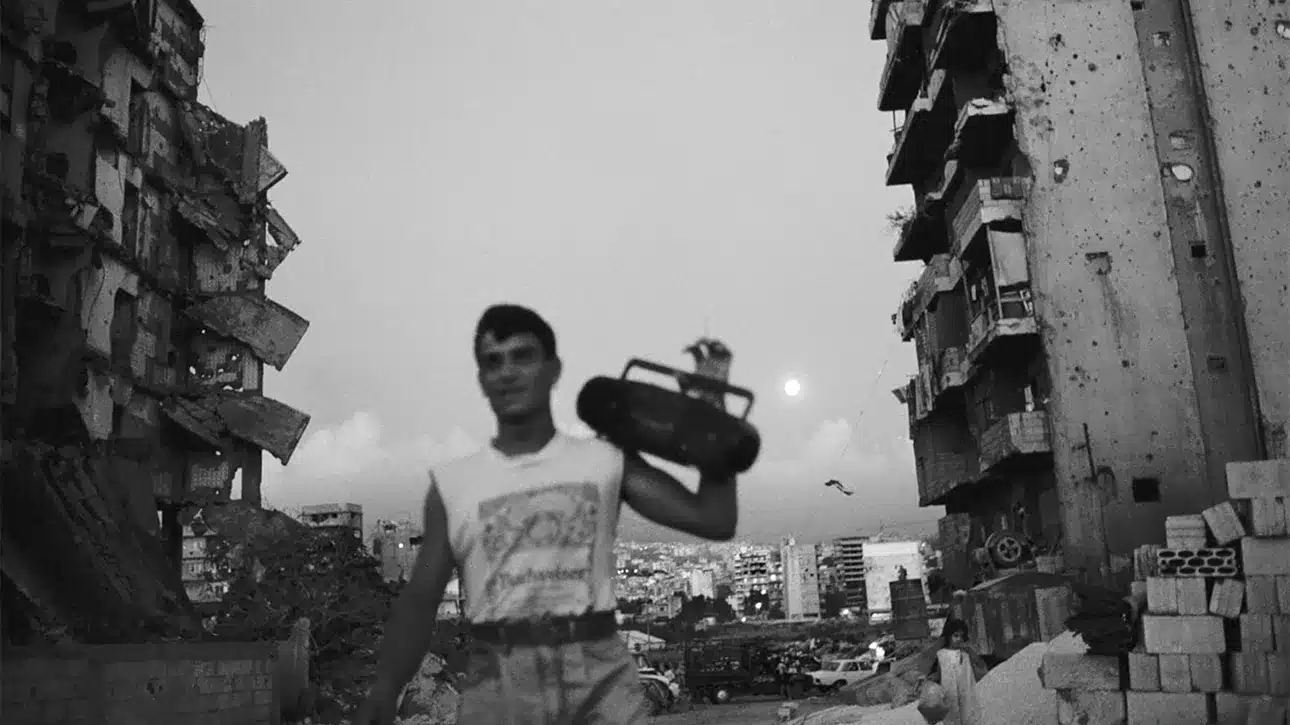
Nevertheless, the film achieves moments of profound resonance through its human subjects—individuals dancing at weddings, posing for home cameras, crowding cramped apartments, or walking along a Mediterranean coastline juxtaposed against soldiers and rubble. Anchored by a brilliant, binding sound design overseen by Pierre Armand, the film uses music, radio voices, and ambient noise to stitch together images that were never meant to meet. Ultimately, Do You Love Me stands as a monumental, polarizing experiment: an intimate meditation on the Lebanese psyche that brilliantly evokes the sensation of national trauma while simultaneously obscuring the precise political mechanics that generated it.
Detailed Chronology and Methodological Genesis
To understand the structural architecture of Do You Love Me, one must first trace the grueling timeline of its production and the archival crisis that necessitated its radical form. The project began taking shape in 2018, conceived against the backdrop of a Lebanon perpetually grappling with institutional amnesia. In a country where official histories are heavily contested, sectarianized, or simply lost to decades of civil war, foreign invasions, and administrative neglect, preserving an audiovisual record is an act of political resistance.
The Archival Hunt (2018–2024)
- Phase One: Source Discovery: Lana Daher and her research team embarked on an exhaustive, decentralized hunt for moving images and audio. With no centralized national film archive to consult, the team combed through private collections, regional film societies, abandoned storage facilities, and digitized family histories.
- Phase Two: Culling and Selection: From an initial pool exceeding 20,000 distinct archival items, the project was whittled down to a curated compendium spanning more than 70 years of Lebanese history. This corpus incorporated excerpts from over 100 independent Lebanese fiction and documentary films.
- Phase Three: Montage and Editing: Collaborating with editor Qutaiba Barhamji, Daher spent years experimenting with the friction between disparate media formats. The editorial challenge was immense: how to sequence 16mm film stock, VHS tape degradation, digital broadcast feeds, and high-definition home videos without imposing a false historical narrative.
The Mechanics of the Montage
The chronological spine of Do You Love Me does not move forward in a straight line; rather, it spirals inward. Daher and Barhamji exploit the physical properties of their source materials—fluctuations in film grain, color grading, aspect ratios, and acoustic fidelity—to create a sense of temporal collapse.
When a cut shifts from a fictional drama shot in the 1970s to a news broadcast from the 2006 Israeli-Lebanese war, and immediately down to a 1990s home video, the differences in image quality fail to separate the eras. Instead, their close proximity makes them feel agonizingly simultaneous. Throughout the montage, bombed-out buildings from entirely different decades appear to continue collapsing into one another. The cuts transform historical events into a recurring, perpetual impact, denying the audience the necessary psychological distance to absorb one shock before the next one strikes.
Supporting Context & Metrics: The Anatomy of a National Collage
To fully grasp the scale of Daher’s endeavor, it is instructive to examine the quantitative and qualitative dimensions of the archive she assembled, as well as the theoretical implications of her editorial choices.
Archival Metrics at a Glance
- Total Runtime: 75 minutes.
- Historical Span Covered: Over 70 years (ranging from pre-civil war prosperity to the post-2020 Beirut port explosion era).
- Initial Research Pool: More than 20,000 audiovisual sources.
- Independent Cinema Referenced: Over 100 works of Lebanese independent cinema.
- Core Creative Team: Directed by Lana Daher; Edited and Co-written by Qutaiba Barhamji; Sound Design by Pierre Armand.
The Soundscape as a Binding Agent
In the absence of a conventional, separately composed original score, the film relies entirely on a found-sound ecology managed by sound designer Pierre Armand. Radio broadcasts, political speeches, recorded testimonies, street protests, and popular songs are woven across images that share no original context.
The title song, performed by the legendary Bendaly Family, serves as the film’s most recognizable and emotionally resonant refrain. Musical interludes periodically interrupt the visual rush, offering moments of collective motion, dancing, and fleeting joy. Sound supplies the continuity that the aggressive visual cuts deliberately deny. Over time, however, this acoustic binding creates its own paradox: it forces disparate historical fragments into the same emotional current, causing historical differences to register less as factual data and more as mere interruptions in the film’s hypnotic flow.
The Spatial Dialectic: Apartments, Streets, and the Sea
Daher exerts control not through traditional mise-en-scène, but through precise selection and spatial juxtaposition. The film establishes a recurring triad of environments:
- The Private Apartment: Crowded domestic spaces that compress human bodies into interior frames, highlighting domestic endurance, familial warmth, and claustrophobia.
- The Contested Street: Public thoroughfares claimed by soldiers, militias, checkpoints, and piles of concrete rubble. Here, private bodies are thrust into the violent theatre of state and factional conflict.
- The Open Sea: The Mediterranean horizon, offering a rare visual escape and a symbol of both departure and return.
Practiced fictional gestures sit side-by-side with self-conscious home-movie performances. In some instances, the montage creates a match-cut where a physical gesture begun in one archival source appears to be completed by a completely different body in another decade and location.
Critical Reception and Official Discourse
As Do You Love Me travels the international film festival circuit and enters critical discourse, it has generated intense debate among film critics, historians, and cultural theorists. The tension between the film’s artistic brilliance and its historical elisions forms the core of this ongoing dialogue.
The Problem of Political Erasure
Many critics have pointed out that while the film brilliantly captures the feeling of living in perpetual crisis, its systematic refusal to anchor events in identifiable political actors makes it a frustrating historical document. By flattening the distinctions between the 1975–1990 civil war, successive Israeli invasions and occupations, and the catastrophic 2020 Beirut port explosion, the montage promotes a fatalistic narrative: Lebanon is fundamentally unchanged since the 1970s.
Political science and historical perspectives argue that this compression carries heavy consequences. When foreign interventions, sectarian leadership, and specific chains of political responsibility dissolve into an atmospheric blur, tracing accountability becomes nearly impossible.
The Preemptive Absolution of Confusion
The film’s opening disclaimer—warning viewers that "disorientation is part of the journey"—has itself become a focal point of critical analysis. Reviewers note that this acts as an advance absolution: because confusion is explicitly intended by the filmmakers, intellectual frustration or historical incomprehension cannot be counted as artistic failures.
Furthermore, this leveling technique expands the film’s collective claim. While Daher maintains a deeply personal artistic vision, the official synopsis promotes the work as an exploration of the "Lebanese collective psyche." By withholding a stable first-person narrator, her personal archival selections effortlessly blur into a collective statement. This raises an urgent ethical and aesthetic question: To what extent can an individual filmmaker appropriate the collective television, radio, and journalism of an entire nation to validate one specific sensibility?
Comparative Frameworks: Do You Love Me vs. Yes
To contextualize Daher’s approach, critics have frequently drawn comparisons to other contemporary cinematic explorations of war and national identity, such as Nadav Lapid’s 2025 film Yes. While Lapid operates within the realm of fiction rather than archival collage, both films confront the complicity of citizens within militarized societies.
However, Lapid’s frantic rhythm and mordant absurdity assign political agency directly to specific bodies—musicians and dancers selling their dignity in rooms organized by elite wealth and power. In contrast, Daher’s reliance on a closed-circuit historical archive disperses complicity and agency into the ether, favoring atmospheric immersion over direct political confrontation.
Future Outlook: The Legacy of Found-Footage Historiography
As contemporary societies increasingly grapple with digital fragmentation, deep fakes, and the democratization of image-making, Do You Love Me offers a profound glimpse into the future of archival historiography. Lana Daher’s experiment forces us to ask how national identities will be constructed in the twenty-first century when official institutions fail or collapse entirely.
Implications for Archival Preservation in the Middle East
The film has already sparked renewed urgency among cultural preservationists in Lebanon and the wider Levant. It underscores the critical need for independent, decentralized digital repositories that can rescue deteriorating 16mm reels, magnetic tapes, and domestic hard drives before they are lost to economic collapse, infrastructural decay, or armed conflict. Future initiatives are expected to leverage AI-driven indexing and community-led archiving to secure the fragile audiovisual heritage of the region.
The Evolution of the Essay Film
For the medium of the essay film and the archival documentary, Do You Love Me sets a high and contentious bar. It demonstrates that found-footage cinema can transcend simple historical illustration to become a visceral, psychological landscape. Yet, it also serves as a cautionary tale for future filmmakers: the pursuit of poetic disorientation must be carefully balanced against the ethical imperative of historical clarity.
Ultimately, Do You Love Me leaves its audiences suspended in a delicate paradox. Viewers are invited to share Lana Daher’s deeply felt, aching sensation of Beirut—a city submerged in past and present simultaneously—even as they are left wishing they could reach past the shimmering montage to touch the concrete historical realities that separate one era of catastrophe from the next. Whether viewed as an aesthetic triumph or a historical evasion, the film ensures that the audiovisual ghost of Lebanon will continue to haunt screens across the globe for years to come.









Belum ada komentar. Jadilah yang pertama berkomentar!