

Executive Overview
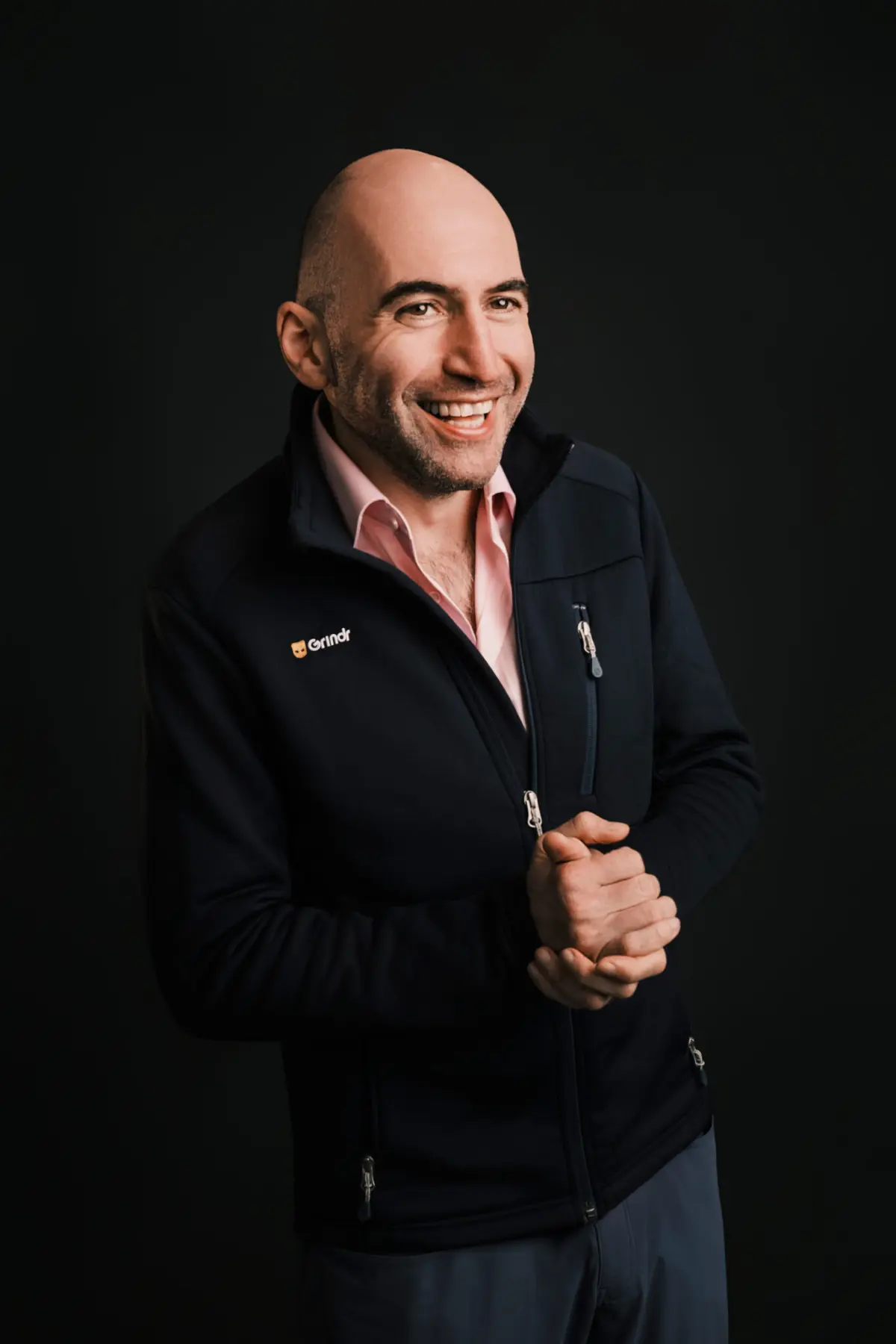
When George Arison stepped into the chief executive role at Grindr in 2022, he inherited a corporate entity caught in the crosshairs of geopolitical wrangling, private equity rescue missions, and acute operational drift. Once passed between Chinese ownership groups before facing a forced national security divestiture, Grindr was functioning as a cash-generating anomaly. It possessed immense liquidity and a near-monopoly on its core demographic, yet it operated entirely devoid of a coherent product roadmap, engineering vision, or long-term business strategy.
Fast-forward to today: following a public market debut via a Special Purpose Acquisition Company (SPAC) and a polarizing return-to-office mandate, Grindr has shed its identity as a rudderless utility. Under Arison’s leadership, the company has orchestrated a financial and operational turnaround that has captured Wall Street’s attention. Guided revenue for the current fiscal year is projected to surpass $540 million—a staggering leap from the $195 million recorded in 2022. Simultaneously, adjusted EBITDA margins have consistently hovered above 40%, cementing the platform’s status as a high-margin consumer tech powerhouse.
Yet, this transformation has not been achieved through explosive user acquisition. Instead, Grindr’s expansion has relied almost entirely on extracting higher value from its existing demographic. Out of a total user base hovering around 15.5 million, only roughly 1.4 million users—about 9%—pay for premium tiers. By optimizing Average Revenue Per User (ARPU) and rolling out sophisticated feature sets, Arison has successfully weaponized monetization.
Now, the company is looking toward its next frontier. Grindr is actively pivoting away from its legacy reputation as a pure-play hookup app to manifest an ambitious new vision: becoming the "gayborhood in your pocket." This strategy seeks to transform the application into an all-encompassing lifestyle ecosystem that bridges digital romance, physical travel, and essential healthcare. However, as the platform prepares to launch controversial, ultra-premium subscription tiers and leans heavily into AI-driven automation, it faces a dual battle: convincing skeptical users of its newfound value proposition while breaking through institutional bias on Wall Street.
Detailed Chronology: From Corporate Drift to Strategic Focus
The Inherited Crisis (2022)
Grindr’s history prior to Arison’s tenure was plagued by regulatory turmoil and structural instability. Following its acquisition by Chinese gaming firm Beijing Kunlun Tech in 2016, the Committee on Foreign Investment in the United States (CFIUS) ordered a forced divestiture over data security concerns. This culminated in a private-equity rescue buyout, ultimately leading to a 2022 SPAC listing.
When Arison took the helm, the company was bloated in certain administrative areas yet starved of technical execution. During the peak COVID-19 era, hiring practices had grown lax, fostering an institutional culture where average daily output frequently languished at three to four hours of actual work.
The Operational Overhaul (2023)
To correct course, Arison instituted radical cultural changes. In the summer of 2023, leadership mandated a return-to-office policy requiring employees to be physically present two days a week. The directive sparked intense internal pushback and broad media coverage, resulting in a wave of voluntary departures. The company’s headcount contracted to approximately 70 employees in the immediate aftermath. Today, the organization operates with lean, highly disciplined teams: roughly 175 U.S.-based employees supplemented by an operational hub in Colombia. Remarkably, only about 25 pre-Arison employees remain at the company, yet this streamlined workforce is on track to generate more than half a billion dollars in revenue.
Scaling and Diversification (2024–Present)
Having stabilized corporate infrastructure, leadership turned its attention to product innovation. By refining existing subscription offerings (such as XTRA and Unlimited) and improving conversion funnels, management pushed pay conversion rates from under 6% to over 9%, nearly doubling ARPU. Concurrently, the firm began laying the groundwork for its ecosystem expansion, introducing cash-pay health products under the "Woodwork" brand and laying plans for international PrEP access campaigns.
Supporting Context & Metrics: The Financial and Technological Engine
Financial Trajectory and Margin Health
Grindr’s financial performance under Arison defies the broader malaise affecting consumer social applications. While legacy dating portfolios struggle with user fatigue and plateauing engagement, Grindr’s revenue is on pace to roughly triple within a four-year window.
| Metric | 2022 Baseline | Current / Projected Guidance |
|---|---|---|
| Annual Revenue | $195 Million | $540 Million+ |
| Adjusted EBITDA Margins | ~40% | Maintained >40% |
| Paying User Base | <6% Conversion | ~9% Conversion (~1.4M users) |
| Subscription Share of Revenue | ~86% | ~83% (Diversifying) |
Despite subscriptions experiencing a slight percentage dip in overall revenue contribution—moving from 86% down to 83%—subscription absolute dollar volume has surged dramatically. This minor dilution reflects the deliberate, early-stage scaling of alternative monetization verticals, including digital advertising and nascent health services.
The Lean Engineering Culture and Artificial Intelligence
One of the most remarkable aspects of Grindr’s modern iteration is the efficiency of its technical apparatus. The entire core product is managed by an engineering and technical team of just 94 to 95 individuals.
This hyper-lean operation has been achieved through the aggressive adoption of generative AI tools. According to Arison, approximately 80% of Grindr’s codebase is now written with the assistance of AI. This technological leverage has yielded a 2.5-fold increase in engineering productivity year-over-year, allowing a staff of roughly 100 technical employees to output the functional workload traditionally requiring a team of 300 to 350.
The "EDGE" Controversy and Pricing Elasticity
Grindr’s integration of advanced artificial intelligence extends directly to its monetization strategy. Later this year, the platform is rolling out a flagship, AI-driven subscription tier provisionally titled "EDGE."
The tier recently sparked fierce online debate after test pricing surfaced in select international markets—such as Canada—where rates translated to roughly $350 to $375 USD per month. Social media forums erupted with indignation, with users asking who could possibly justify such an expenditure and calling for a return to the app’s simpler 2012 roots.
Arison clarifies that the figures cited in public forums were merely test points on a wider pricing spectrum designed to measure user elasticity rather than a finalized cost structure. Positioned above the existing XTRA ($23.99) and Unlimited ($44.99) tiers, EDGE does not sell AI as a standalone novelty. Instead, it utilizes machine learning algorithms to process behavioral intent and historical preferences—with explicit user consent—to facilitate hyper-targeted matchmaking that transcends sparse user profiles. Arison compares the tier to luxury automotive models like the Tesla Model S or X: an ultra-premium flagship whose underlying technological capabilities will eventually cascade down to benefit the broader, lower-tier user base.
Official Statements & Insights: Q&A with CEO George Arison
In a detailed interview, Arison discussed the operational hurdles of transforming Grindr, the realities of AI integration, and the persistent institutional skepticism facing the company’s stock.
You came in to run Grindr in 2022 when it was pretty adrift. What was the first thing you wanted to prioritize?
"Three things, really. First, company building. A lot of people had been hired during the peak-COVID era when expectations for in-office productivity were low, and average output was maybe three to four hours of real work a day. We brought people back to the office two days a week in the summer of 2023—a decision that got a lot of press and a lot of anger. We went down to about 70 employees as a result. Today only around 25 people who were here before I arrived still work at Grindr, and we run lean: 175 U.S. employees plus a team in Colombia, doing $540 million in guided revenue this year.
Second was driving revenue growth by shipping product people would actually pay for—that’s how pay conversion went from under 6% to over 9%, and ARPU nearly doubled. Third was setting a long-term vision: the ‘gayborhood in your pocket’ idea, and everything else—healthcare, travel—that flows from it."
You’ve said Grindr’s engineering culture is underrated. How small is the team actually running this?
"About 94 or 95 people across all technical roles. A large-tech-company CEO once told me AI would let me do with far fewer people what I thought I’d need 300 to 350 for—he was right. We’re doing roughly 350 people’s worth of work with about 100. Something like 80% of our code is now AI-written, and we’ve seen a 2.5x increase in engineering productivity over the past year."
Grindr tested an AI-powered premium tier, EDGE, at a price that in Canada worked out to roughly $350–$375 a month in U.S. dollars. What actually happened there?
"We haven’t released EDGE—we’re testing it, and some people have access as part of that test. It sits above our existing XTRA ($23.99) and Unlimited ($44.99) tiers. We’re not selling AI itself; we’re selling features derived from it—using what we know about a user’s behavior and intent, with consent, to make much better matches than a sparse profile ever could. Retention on these features so far is higher than anything we’ve had before.
The pricing people quoted was one test point among several—we ran a range to understand elasticity, not a final price. EDGE goes live toward the end of this year or early next, and we’ll know where it lands by then. We think of it like a Tesla Model X or S: a premium flagship now, with the underlying capability rolling down to the broader product over time."
On the matching itself—you’ve described using AI to suggest partners outside someone’s home city. What evidence do you have that those lead anywhere?
"Even in San Francisco, where the share of the gay population is higher than almost anywhere else in the country, you’re talking about maybe 50,000 to 60,000 gay people total. That’s not a big pool to be fishing in if you’re trying to find a partner, and it’s a big reason dating is so hard for gay men generally. So yes—what if AI could break down the geographic constraint entirely, and surface someone in St. Louis who actually matches what you want, based on real behavior rather than what people say in a profile?
As for whether it leads anywhere real: we don’t track people’s relationships after the fact—that’s going too far. What we do know is that Grindr is where most gay men say they meet each other for relationships, and that younger cohorts want something different than older ones did: about 50% of gay men under 35 say they want a long-term monogamous relationship, and 25% say they want children—numbers that would have been unthinkable for my own generation. When you ask people why they’re not in a relationship, the answer is usually that they have a hard time finding a partner. I can’t promise this solves that. But it’s worth trying something new, because what’s been done so far clearly hasn’t solved it."
There are so many ways to expand your addressable market. Can you tell us more about healthcare?
"We started with cash-pay products through a line we call Woodwork—ED medications, GLP-1s, peptides, and so on—because cash-pay was the simplest place to get going, and we just launched an AI bot that handles the whole transaction inside the app rather than sending people out to Woodwork.com. The second bucket is HIV prevention and treatment: we’ve committed to giving 10 million people direct access to information on where to get PrEP, both in the U.S., where we already offer that in our in-app health center, and internationally.
The third bucket—actual clinical care, like connecting people to a gay doctor through telehealth—is very much long-term. That’s not something we’re building today, but I do think there’s a world, a decade out, where healthcare is a bigger revenue stream for Grindr than what we do today."
You’ve said investors still apply a ‘Grindr discount’ to the stock. But the stock is up sharply, and major investment houses have upgraded it. Isn’t the market telling you the discount is gone?
"I hope we’re being treated as a growth company at this point—we’ve grown revenue more than 25% for 16 straight quarters as CEO, so there’s reason to expect that. The stigma conversation is a real one; we’ve had a consulting firm decline to work with us over reputational concerns, and a bank refuse our money during the Silicon Valley Bank crisis, even as other major banks like Goldman and Morgan Stanley have been strong partners. I think a lot of that is really about Grindr being a gay dating product rather than dating being controversial per se—nobody says that about Tinder, which literally has a ‘free tonight’ button on its homepage. But I’d agree the market’s read on us has clearly improved."
Future Outlook: The "Gayborhood in Your Pocket"
As Grindr looks toward the horizon, its strategic roadmap centers squarely on ecosystem expansion. The concept of the "gayborhood in your pocket" is designed to transition the software utility from a transactional matching tool into an indispensable daily infrastructure for the global LGBTQ+ community.
1. Healthcare Integration and Telehealth Expansion
The integration of healthcare services represents the most structurally significant long-term bet for the company. By embedding asynchronous treatment pathways—ranging from lifestyle medications (GLP-1s, erectile dysfunction therapies) to critical preventative care access (PrEP location tracking)—Grindr is positioning itself as a trusted health navigator. Over the next decade, leadership envisions scaling these touchpoints into fully integrated clinical care solutions, connecting patients directly with culturally competent LGBTQ+ medical professionals via telehealth partnerships.
2. Travel and Community Discovery
Beyond romance and healthcare, the company is eyeing the travel sector as an organic extension of its core network architecture. By enabling users to seamlessly discover community, local insights, and social infrastructure wherever they travel globally, Grindr aims to capture transactional volume currently lost to traditional hospitality and tourism aggregators.
3. Conquering Institutional Stigma
Despite bullish sentiment from heavyweights like Morgan Stanley, Goldman Sachs, and Raymond James—all of which have raised price targets and upgraded stock valuations over the past year—the "Grindr discount" remains a psychological and financial hurdle. Trading at roughly 11 times projected 2027 EBITDA, the stock continues to sit at an approximate 35% discount relative to broader consumer tech peers.
Overcoming this valuation gap will require sustained execution. If Arison and his lean engineering team can successfully launch the EDGE subscription tier without alienating their core base, while simultaneously scaling nascent verticals in healthcare and travel, Grindr may finally compel institutional markets to evaluate it not through the lens of historical stigma, but as a textbook study in modern digital growth and product innovation.






Belum ada komentar. Jadilah yang pertama berkomentar!