

Executive Overview
Spring in Northern Japan arrives not as a whisper, but as a sweeping, synchronized awakening. Nowhere is this more vividly expressed than in Yamagata Prefecture, a region where topography and history intersect to create one of the most dynamic hanami (cherry blossom viewing) landscapes in the Japanese archipelago. Bounded by rugged mountain ranges, sculpted by winding river systems, and steeped in the lore of samurai clans and feudal domains, Yamagata offers a cherry blossom season that transcends mere aesthetic appreciation. It is a living archive of agrarian tradition, urban planning, and ecological resilience.
While metropolitan hubs like Tokyo and Kyoto command the lion’s share of international media attention during the spring bloom, Yamagata presents an alternative narrative. Because of the prefecture’s dramatic variations in elevation—ranging from coastal plains along the Sea of Japan to high-altitude plateaus like Nishi Zao—the viewing window here is uniquely extended. The season unfurls progressively from mid-April through early May.
This comprehensive report examines Yamagata’s top ten sakura destinations, contextualizing them within their historical, architectural, and environmental frameworks. Designed for cultural travelers, travel industry professionals, and Japan enthusiasts alike, this guide explores how the prefecture leverages its natural assets and heritage sites to offer an authoritative blueprint for an unforgettable spring excursion.
Detailed Chronology and Destination Profiles
The sequential progression of the cherry blossom front across Yamagata Prefecture mirrors its geographic elevation and historical settlement patterns. Below is an exhaustive breakdown of the top ten designated sites, detailing their botanical makeup, historical provenance, and seasonal highlights.
1. Hiyoriyama Park: Maritime Heritage and Coastal Sunsets (Sakata City)
- Peak Viewing: Mid- to late April
- Botanical Highlights: Approximately 400 trees, featuring single-petaled Somei Yoshino and graceful weeping cherries (shidarezakura).
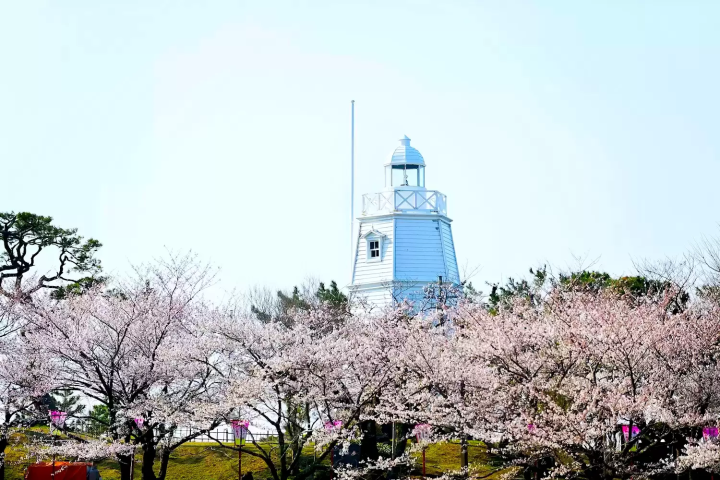
Perched along the windswept coastline of Sakata City, Hiyoriyama Park serves as an evocative monument to Japan’s Edo- and Meiji-era maritime commerce. Historically, this bluff overlooked the bustling operations of the Kitamaebune—the historic trading ships that navigated the Sea of Japan to move cargo between Osaka and Hokkaido. Today, the park honors this legacy by housing a half-scale replica of a trading vessel alongside what is recognized as Japan’s oldest wooden hexagonal lighthouse.
As spring arrives, the arrival of 400 blooming cherry trees softens the industrial and nautical architecture of the park. When dusk settles, the convergence of illuminated paper lanterns, the historic lighthouse, and unobstructed panoramic vistas of the Sea of Japan creates a striking visual contrast. The Sakata Hiyoriyama Cherry Blossom Festival anchors this period, drawing visitors seeking both photographic compositions and a tactile connection to Japan’s coastal trading history.

2. Kajo Park: A Moated Stronghold of 1,500 Trees (Yamagata City)
- Peak Viewing: Mid-to-late April
- Botanical Highlights: Roughly 1,500 trees, including ancient specimens exceeding six centuries in age.
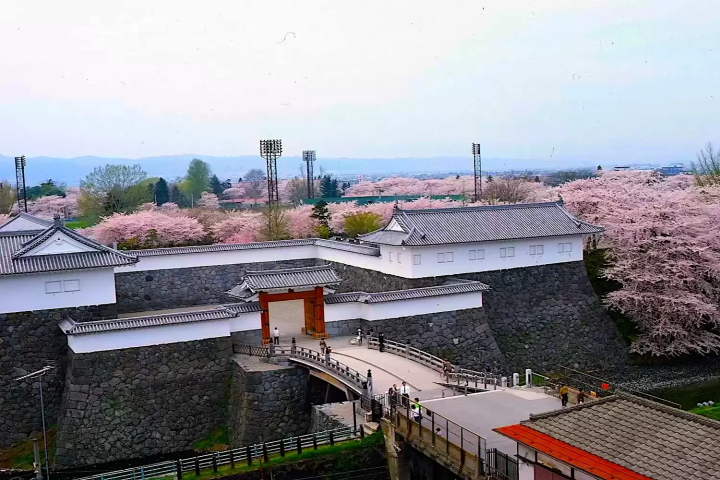
Occupying the sprawling footprint of the former Yamagata Castle—originally expanded during the Sengoku period by the formidable warlord Mogami Yoshiaki—Kajo Park is a masterclass in urban historical preservation. Designated as a national historic site, the park retains its formidable stone walls, defensive moats, and the reconstructed Ninomaru East Gate.
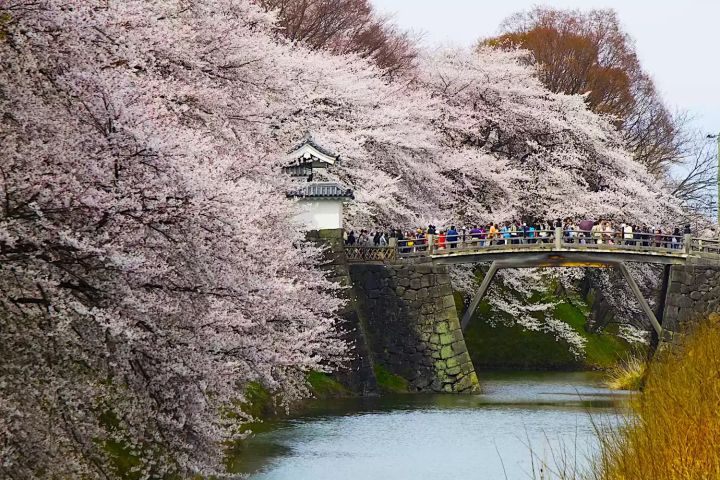
Within these fortifications stand 1,500 cherry trees. The visual interplay between the jagged grey stone masonry, the reflective dark waters of the moats, and the billowing clouds of pink and white blossoms establishes Kajo Park as Yamagata City’s premier hanami anchor. Cultural enrichment is omnipresent here; the grounds also host the Yamagata Prefectural Museum, the Yamagata Museum of Art, and the Old Saiseikan—a striking Meiji-era architectural marvel relocated from the former city hospital. Nighttime illuminations (yozakura) further elevate the site, casting long, dramatic reflections across the water.
3. Eboshiyama Park: The Millennium Sanctuary of Nanyo (Nanyo City)
- Peak Viewing: Mid- to late April
- Botanical Highlights: Approximately 1,000 trees, anchored by century-old Edohigan specimens.
Formally recognized as one of Japan’s Top 100 Cherry Blossom Spots, Eboshiyama Park in Nanyo City is the southern terminus of the celebrated Okitama Sakura Corridor. Situated within the sacred precincts of Eboshiyama Hachiman Shrine, this sanctuary has commanded spiritual and ecological reverence since the Edo period.
Affectionately dubbed the "Eboshiyama Senbonzakura" (Thousand Sakura Trees), the park boasts an exceptional density of ancient Edohigan cherry trees—a native wild species renowned for its longevity. The approach to the shrine features a natural floral tunnel framed by weathered stone torii gates and centuries-old trunks. Coinciding with the peak bloom, the Akayu Onsen Cherry Blossom Festival invites visitors to combine their botanical explorations with a therapeutic soak in the neighboring hot spring district.

4. Mamigasaki Sakura Line: Riverfront Tunnels and Mountain Panoramas (Yamagata City)
- Peak Viewing: Mid- to late April
- Botanical Highlights: A linear plantation of roughly 200 trees lining the riverbanks.
Tracing the course of the Mamigasaki River, which historically functioned as part of the outer defenses for Yamagata Castle, the Mamigasaki Sakura Line transforms an urban waterway into a sweeping corridor of color.
Two hundred carefully managed cherry trees flank the river embankment, creating an unbroken canopy that arches over the adjacent roadway. Motorists and pedestrians alike are treated to a dynamic visual pairing: vibrant pink blossoms in the foreground contrasting against the snow-dappled peaks of the majestic Zao Mountain Range in the distance. Evening illuminations turn the roadway into an ethereal tunnel of light, making it a favorite destination for evening drives and leisurely riverbank strolls.
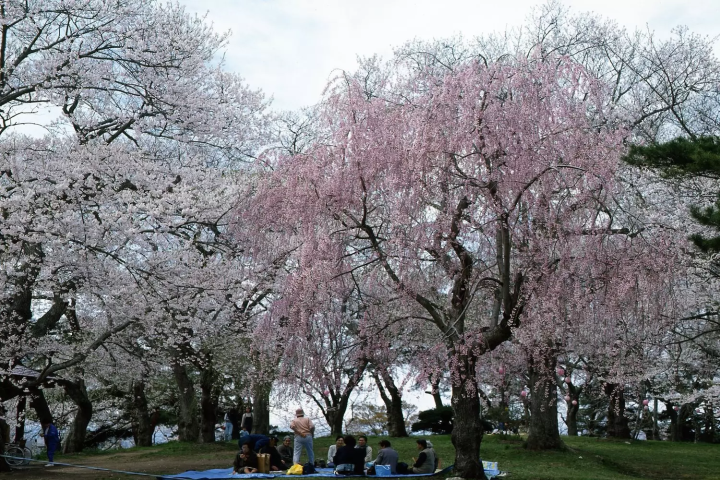
5. Kaminoyama Castle and Tsukioka Park: Hilltop Vistas and Thermal Springs (Kaminoyama City)
- Peak Viewing: Mid- to late April
- Botanical Highlights: Approximately 200 Somei Yoshino trees.
Rising above the historic hot spring town of Kaminoyama, Tsukioka Park occupies the elevated grounds of the region’s former feudal seat. While the original fortification dates back to the Warring States period, the reconstructed castle keep now functions as a local history museum.
The park grounds wrap around the castle architecture, populated by some 200 Somei Yoshino cherry trees. Because of its elevated perch on the hillside, visitors are rewarded with expansive vistas overlooking the steaming onsen town below, framed by a foreground of delicate spring petals. The harmonious integration of historical exhibits, family-friendly recreational spaces, and nighttime illumination programs makes this an accessible yet deeply rewarding stop on any Yamagata itinerary.

6. Tendo Park (Mount Maizuru): Panoramic Vistas and Living Shogi (Tendo City)
- Peak Viewing: Mid- to late April
- Botanical Highlights: Roughly 2,000 trees blanketing the mountain slopes.
Rising directly behind the hot spring city of Tendo, Mount Maizuru—the site of a former Sengoku-era fortress—has been systematically cultivated into a monumental cherry blossom destination. Initiated by local visionaries as early as 1902, generations of residents have planted roughly 2,000 trees across the mountainside, earning the site a coveted spot among Japan’s Top 100 Cherry Blossom locations.
Tendo is internationally renowned as the capital of Japanese chess (shogi) piece production. Capitalizing on this identity, the park plays host to the famous Tendo Cherry Blossom Festival in mid-April. Its signature event, "Human Shogi" (Ningen Shogi), features participants clad in full samurai armor and elaborate court kimonos acting as living pieces on a giant outdoor board—a dramatic synthesis of military history and botanical celebration.

7. Nishi Zao Oyama Sakura: A 500-Year-Old Botanical Titan (Yamagata City)
- Peak Viewing: Late April to early May
- Botanical Highlights: A single, monumental Edohigan specimen standing 18 meters tall with a 5-meter trunk circumference.
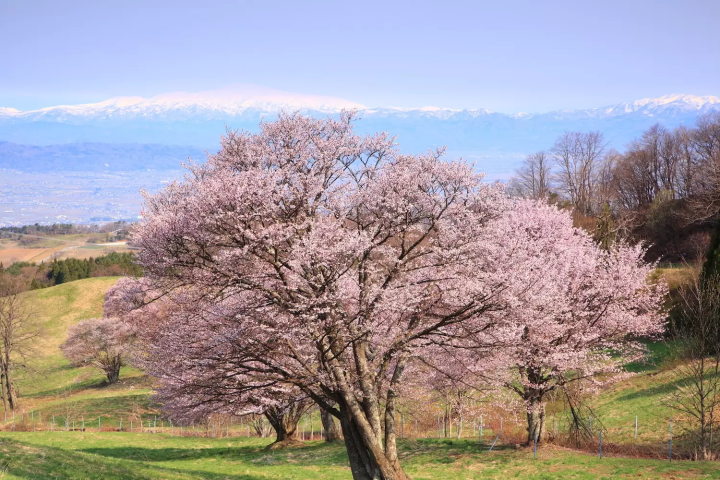
Breaking away from clustered groves and urban parks, the Nishi Zao Oyama Sakura represents a masterclass in individual botanical majesty. Located on the high-altitude Nishi Zao Plateau, this wild Edohigan tree is estimated to be approximately 500 years old.
Having taken root long before the establishment of the Tokugawa Shogunate, the tree stands as a silent witness to centuries of regional transformation. Reaching a height of 18 meters with a massive root-to-branch presence, it blooms considerably later than its urban counterparts due to the plateau’s alpine climate. Requiring a brief 20-minute hike across upland meadows from the nearest parking area, this ancient sentinel allows travelers to experience authentic cherry blossom viewing well into Golden Week.

8. Tsuruoka Park: Moat Reflections and Shonai Region Festivities (Tsuruoka City)
- Peak Viewing: Mid- to late April
- Botanical Highlights: Approximately 730 trees, blending Somei Yoshino, weeping cherries, and double-flowered Yaezakura.
Constructed upon the historic ruins of Tsurugaoka Castle—once the seat of the powerful Shonai Domain—Tsuruoka Park is officially designated as one of Japan’s Top 100 Cherry Blossom Spots. Housing roughly 730 meticulously maintained trees, the park offers a diverse botanical palette that transitions gracefully from single-petaled varieties to fluffy double-flowered late bloomers.
The physical layout of the park—characterized by sprawling earthen ramparts, stone-lined moats, and preserved Meiji-era architectural structures—provides an exceptional canvas for photographers. During the Tsuruoka Cherry Blossom Festival, the grounds come alive with traditional food stalls and bustling crowds, while evening light-ups cast a warm, reflective glow across the tranquil waters of the castle moat.
9. Matsugasaki Park: Samurai Lore and Uesugi Heritage (Yonezawa City)
- Peak Viewing: Mid- to late April
- Botanical Highlights: Around 200 trees encircling the historic castle moat.
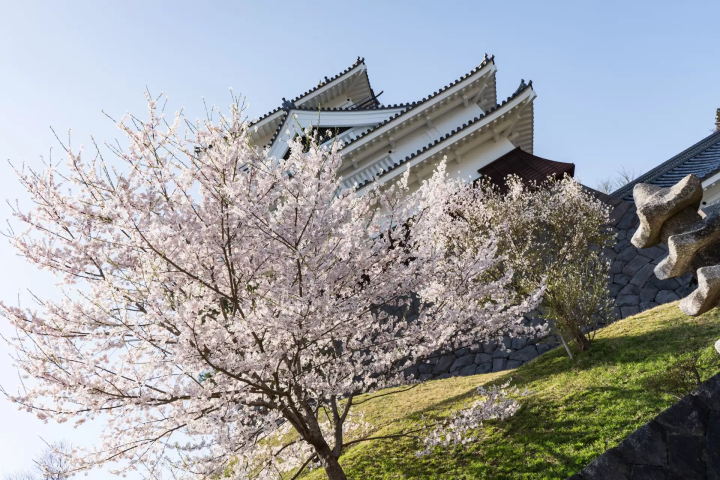
Set within the inner fortifications of the historic Yonezawa Castle in the southern reaches of the prefecture, Matsugasaki Park is inextricably linked to the legacy of the legendary warlord Uesugi Kenshin. The park grounds house Uesugi Shrine, drawing historians, martial arts enthusiasts, and cultural pilgrims year-round.
Approximately 200 cherry trees trace the geometric perimeter of the castle moats. When these trees reach peak bloom, their soft petals cascade toward the water’s edge, establishing a serene aesthetic that contrasts sharply with the martial history of the Uesugi clan. The park serves as the epicenter for the annual Yonezawa Uesugi Festival, which features theatrical battle reenactments, historic processions, and traditional drumming performances.

10. Kuratsu River Weeping Sakura: Cascading Urban Canopies (Tendo City)
- Peak Viewing: Mid- to late April
- Botanical Highlights: A 1.4-kilometer continuous promenade featuring roughly 200 weeping cherry trees (shidarezakura).
Concluding our regional survey is the Kuratsu River promenade in Tendo City. Born from a deliberate civic greening initiative, this linear park stretches for 1.4 kilometers along both banks of the river just south of the municipal hall.
Unlike standard upright cherry trees, the selection here consists entirely of weeping varieties. Their sweeping, flexible branches droop gracefully toward the water, creating a continuous, arched floral tunnel. When illuminated at night over a targeted 750-meter stretch, the shimmering reflections on the river surface produce an intimate, romantic atmosphere that concludes the prefecture’s primary viewing circuit with quiet elegance.

Supporting Context and Regional Metrics
To fully appreciate the scope of Yamagata’s cherry blossom landscape, one must analyze the environmental and logistical factors that govern the region:
- Elevation-Driven Longevity: Because Yamagata’s terrain varies dramatically from sea-level coastal ports (like Sakata) to high-altitude inland plateaus (like Nishi Zao), the local cherry blossom season is effectively stretched from a standard two-week window to nearly a full month (mid-April to early May). This topographical variance allows travelers to systematically "chase" the bloom northward and upward.
- Historical Continuity: Eight of the ten featured locations are anchored directly to historical castle ruins, samurai strongholds, or ancient shrine grounds. This integration reflects centuries of deliberate arboriculture, wherein regional lords and local communities utilized cherry trees to project permanence, honor deities, and soften martial architecture.
- Economic and Cultural Impact: Festivals such as Tendo’s Ningen Shogi and Yonezawa’s Uesugi Festival drive significant domestic and international tourism, injecting vital revenue into local hospitality, hot spring (onsen) ryokans, and artisanal craft industries.
Official Statements and Industry Insights
Regional tourism authorities and municipal cultural boards have increasingly emphasized the synergy between natural heritage and historical preservation. In recent strategic planning briefs, tourism development officials in Yamagata have noted:

"The cherry blossoms of Yamagata are not merely seasonal attractions; they are living testaments to our regional identity. By pairing centuries-old arboreal specimens with the preserved architectures of our feudal past—such as the moats of Kajo Park or the sacred precincts of Eboshiyama—we offer visitors an authentic, multi-layered cultural experience that cannot be replicated in modern urban centers."
Furthermore, conservation groups managing sites like the 500-year-old Nishi Zao Oyama Sakura emphasize the rigorous maintenance required to sustain these botanical landmarks. Local arborists coordinate regular soil aeration, structural cabling, and disease monitoring to ensure that these ancient trees survive environmental shifts for generations to come.
Future Outlook: Sustainable Tourism and Strategic Development
As international interest in regional Japanese destinations surges, Yamagata Prefecture faces both an opportunity and a stewardship challenge. The future outlook for cherry blossom tourism in the region hinges on sustainable infrastructure development and crowd management.
- Spread-Pattern Itinerary Promotion: Tourism agencies are actively encouraging multi-stop itineraries that leverage the elevation-based timeline. By guiding visitors away from singular congestion points and distributing them across the prefecture’s diverse latitudinal zones, local authorities aim to minimize environmental wear on sensitive park roots while maximizing economic benefits for rural communities.
- Enhanced Accessibility: Infrastructure upgrades focusing on barrier-free walking paths, multilingual digital wayfinding, and coordinated public transportation links are currently underway across major sites like Tsuruoka Park and Kajo Park.
- Preservation Funding: Public-private partnerships are expanding to secure dedicated funds for the continuous maintenance and cloning of endangered historic cherry tree varieties, ensuring that the historical lineage of Yamagata’s canopy remains unbroken.
By harmonizing rigorous ecological stewardship with strategic cultural tourism, Yamagata Prefecture is well-positioned to remain an authoritative, premier destination for travelers seeking the definitive Japanese spring experience.








Belum ada komentar. Jadilah yang pertama berkomentar!