

In the fast-evolving landscape of artificial intelligence, the defining constraint of our time has shifted from computational power to data abundance. While large language models (LLMs) gorged themselves on the digitized history of human text scraped from the internet, general-purpose physical robots face a much harsher reality: there is no web equivalent for the physical world.
Enter XDOF, a stealth-born startup that has quietly positioned itself as the indispensable bottleneck-breaker for the robotics revolution. Just three months after emerging from stealth mode and announcing a $70 million Series A round in June, XDOF is already in late-stage negotiations for a massive Series B funding round. Led by prominent venture capital firm 8VC, the new financing values the nascent data infrastructure provider at an astonishing $1.2 billion, catapulting the company into elite unicorn status at breakneck speed.
The valuation is not a product of speculative hype alone; it is fueled by a hyper-aggressive revenue trajectory. XDOF’s annualized revenue is already hurtling toward the $50 million milestone, driven by early contracts with roughly 20 tier-one customers, including several of the world’s leading frontier AI laboratories. By acting as an outsourced data-supply chain, XDOF solves the dirty, unglamorous, yet existential problem of robot training: collecting millions of hours of real-world teleoperation and human movement data.
Often described by investors as the "Scale AI or Mercor for physical robotics," XDOF is rapidly building out the pipelines, annotation systems, and collection tools that robotics companies cannot efficiently build themselves. As the artificial intelligence industry races to bridge the chasm between digital smarts and physical dexterity, XDOF is positioning itself as the tollbooth for the future of embodied AI.
Detailed Chronology: From UC Berkeley Labs to Unicorn Velocity
The Academic Genesis: GELLO and the Data Desert
The foundational roots of XDOF trace back to the rigorous robotics laboratories of the University of California, Berkeley. While pursuing his Ph.D., co-founder Philipp Wu found himself repeatedly stalled by a singular, frustrating bottleneck: the absolute scarcity of large-scale, high-quality physical datasets required to teach robots how to interact dynamically with the real world.
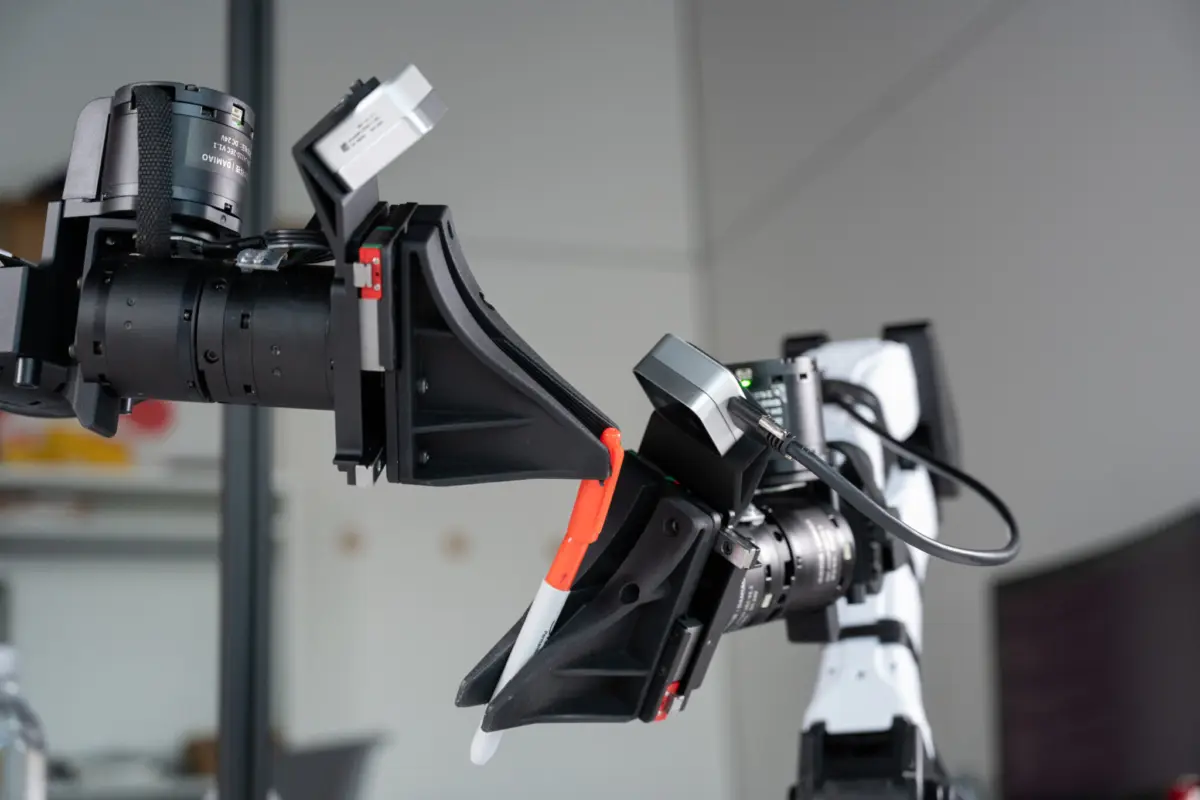
Traditional machine learning requires vast troves of training data, but standard robotics development was mired in slow, expensive, and bespoke data collection methods. Recognizing that academic labs could never scale data acquisition on their own, Wu joined forces with fellow researcher Fred Shentu. Together, they developed GELLO—a low-cost, open-source teleoperation system designed to let human operators remotely control robotic arms with high precision, thereby generating vast quantities of clean training data.
Their subsequent academic research paper sent shockwaves through the robotics community, establishing a reliable, cost-effective framework for capturing dexterous manipulation data. This academic breakthrough laid the technical and philosophical blueprint for what would eventually become XDOF, founded by Wu (CEO) and Shentu (CTO) in 2024.
Stealth, the $70 Million Series A, and Sudden Growth
XDOF operated under the radar for much of its early lifecycle, refining its technology and establishing initial enterprise relationships. The startup officially emerged from stealth in mid-2024, culminating in a heavily publicized $70 million Series A funding round in June, which featured participation from premier venture capital heavyweights including Thrive Capital, Andreessen Horowitz, Lux Capital, and Spark Capital.
At the time of the Series A, XDOF leadership had envisioned a standard operational runway, fully expecting to deploy their capital over a traditional 18-to-24-month horizon before returning to the market for additional funding. However, the sheer velocity of the market’s demand for physical AI data fundamentally upended those plans.
Propelled by an annualized revenue run-rate closing in on $50 million, venture capital firms quickly swarmed the startup, eager to buy into its growth engine. This intense inbound investor pressure catalyzed the ongoing late-stage Series B talks led by 8VC. While deal terms remain fluid, and the exact quantum of capital being raised has not yet been publicly finalized, the $1.2 billion valuation underscores the fierce race among venture capitalists to secure stakes in foundational AI infrastructure. Neither XDOF nor 8VC responded to requests for comment regarding the transaction.
Supporting Context & Metrics: The Mechanics of Physical Data Collection
The Architectural Blueprint: Why Robotics Needs Its Own Scale AI
During the early years of the generative AI boom, companies like Scale AI achieved massive valuations by building the data-labeling factories that trained LLMs and multimodal models. They hired armies of human annotators to clean text, tag images, and align conversational outputs.
Physical robotics, however, presents an exponentially more complex set of challenges. A robot cannot simply read the internet to learn how to fold laundry, pack shipping boxes, pour coffee, or navigate uneven terrain. It requires real-world physical interaction data—often called teleoperation data—which records how humans manipulate objects in three-dimensional space.
XDOF’s business model capitalizes on this vacuum. By establishing proprietary data pipelines, collection tools, and annotation frameworks, XDOF bridges the gap between raw hardware and advanced neural networks. Investors and industry analysts frequently draw parallels between XDOF and digital data giants, noting that just as Scale AI accelerated the LLM boom, XDOF is providing the essential raw materials required to commercialize general-purpose humanoid and multi-purpose robots.
The Global Data-Collection Machine: Teleoperation and Egocentric Sensors
Collecting robotic training data is famously labor-intensive, requiring a blend of advanced hardware engineering and global human operations management. XDOF has engineered a multifaceted data-harvesting apparatus that combines remote robot teleoperation with human-centric motion capture.
To build its vast datasets, XDOF relies on two primary methodologies:
- Remote Teleoperators: Human technicians situated globally who steer robotic systems remotely via interface devices (such as Wu and Shentu’s GELLO framework), executing intricate physical maneuvers that are recorded at high frequencies.
- Egocentric Human Collectors: Human workers equipped with advanced body sensors, spatial cameras, and wearable telemetry rigs who perform everyday manual tasks—such as folding clothes, sorting inventory, and flattening corrugated boxes—to capture natural human kinematics and motion strategies.
This dual approach allows XDOF to harvest both robot-specific execution data and human-demonstration datasets, translating organic human movement into actionable training weights for machine learning models.
Landmark Partnerships: The ABC Dataset and Frontier Labs
XDOF’s operational capabilities are further bolstered by high-profile academic and industrial collaborations. Most notably, the startup has partnered with the UC Berkeley AI Research (BAIR) lab to curate and release what is widely believed to be the largest, highest-quality repository of robot training data ever assembled, designated as the ABC dataset.
This open collaboration provides the broader scientific community—along with XDOF’s paying enterprise clients—with a foundational dataset that accelerates research and development cycles. Coupled with its commercial traction—serving approximately 20 enterprise customers, including multiple elite frontier AI labs—XDOF is rapidly scaling its infrastructure to meet the surging demands of the robotics sector.
Competitive Landscape & Industry Dynamics
While XDOF has captured the lion’s share of early venture capital enthusiasm, it is not operating in an isolated vacuum. The race to supply training data for physical AI is intensifying as venture-backed startups and established incumbents recognize the immense profit potential of the robotics data supply chain.
Direct competitors in the physical data collection space include startups like Mecka AI, which are similarly attempting to build out teleoperation and real-world data capture networks. Furthermore, traditional human-data platforms that originally focused exclusively on digital LLM annotation—such as Scale AI and Micro1—are aggressively expanding their operational footprints into physical robotics, multimodal data collection, and spatial computing annotation.
Despite this burgeoning competition, XDOF’s deep academic pedigree, early traction with tier-one labs, and massive incoming capital injection give it a significant first-mover advantage. By locking in lucrative contracts with the world’s leading robotics developers before the market standardizes, XDOF is well-positioned to cement its status as the definitive data backbone for the physical AI era.
Future Outlook: The Road Ahead for Embodied AI
As XDOF finalizes its landmark $1.2 billion Series B round, the company’s trajectory offers a clear window into the future of enterprise technology and venture capital. The era of pure software dominance is giving way to a hybrid future where artificial intelligence must interface directly with the physical world.
In the immediate term, XDOF plans to deploy its war chest to aggressively expand its global footprint of data collectors. This includes scaling up remote teleoperation teams worldwide and deploying advanced body-sensor networks to capture increasingly complex manual operations.
However, long-term challenges remain. Scaling human-in-the-loop data collection is inherently capital-intensive and operationally complex. Maintaining quality control across thousands of global teleoperators, ensuring data security for frontier AI lab clients, and continuously innovating data-compression and annotation pipelines will be critical tests for founders Philipp Wu and Fred Shentu as they transition XDOF from a high-flying startup into a mature corporate institution.
Ultimately, XDOF’s meteoric rise underscores a profound industrial truth: as companies around the globe race to build the first truly autonomous, general-purpose humanoid robots, the most valuable company in the robotics ecosystem may not be the one building the hardware, but the one supplying the data that brings it to life.








Belum ada komentar. Jadilah yang pertama berkomentar!