

Executive Overview
As the artificial intelligence revolution surges forward, the infrastructure supporting it is hurtling toward a massive physical bottleneck. Data center developers, caught in the crosshairs of an unprecedented demand wave, are projected to pour as much as $4 trillion into new facilities by the end of the decade. Yet, this historic capital expenditure faces severe headwinds. Builders are increasingly constrained not by a lack of capital or ambition, but by the harsh realities of politics, permitting delays, and—most critically—power-grid limitations. Finding a plot of land with the gigawatt-scale power allocation required for modern AI training clusters has become akin to finding a needle in a haystack.
Traditionally, the data center industry has treated the speed of fiber-optic communication as an immutable law of physics. While engineers obsess over optimizing every clock cycle within a Graphics Processing Unit (GPU) and refining the networking switches inside server racks, the speed at which data travels across physical geography has remained bound by the refractive index of glass.
Enter Relativity Networks. In a move that could fundamentally alter the geographical math behind the modern data center buildout, the company is betting that dramatically faster fiber can rewrite the rules of infrastructure development. On Tuesday, Relativity Networks announced a $22 million SAFE (Simple Agreement for Future Equity) note funding round. The financing was spearheaded by prominent deep-tech and venture capital backers, including Rhapsody Venture Partners, Bell Ventures Inc., and Faster Than Glass LLC. Alongside this capital injection, the company secured a massive $40 million follow-on commercial order from a leading hyperscaler that has opted to remain anonymous.
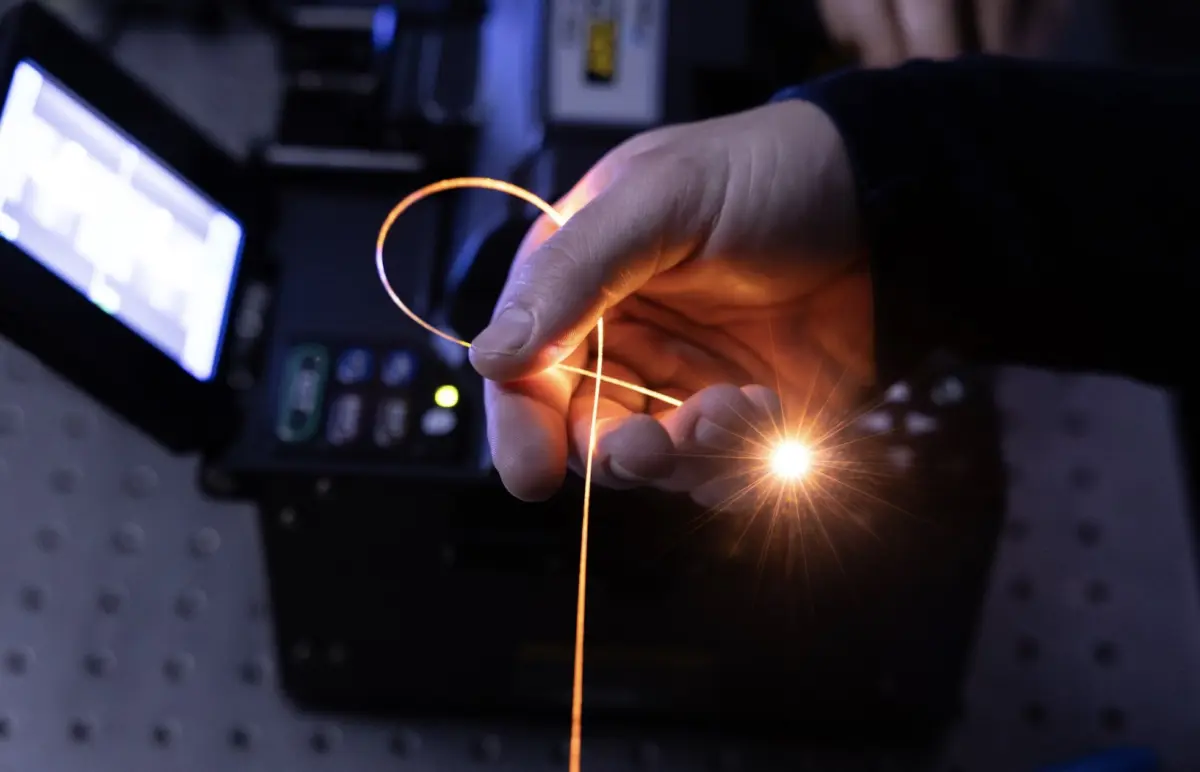
At the heart of Relativity Networks’ thesis is hollow-core fiber, a sophisticated and rarely deployed optical technology. By replacing traditional solid glass cores with air-filled vacuum chambers, hollow-core fiber allows data to travel at speeds roughly 30% faster than conventional fiber-optic lines. For an industry struggling to find contiguous plots of land with sufficient power, this speed boost translates directly into spatial freedom: a 30% increase in allowable distance between facilities before latency becomes a performance bottleneck.
As CEO Jason Eisenholz aptly frames it, the tech sector is transitioning into a new paradigm. The first era of the AI boom optimized raw compute (GPU, GPU, GPU). The second era optimized networking architecture inside the data center to feed that compute. Now, as the physical limits of power grids close in, the industry is entering a third era: optimizing geography.
Detailed Chronology: The Funding, The Technology, and The Hyperscaler Bet
The commercial trajectory of Relativity Networks reached a critical inflection point on Tuesday with the public disclosure of its latest financial and operational milestones. However, the groundwork for this announcement has been laid over years of quiet engineering breakthroughs and strategic supply chain alignment with the world’s largest cloud providers.
The $22 Million SAFE Financing Round
The recent $22 million capital raise utilized SAFE notes—a standard financial instrument in pre-seed and seed rounds that converts into equity during a subsequent priced funding round. The participation of specialized deep-tech venture firms such as Rhapsody Venture Partners and Bell Ventures signals high institutional confidence in a hardware-centric, capital-intensive bet that diverges sharply from typical software-as-a-service (SaaS) investments.
Unlike traditional telecom startups that build consumer-facing broadband infrastructure, Relativity Networks operates in the hyper-specialized domain of high-performance enterprise networking. The funds raised in this round are earmarked for scaling manufacturing processes, refining the structural integrity of hollow-core cables, and preparing for large-scale enterprise deployments.
The $40 Million Hyperscaler Validation
Perhaps more significant than the venture capital backing is the commercial validation represented by a $40 million follow-on order from an unnamed hyperscale cloud provider. In the tech industry, a follow-on order indicates that the buyer has already conducted rigorous proof-of-concept testing, likely deployed initial runs of the technology in live environments, and found the performance metrics compelling enough to commit tens of millions of dollars in follow-on capital.
Hyperscalers—monolithic entities like Microsoft, Amazon, Google, and Meta—are notoriously protective of their supply chains and technological advantages. The fact that a premier hyperscaler is placing multi-million-dollar bets on hollow-core fiber underscores the urgency of their infrastructure dilemmas. They are no longer experimenting with edge technologies; they are actively integrating them to solve existential scaling problems.
Supporting Context & Metrics: The Physics and Economics of Hollow-Core Fiber
To understand why a 30% increase in fiber speed is causing a stir among infrastructure planners, one must examine the fundamental physics of data transmission and the modern topology of AI data centers.
The Physics: Glass vs. Air (Vacuum)
In conventional fiber-optic communication, data is transmitted as pulses of light through a core made of ultra-pure silica glass. While light travels at an absolute speed limit in a vacuum ($c approx 300,000$ kilometers per second), its velocity drops significantly when passing through a medium like glass due to the material’s refractive index (which is roughly $1.5$ for standard optical fiber). Consequently, light in conventional fiber crawls at about two-thirds of its maximum speed, taking approximately five microseconds to traverse a distance of one kilometer.
Relativity Networks utilizes hollow-core fiber, an advanced architectural shift in optical engineering. Instead of a solid glass core, the center of the fiber cable consists of a microscopic air-filled channel or vacuum chamber surrounded by a complex photonic-crystal cladding. Because light travels primarily through air rather than dense glass, the refractive index drops close to $1.0$.
The performance gains are stark:
- Conventional Fiber Latency: ~5 microseconds per kilometer.
- Hollow-Core Fiber Latency: ~3.5 microseconds per kilometer.
- Speed Improvement: Approximately 30% reduction in latency.
The Scale of Modern AI Workloads
To appreciate why microseconds matter, one must examine how artificial intelligence workloads have evolved. In the early days of deep learning, neural networks could be trained on a single rack of GPUs. Communication latency between chips within the same chassis or rack was negligible.
However, modern frontier models—such as GPT-4 successors, multimodal foundational models, and massive reasoning engines—require clusters comprising tens of thousands of GPUs working in absolute synchronization. When thousands of processors are crunching interdependent matrix multiplications simultaneously, any delay in data transfer forces expensive compute nodes to idle, severely degrading training efficiency.
As a result, modern AI data centers have ballooned in physical size. A single campus now routinely spans hundreds of acres, incorporating dozens of sprawling buildings. Within these boundaries, standard fiber latency can become a bottleneck. More importantly, because a single plot of land rarely offers the hundreds of megawatts—or gigawatts—required by hyper-scale AI clusters, companies are forced to distribute their compute workloads across multi-campus deployments.
As CEO Jason Eisenholz explained:
"The largest systems are distributing the compute across multiple campuses to reach the power that exists. They’re moving to where the warm shell is, but they still need to operate as one synchronized machine."
Alleviating the Spatial Logic of the Power Grid
The data center industry is currently colliding with a severe macroeconomic wall: the electrical grid. Utilities across North America and Europe are struggling to keep pace with the exponential surge in power demand driven by AI. Securing a grid interconnection queue can take anywhere from three to seven years, and local zoning boards are increasingly pushing back against the massive noise, water consumption, and electrical strain of mega-facilities.
This has created a rigid spatial logic: developers must build wherever "warm shells" (pre-existing industrial buildings or facilities with existing electrical infrastructure) and power allocations are available, even if those sites are geographically fragmented.
This is where Relativity Networks’ core value proposition shines. By reducing optical latency by 30%, the company effectively extends the spatial boundaries of what constitutes a unified data center campus. Developers can span 30% larger physical distances between disparate buildings or separate regional campuses without running afoul of the strict latency thresholds required for distributed GPU synchronization. In essence, hollow-core fiber shrinks the perceived geographical distance between disconnected power pockets, knitting them together into a single, cohesive virtual supercomputer.
Official Statements and Industry Perspective
The implications of this technological leap extend far beyond standard telecom upgrades, touching upon core strategic shifts in how enterprise infrastructure will be planned for the next decade.
The Three Eras of AI Infrastructure Optimization
In discussions regarding the structural evolution of the artificial intelligence boom, industry leaders have begun categorizing technological development into distinct phases. According to Jason Eisenholz, the trajectory can be mapped across three clear eras:
- Era One: Compute Optimization. The initial phase of the generative AI explosion focused relentlessly on raw processing power. The entire industry mantra was dominated by the race for hardware supremacy: GPU, GPU, GPU. Companies scrambled to secure Nvidia H100 and B200 chips, prioritizing raw floating-point operations per second (FLOPS) above all else.
- Era Two: Intra-Data Center Networking. As compute clusters scaled to thousands of chips, raw processing power became bottlenecked by internal communication channels. The industry pivoted heavily toward optimizing networking inside the data center—deploying advanced InfiniBand architectures, high-speed Ethernet switches, and optical transceivers to ensure chips could talk to one another without stalling.
- Era Three: Geographical Optimization. As power grids max out and suitable land becomes scarce, the current bottleneck has shifted outside the four walls of the data center. The defining challenge of the coming years is how to connect distributed pockets of power and real estate across cities, regions, and states without sacrificing the hyper-low latency demanded by distributed AI training. This is the exact frontier that Relativity Networks aims to dominate.
Navigating Manufacturing and Commercialization Challenges
Despite the clear theoretical and commercial promise, deploying hollow-core fiber at scale is not without hurdles. Manufacturing photonic-crystal fibers with microscopic air chambers requires extreme precision, cleanliness, and material science innovations far exceeding the production lines of traditional drawn glass fiber.
Furthermore, splicing, terminating, and field-installing hollow-core cables require specialized tools and training for fiber technicians accustomed to legacy infrastructure. However, the $40 million follow-on order from a top-tier hyperscaler strongly indicates that these manufacturing and deployment hurdles are actively being surmounted in real-world operational environments.
Future Outlook: The Next Decade of Data Center Topology
As capital expenditures toward AI infrastructure march relentlessly toward the projected $4 trillion mark by 2030, the strategic playbook for data center developers is undergoing a fundamental rewrite. The old rules—which dictated that high-performance compute clusters must reside in tightly packed, contiguous mega-facilities directly adjacent to reliable power plants—are no longer sustainable in a grid-constrained world.
The commercial validation of hollow-core fiber marks the beginning of a profound shift in infrastructure planning. By bending the rules of optical physics and shaving microseconds off long-distance transmissions, companies like Relativity Networks are providing developers with a vital pressure valve.
Looking ahead, several key trends are likely to define the integration of this technology into the global digital backbone:
- Decentralized Superclusters: Instead of searching for single, unachievable multi-gigawatt plots of land, hyperscalers will increasingly federate smaller, pre-existing data center footprints across metropolitan areas, linking them via ultra-low-latency hollow-core backbones to operate as unified logical entities.
- Telecom and Enterprise Convergence: The boundary between traditional telecommunications transport networks and internal data center campus fabrics will continue to blur. Optical physics will become an active design parameter for software architects and infrastructure engineers alike.
- Regulatory and Grid Arbitrage: Armed with the ability to span greater distances without performance penalties, developers will increasingly site heavy compute workloads in regions with stranded renewable energy assets or cooperative local grids, routing data seamlessly back to urban consumption hubs over high-speed hollow-core links.
In the final analysis, the race to build the infrastructure of the artificial intelligence era will not be won solely by those who secure the most silicon or the largest tracts of land. Increasingly, it will be won by those who can master geography—turning physical distance from a rigid constraint into a flexible, optimized variable. Through advanced optical engineering and strategic capital deployment, Relativity Networks has positioned itself squarely at the vanguard of this new geographical frontier.








Belum ada komentar. Jadilah yang pertama berkomentar!