

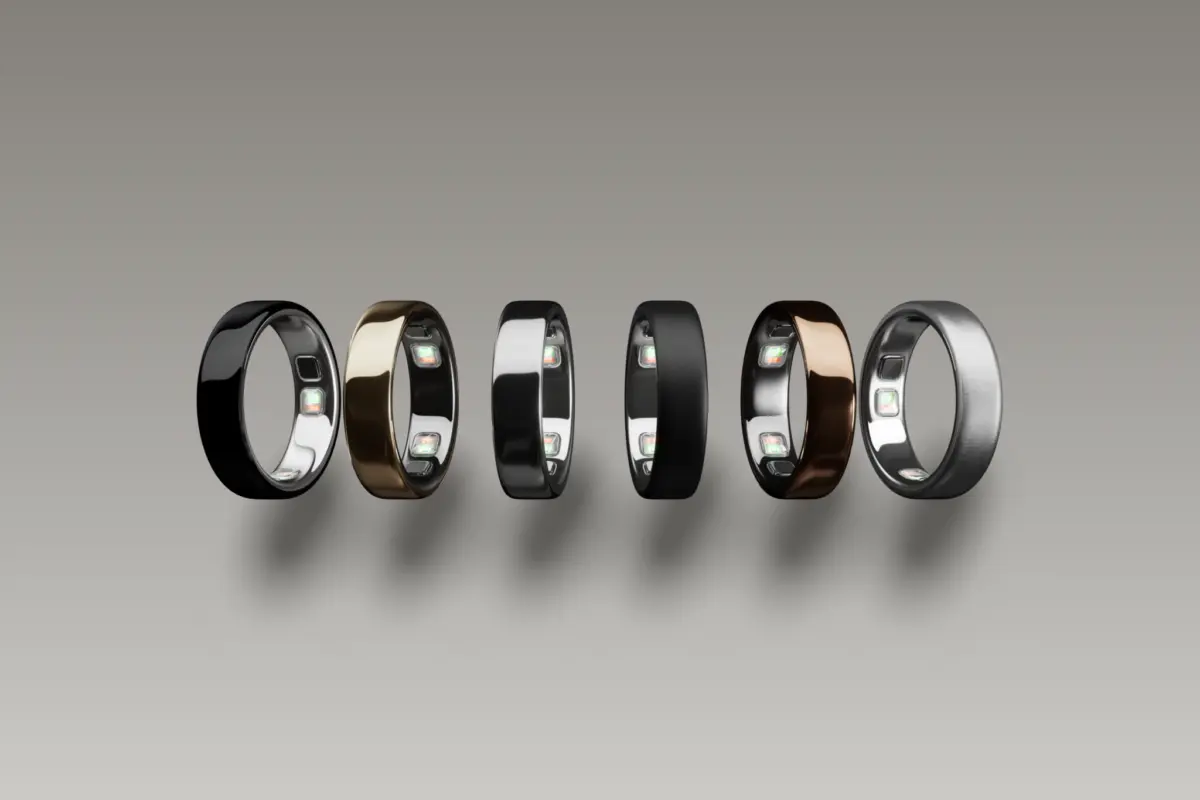
Executive Overview
The smart ring market has officially crossed a major inflection point. What began as a discreet, screen-free alternative to bulky smartwatches—designed primarily to track sleep cycles and resting heart rates—has morphed into a fiercely contested battleground for advanced consumer electronics. At the center of this transformation is Oura, the Finnish pioneer that has largely dominated the category for years. Refusing to rest on its laurels, Oura officially filed for an initial public offering (IPO) on September 3, capitalizing on a staggering financial surge that saw its revenue nearly double to $1.21 billion for the nine-month period ending June 30. Over the past year alone, the company has sold 3.6 million rings and amassed a robust base of roughly 5 million paid members, a milestone further bolstered by the recent launch of the Oura Ring 5, its slimmest and lightest titanium band to date.
Yet, Oura’s aggressive move toward public markets coincides with an unprecedented wave of disruption. The smart ring landscape is no longer a quiet duopoly or niche hobbyist space; it is getting crowded, noisy, and remarkably complex. Rivals from Europe, Asia, and North America are emerging from all corners with divergent strategies to dethrone the market leader.
Where Oura and traditional trackers focused strictly on passive biometrics, emerging contenders are betting on high-utility features. Companies like France’s Circular are introducing contactless payments via NFC chips, while brands like RingConn and Dreame are integrating haptic vibrations and tactile touchpads. Others, such as Ultrahuman—backed by a recent $70 million funding round featuring Qualcomm’s venture arm—are aiming even higher, attempting to turn two-gram titanium bands into standalone micro-computers capable of running local software, powering AI interactions, and handling complex computational tasks.
The irony is palpable. Smart rings originally won over consumers because they offered an escape from the relentless glare of screens and notifications. Yet, as the industry races to cram smartphone-like capabilities onto the human finger, the sector risks losing the very invisibility that made it appealing in the first place. To make sense of this rapidly shifting, increasingly confusing landscape, this report provides a deep dive into the market dynamics, financial milestones, legal battles, and the top contenders vying to capture Oura’s crown.

Detailed Chronology: The Escalation of the Smart Ring Market
To understand how the smart ring market reached its current high-stakes environment, one must examine the rapid succession of competitive maneuvers, regulatory hurdles, and technological leaps that have defined the sector over the past two years.
The Ecosystem Giants Enter (2024)
The competitive dynamics shifted permanently in mid-2024 when Samsung became the first major global tech titan to enter the space. Launching the Galaxy Ring in July 2024 for $399, Samsung signaled to the industry that smart rings were no longer just the domain of specialized startups. While the Galaxy Ring offered deep integration within Samsung’s sprawling hardware ecosystem, its initial feature set leaned relatively basic, lacking advanced medical-grade diagnostics like sleep apnea or atrial fibrillation (AFib) detection. Nonetheless, its arrival validated the form factor for the mainstream consumer.
Legal Gridlock and the U.S. Patent Battle (Late 2025)
As competition intensified, the battleground expanded from consumer marketing to the courtroom. In October 2025, the U.S. International Trade Commission (ITC) ruled in favor of Oura in a high-stakes patent infringement dispute against rival Ultrahuman. The ruling dealt a severe blow to Ultrahuman’s U.S. operations, effectively blocking the company from importing new ring inventory into the American market. Rather than folding, Ultrahuman was forced to completely redesign its hardware architecture to circumvent Oura’s protected intellectual property, setting the stage for a dramatic market reentry.
The Hardware Reimagining and CES Innovations (Early 2026)
The opening months of 2026 brought a flurry of technological unveilings that shattered expectations of what a ring could do. At CES and subsequent spring showcases, companies began redefining wearables:

- Dreame’s Input Ring: Dreame entered the market by introducing a ring equipped with a small physical touchpad, allowing users to execute micro-gestures like skipping audio tracks or snapping photos on a paired smartphone, alongside haptic alerts.
- RingConn Gen 3: Launched in May 2026 starting at $349, RingConn introduced advanced vascular health insights, utilizing proprietary sensor data to evaluate changes in vascular strain over time after initial calibration with traditional blood pressure cuffs.
- Ultrahuman Ring Pro: In February 2026, Ultrahuman officially unveiled the $479 Ring Pro, engineered specifically with a redesigned form factor to clear U.S. patent hurdles while introducing a revamped heart-rate sensing array and a powerful dual-core processor.
The September Convergence: IPOs, Funding, and New Series (September 2026)
The first week of September 2026 marked a watershed moment for the industry, characterized by three major announcements happening almost simultaneously:
- Oura’s IPO Filing: On September 3, Oura officially filed its paperwork to go public, showcasing extraordinary financial health with $1.21 billion in revenue for the first three quarters of the fiscal year.
- Ultrahuman’s $70M Capital Injection: On the exact same day, Ultrahuman announced a massive $70 million funding round backed by Qualcomm, explicitly signaling a strategic pivot to transform smart rings into edge-computing devices capable of running local software.
- Circular’s Ring 3 Series Announcement: French manufacturer Circular unveiled its upcoming Ring 3 series (comprising Pro and Slim models), bringing contactless NFC payments and silent haptic alarms to the forefront of consumer expectations.
Supporting Context & Metrics: Financial Health and Market Realities
Behind the sleek marketing campaigns and hardware redesigns lies a booming global economy for health tech. Oura’s financial disclosures ahead of its IPO offer a rare, transparent window into the commercial viability of the smart ring category. Generating $1.21 billion in revenue for the nine-month period ending June 30—nearly doubling its performance from the previous year—proves that consumer demand for continuous, subscription-backed biometric monitoring has transitioned from a tech-enthusiast trend into a mainstream wellness habit.
Furthermore, Oura’s milestone of selling 3.6 million rings over the past year and servicing roughly 5 million paid members highlights the potency of its recurring revenue model. Unlike traditional wristwatches that rely entirely on upfront hardware sales, smart ring companies frequently pair their devices with proprietary companion apps locked behind monthly subscription fees. This dual-stream revenue model has attracted intense venture capital interest, as evidenced by Ultrahuman’s recent $70-million windfall.
However, unit economics and manufacturing costs remain challenging. Titanium construction, micro-soldering of multi-wavelength photoplethysmography (PPG) sensors, and the miniaturization of high-density lithium-ion batteries require heavy capital expenditure. Additionally, regulatory hurdles—such as securing FDA clearance for ECG and blood pressure monitoring features—add significant runway time and financial overhead for any company attempting to match Oura’s market penetration.

Official Statements and Industry Perspectives
The rapid commercialization and technological creep of smart rings have sparked intense debate among industry leaders, analysts, and tech commentators regarding the ultimate destination of the form factor.
Industry analysts have increasingly pointed out the philosophical contradiction at the heart of the modern wearable market. When smart rings first gained traction, their primary value proposition was subtraction rather than addition. By stripping away touchscreens, notifications, and vibrating alerts, rings allowed users to monitor their sleep stages, body temperature, and heart rate variability without tethering their attention to a glowing display.
Yet, executive statements from emerging players tell a different story. Representatives from Circular and Dreame have emphasized that consumers increasingly demand utilitarian convergence. By embedding NFC chips for tap-to-pay functionality and haptic motors for silent reminders, these companies argue that the finger is simply the next logical real estate for ambient computing.
Meanwhile, the partnership between Ultrahuman and Qualcomm represents a bold bet on edge AI. Executives at Qualcomm’s venture arm noted during the September funding announcement that wearable form factors must evolve beyond passive data collectors. By outfitting rings with dedicated dual-core processors capable of running on-device software, the vision is to create lightweight, invisible nodes capable of executing localized machine learning models—ushering in an era where health tracking seamlessly intersects with ambient artificial intelligence.

The Contenders: Mapping the Competition
To fully grasp the current landscape, we must examine the specific hardware strategies and feature sets of the primary contenders challenging Oura’s dominance.
+-----------------------------------------------------------------------------------+
|                        THE SMART RING LANDSCAPE AT A GLANCE                       |
+---------------+-------------------+---------------------+-------------------------+
| Company       | Flagship Device   | Starting Price      | Standout Feature        |
+---------------+-------------------+---------------------+-------------------------+
| Oura          | Oura Ring 5       | Market Dependent    | Slimmest form factor,   |
|               |                   | (Subscription Model)| massive 5M member base  |
+---------------+-------------------+---------------------+-------------------------+
| Ultrahuman    | Ring Pro          | $479                | Dual-core processor,    |
|               |                   |                     | edge software goals     |
+---------------+-------------------+---------------------+-------------------------+
| Circular      | Ring 3 Series     | TBA (Early 2027)    | NFC contactless         |
|               | (Pro & Slim)      |                     | payments & haptics      |
+---------------+-------------------+---------------------+-------------------------+
| RingConn      | RingConn Gen 3    | $349                | Vascular health strain  |
|               |                   |                     | tracking & alerts       |
+---------------+-------------------+---------------------+-------------------------+
| Samsung       | Galaxy Ring       | $399                | Seamless integration    |
|               |                   |                     | within Samsung ecosystem|
+---------------+-------------------+---------------------+-------------------------+
| Dreame        | Dreame Smart Ring | TBA                 | Physical touchpad &     |
|               |                   |                     | media control gestures  |
+---------------+-------------------+---------------------+-------------------------+
1. Ultrahuman
- Flagship Device: Ring Pro ($479, shipping mid-September)
- Strategic Focus: Edge computing, high-performance biometrics, and software expansion.
- Deep Dive: Following its bruising legal battle with Oura in late 2025, Ultrahuman re-engineered its hardware identity with the Ring Pro. Designed to circumvent patent restrictions while entering the U.S. market, the device features a newly optimized heart-rate sensing matrix designed for superior signal acquisition during deep sleep stages. Backed by Qualcomm’s recent $70 million investment, Ultrahuman is positioning its hardware to run localized software routines, laying the groundwork for AI-driven health interventions and interactive computing directly from the finger.
2. Circular
- Flagship Device: Ring 3 Series — Pro and Slim (Launching early next year)
- Strategic Focus: Contactless utility and haptic communication.
- Deep Dive: Circular is aggressively pushing the boundaries of what a ring can do outside of health tracking. The upcoming Ring 3 series integrates an NFC chip for seamless contactless payments, directly challenging smartwatches and smartphones at the checkout counter. Furthermore, the inclusion of on-finger haptic vibration alerts enables silent wake-up alarms, granular health notifications, and task reminders. On the medical front, the Ring 3 Pro boasts an FDA-cleared ECG for AFib detection, blood pressure trend analysis, and continuous glucose tracking.
3. RingConn
- Flagship Device: RingConn Gen 3 ($349, launched May)
- Strategic Focus: Vascular health and accessible comprehensive monitoring.
- Deep Dive: RingConn has carved out a robust market share by offering advanced clinical insights at a competitive price point. The Gen 3 introduces specialized vascular health analytics, assessing fluctuations in vascular strain over time once calibrated against traditional blood pressure readings. While it includes standard health tracking—such as blood oxygen saturation, sleep stages, and stress levels—it utilizes vibration alerts primarily as an immediate safety and health warning mechanism rather than an interactive communication channel.
4. Samsung
- Flagship Device: Galaxy Ring ($399, launched 2024)
- Strategic Focus: Ecosystem lock-in and mainstream consumer convenience.
- Deep Dive: As the first major consumer electronics giant to enter the ring market, Samsung leverages its massive hardware ecosystem. The Galaxy Ring is tailor-made for users already embedded within Samsung’s Galaxy smartphone and tablet family. While its sensor suite is somewhat conservative compared to niche competitors—notably lacking advanced medical-grade diagnostics like sleep apnea or AFib detection—its brand recognition and polished companion software make it a formidable mass-market contender.
5. Dreame
- Flagship Device: Dreame Smart Ring (Pricing and availability TBA)
- Strategic Focus: Tactile control and gesture-based media management.
- Deep Dive: Best known for household robotics, Dreame surprised the wearables sector by unveiling a smart ring featuring an integrated physical touchpad. This unique hardware addition allows wearers to perform micro-gestures—such as skipping musical tracks or remotely triggering a smartphone camera shutter. Alongside these input capabilities, the ring provides comprehensive heart-rate variability (HRV) analysis, sleep tracking, and blood oxygen monitoring, signaling a heavy lean into multi-functional device control.
Future Outlook: Where is the Smart Ring Headed?
As Oura moves toward becoming a publicly traded entity with over a billion dollars in revenue, and as venture capital floods into competing hardware ecosystems, the smart ring industry stands at a profound crossroads.
The core tension moving forward will revolve around form versus function. Will consumers embrace rings that double as micro-smartphones—complete with NFC payment chips, haptic alarms, physical touchpads, and localized AI computing—or will the market experience a consumer backlash against feature creep, ultimately pushing buyers back toward the quiet, minimalist ethos that made Oura a household name in the first place?
If recent funding rounds and product roadmaps are any indication, the industry has cast its vote. The era of the simple sleep-tracking band is rapidly drawing to a close. We are entering an aggressive, high-stakes era where titanium rings on our fingers are poised to become the ultimate ambient computing hubs. Whether users genuinely want to manage payments, answer alerts, and run software via a two-gram band remains the multi-billion-dollar question that Oura’s impending public debut—and its rivals’ aggressive innovations—will soon answer.





Belum ada komentar. Jadilah yang pertama berkomentar!