

Executive Overview
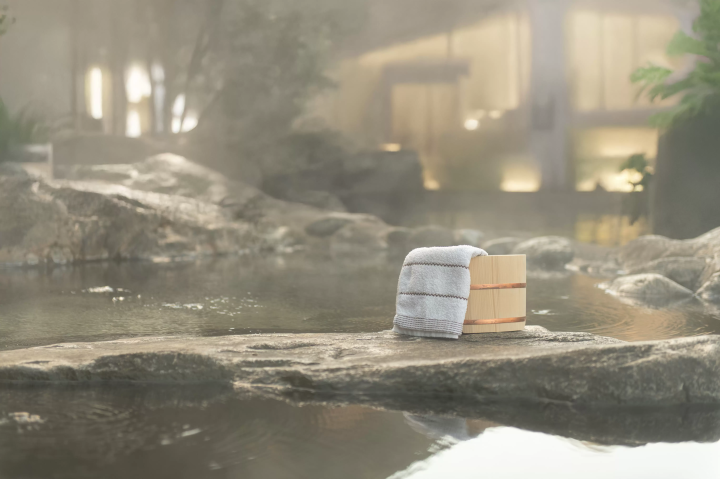
For the international traveler, Japan’s multifaceted bathing culture stands out as one of the most culturally enriching, deeply historic, and restorative experiences the country has to offer. However, navigating the landscape of Japanese immersion spaces can initially present a steep learning curve. Visitors frequently encounter a constellation of overlapping and often confusing terminology: onsen (hot springs), sento (public bathhouses), daiyokujo (large public hotel baths), and ofuro (general bathtubs).
While these terms are occasionally used interchangeably by casual observers, they represent fundamentally distinct physical spaces, legal classifications, and social traditions. Misunderstanding these nuances can lead to cultural faux pas or missed opportunities to experience authentic regional lifestyles.
Fundamentally, the distinction between an onsen and a sento rests on a paradox well-known to locals: hot springs are defined by the subterranean geological properties of the water itself, whereas public bathhouses are defined by their structural classification as community facilities. Consequently, a neighborhood sento may feature mineral-rich natural hot spring water, while a luxurious, multi-story hotel with a daiyokujo might simply be circulating heated municipal tap water.
Beyond nomenclature, Japanese bathing operates under a strict, unwritten code of communal consideration. Designed to maintain hygiene and shared tranquility, these rules dictate everything from pre-bath cleansing rituals to body modification policies. This comprehensive report deconstructs the terminology, clarifies the legal frameworks governing mineral springs, details essential etiquette, and explores how both first-time tourists and seasoned Japan veterans can integrate authentic bathing traditions into a modern travel itinerary.
Detailed Chronology and Cultural Evolution: From Local Necessity to Global Wellness
To truly appreciate the steam rising from a rural mountain onsen or the retro tiles of an urban sento, one must understand the historical trajectory that embedded bathing deep into the Japanese social fabric.
The Ancient Origins of Purifying Waters
Bathing in Japan began not merely as a hygienic practice, but as a spiritual ritual rooted in Shinto purification (misogi). Volcanic activity across the archipelago provided an abundance of natural thermal springs, which early inhabitants regarded as sacred gifts possessing healing properties bestowed by the kami (spirits). Buddhist teachings, which arrived via the Asian mainland in the 6th century, further popularized bathing; temples frequently maintained bathhouses (yuya) for the sick and impoverished as an act of compassion and religious devotion.
The Rise of the Edo-Period Sento
By the Edo period (1603–1867), communal bathhouses (sento) emerged as essential infrastructure in densely populated urban centers like Edo (modern-day Tokyo). Because private residential plumbing was virtually nonexistent for the common citizenry, public bathhouses became bustling neighborhood hubs. People of all social strata—minus the ruling samurai elite, who often had private provisions—gathered to wash away the grime of daily labor. These spaces functioned as equalizers, breaking down rigid class barriers and serving as early centers for community news and socialization.
The Modern Transformation: Tourism and Therapeutic Retreats
As plumbing modernized throughout the 20th century, private home bathrooms (ofuro) became standard across Japanese households, precipitating a decline in traditional sento numbers. However, rather than fading into obscurity, both sento and onsen underwent a profound cultural pivot.
- Onsen regions transitioned from austere therapeutic recovery zones (toji*) into leisure destinations where urbanites sought respite from corporate stress.
- Simultaneously, urban sento evolved into "super public baths" (super sento or kenko-land facilities) that integrated saunas, open-air baths, dining establishments, and relaxation lounges.
Today, Japanese bathing culture occupies a dual space: it remains a vital anchor of everyday community life for locals, while serving as a premier wellness tourism asset recognized globally by organizations like the Japan National Tourism Organization (JNTO) for its capacity to alleviate the fatigue of modern travel.
Supporting Context & Metrics: Decoding the Terminology
To demystify the terminology, it is helpful to categorize the various bathing spaces by their primary definitions, regulatory standards, and operational points of distinction.
Terminology Breakdown
| Term (Japanese) | Core Meaning | Primary Operational Point |
|---|---|---|
| Ofuro (風呂) | Bathing and the bathroom/bathtub in general. | A broad, catch-all term that includes domestic residential bathrooms and the act of taking a bath. |
| Onsen (温泉) | Water that springs from underground and meets specific national legal standards. | Describes the chemical, thermal, and mineral properties of the water source. |
| Sento (銭湯) | A local public bathhouse accessible to the general public for a regulated fee. | Represents a community-oriented structural facility category. |
| Daiyokujo (大浴場) | A large shared bathroom designed to accommodate numerous guests simultaneously. | Commonly found in hotels and ryokan (inns); the water used is not guaranteed to be natural hot spring water. |
| Super Sento (スーパー銭湯) | A sprawling, modern entertainment facility combining baths, saunas, dining, and relaxation zones. | Represents a leisure complex; some facilities utilize natural hot spring water pumped from deep underground, while others use treated tap water. |
The Legal Definition of an Onsen
A common misconception among travelers is that any body of warm water can be marketed as an onsen. In reality, Japan’s Hot Spring Law (Onsen-hō), enacted to protect consumers and regulate resource exploitation, establishes strict criteria. Under this legislation, water qualifies as an onsen if it meets either of the following conditions:
- Temperature Threshold: The water gushing from the source must possess a natural temperature of 25°C (77°F) or higher.
- Mineral Content Threshold: Even if the temperature falls below 25°C, the water must contain a designated minimum concentration of at least one of 19 specific mineral and chemical components—such as lithium ions, dissolved carbon dioxide, sulfur compounds, or iron—defined by law.
This means a spring can produce water that is cool or even cold at its source yet still be legally classified as an onsen due to its therapeutic mineral composition. Conversely, naturally warm water that fails to hit either the thermal or mineral thresholds cannot be legally labeled as an onsen.
Official Guidelines & Etiquette: Mastering the Japanese Bathing Ritual
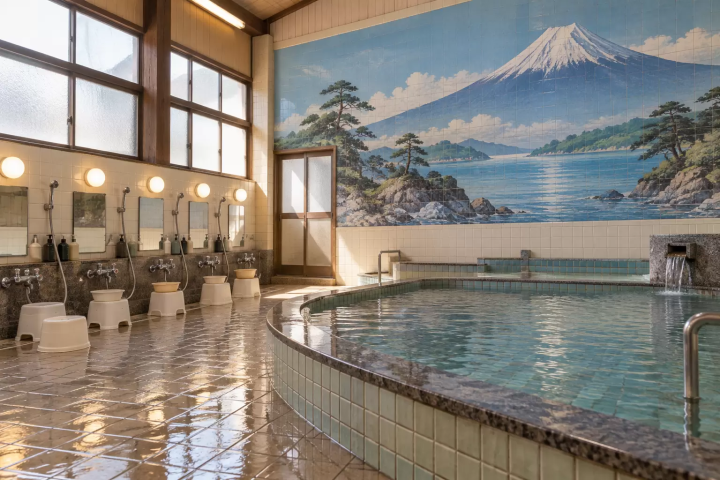
Whether stepping into a rustic volcanic pool in the mountains of Gifu Prefecture or visiting a retro neighborhood sento in downtown Tokyo, the foundational protocol remains uniform. Japanese bathing spaces are shared communal environments governed by consideration for others.
The Five-Step Bathing Process
-
The Changing Room (Datsui-jo):
Upon entering the facility, guests strip completely naked in the changing room, placing their garments and personal belongings into baskets or lockers. Swimwear is strictly prohibited in traditional Japanese baths. Genders are separated into distinct sections, usually designated by blue curtains or kanji characters for men (男) and women (女). -
The Cleansing Ritual (Kakeyu and Washing Stations):
Before entering any communal bathtub, absolute cleanliness is mandatory. Guests must sit on small plastic stools provided at the washing stations, equipped with handheld showers, mirrors, soap, and shampoo. You must thoroughly wash and rinse your body outside the tub. The communal bathtubs are explicitly reserved for soaking and relaxing after you are entirely clean, not for scrubbing off dirt.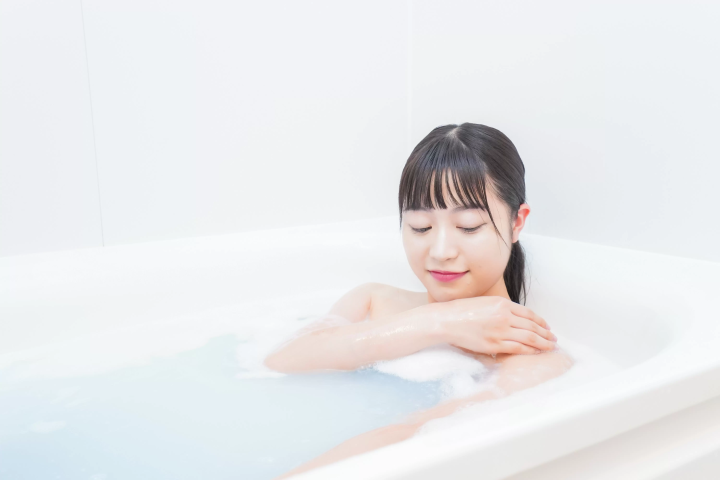
-
Soaking in the Tub (Yubune):
Once thoroughly rinsed of all soap residue, enter the hot water slowly. If the water temperature feels too intense, do not force a long immersion; start with a brief soak to allow your body to acclimate. -
Managing Towels and Hair:
While you may bring a small modesty towel (tenugui) into the bathing area to cover yourself while walking between zones, never allow the towel to touch the bathwater. Most bathers fold their small towel and place it dry on top of their heads or on the edge of the tub. Furthermore, individuals with long hair must tie it up securely to ensure stray strands do not drift into the shared water. -
Post-Bath Protocol:
Before returning to the changing room, use your small towel to wipe down excess moisture from your skin so you do not drip water onto the carpeted or tiled floors of the changing area.
Navigating the Tattoo Policy
Historically associated with organized crime (yakuza), tattoos remain a sensitive subject in Japan’s public bathing sector. While social attitudes are slowly shifting—particularly in anticipation of international tourism—rules vary widely by facility:
- Some traditional hot springs enforce a strict zero-tolerance ban on all tattoos, regardless of origin or meaning.
- A growing number of facilities now permit entry on the condition that tattoos are completely concealed using flesh-colored cover stickers or waterproof bandages.
- Modern resorts, private hot spring rooms (kashikiri), and progressive urban sento frequently welcome guests with tattoos without restriction.
Travelers are strongly advised to consult the official websites of individual facilities prior to arrival to avoid awkward confrontations.
Future Outlook: Therapeutic Tourism and Regional Revitalization
As the Japanese tourism sector charts its course through the mid-2020s, national strategies are increasingly leaning into the deep cultural value of wellness travel.
In the Japan National Tourism Organization’s (JNTO) recent marketing framework tailored for key international demographics—particularly repeat visitors from markets like Taiwan—"hot springs and therapeutic bathing (toji)" has been explicitly positioned as a core theme. Rather than participating in whirlwind, multi-city sightseeing tours that hop rapidly from one urban center to another, a growing segment of international travelers is opting for slow travel.
This modern iteration of toji involves checking into a traditional hot spring inn (ryokan), settling into a rhythmic routine of soaking in mineral waters, partaking in locally sourced seasonal cuisine (kaiseki), strolling through historic hot spring towns, and allowing the restorative properties of the earth to heal the fatigue of travel.
Regions like Gero Onsen in Gifu Prefecture, Dogo Onsen in Ehime, and Kusatsu Onsen in Gunma serve as prime examples of destinations where the entire town layout revolves around the thermal spring experience. These locales offer foreign visitors an immersive window into provincial Japanese life that cannot be replicated in metropolitan concrete jungles.
Ultimately, understanding the distinctions between an onsen, a sento, and an ofuro transforms a simple bath into a profound cultural immersion. By respecting local etiquette, embracing the quiet rhythm of the communal washhouse, and stepping off the beaten path into regional hot spring towns, travelers unlock an enduring, authentic dimension of Japanese society—one defined by hospitality, hygiene, and shared tranquility.




Belum ada komentar. Jadilah yang pertama berkomentar!