

Executive Overview
The Wikimedia Foundation has officially expanded its interactive engagement footprint on mobile devices, bringing its popular daily historical trivia game, "Which came first?", to the iOS ecosystem. Rolled out in the latest update of the official Wikipedia application for iPhone and iPad, the feature introduces a gamified approach to exploring the vast archives of the world’s largest free encyclopedia. Following a successful prior launch on Android devices, the addition bridges a crucial platform gap, giving Apple users direct access to a bite-sized, daily chronological challenge.
Designed to blend education with entertainment, "Which came first?" challenges users with a series of five daily questions rooted in significant historical occurrences. Uniquely tied to the calendar, every round features events that specifically transpired on the current day in history across various centuries and geographies. By integrating tracking metrics such as average scores, ongoing gameplay streaks, and a comprehensive archive of past rounds, Wikipedia is transforming passive reading into an active, habit-forming daily ritual. This strategic move highlights a broader industry trend: cultural and educational institutions leveraging gamification to capture user attention, combat information fatigue, and foster deeper engagement with factual content.
Detailed Chronology: From Android Genesis to iOS Integration
The Evolution of Wikipedia’s Mobile Strategy
For over two decades, the Wikimedia Foundation’s primary mission has remained steadfast: providing free, accessible knowledge to anyone with an internet connection. However, the methods of delivering that knowledge have evolved dramatically. As mobile browsing eclipsed desktop usage, the official Wikipedia iOS and Android applications became vital gateways for millions of daily readers.
Historically, these apps focused on utility—allowing users to search articles, read "Today’s Featured Article," explore curated lists, and view images related to their current geographic location. While effective, these features catered primarily to intent-driven searches. Users opened Wikipedia when they needed an answer. The introduction of "Which came first?" represents a fundamental philosophical shift: moving from a pull-based information repository to a push-and-pull interactive platform that encourages daily, spontaneous discovery.
The Android Rollout as a Testing Ground
Before arriving on Apple’s ecosystem, "Which came first?" debuted on the Wikipedia Android application. Serving as a real-world testing ground, the Android release allowed developers to gauge user reception, optimize interface responsiveness, and refine the core gameplay loop.
Developers needed to ensure that sorting historical events by chronological order felt intuitive on smaller touchscreens. Early metrics from the Android rollout demonstrated high user retention and consistent daily engagement. Players responded positively to the premise: rather than memorizing dry dates, users had to weigh the context of interconnected or coincidental historical milestones, relying on logic, intuition, and historical reasoning. Encouraged by these positive engagement metrics and steady community feedback, the Wikimedia development team fast-tracked the feature’s integration into the iOS application architecture.
The iOS Launch and User Experience
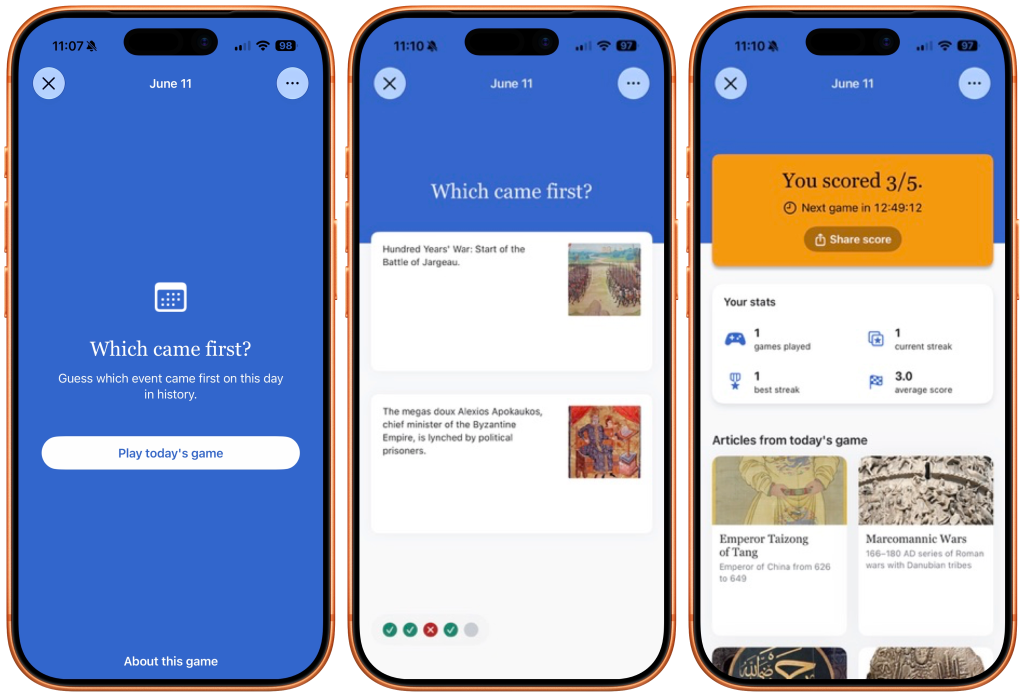
Starting today, iPhone and iPad users running the latest version of the Wikipedia app will find "Which came first?" seamlessly embedded within the application’s Explore feed.
Upon launching the game, users are greeted with five carefully curated daily questions. Each question presents a pair (or sequence) of historical events that share a common calendar date in history, challenging the player to correctly identify which occurred earlier. The design is clean, minimalist, and free of aggressive monetization or intrusive advertisements—staying true to Wikipedia’s non-profit ethos. Furthermore, the inclusion of a historical archive ensures that users who miss a day can still test their skills on previous puzzles, while persistent stat-tracking (covering streaks and average accuracy) incentivizes long-term participation.
Supporting Context & Metrics: The Psychology of Micro-Learning and Gamification
Why Gamification Works for Digital Encyclopedias
The integration of "Which came first?" into the Wikipedia ecosystem is not merely a novelty; it is a masterclass in digital retention strategy. In an era dominated by algorithmic short-form video feeds and hyper-addictive social media applications, educational platforms face fierce competition for user attention spans.
By introducing micro-games, Wikipedia taps into the psychological principles of micro-learning and habit loops.
- The Cue: Opening the Wikipedia app as part of a morning routine.
- The Routine: Playing the five-question "Which came first?" challenge.
- The Reward: Instant feedback, learning a surprising historical fact, and maintaining an active gameplay streak.
This framework transforms learning from a chore into a rewarding daily ritual. Users who might otherwise spend five minutes scrolling through social media can instead absorb historical context, reinforcing general knowledge without feeling like they are studying.
The Power of Date-Driven Historical Context
One of the most compelling structural aspects of "Which came first?" is its reliance on the calendar day. By anchoring trivia questions to "this day in history," the game establishes a tangible, relatable link between the past and the present.
For instance, a user playing the game on a specific date might discover that a groundbreaking scientific discovery in the 19th century happened on the exact same calendar day as a major political treaty in the 15th century, though separated by hundreds of years. This temporal juxtaposition fosters lateral thinking and helps users build a mental web of global history rather than viewing events as isolated data points.
Quantitative Engagement Indicators
While the Wikimedia Foundation operates as a non-profit and typically prioritizes public benefit over commercial metrics, the success of mobile features is traditionally measured through several key performance indicators (KPIs):
- Daily Active Users (DAU): Features like daily trivia games provide a compelling reason for users to open an app even when they do not have a specific research query.
- Session Duration: Gamification naturally increases the time users spend inside the application interface.
- App Store Ratings and Retention: Positive additions to core utility apps often translate to improved App Store rankings and reduced uninstallation rates.
Early indicators from the Android version suggest that historical trivia significantly boosts retention among younger demographics, a crucial target audience for long-term knowledge preservation.

Official Perspectives and Industry Reactions
The Wikimedia Vision for Interactive Knowledge
While the Wikimedia Foundation has traditionally focused on text, media, and structural data organization, leadership has increasingly recognized the importance of modern UX paradigms. Interactive features align with the organization’s broader strategic goals for the decade: making human knowledge more accessible, engaging, and relevant to digital-native generations.
Industry analysts have praised the rollout, noting that traditional reference sites must innovate to remain culturally relevant. Wikipedia’s strength lies in its unmatched database of verified historical occurrences. Turning that database into an interactive engine is a low-cost, high-yield method for driving organic app discovery.
User Reception and Community Feedback
Early reactions from the iOS community—visible across developer forums, social media, and tech blogs—have been overwhelmingly favorable. Long-time Wikipedia supporters have lauded the feature for being lightweight and unobtrusive. Unlike commercial gaming apps that bombard users with microtransactions, energy meters, and video ads, Wikipedia’s trivia game remains pure, educational, and respectful of the user’s experience.
Educators and history enthusiasts have also chimed in, highlighting the game’s potential as a quick classroom warmup or a fun mental exercise during commutes. The ability to track streaks has sparked friendly competition among users online, creating organic word-of-mouth marketing for the Wikipedia mobile app.
Future Outlook: What’s Next for Wikipedia on Mobile?
Expanding Beyond History Trivia
With the successful cross-platform deployment of "Which came first?" across both Android and iOS, industry observers are left wondering what interactive features the Wikimedia development team might explore next.

Potential avenues for future expansion within the Wikipedia app could include:
- Geographic Mapping Challenges: Trivia games focused on matching historical events to their precise geographic locations.
- Biographical Connections: Mini-games challenging users to find the degrees of separation between historical figures using Wikipedia’s famous interconnected linking system.
- Multilingual Localization: Expanding daily trivia games into dozens of additional languages to serve Wikipedia’s massive global readership outside of English-speaking markets.
The Sustained Importance of Open Knowledge
As artificial intelligence and automated content generation increasingly flood the digital landscape, platforms grounded in human-verified facts—such as Wikipedia—play a vital role in maintaining information integrity. By making the process of discovering verified history fun and engaging through features like "Which came first?", Wikipedia not only secures its place on millions of smartphone home screens but also actively cultivates a more informed, curious global public.
How to Access the Game Today
For iPhone and iPad users eager to test their historical intuition, the feature is available immediately.
- Ensure your device is running the latest version of the Wikipedia app (available via the Apple App Store).
- Open the application and navigate to the Explore feed.
- Locate the "Which came first?" module, dive into today’s five historical questions, and start building your gameplay streak.






Belum ada komentar. Jadilah yang pertama berkomentar!