Just two hours west of Tokyo’s urban expanse lies a subterranean sanctuary where the earth yields some of the most pristine fresh water on the planet. Nestled at the dramatic foot of Mount Kai-Komagatake in the Minami Alps, the Hakushu region of Hokuto City, Yamanashi Prefecture, has long been revered as a historic "village of famous waters."
In autumn, when the surrounding granite-carved mountains burst into a brilliant palette of crimson, gold, and amber, Hakushu transforms into an idyllic destination for a sensory-rich road trip. This autumn expedition is designed to trace the journey of these legendary spring waters from their mountain origins down to historic post towns, engaging every sense along the way. Travelers can fill their bottles with crisp soft water at its source, hike through the vibrant foliage of the Shirakawa Gorge, sample culinary creations nurtured by the region’s mineral-rich streams, explore centuries-old merchant streets, and conclude the day with a restorative soak in an alpine hot spring.
This comprehensive travel guide outlines a meticulously planned itinerary, offering essential safety protocols, cultural insights, and logistical metrics for a seamless journey through one of Japan’s premier natural ecosystems.
Detailed Chronology: A Day-Long Itinerary Through Hakushu
An exploration of Hakushu’s water-centric geography requires careful pacing to fully appreciate the region’s natural beauty and cultural heritage. Below is the optimized itinerary for a day trip starting from Tokyo via the Chuo Expressway.
Time
Destination / Milestone
Duration / Logistics
Travel Tips & Highlights
09:00
Chuo Expressway: Chuo-Sutama IC
Approx. 2 hours from Tokyo
The official departure point for the famous spring water trail.
09:15
Roadside Station Hakushu (Michi-no-Eki)
20 mins from Sutama IC / 15 mins from Kobuchizawa or Nagasaka IC
Free parking (85 regular spaces). Collect pure spring water and browse local farm-fresh produce.
10:00
Shirakawa Valley Parking Lot
7 mins by car from Michi-no-Eki Hakushu
Free parking available (approx. 100 regular spaces; elevation 770–1,100m).
10:05
Takeu Mount Komagatake Shrine
5 mins on foot from the parking lot
Observe traditional Shinto purification rituals and pray for a safe journey.
10:15
Shirakawa Gorge: Sen-ga-buchi Pool
10 mins on foot from the shrine
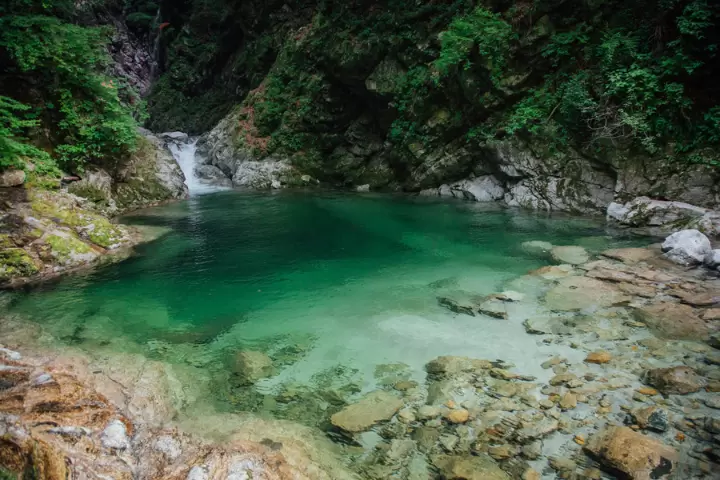
Marvel at the emerald-green pool set against brilliant autumn foliage and white granite riverbeds.
12:00
Kamoshika Shokudo (Michi-no-Eki)
7 mins by car from the Shirakawa Valley parking lot
Enjoy a hearty local lunch featuring seasonal vegetables, wild plants, and Yamanashi’s famous hoto noodles.
13:30
Daigahara-juku Municipal Parking Lot
5 mins by car from the roadside station
Free parking; gateway to the historic Koshu Kaido post town.
13:35
Daigahara Kinseiken
5 mins on foot from the municipal parking lot
Savor traditional Japanese confections, including the legendary Shingen Mochi.
14:15
Itoma Chocolate & Ice Cream
2 mins on foot from Kinseiken
Indulge in bean-to-bar craft chocolates, hot chocolate, and specialty pastries.
14:45
Yamanashi Meijo Co., Ltd. (Shichiken)
3 mins on foot from Itoma
Experience premium sake tastings at the Onakaya bar, featuring world-renowned sparkling sake.
16:00
Ojiro Hot Spring (Ojiro no Yu)
10 mins by car from Daigahara-juku
Free parking (400 spaces); unwind in mineral-rich natural open-air baths.
17:00
Return Journey: Chuo-Sutama IC
Approx. 22 mins by car from Ojiro no Yu
Proceed carefully back onto the Chuo Expressway toward Tokyo.
Supporting Context & Metrics: The Science and Geography of Hakushu
The Hydrological Marvel
Hakushu’s water does not merely sit in reservoirs; it is actively forged by geological time. Precipitation falling upon the jagged peaks of the Minami Alps trickles down through dense layers of ancient granite bedrock. Over many years, this natural filtration process strips away impurities while infusing the water with a delicate balance of minerals, refining it into a crisp, remarkably soft water. This unique chemical profile has earned the Shirakawa (Ojiro River) official recognition as one of Japan’s 100 Best Waters by the Ministry of the Environment.
Essential Trail Metrics & Safety Protocols
Navigating alpine gorges and rural roads requires adherence to strict safety guidelines to preserve both personal well-being and the fragile local environment:
Autumn Foliage Windows: Peak viewing for autumn leaves in the Shirakawa Gorge typically spans from early to late November, dictated by seasonal temperature drops. Always verify current foliage reports prior to departure.
Canyon Safety: The Shirakawa Gorge is susceptible to rapid water level spikes following heavy rainfall. Swimming and open fires are strictly prohibited at Sen-ga-buchi.
Footwear and Attire: Because the trail involves walking along uneven granite riverbeds, sturdy, non-slip hiking shoes and layered clothing are mandatory. Autumn mountain temperatures can plummet quickly, necessitating a reliable windbreaker or jacket.
Wildlife Awareness: The Minami Alps remain a thriving habitat for Asiatic black bears. Hikers venturing into the valley must carry bear bells and adhere to standard wildlife safety protocols.
Leave No Trace: To protect the pristine watershed for future generations, all visitors must carry out their own trash. Littering in the gorges or around natural springs is strictly prohibited.
Official Statements & Experiential Highlights
Phase 1: The Gateway at Michi-no-Eki Hakushu
The journey begins at Roadside Station Hakushu, situated directly at the confluence of rural agriculture and alpine hydrology. Featuring a 24-hour natural water collection point, the station allows travelers to fill reusable bottles with crisp mountain water straight from the source.
"Drawing pure spring water and experiencing the blessings of Hakushu—this is where our autumn journey in search of pristine water begins," notes the regional tourism bureau.
Adjacent to the water station, the farmers market offers seasonal highland produce, while the Kamoshika Shokudo serves comforting regional dishes. Visitors should not miss the signature "Hakushu Yamajio Soft" ice cream—a rich soft-serve made from Kiyosato milk accented with yamajio, a specialized salt extracted by boiling down mineral-rich hot spring water from Ojiro no Yu.
Phase 2: Spiritual Cleansing and the Emerald Pools of Shirakawa Gorge
A short drive leads past pastoral landscapes to the entrance of the Shirakawa Valley. Just off the trailhead lies Takeu Mount Komagatake Shrine, where visitors are encouraged to participate in traditional Shinto purification rites before entering the sacred precincts.
Following the path across a suspension bridge over white granite boulders brings travelers to Sen-ga-buchi, an emerald-green pool of astonishing clarity. In autumn, the vibrant canopy of red and yellow maples and beeches creates a breathtaking mirror effect on the water’s surface.
Note for Hikers: While the stroll to Sen-ga-buchi is gentle and accessible for families, the continuation toward Fudo Falls transitions into a narrow mountain trail with exposed drops. Travelers attempting this secondary route must possess appropriate alpine footwear and proceed with extreme caution.
Phase 3: Historic Commerce at Daigahara-juku
Transitioning from the wilderness to human history, the route leads to Daigahara-juku, a remarkably preserved post town along the historic Koshu Kaido (designated one of Japan’s 100 Best Roads). During the Edo period, this highway hummed with travelers moving between Edo and Koshu. Today, historic timber buildings house master artisans who utilize Hakushu’s water to craft world-class products.
Daigahara Kinseiken: Operating since 1902, this venerable confectioner creates exquisite wagashi, most notably the legendary Shingen Mochi and the ethereal, summer-exclusive Mizu Shingen Mochi, both dependent on the pure local water.
Itoma Chocolate & Ice Cream: A contemporary bean-to-bar specialty shop offering artisanal chocolates, rich hot chocolates, and complex ice creams that merge modern confectionery with local alpine ingredients.
Yamanashi Meijo Co., Ltd. (Shichiken): Brewing sake since 1750, Shichiken leverages Hakushu spring water to produce celebrated vintages, including globally acclaimed sparkling sakes. Visitors can sample selections at the Onakaya tasting bar.
Phase 4: Therapeutic Immersion at Ojiro no Yu
The expedition reaches its physical climax at Ojiro no Yu, a natural hot spring facility fed by mineral-rich waters welling up from deep beneath the Shirakawa basin. The facility features striking open-air baths split into two distinct experiences: "Akayu" (red water), utilizing 100% unblended, iron-rich natural hot spring water known for its profound heat-retention and fatigue-relieving properties, and "Shiroyu" (white water), blended with pure Hakushu spring water. Soaking in the open-air bath while overlooking the crisp autumn foliage and distant peaks provides the ultimate remedy for travel fatigue.
Future Outlook: Sustainability and the Preservation of "Village Waters"
As global climate pressures mount and urban populations increasingly seek refuge in rural retreats, the delicate balance of Hokuto City’s hydrological ecosystem faces new scrutiny. Local authorities, agricultural cooperatives, and commercial entities in Hakushu are collaborating on watershed conservation initiatives designed to protect the subterranean granite filters that guarantee the region’s water quality.
Future infrastructural developments in Hokuto City will prioritize low-impact tourism, strict waste management enforcement, and educational outreach programs aimed at instilling a deep respect for natural water resources among incoming travelers. By framing travel not merely as consumption, but as an active engagement with the life-sustaining properties of water, Hakushu serves as a pioneering model for sustainable eco-tourism in rural Japan.
For travelers planning their next seasonal escape, Hakushu offers an unmatched synthesis of natural splendor, cultural preservation, and restorative wellness—proving that the simplest element on earth remains its most luxurious treasure.


![[Two hours from Tokyo] An autumn road trip in search of the famous spring water of Hakushu, Hokuto City.](https://resources.matcha-jp.com/resize/720x2000/2026/08/25-269627.webp)
![[Two hours from Tokyo] An autumn road trip in search of the famous spring water of Hakushu, Hokuto City.](https://resources.matcha-jp.com/resize/720x2000/2026/08/26-269675.webp)
![[Two hours from Tokyo] An autumn road trip in search of the famous spring water of Hakushu, Hokuto City.](https://resources.matcha-jp.com/resize/720x2000/2026/08/28-269789.webp)
![[Two hours from Tokyo] An autumn road trip in search of the famous spring water of Hakushu, Hokuto City.](https://resources.matcha-jp.com/resize/720x2000/2026/08/26-269688.webp)
![[Two hours from Tokyo] An autumn road trip in search of the famous spring water of Hakushu, Hokuto City.](https://resources.matcha-jp.com/resize/720x2000/2026/08/26-269689.webp)
![[Two hours from Tokyo] An autumn road trip in search of the famous spring water of Hakushu, Hokuto City.](https://resources.matcha-jp.com/resize/720x2000/2026/08/26-269691.webp)
![[Two hours from Tokyo] An autumn road trip in search of the famous spring water of Hakushu, Hokuto City.](https://resources.matcha-jp.com/resize/720x2000/2026/08/26-269705.webp)
![[Two hours from Tokyo] An autumn road trip in search of the famous spring water of Hakushu, Hokuto City.](https://resources.matcha-jp.com/resize/720x2000/2026/08/28-269821.webp)





Belum ada komentar. Jadilah yang pertama berkomentar!