

Executive Overview
In an era where digital engagement is increasingly defined by bite-sized, gamified learning experiences, the Wikimedia Foundation is expanding its mobile footprint in a fresh, interactive direction. Following a successful rollout on Android devices, Wikipedia has officially brought its daily historical facts trivia game, "Which came first?", to the iOS ecosystem. Integrated directly into the latest version of the official Wikipedia iPhone application, the feature invites users to test their chronological reasoning by challenging them to sequence pivotal historical occurrences that share a calendar day.
Far from being a mere novelty, this release represents a strategic shift in how the world’s largest crowdsourced encyclopedia encourages user retention and active learning. By weaving gamification into the fabric of its mobile interface, Wikipedia is tapping into the psychological appeal of daily puzzle challenges—a market popularized by phenomena like Wordle—while anchoring the gameplay in verifiable, deeply researched historical data. Accessible directly from the app’s Explore feed, "Which came first?" transforms passive reading into an engaging daily ritual, challenging history buffs and casual learners alike to examine the tapestry of human events through a comparative lens.
Detailed Chronology: From Android Genesis to iOS Integration
The journey of "Which came first?" from an experimental concept to a cross-platform mobile feature reflects a deliberate product evolution by the teams behind the Wikipedia mobile apps.
The Android Pilot Phase
Long before iPhone users could access the game, the Wikimedia product development team deployed "Which came first?" to the Android ecosystem. The primary objective of the Android rollout was to test user engagement metrics, refine the user interface (UI), and gauge whether daily trivia could organically drive traffic to longer-form Wikipedia articles.
During this initial phase, developers discovered that users naturally gravitated toward the challenge of comparing events from vastly different eras that coincidentally shared a calendar date. For instance, a player might be asked to sequence the signing of a medieval charter against a 20th-century technological breakthrough simply because both occurred on a given day, such as June 12th. The positive reception on Android laid the groundwork for a broader, synchronized mobile strategy, culminating in the recent port to Apple’s iOS platform.
The iOS Launch and App Store Integration
Beginning today, the latest update to the official Wikipedia iOS app brings the game natively to iPhone users. Rather than requiring a separate download or forcing users to navigate away from the primary encyclopedia interface, "Which came first?" is seamlessly embedded within the app’s dynamic Explore feed.
Upon opening the app and navigating to the Explore section, users are greeted with the daily prompt. The gameplay mechanic is straightforward yet intellectually stimulating: players are presented with a series of historical events—all of which historically occurred on the exact current calendar day—and must successfully order them chronologically.
To ensure long-term engagement and replayability, the development team incorporated robust tracking features:
- Daily Challenges: Exactly five new questions are generated every 24 hours, ensuring fresh content for daily players.
- Comprehensive Archives: For users who miss a day or wish to push their historical knowledge further, a dedicated archive allows access to previous rounds of the game.
- Performance Metrics: The app tracks personal statistics, including a user’s average score over time and their ongoing gameplay streak, appealing to the competitive metrics-driven mindset common among modern mobile gamers.
Supporting Context & Metrics: The Psychology of Gamified Education
The integration of "Which came first?" into the Wikipedia iOS app is underpinned by established principles of educational psychology, micro-learning, and digital user retention. Understanding why this feature matters requires looking at broader trends in digital consumption, mobile app design, and the evolving mission of the Wikimedia Foundation.
Micro-Learning and Cognitive Retention
Educational researchers have long argued that micro-learning—the delivery of content in small, digestible chunks—significantly improves information retention. By reducing cognitive load, platforms can help users internalize complex facts without overwhelming them. Wikipedia’s new game capitalizes on this by restricting each daily session to just five comparative questions.
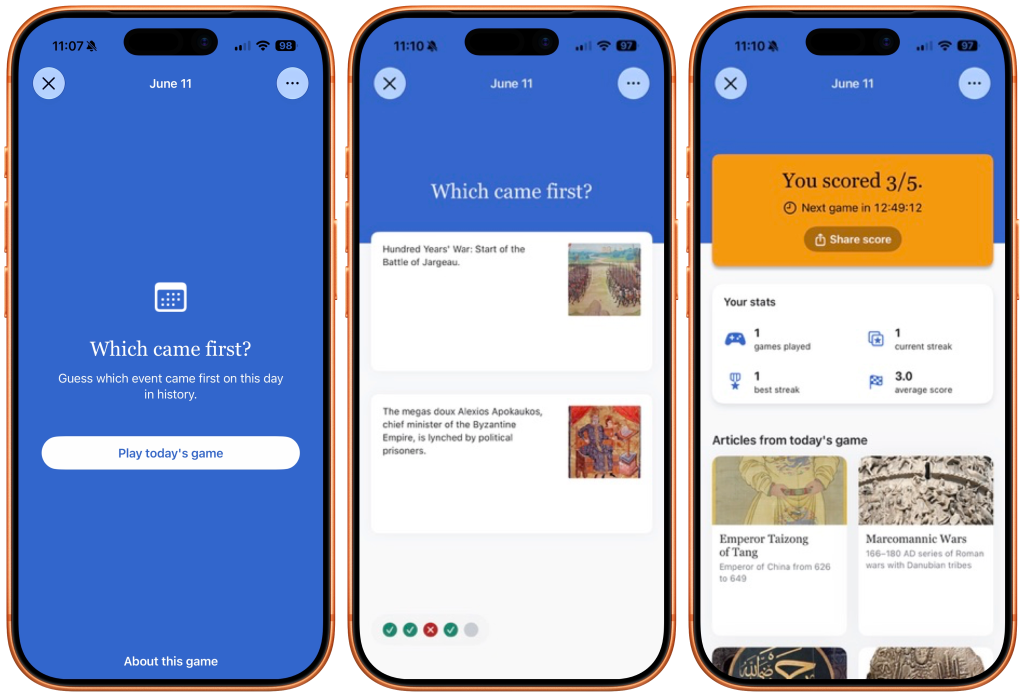
When a user incorrectly guesses whether an event predates another, the ensuing revelation acts as a powerful cognitive anchor. Driven by curiosity, players are far more likely to tap through to the full Wikipedia article to read the context behind the event. In this way, "Which came first?" functions not only as a game, but as an intelligent, frictionless funnel driving deep-dive reading and continuous education.
The "Daily Puzzle" Phenomenon
The digital landscape has undergone a seismic shift in how audiences consume daily challenges. Following the viral explosion of games like Wordle, mobile users have demonstrated an immense appetite for low-friction, once-a-day intellectual exercises that can be completed during a morning commute or a coffee break.
By introducing a streak-tracking mechanism and an average score counter, Wikipedia has tapped into this exact psychological loop. Streaks create a sense of investment; users are motivated to return day after day to protect their record. Furthermore, because the questions are tied directly to "this day in history," the game creates a personalized, temporally relevant connection between the player’s present moment and the vast expanse of global history.
Official Insights & The Wikimedia Mission
While Wikipedia is universally recognized as a static repository of human knowledge—a digital Alexandria built by a global community of volunteer editors—its mobile applications have increasingly transformed into active discovery platforms.
Expanding Beyond the Static Encyclopedia
Historically, accessing Wikipedia meant searching for a specific topic, reading an article, and closing the browser or app. Over the past several years, however, the Wikimedia Foundation has actively explored ways to make the encyclopedia more serendipitous. Features like "Featured Picture of the Day," "On This Day" cards, and now "Which came first?" are designed to spark accidental learning.

A spokesperson for the mobile development ecosystem noted that the goal of introducing games like "Which came first?" is to lower the barrier to entry for historical literacy. History can often feel intimidating, academic, or disconnected from modern life when presented purely as dense text. By packaging historical chronology into an intuitive, gamified format, Wikipedia is making historical exploration accessible to younger demographics and casual mobile users who might not otherwise browse an encyclopedia for leisure.
Open Access and Community-Driven Content
It is worth noting that the questions powering "Which came first?" draw directly from the immense, verified repository of historical data compiled by Wikipedia’s volunteer editing community. Every date, event, and chronological milestone used in the game is backed by the rigorous citation standards and neutral point-of-view policies that govern the platform. This ensures that while the interface is playful, the underlying educational value remains uncompromised and intellectually rigorous.
Future Outlook: What’s Next for Wikipedia Mobile Gaming?
The successful deployment of "Which came first?" across both Android and iOS raises an intriguing question for the future: Will the Wikimedia Foundation expand its gaming initiatives further?
Potential Roadmap Enhancements
As mobile engagement metrics from the iOS and Android rollouts are analyzed over the coming months, product strategists may consider several avenues for expansion:
- Thematic Expansion Packs: Beyond general history tied to the current calendar date, future updates could introduce specialized categories such as scientific discoveries, art history, geopolitical treaties, or pop culture milestones.
- Social and Competitive Features: While the current iteration focuses on personal streaks and average scores, the addition of social sharing tools—allowing users to challenge friends or share their daily results on social media—could mirror the viral growth loops seen in other daily puzzle games.
- Localized Content: Given Wikipedia’s global reach and presence in hundreds of languages, adapting "Which came first?" to feature regionally specific historical events could dramatically increase international engagement and cultural relevance.
Conclusion
With the launch of "Which came first?" on the iPhone, Wikipedia has successfully bridged the gap between serious academic reference and accessible daily entertainment. By leveraging the psychological appeal of streaks, micro-learning, and chronological puzzles, the platform has given millions of mobile users a compelling new reason to open the app every single day.

For those looking to test their knowledge of world history, discover forgotten milestones, and learn something new about the events that shaped our world on this very day centuries ago, the update is available now. iPhone users can experience the game firsthand by downloading or updating the official Wikipedia app and navigating directly to the Explore feed.






Belum ada komentar. Jadilah yang pertama berkomentar!