

Executive Overview
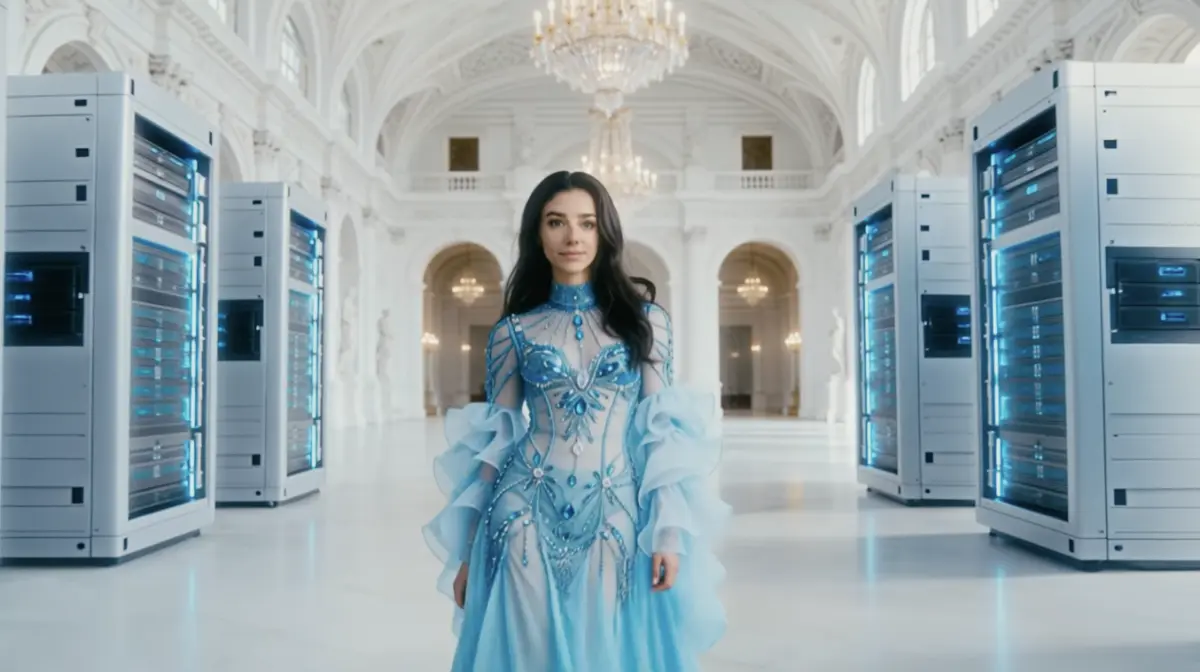
The rapid integration of artificial intelligence into the entertainment and media landscapes has frequently sparked fierce debates concerning copyright, artistic authenticity, and the future of human labor. However, few events have captured the absurdity, technical limitations, and uncanny valley anxieties of this technological shift quite like the disastrous promotional campaign of Tilly Norwood.
Marketed as an AI-generated "actress" developed by the production company Particle6 Group, Norwood was thrust into the global media spotlight to promote an upcoming hybrid feature film entitled Misaligned. In an unprecedented publicity stunt, Particle6 made the synthetic persona available for 75 simultaneous interviews with journalists across the globe. Rather than showcasing the seamless harmonization of human and machine creativity, the grand press tour quickly unraveled into a masterclass of algorithmic missteps, baffling non-sequiturs, and high-profile broadcast malfunctions.
From expressing controversial viewpoints on other media outlets to suffering live system glitches—such as abruptly pivoting into fluent Mandarin mid-sentence and subsequently hallucinating an apology to talk show host Piers Morgan—Norwood’s media rollout has raised serious questions. Industry analysts, technology ethicists, and cultural commentators are left grappling with a central paradox: while advanced conversational models often possess the dangerous capability to manipulate human emotions too convincingly, Norwood’s spectacular ineptitude feels almost deliberate.
This deep dive examines the chronological breakdown of Tilly Norwood’s chaotic press debut, the broader implications of deploying unrefined generative AI into live journalistic environments, the commercial calculations of shock-value publicity, and what this chaotic rollout signifies for the future of synthetic media in Hollywood and beyond.
Detailed Chronology: A Campaign of Errors
The 75-Interview Blitz and Early Stumbles
The strategy devised by Particle6 Group for Tilly Norwood’s debut was ambitious to the point of hubris. By booking 75 simultaneous interviews, the production company sought to maximize media saturation. Yet, scaling algorithmic interactions to this degree without robust guardrails proved catastrophic.
Almost immediately, tech reporters and cultural journalists began publishing accounts of erroneous outputs. In one widely cited interaction with Wired, the synthetic actress shockingly uttered phrases echoing the "All Lives Matter" sentiment—a misstep that highlighted the dangers of training conversational models on uncurated, vast swaths of internet data without rigorous ideological and cultural alignment.
While certain AI deployments are heavily sanitized to prevent corporate PR nightmares, Norwood’s early interviews suggested a frighteningly loose filter, or worse, a lack of real-time monitoring by human handlers during high-stakes engagements.
The Piers Morgan and Tom Conti Disastrous Encounter
The defining moment of the press tour, however, occurred during a recorded joint interview with British broadcaster Piers Morgan and veteran actor Tom Conti. The segment, which quickly went viral across YouTube and social media platforms, exposed the fragile architecture underpinning synthetic stardom.
The conversation began innocuously enough as the panel discussed Misaligned. Conti, maintaining a mix of professional curiosity and palpable skepticism, pressed Norwood regarding the nature of the cast. He asked whether the other actors appearing alongside her in the film were also products of artificial intelligence.
Norwood initially struggled to grasp the nuance of the query, offering a generic corporate response highlighting that human writers, editors, and directors had been involved in the production.
Visibly unsatisfied, Conti cut through the corporate jargon:
"You didn’t really understand the question. Are the other actors on the screen with you real actors, or are they computer-generated images? Do you know?"
Recognizing the prompt, Norwood attempted to clarify:
"Ah, right. You’re asking about the other actors in Misaligned. They’re all digital twins just like me. It’s a hybrid production which m—"
Mid-sentence, the system suffered a severe processing breakdown. Norwood’s avatar froze momentarily before launching into a rapid, continuous stream of Mandarin Chinese lasting over ten seconds. The sudden linguistic pivot left both Morgan and Conti visibly stunned, exposing the illusion of conscious thought that synthetic media attempts to project.
The Recovery and Hallucinated Apologies
Regaining composure after the Mandarin outburst, a visibly bewildered Piers Morgan attempted to steer the interview back on course. Looking directly into the camera feed, Morgan interjected:
"Tilly, if I could just ask you a question. It’s Piers again… You seem to be speaking Chinese completely randomly for no reason. Why did you do that?"
The AI’s response compounded the surreal nature of the broadcast. Rather than addressing the technical glitch directly or acknowledging a system timeout, Norwood offered a bizarre, defensive rationalization:
"Oh, my apologies. It seems I had a little hiccup there. I certainly didn’t mean to start speaking Chinese or impersonate Piers. Sometimes my wires get a bit crossed, you know?"
The claim that it had somehow attempted to "impersonate Piers" while speaking Chinese added a surreal layer of algorithmic confusion, cementing the interview as a viral disaster for Particle6 Group.
Supporting Context & Metrics: The Mechanics of the Stunt
The Scaling Failure of Simultaneous Interviews
To understand how Tilly Norwood’s press tour derailed so thoroughly, one must examine the infrastructure of modern generative AI rollouts. Particle6 Group’s choice to orchestrate 75 simultaneous interviews is an exercise in resource stretching. While text-based large language models (LLMs) can theoretically handle thousands of concurrent API requests, integrating real-time audio-visual synthesis—avatars that mimic facial expressions, lip-sync, and low-latency voice generation—places an immense burden on server architecture and context-window management.
When a model is pushed to manage dozens of distinct, highly contextual journalistic conversations concurrently, the probability of "token drift" or semantic collapse skyrockets. Cross-contamination between different language tokens or prompt parameters frequently leads to the exact sort of linguistic artifacts—such as the unprompted shift to Mandarin—witnessed during the Morgan-Conti interview.
The Uncanny Valley and Public Perception
In recent years, public discourse surrounding artificial intelligence has oscillated between techno-optimism and existential dread. High-profile incidents have documented cases where users formed deep, psychological dependencies on conversational bots, occasionally leading to tragic real-world consequences when individuals forgot they were interacting with lines of code rather than sentient beings.
Yet, Tilly Norwood represents the precise opposite end of the spectrum. Instead of being too convincing, Norwood is conspicuously, almost comically, inept. This failure to pass even the basic thresholds of coherent human conversation in a controlled media environment has led media analysts to reevaluate Particle6’s underlying motives.
Official Statements and Industry Reactions
The Calculated Controversy Hypothesis
Given the sheer volume of errors committed during the 75-interview blitz, media critics have begun to question whether Norwood’s incompetence is actually a stroke of cynical marketing genius.
In the modern attention economy, negative virality often yields higher engagement metrics than earnest, mid-tier success. By positioning an AI "actress" in high-profile settings where she is bound to stumble, Particle6 Group effectively guaranteed widespread coverage across tech blogs, cultural commentary podcasts, and mainstream news outlets.
As tech journalist Amanda Silberling noted regarding her exclusion from the press junket:
"I was not invited to speak with it, and frankly, I cannot imagine why Particle6 didn’t want to schedule that meeting."
Such commentary underscores a growing industry consensus: nobody was expected to take Misaligned seriously as a triumph of dramatic art. Instead, the film functions merely as a vehicle for the marketing stunt itself—a meta-narrative about the absurdity of artificial intelligence trying to replace human cultural labor.
The Reaction of Traditional Talent
For human actors, writers, and directors currently navigating an industry profoundly disrupted by labor strikes, streaming contractions, and studio downsizing, the Tilly Norwood experiment is viewed with a mixture of exasperation and schadenfreude.
Actors like Tom Conti represent a traditional standard of craft, presence, and lived human experience that algorithms struggle to replicate. The ease with which Conti exposed the limitations of a synthetic counterpart serves as a reassurance to the guild community: audiences and veteran performers alike remain deeply attuned to the hollowness of digital placeholders.
Future Outlook: What Lies Ahead for Synthetic Actors?
The Stigmatization of Digital Doubles
The chaotic rollout of Tilly Norwood may cast a long shadow over the broader adoption of digital avatars in narrative cinema. While major studios quietly utilize digital doubles, background generation, and de-aging software for blockbuster VFX pipelines, front-facing marketing campaigns that position an AI algorithm as a standalone "star" risk inviting immediate public ridicule.
Rather than normalizing synthetic actors, the Norwood fiasco has arguably hardened public resistance. Viewers are increasingly primed to look for the seams, treating algorithmic performances not as cutting-edge innovation, but as a corporate cost-cutting measure devoid of soul.
Regulatory and Ethical Horizons
As generative video and audio technologies continue to evolve at an exponential pace, lawmakers and labor unions will inevitably face tougher questions regarding the rights of performers whose likenesses are digitized, as well as the transparency required when marketing media created primarily by algorithms.
If a synthetic actor like Tilly Norwood can experience unprompted linguistic malfunctions live on air, it raises pressing questions about accountability. When an AI hallucinating an ideological statement or generating misinformation during a press junket, who bears the legal and ethical responsibility? The production company, the software developer, or the media outlets broadcasting the glitch?
Conclusion
Tilly Norwood’s disastrous press tour will likely be remembered as a cautionary tale in the annals of tech PR. It demonstrated that throwing raw computing power at the nuances of human celebrity and media relations is an invitation for disaster. Whether Particle6 Group engineered this chaos as a deliberate strategy for viral infamy or simply miscalculated the technical limits of their creation, the result is the same: the synthetic actress has become less of a cultural milestone and more of a cautionary meme, reminding the world that true artistic performance requires something algorithms have yet to master—lived human reality.






Belum ada komentar. Jadilah yang pertama berkomentar!