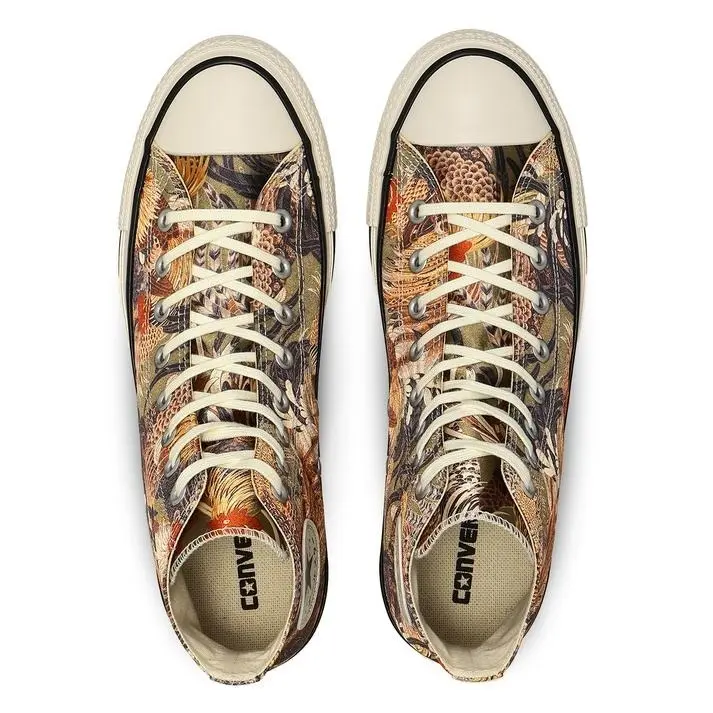
In the ever-evolving landscape of contemporary fashion, collaborations between global streetwear brands and historical art institutions have become increasingly common. However, few releases achieve the seamless synthesis of fine art and everyday utility demonstrated by Converse Japan’s latest footwear offering. Enter the All Star IJ HI—a high-top sneaker that literalizes the concept of the "canvas" by featuring the vibrant, intricate avian motifs of one of Japan’s most celebrated classical painters, Itō Jakuchū.
Priced at 14,300 yen (approximately $90 USD) and launched as a retail exclusive through major Japanese footwear chain ABC Mart, this limited-edition release bridges a staggering chronological and cultural gap. It links the early-modern aesthetics of the mid-Edo period with modern urban street culture. While Converse as a global entity has spent over a century anchoring Western athletic and counterculture movements, Converse Japan—operating as a distinct subsidiary under the umbrella of Japan’s historic Itochu Corporation—frequently curates localized editions tailored to Japanese sensibilities.
The All Star IJ HI is not merely a novelty print slapped onto a classic silhouette; it is a meticulously designed homage to Saboten Gunkeizu (Paintings of Roosters and Cacti), a masterwork executed in 1789 by Jakuchū on the sliding doors (fusuma) of Osaka’s Saifukuji Temple. By translating these centuries-old pigments onto woven textile, Converse Japan invites art enthusiasts and sneakerheads alike to walk quite literally within the brushstrokes of an Edo-period master.
Detailed Chronology
To fully appreciate how an 18th-century temple sliding door found its way onto a contemporary high-top sneaker, one must trace a fascinating timeline spanning more than three centuries of cultural, commercial, and artistic evolution.
1712: The Birth of a Maverick
Itō Jakuchū was born in Kyoto in 1712 to a prosperous family that operated a wholesale greengrocer business (masuya) situated in the bustling heart of Nishiki Market—a district that remains a premier tourist and culinary destination today. As the eldest son, Jakuchū was expected to inherit and manage the family enterprise. For the first several decades of his life, he dutifully fulfilled these commercial obligations, navigating the day-to-day trade of vegetables and provisions.
The Mid-18th Century: Embracing the Brush
Despite his success as a merchant, Jakuchū’s true calling lay in the visual arts. In his late 30s, following the death of his father, he stepped down from active management of the family business to dedicate himself entirely to painting. Eschewing the conventional schools of painting dominant in Kyoto at the time—such as the Kano and Tosa schools—Jakuchū forged an idiosyncratic path. He immersed himself in the close observation of nature, famously keeping flocks of chickens and roosters in his backyard to study their anatomy, plumage, behavior, and shifting color palettes in microscopic detail.
Jakuchū’s obsession with fowl culminated in numerous masterworks categorized under the genre of gunkeizu (paintings of chickens and roosters). In 1789, at the age of 77, he produced one of his most visually striking and structurally innovative works: Saboten Gunkeizu (Roosters and Cacti), painted directly onto the sliding partitions (fusuma) of Saifukuji Temple in Osaka. This late-career masterpiece showcased his extraordinary command of color, pattern, and form, juxtaposing the organic dynamism of domestic roosters with the exotic, architectural lines of desert cacti—a surreal botanical pairing for an artist rooted in traditional Japanese landscapes.
The 20th Century: The Rise of the Canvas Classic
Fast-forwarding more than a century from Jakuchū’s era, the trajectory of modern footwear underwent a seismic shift. In the early 20th century, the Converse Rubber Shoe Company introduced a durable athletic shoe featuring a heavy-duty cotton canvas upper, initially designed for basketball players. By 1917, the iteration known globally as the "All Star" was born. Over the decades, this humble athletic shoe transcended the hardwood floor to become an iconic symbol of rebellion, youth culture, and artistic expression worldwide.
2003–Present: The Corporate Bifurcation and Localized Art
A pivotal structural shift occurred in 2003 when Nike acquired the global Converse brand. However, Converse Japan has historically operated as an independent corporate entity—currently structured under the powerful Itochu trading conglomerate. This autonomy has allowed Converse Japan to pursue unique product lines, localized manufacturing standards, and high-concept cultural collaborations that rarely see release outside of the domestic Japanese market. The All Star IJ HI is the latest crown jewel in this lineage of localized, art-inflected footwear design.
Supporting Context & Metrics
The release of the All Star IJ HI is underpinned by fascinating historical, cultural, and commercial metrics that contextualize its unique appeal in the contemporary marketplace.
The World of Itō Jakuchū
Jakuchū operated during the Edo period, a time when Japan was strictly isolated from the rest of the world under the isolationist foreign policy (sakoku) enacted by the Tokugawa Shogunate. Consequently, Jakuchū lived his entire life without ever encountering foreign footwear; his world was one defined by traditional Japanese geta (wooden clogs) and zori (straw sandals).
Despite this historical detachment from modern footwear, his artistic style possesses a striking, almost proto-modern graphic quality. His intricate detailing, high-contrast pigmentation, and stylized abstraction of natural forms have earned him modern recognition as an artistic visionary who predated pop art and surrealism by centuries.
Product Specifications and Pricing
Model Name: Converse All Star IJ HI
Design Motif: Excerpts from Saboten Gunkeizu (1789), originally painted on temple sliding doors at Saifukuji Temple, Osaka.
Release Date: September 2026
Retail Price: 14,300 Japanese Yen (approximately $90 USD, subject to currency fluctuations).
Distribution Channel: Exclusive retail availability through Japanese footwear retailer ABC Mart, accessible via their physical storefronts and dedicated e-commerce platform.
Aesthetic Profile: A careful balance of vibrant, multicolored avian and botanical illustrations printed across the durable canvas upper, styled to maintain high fashion appeal without descending into garishness.
Official Statements & Industry Perspectives
While formal press releases from corporate entities often emphasize marketing copy, industry analysts and art historians have weighed in on the cultural implications of wearable historical masterpieces.
Art historians specializing in the Edo period have noted an encouraging trend in how classical Japanese art is being introduced to younger generations. Dr. Kenjiro Sato, a curator of early modern Japanese painting, remarked on the intersection of heritage and streetwear:
"Itō Jakuchū possessed a hyper-realistic yet deeply imaginative eye that continues to captivate modern audiences. Translating his temple paintings onto an everyday object like a canvas sneaker strips away the intimidating aura of the museum gallery. It allows people to carry a piece of cultural history quite literally on their feet, fostering an intimate, tactile connection with a master who painted over two centuries ago."
Meanwhile, retail analysts observing the Japanese footwear market have praised Converse Japan’s astute localization strategy. Unlike Western sneaker drops that frequently rely on contemporary pop-culture or sports franchise crossovers, Converse Japan consistently leverages domestic artistic heritage to carve out a distinct niche for discerning consumers.
A spokesperson for ABC Mart highlighted the overwhelming domestic interest during the initial launch phase, noting that the All Star IJ HI appeals equally to sneaker collectors seeking unique visual variants and cultural tourists eager to acquire wearable pieces of Japanese heritage.
Future Outlook
The launch of the All Star IJ HI signals a broader, highly profitable trajectory for lifestyle and apparel brands operating within the Japanese market. As consumers increasingly seek products that tell a compelling narrative—moving beyond simple brand logos to embrace storytelling rooted in history, craftsmanship, and locality—collaborations between high fashion and classical art institutions are poised to accelerate.
For Converse Japan, the success of the IJ (Ito Jakuchū) line opens exciting doors for future iterations. Industry insiders speculate whether subsequent releases might explore other luminaries of the Edo art world, such as Katsushika Hokusai, Utagawa Hiroshige, or Tawaraya Sōtatsu, bringing additional masterworks from temple walls and museum archives onto the ubiquitous canvas sneaker.
Ultimately, the All Star IJ HI proves that great art is truly timeless. Whether gracing the dark cedar sliding doors of an Osaka temple in 1789 or pounding the concrete pavement of modern Tokyo, the roosters and cacti of Itō Jakuchū continue to strut with undeniable style, cementing their place as genuine all-stars of both Japanese art history and contemporary streetwear.


![Converse Japan and one of Japan’s greatest painters combine for fine fowl shoes [Photos]](https://soranews24.com/wp-content/uploads/sites/3/2026/09/0_081694.jpg?w=640)
![Converse Japan and one of Japan’s greatest painters combine for fine fowl shoes [Photos]](https://soranews24.com/wp-content/uploads/sites/3/2026/09/2_a38b8b.jpg?w=640)
![Converse Japan and one of Japan’s greatest painters combine for fine fowl shoes [Photos]](https://soranews24.com/wp-content/uploads/sites/3/2026/09/3_b06238.jpg?w=640)
![Converse Japan and one of Japan’s greatest painters combine for fine fowl shoes [Photos]](https://soranews24.com/wp-content/uploads/sites/3/2026/09/4_a629f2.jpg?w=640)
![Converse Japan and one of Japan’s greatest painters combine for fine fowl shoes [Photos]](https://soranews24.com/wp-content/uploads/sites/3/2026/09/5_6bc937.jpg?w=640)
![Converse Japan and one of Japan’s greatest painters combine for fine fowl shoes [Photos]](https://soranews24.com/wp-content/uploads/sites/3/2026/09/6_772700.jpg?w=640)







Belum ada komentar. Jadilah yang pertama berkomentar!