

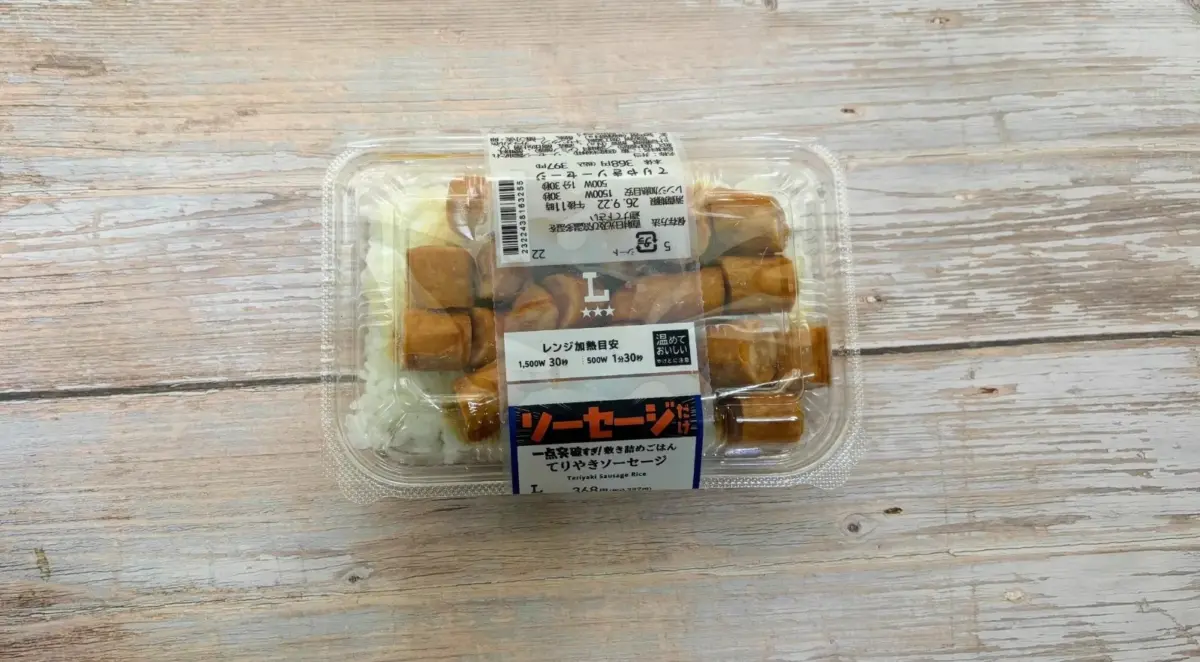
In the hyper-competitive ecosystem of Japanese convenience stores—locally known as konbini—innovation is typically measured by the addition of culinary variety. A standard Japanese boxed lunch, or bento, is traditionally celebrated as a miniature mosaic of Japanese culinary arts: a carefully balanced composition featuring a bed of pristine white rice flanked by grilled fish, rolled omelets (tamagoyaki), pickled vegetables, simmered root vegetables, and various meat accompaniments.
However, major convenience store chain Lawson has shattered this convention with the rollout of its disruptive Ittentoppasugi bento series, which translates roughly to "super single-minded" or "hyper-focused." Launched on September 22, these radical boxed lunches abandon the hallmark diversity of the Japanese bento entirely. Instead, they present consumers with a stark proposition: a heavy base of rice, precisely one single topping, and absolute nothing else.
This bold conceptual shift immediately triggered a nationwide debate. While minimalists and budget-conscious consumers hailed the products as a pragmatic response to persistent inflation, cultural critics and online commentators viewed the bare-bones lunches through a more somber lens. To many, the Ittentoppasugi line serves as a visible bellwether for Japan’s ongoing economic pressures—an uncomfortable symbol of how rising living costs are progressively eroding everyday consumer pleasures.
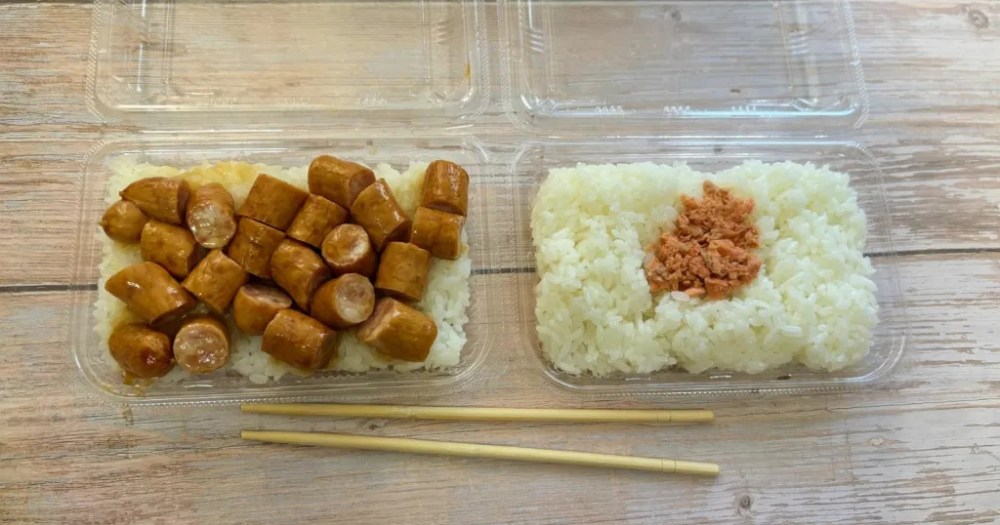
To determine whether Lawson’s extreme minimalism represents a stroke of culinary genius or a depressing manifestation of economic austerity, our investigative reporting team stepped inside a local branch, procured the flagship variants, and conducted a thorough journalistic and sensory evaluation.
Detailed Chronology: The Tasting and Investigation
Stepping Into the Konbini: Arrival and First Impressions
Walking into a Japanese convenience store on the release day of a new bento has historically been an experience defined by anticipation and culinary discovery. Glass refrigerated cases overflow with vibrant packaging, colorful side dishes, and enticing flavor combinations.
Entering our neighborhood Lawson on the morning of September 22, however, our emotional state was decidedly more subdued. Resting quietly on the shelves were the newly debuted Ittentoppasugi lunches. Even through the clear plastic lids, the visual austerity of the products was striking. There were no bright splashes of pickled radish, no leafy greens, and no decorative garnishes. It was simply a sea of white rice punctuated by a solitary, isolated protein.

The public reaction leading up to this release had been swift and vocal. Social media feeds across Japan lit up not with expressions of culinary excitement, but with expressions of quiet resignation. Consumers pointed out that even a standard onigiri (rice ball) often boasts a more complex ingredient profile, frequently wrapped in nutrient-rich nori seaweed and packed with layered fillings. The prevailing digital sentiment framed the release as a disheartening milestone: another clear sign of creeping shrinkflation and rising commodity costs forcing retailers to strip away the traditional comforts of daily life.
Yet, economics cannot be ignored. With conventional multi-dish bento steadily creeping upward in price—often pushing past the 600-to-800-yen threshold—Lawson’s ultra-aggressive price points offered an undeniable draw. Intrigued by the gamble, we purchased the two flagship savory options available: the Ittentoppasugi Salmon Bento and the Ittentoppasugi Sausage Bento.
The Salmon Bento Evaluation: Poverty Chow or Regional Heritage?
We began our taste test with the more affordable option: the Ittentoppasugi Salmon Bento, priced at a modest 297 yen (approximately $1.90 USD).
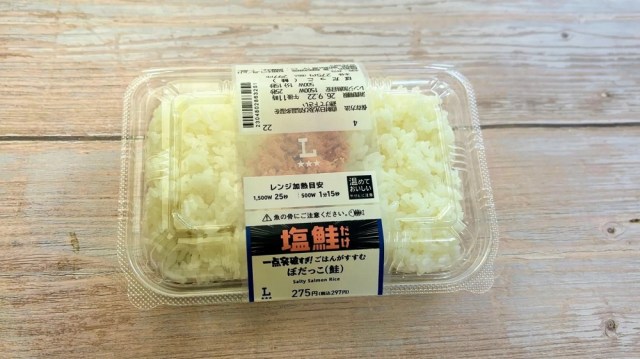
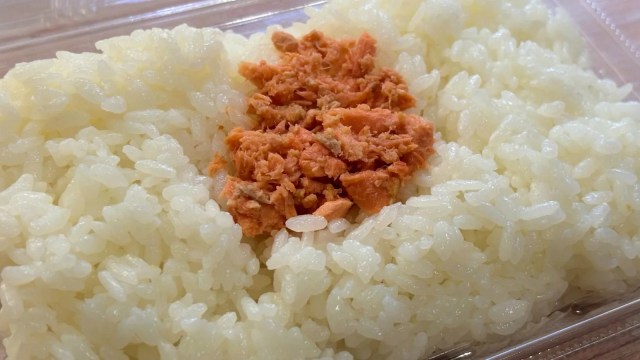
Peeling back the plastic film, the psychological impact of the meal was immediate. Inside lay a bed of plain white rice accompanied by a scattering of flaked salmon, radiating an almost palpable atmosphere of economic austerity. There was no escaping the reality of what this meal represented.
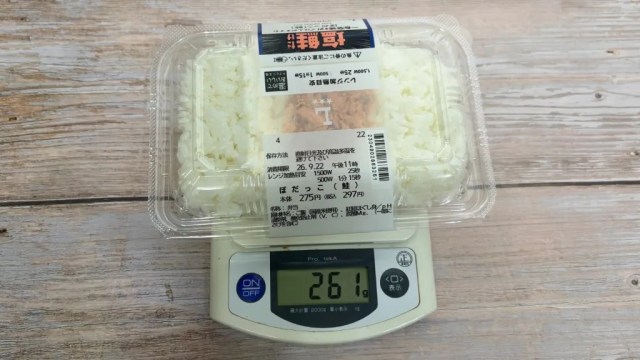
However, a closer inspection of the metrics revealed a surprising counter-narrative regarding volume. Placing the box on a digital scale, the total weight of the single-minded salmon bento registered at approximately 260 grams (9.2 ounces). Subtracting the minimal weight of the plastic container and the sparse fish flakes, it became mathematically evident that the box contained significantly more than 160 grams of rice—the officially recognized standard serving size for an adult meal in Japan. This was, fundamentally, a massive carbohydrate foundation designed to guarantee physical satiation.
Furthermore, the choice of fish introduced an unexpected layer of culinary authenticity. Rather than utilizing standard, mild canned salmon flakes, Lawson sourced bodakko—a heavily salted, traditional style of salmon originating from Akita Prefecture. Akita is widely renowned throughout the Japanese archipelago for producing some of the nation’s highest-quality agricultural rice. Historically, bodakko was developed as a preservation method for harsh winters; because of its intensely salty profile, even a minuscule shred of the fish is engineered to impart robust flavor across a massive volume of plain rice. In this sense, the high rice-to-salmon ratio is not merely an act of corporate cost-cutting, but a direct nod to an established regional dining tradition.
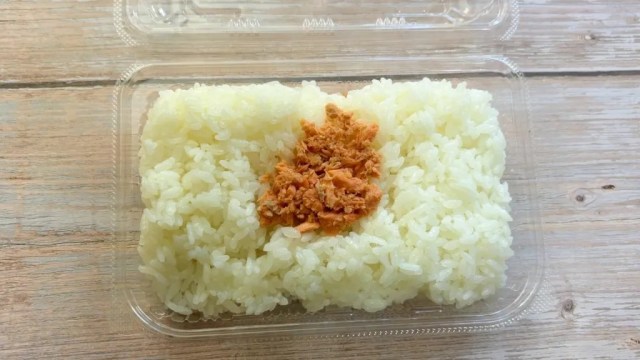
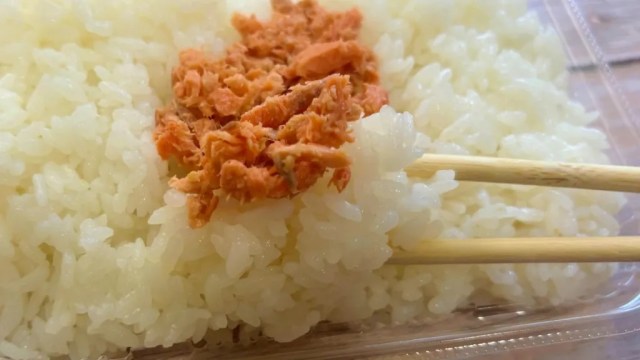
Upon tasting, we discovered that the bodakko lived up to its heritage. The salmon flakes were noticeably saltier than the standard varieties found in conventional convenience store rice balls or bento. Yet, the salinity was masterfully managed—intense, savory, and sharp, but stop-short of being unpalatable. It did not aggressively assault the palate, and could theoretically be consumed on its own without requiring alternating bites of rice.
Nevertheless, the structural flaw of the single-minded design soon became apparent. Eating at a natural, unhurried pace, we found that the salmon flakes were completely depleted by the time we had consumed roughly three-quarters of the rice. The final 25 percent of the meal forced us to finish the remaining plain white rice entirely unassisted—a dry, monochromatic conclusion that highlighted the limitations of the single-topping format.
The Sausage Bento Evaluation: A Cheap Indulgence
Next, we turned our attention to the premium-priced tier of the series: the Ittentoppasugi Sausage Bento, retailing at 397 yen (approximately $2.55 USD).
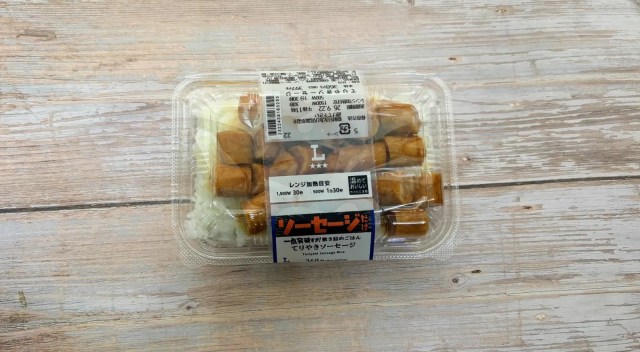
Heftier than its marine counterpart, this package tipped the scales at just over 300 grams, offering an even more formidable carbohydrate and protein mass for the consumer’s hard-earned currency. If the salmon bento leaned heavily into the aesthetic of austere survivalism, the sausage bento successfully staked its claim in the territory of guilt-free, low-cost indulgence.
The visual layout immediately felt more cohesive. Rather than sparse flakes scattered across a vast landscape, the rice was generously blanketed by thick slices of pre-cooked sausage. There is an undeniable, visceral comfort associated with processed breakfast meats, and the sheer volume of protein provided a psychological boost. It felt less like "no-other-option poverty chow" and more like a decadent, nostalgic throwback to late-night dormitory meals or hurried childhood dinners.
To elevate the profile of the dish, Lawson’s product development team applied a light glaze of a teriyaki-style sweet-and-savory sauce across the sausage slices. This culinary decision proved effective. The sauce introduced a sticky, umami-rich depth that cut through the richness of the meat and married exceptionally well with the steaming bed of underlying rice. Every bite delivered a harmonious balance of savory protein, caramelized sweetness, and clean starch.
By the time the final bite of the sausage bento was finished, the rice-to-protein ratio felt far better balanced than the salmon iteration. While neither meal could realistically be mistaken for fine dining, the sausage bento accomplished its core design objective with flying colors: it delivered immediate physical comfort, absolute accessibility, and genuine flavor satisfaction at a price point that defies current economic inflationary trends.
Supporting Context & Metrics: The Economic Landscape of Modern Japan
To fully contextualize Lawson’s Ittentoppasugi phenomenon, one must examine the macroeconomic headwinds currently battering the Japanese retail and food service sectors. For over three decades, Japan enjoyed a rare period of stable or even deflationary pricing. Consumers grew accustomed to buying high-quality, complex convenience store meals without seeing significant price spikes.
However, the post-pandemic global economic landscape—compounded by a historically weak Japanese yen, surging international energy costs, and escalating supply chain expenses for imported wheat, fertilizers, and animal feed—has triggered an unprecedented wave of inflation across the nation. Major food manufacturers and convenience store chains (comprising the "Big Three": Lawson, 7-Eleven, and FamilyMart) have faced severe margin compression.
Historically, Japanese convenience stores navigated rising costs through quiet "shrinkflation"—gradually reducing product sizes by 5 to 10 percent while maintaining nominal price points. When shrinkflation reached its mathematical limits, retailers were forced to raise prices outright. Standard bento boxes that once hovered comfortably in the 450-to-500-yen range have increasingly breached 650 to 800 yen. For urban working-class professionals, students, and fixed-income seniors, purchasing a daily convenience store lunch has shifted from an effortless daily convenience to a calculated budget line item.
Within this climate, the Ittentoppasugi series emerges as a brilliant, if sobering, engineering solution:
- Radical Simplification of Supply Chains: By reducing a bento from five or six distinct side dishes (requiring multiple suppliers, varying preparation methods, and complex packaging) down to rice and a single bulk-purchased protein, Lawson dramatically slashes procurement, processing, and assembly overhead.
- Aggressive Price Points: Offering a filling, 260-to-300-gram meal starting at 297 yen undercuts traditional market alternatives by nearly 50 percent, capturing an increasingly anxious demographic of budget-strapped consumers.
- Carbohydrate Density: By ensuring that the rice portion exceeds standard nutritional guidelines (often pushing past 200 grams of dry-equivalent weight cooked), the product guarantees physical fullness—addressing the immediate biological need for caloric energy over culinary variety.
Official Statements and Industry Reception
Lawson’s corporate communications division has framed the Ittentoppasugi lineup not as a retreat into austerity, but as a bold, playful embrace of hyper-focus. In promotional materials accompanying the launch, company representatives emphasized that the series was designed for consumers who know exactly what they want and refuse to be bogged down by superfluous side dishes.

Industry analysts, however, maintain a more pragmatic view. Speaking on condition of anonymity, a retail strategist based in Tokyo noted:
"What Lawson has executed here is a psychological masterclass in framing. They took the harsh reality of inflationary cost-cutting and dressed it up as a philosophical choice—’single-mindedness.’ Consumers are smart enough to recognize the economic pressures driving this trend, but because the products actually taste good and deliver exceptional caloric value for under 300 yen, the market is willing to forgive the lack of variety."
Social media reactions continue to mirror this complex duality. While early viral posts expressed dismay at the visual barrenness of the boxes—with some users jokingly comparing the salmon bento to a blank canvas of despair—subsequent reviews from influential food bloggers and mainstream YouTubers have largely adopted a tone of cautious approval. The consensus among reviewers is clear: while you wouldn’t want to eat a single-topping bento for every meal, they serve as a highly functional, budget-friendly safety net in an increasingly expensive world.
Future Outlook: The Expanding Horizon of Single-Mindedness
Lawson’s gamble on extreme culinary minimalism appears to be paying off. Despite the initial online hand-wringing over economic decline, early sales figures for the Ittentoppasugi salmon and sausage bento have exceeded internal retail forecasts, particularly among young urbanites and university students operating on tight monthly allowances.
Capitalizing on this momentum, Lawson has already announced plans to expand the product ecosystem. Rumors and official previews confirm that the next installment in the pipeline will be an Ittentoppasugi Corn Bento—featuring a heavy foundation of butter-infused rice blanketed entirely by sweet kernel corn.
Whether this upcoming botanical variant will successfully bridge the gap between novelty and nutritional satisfaction remains to be seen. However, one thing is certain: the era of the hyper-focused, aggressively priced convenience store meal is officially here to stay. As global economic pressures continue to test the limits of modern retail, Lawson has demonstrated that sometimes, stripping away the excess is the only way forward. Our reporting team, for one, stands ready with chopsticks in hand to see how far this single-minded experiment can go.







Belum ada komentar. Jadilah yang pertama berkomentar!