

Executive Overview
In an era defined by minimalist interior design, hyper-optimized smart homes, and the relentless pursuit of ergonomic productivity, one intrepid journalist has boldly charted an entirely different domestic frontier. Natsuno Futon, a Japanese-language writer for SoraNews24, has redefined the concept of a "home within a home"—not through high-end smart-home automation or Scandinavian modular furniture, but via an artisanal, heavily taped cardboard fortress plastered entirely in savory snacks.
![If anyone needs us, we’ll be in the cardboard Japanese snack house we just built [Photos]](https://soranews24.com/wp-content/uploads/sites/3/2026/10/0_cee4c3.jpg?w=1000&h=525&crop=1)
Conceived as a grown-up spin on the classic childhood secret fort—and drawing esoteric inspiration from a friend’s domestic experiment—this ephemeral architecture blends DIY frugality with unapologetic culinary hedonism. Operating on an initial budget of 3,000 yen (approximately $19 USD), Futon set out to construct a personal, human-scaled retreat dedicated entirely to relaxation, seclusion, and continuous, frictionless snacking.
![If anyone needs us, we’ll be in the cardboard Japanese snack house we just built [Photos]](https://soranews24.com/wp-content/uploads/sites/3/2026/10/2_eab202.jpg?w=640)
What began as a modest exercise in corrugated cardboard assembly ultimately blossomed into a three-hour marathon of structural engineering and gourmet snack curation. This investigative report chronicles the meticulous methodology, economic realities, structural hurdles, and psychological benefits of Futon’s unorthodox sanctuary, offering an authoritative look at the pinnacle of modern snack-based interior design.
![If anyone needs us, we’ll be in the cardboard Japanese snack house we just built [Photos]](https://soranews24.com/wp-content/uploads/sites/3/2026/10/3_69f78b.jpg?w=640)
Detailed Chronology: From Blueprint to Edible Edifice
Phase 1: Material Sourcing and Structural Framework
Every ambitious architectural undertaking begins with rigorous material procurement. Recognizing early on that traditional building materials such as lumber, masonry, and reinforced concrete vastly exceeded her modest 3,000-yen budget, Futon turned to the trusted reliability of industrial corrugated paper.
![If anyone needs us, we’ll be in the cardboard Japanese snack house we just built [Photos]](https://soranews24.com/wp-content/uploads/sites/3/2026/10/4_cb17f9.jpg?w=640)
A supply run to the prominent Japanese home center chain Viva Home yielded the project’s foundational elements: three large-sized cardboard box sheets, boasting exterior dimensions of 54 by 39 by 46 centimeters (roughly 21.3 by 15.4 by 18.1 inches) when fully expanded. Rather than utilizing the sheets to form standard shipping containers, Futon innovated on the fly. She taped two of the large sheets together to establish the four perimeter walls of the interior dwelling, ensuring adequate floor space to comfortably accommodate a personal relaxation chair.
![If anyone needs us, we’ll be in the cardboard Japanese snack house we just built [Photos]](https://soranews24.com/wp-content/uploads/sites/3/2026/10/5_ed589d.jpg?w=640)
With the walls secured, Futon turned her attention to the roofline. The third cardboard sheet was meticulously folded into a classic gabled roof design and anchored to the top of the wall assembly using generous amounts of packing tape. Utilizing a precision craft knife, she carved out an inviting entryway and a functional side window, cleverly repurposing the cardboard offcuts to fashion a decorative, highly aesthetic faux chimney.
![If anyone needs us, we’ll be in the cardboard Japanese snack house we just built [Photos]](https://soranews24.com/wp-content/uploads/sites/3/2026/10/7_f22c50.jpg?w=640)
Phase 2: The 100-Yen Foundation and the Daiso Supply Run
With the structural skeleton fully erected, the edifice lacked its defining characteristic: the snacks. Having already invested 1,500 yen into the cardboard and adhesive tape, Futon faced her first major financial constraint, forcing her to stretch the remaining half of her budget to achieve maximum visual and gustatory impact.
![If anyone needs us, we’ll be in the cardboard Japanese snack house we just built [Photos]](https://soranews24.com/wp-content/uploads/sites/3/2026/10/8_0aae67.jpg?w=640)
True to the time-honored traditions of budget-conscious DIY projects across Japan, Futon headed directly to the ubiquitous 100-yen discount chain, Daiso. Sifting through aisles of high-volume, low-cost merchandise, she curated an eclectic assortment of wallet-friendly salty and spicy snack packs. Eschewing the sweet, confectionery route—such as her previous Christmas gingerbread house venture—Futon deliberately targeted mature, savory profiles. These robust flavors aligned with the sophisticated, adult aesthetic she envisioned for her cardboard playhouse.
![If anyone needs us, we’ll be in the cardboard Japanese snack house we just built [Photos]](https://soranews24.com/wp-content/uploads/sites/3/2026/10/9_f6f012.jpg?w=640)
Realizing quickly that her remaining budget would not facilitate complete, 360-degree exterior coverage, Futon adopted a strategic design philosophy. She opted to concentrate her snack inventory primarily on the gabled roof. Furthermore, by positioning the completed structure snugly against the corner of the room, the unadorned backside of the house remained hidden from view, preserving the visual integrity of the installation without incurring additional material costs.
![If anyone needs us, we’ll be in the cardboard Japanese snack house we just built [Photos]](https://soranews24.com/wp-content/uploads/sites/3/2026/10/10_d0ed71.jpg?w=640)
Phase 3: Scaling Up and Overcoming Engineering Challenges
Initially satisfied with her budget-restricted creation, Futon quickly encountered a psychological phenomenon familiar to home renovators worldwide: feature creep. Gazing upon her snack-adorned roof, she noted that the unadorned lower walls suddenly appeared barren by comparison. Yielding to temptation, she threw financial caution to the wind, blew past her original 3,000-yen budget, and embarked on a secondary procurement mission.
![If anyone needs us, we’ll be in the cardboard Japanese snack house we just built [Photos]](https://soranews24.com/wp-content/uploads/sites/3/2026/10/11_1bcb51.jpg?w=640)
In her newfound splurging mode, Futon abandoned the restrictive confines of Daiso’s 100-yen pricing model. She ventured into local supermarkets and convenience stores to acquire more luxurious, high-end fare. The upgraded material palette introduced gourmet delicacies, including premium beef jerky, mini dried fish-cake cutlets, imported pistachios, and individually wrapped artisanal cheeses.
![If anyone needs us, we’ll be in the cardboard Japanese snack house we just built [Photos]](https://soranews24.com/wp-content/uploads/sites/3/2026/10/12_06388d.jpg?w=640)
However, architectural ambition is rarely without peril. The introduction of these premium, non-100-yen products presented immediate structural challenges. Unlike the lightweight, pillow-like bags from Daiso, the heavier, denser packaging of the gourmet snacks defied simple tape adhesion. Several high-end items initially succumbed to gravity, sliding down the cardboard facade and necessitating a far more liberal, industrial-strength application of packing tape to maintain structural integrity.
![If anyone needs us, we’ll be in the cardboard Japanese snack house we just built [Photos]](https://soranews24.com/wp-content/uploads/sites/3/2026/10/13_921435.jpg?w=640)
Following approximately three hours of intensive labor, cutting, taping, and culinary curation, the cardboard snack house was officially complete.
![If anyone needs us, we’ll be in the cardboard Japanese snack house we just built [Photos]](https://soranews24.com/wp-content/uploads/sites/3/2026/10/14_6e0763.jpg?w=640)
Supporting Context & Metrics: Breaking Down the Build
To fully appreciate the scope of Natsuno Futon’s achievement, it is necessary to examine the quantitative and qualitative metrics underpinning the project.
![If anyone needs us, we’ll be in the cardboard Japanese snack house we just built [Photos]](https://soranews24.com/wp-content/uploads/sites/3/2026/10/15_89a9d5.jpg?w=640)
Financial Breakdown
- Initial Budget Cap: ¥3,000 JPY (~$19.00 USD)
- Structural Material Expenditure: ¥1,500 JPY (Cardboard sheets and packing tape sourced from Viva Home)
- Phase 1 Snack Expenditure (Daiso): ~¥1,500 JPY (Salty and spicy 100-yen snack packs)
- Phase 2 Snack Expenditure (Supermarket/Convenience Store): Undisclosed budgetary overage (Beef jerky, fish-cake cutlets, pistachios, and cheeses)
- Total Construction Time: Approximately 3 hours
Architectural Specifications
- Primary Medium: Heavy-duty corrugated cardboard
- Adhesive Technology: High-tensile packing tape
- Key Features: Gabled roof, operational entry door, precision-cut ventilation window, and a bespoke recycled-cardboard faux chimney.
- Spatial Configuration: Single-occupancy interior designed to house one relaxation chair, optimized for corner placement to minimize exterior finishing requirements.
Psychological Analysis & Interior Habitability
Upon crawling inside her finished creation, Futon reported an immediate sense of profound coziness. Far from feeling like a claustrophobic trap, the carefully calculated dimensions, combined with the strategic ventilation offered by the door, window, and roof openings, maintained a comfortable interior climate.
![If anyone needs us, we’ll be in the cardboard Japanese snack house we just built [Photos]](https://soranews24.com/wp-content/uploads/sites/3/2026/10/16_719a6d.jpg?w=640)
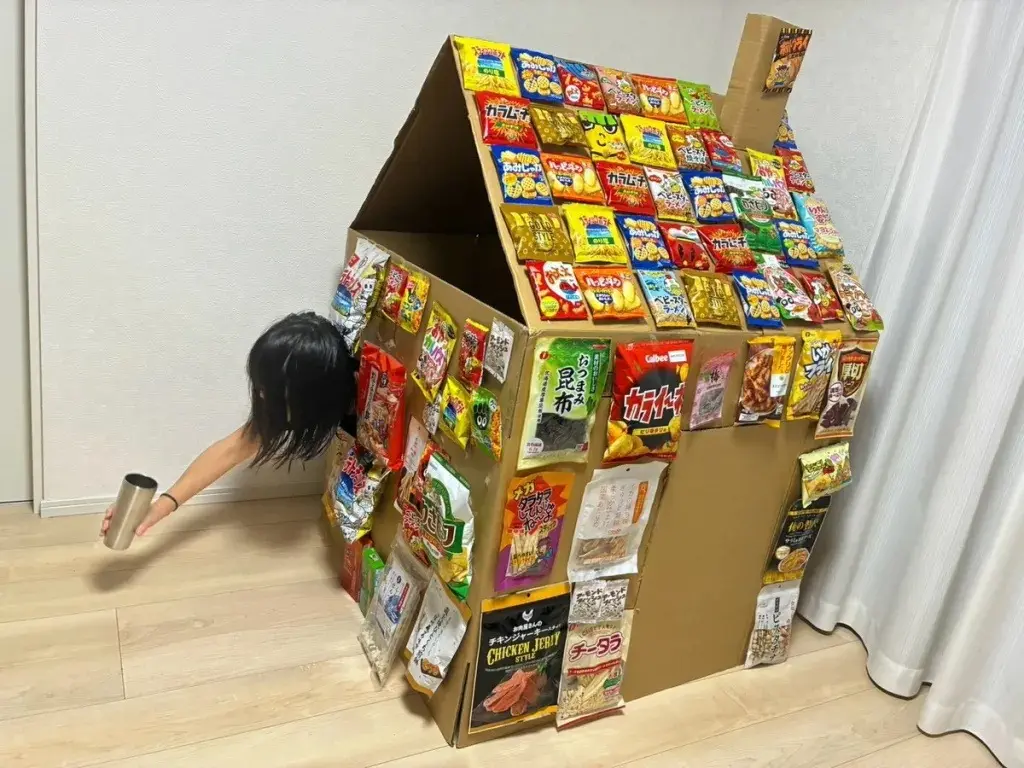
Beyond mere shelter, the interior layout serves a highly functional purpose. The side window doubles as an interactive port, allowing the occupant to reach outward for immediate snack replenishment without breaching the perimeter. Furthermore, the window provides a vital communication channel with the outside world. As Futon notes, the aperture enables the occupant to extend an empty cup outward to request beverage refills from nearby family members or roommates.
![If anyone needs us, we’ll be in the cardboard Japanese snack house we just built [Photos]](https://soranews24.com/wp-content/uploads/sites/3/2026/10/17_c045d6.jpg?w=640)
However, this feature comes with an informal safety advisory: domestic harmony requires advance notification. Without fair warning regarding the construction of an indoor cardboard snack fortification, unsuspecting household members encountering an extended arm emerging from a cardboard wall to demand liquid refreshments run a non-zero risk of mistaking the resident for an apparition straight out of modern Japanese horror cinema.
![If anyone needs us, we’ll be in the cardboard Japanese snack house we just built [Photos]](https://soranews24.com/wp-content/uploads/sites/3/2026/10/18_4bace3.jpg?w=640)
To mitigate this psychological shock, the architecture inherently incentivizes diplomacy. Occupants can readily barter with passing family members, offering their choice of premium exterior-mounted snacks in exchange for prompt hydration services.
![If anyone needs us, we’ll be in the cardboard Japanese snack house we just built [Photos]](https://soranews24.com/wp-content/uploads/sites/3/2026/10/19_a0db7a.jpg?w=640)
Future Outlook: The Evolution of Edible and Ephemeral Architecture
As the year progresses and the holiday season approaches, questions naturally arise regarding the long-term viability and future iterations of Futon’s architectural experiments. Last year’s successful deployment of a Mujirushi Ryohin (Muji) gingerbread house proved that temporary, consumable structures hold a permanent place in her creative rotation.
![If anyone needs us, we’ll be in the cardboard Japanese snack house we just built [Photos]](https://soranews24.com/wp-content/uploads/sites/3/2026/10/20_e993bd.jpg?w=640)
While a cardboard-and-snack fortification lacks the seasonal charm of gingerbread and icing, it introduces a modular, scalable framework that traditional holiday kits cannot match. The ability to dynamically upgrade exterior cladding—shifting from budget-friendly saline chips to high-end beef jerky and cheeses—demonstrates an adaptive resilience unique to modern DIY culture.
![If anyone needs us, we’ll be in the cardboard Japanese snack house we just built [Photos]](https://soranews24.com/wp-content/uploads/sites/3/2026/10/21_2be9e0.jpg?w=640)
Whether this specific installation will be preserved as a permanent domestic fixture or quietly dismantled and consumed remains to be seen. What is certain, however, is that Natsuno Futon has irrevocably altered the landscape of interior design journalism, proving conclusively that with a handful of cardboard, a roll of packing tape, and an unyielding dedication to between-meal nibbles, any corner of a room can be transformed into a castle of pure, unadulterated indulgence.








Belum ada komentar. Jadilah yang pertama berkomentar!