

Executive Overview
Elvis Costello opens his 1978 album This Year’s Model with a jagged, two-minute blast of power-pop called “No Action.” It is a song fueled by romantic obsession, resentment, and the specific, immobilizing frustration of being unable to let something go. The narrator insists he wants nothing to do with someone he clearly cannot stop thinking about. The guitars race, the words tumble over one another, and for all that frantic energy, nobody gets anywhere. Everything is moving, but nothing is changing.
That precise contradiction serves as the haunting subtext for Aaron Sorkin’s 2026 legal drama, The Social Reckoning.
Sorkin returns to the ecosystem of Silicon Valley tech giants that he previously explored in 2010’s The Social Network. Yet, where his earlier collaboration with director David Fincher crackled with psychological horror and structural ambivalence, The Social Reckoning leans into the writer’s worst tendencies: a hyper-articulate, self-congratulatory debate-club fantasy that mistakes rhetorical virtuosity for substantive change.
Chronicling the high-stakes leaks of whistleblower Frances Haugen—played by Mikey Madison—alongside Wall Street Journal reporter Jeff Horwitz (Jeremy Allen White), the film aims to be a definitive indictment of surveillance capitalism. Instead, it becomes a textbook example of Mark Fisher’s Capitalist Realism: a political imagination so thoroughly cornered by the status quo that it can conceive of resistance only as an exercise in making the existing system behave marginally better. By stripping away systemic realities, omitting key historical actors in the name of "clean hands," and reducing life-or-death institutional betrayal to a series of quippy verbal sparring matches, Sorkin offers the audience the cheap thrill of moral clarity without demanding any actual structural sacrifice.
Detailed Chronology: From the "Facebook Files" to the Silver Screen
To understand the dramatic flattening that occurs in The Social Reckoning, one must trace the real-world events that inspired Sorkin’s screenplay. The trajectory from internal corporate dissent to public reckoning was not a neat, three-act Hollywood narrative, but a grinding, high-stakes war of attrition.
1. The Internal Dissent (2019–2021)
Frances Haugen, a data scientist working on civic integrity issues at Facebook (later rebranded as Meta), grew increasingly alarmed by internal metrics proving that the platform’s engagement algorithms systematically amplified extreme content, stoked ethnic violence globally, and exacerbated body image issues among adolescent girls. Realizing that internal memos and appeals to executive leadership were hitting a brick wall, Haugen quietly copied tens of thousands of internal documents before resigning in 2021.
2. The Wall Street Journal Exposé (September 2021)
Partnering with Wall Street Journal reporters, most notably Jeff Horwitz, Haugen leaked the documents to the U.S. Securities and Exchange Commission (SEC) and Congress under the moniker "The Facebook Files." The resulting investigative series laid bare the company’s internal knowledge of its harms, triggering international outrage, congressional hearings, and a public relations crisis for CEO Mark Zuckerberg.
3. Congressional Testimony and Hollow Reform (Late 2021–2025)
Haugen testified before the U.S. Senate, calling for algorithmic transparency and independent regulatory oversight. While the hearings were broadcast globally as a David-versus-Goliath triumph, the material reality of the platform’s business model remained untouched. Surveillance capitalism continued to generate record revenues. By March 2025, Meta announced it was scaling back institutional guardrails, testing Community Notes on Facebook, Instagram, and Threads while officially abandoning its U.S. third-party fact-checking programs.
4. Cinematic Adaptation (2026)
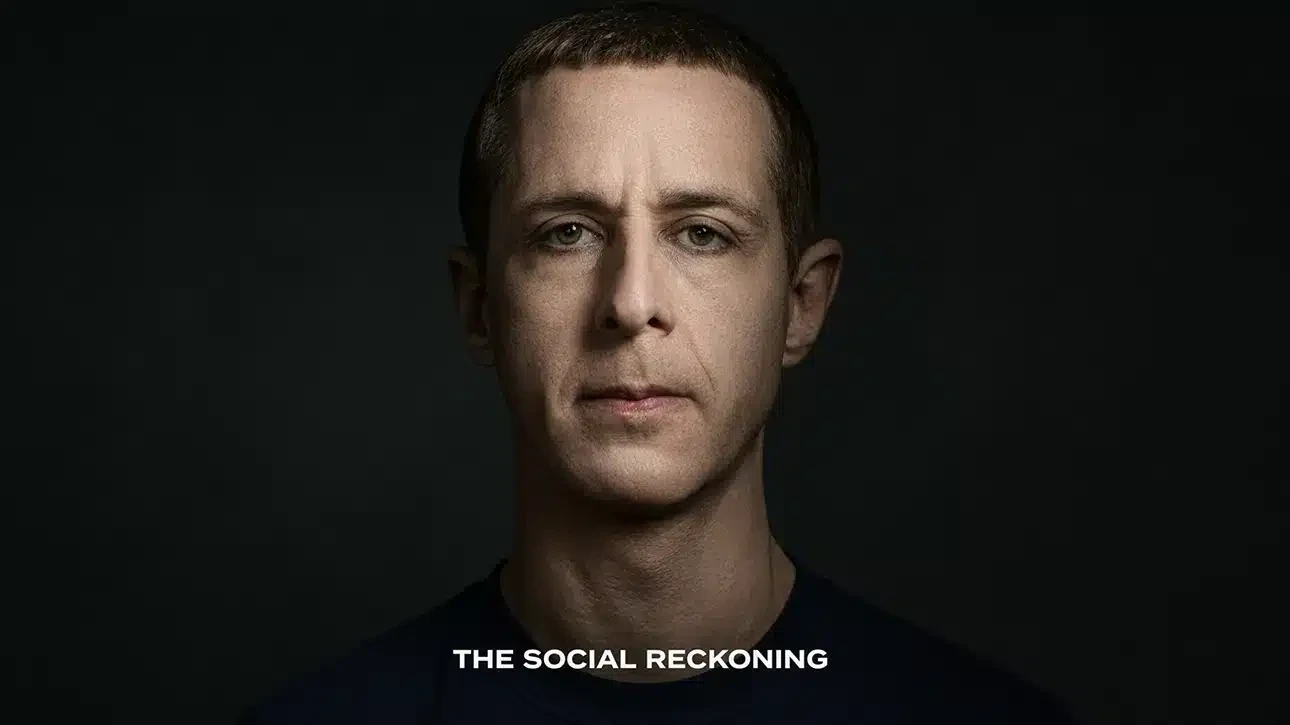
Aaron Sorkin takes this sprawling, deeply systemic crisis and collapses it into his signature rapid-fire conversational format. In The Social Reckoning, the harrowing months of clandestine document copying, legal peril, and corporate paranoia are transformed into theatrical verbal duels. Haugen and Horwitz spar over intellectual dominance, while Jeremy Strong’s portrayal of Mark Zuckerberg is isolated inside a rigid moral fable, divorced from the broader geopolitical and economic apparatus that enabled him.
Supporting Context & Metrics: The Anatomy of Surveillance Capitalism
To critique The Social Reckoning is to critique the specific illusion it propagates: that information management failures are bugs in the system rather than the core features of an extractive economic model.
[ Algorithmic Optimization for Outrage ]
       │
       ▼
[ Maximized User Engagement ]
       │
       ▼
[ Heightened Ad Revenue & Data Harvesting ]
       │
       ▼
[ Inevitable Social & Psychological Harm ] (Misinformation, Teen Mental Health Crises, Political Insurrection)
As cultural theorist Mark Fisher argued in Capitalist Realism (2009), contemporary political culture operates under the assumption that capitalism is the only viable political and economic system, and that even to imagine a coherent alternative is nearly impossible. Sorkin’s film operates squarely within this ideological box.
When analyzing the metrics of Meta’s operational model during the period covered by the film, several stark realities emerge:
- The Profit Motive: Engagement-based algorithms are not accidental byproducts of poor coding; they are mathematically optimized to maximize time-on-site through the monetization of outrage and emotional volatility.
- The Scale of Harm: Internal documents confirmed that leadership was repeatedly presented with data regarding the detrimental impacts on teenage mental health, yet strategic growth targets superseded protective interventions.
- The Regulatory Void: Despite historic congressional testimonies and multi-million-dollar fines, the core structural mechanisms of data accumulation and targeted advertising remain legally protected and fiercely defended by corporate lobbyists.
By framing this systemic apparatus as a problem that can be solved if just the right smart people step up to deliver a devastating rebuttal in a hearing room, Sorkin commits a category error. You cannot debate an algorithm into having a conscience.
Official Statements and Industry Reactions
The release of The Social Reckoning has sparked fierce debates among film critics, technology journalists, and political commentators regarding the responsibilities of biographical drama in an era of acute political crisis.
The Filmmaker’s Defense
Defending his narrative choices—specifically his controversial decision to omit Donald Trump from the dramatization of the January 6 Capitol insurrection—Sorkin argued that introducing explicit partisan figures would distract from the universal themes of information integrity. In interviews surrounding the film’s release, Sorkin maintained that he wanted to keep his "hands clean" of partisan bickering, treating the insurrection almost entirely as an algorithmic malfunction.
Critics, however, have savaged this justification. As political analysts noted, treating the events of January 6 as a software glitch rather than the culmination of orchestrated political strategies, systemic racial resentments, and intentional electoral subversion is a historical evasion. Excising the central political actors to maintain narrative tidiness does not render a film objective; it renders it incoherent.
Journalism vs. Theatricality
Real-world journalism organizations and whistleblower advocates have similarly critiqued the film’s portrayal of investigative reporting. Michael Mann’s 1999 masterpiece The Insider set the gold standard for this subgenre by recognizing that whistleblowing does not liberate the truth; it paints a bullseye on the whistleblower’s back while exposing the profound cowardice and structural compromises of the media institutions themselves.
In contrast, Sorkin’s characters—played with kinetic talent by Mikey Madison and Jeremy Allen White—are reduced to playing chess with their own CVs. Madison’s raw, feral intensity as Haugen is scrubbed clean into clipped, metronomic exposition, while White’s coiled, anxious energy as Horwitz is flattened into pedantic hand-wringing. Rather than illuminating conflicting loyalties and the agonizing material stakes of leaking classified data, the dialogue turns the narrative into an exhibition match for debate-club champions.
Future Outlook: The Limitations of Cinematic Catharsis
As audiences file out of theaters after watching The Social Reckoning, the lingering sensation is not one of mobilization, but of consumerist self-congratulation.
The film offers the intoxicating satisfaction of being on the right side of an argument. Sitting in a theater surrounded by upstanding liberals who snicker at the film’s designated corporate villains and applaud righteous congressional grandstanding creates a ceremonial community. We gather to watch the bad people get exposed, marvel at the smart people who deliver devastating verbal blows, and congratulate ourselves on knowing the difference between right and wrong.
Yet, this dynamic exposes the ultimate dead-end of liberal narrative art:
[ Cinematic Exposure of Wrongdoing ]
       │
       ▼
[ Audience Catharsis & Self-Congratulation ]
       │
       ▼
[ Zero Alteration to the Machinery of Capital ]
The future of political filmmaking must look beyond the Sorkin-esque fixation on rhetorical victory. If cinema is to engage meaningfully with the crises of surveillance capitalism, climate catastrophe, and democratic erosion, it must abandon the comforting myth that structural tyranny can be dismantled with a well-placed semicolon or a snappy monologue down a well-lit corridor.
Until then, all that manic energy, all those brilliant speeches, and all that cinematic noise will continue to result in the exact same political outcome: no action.









Belum ada komentar. Jadilah yang pertama berkomentar!