

Executive Overview
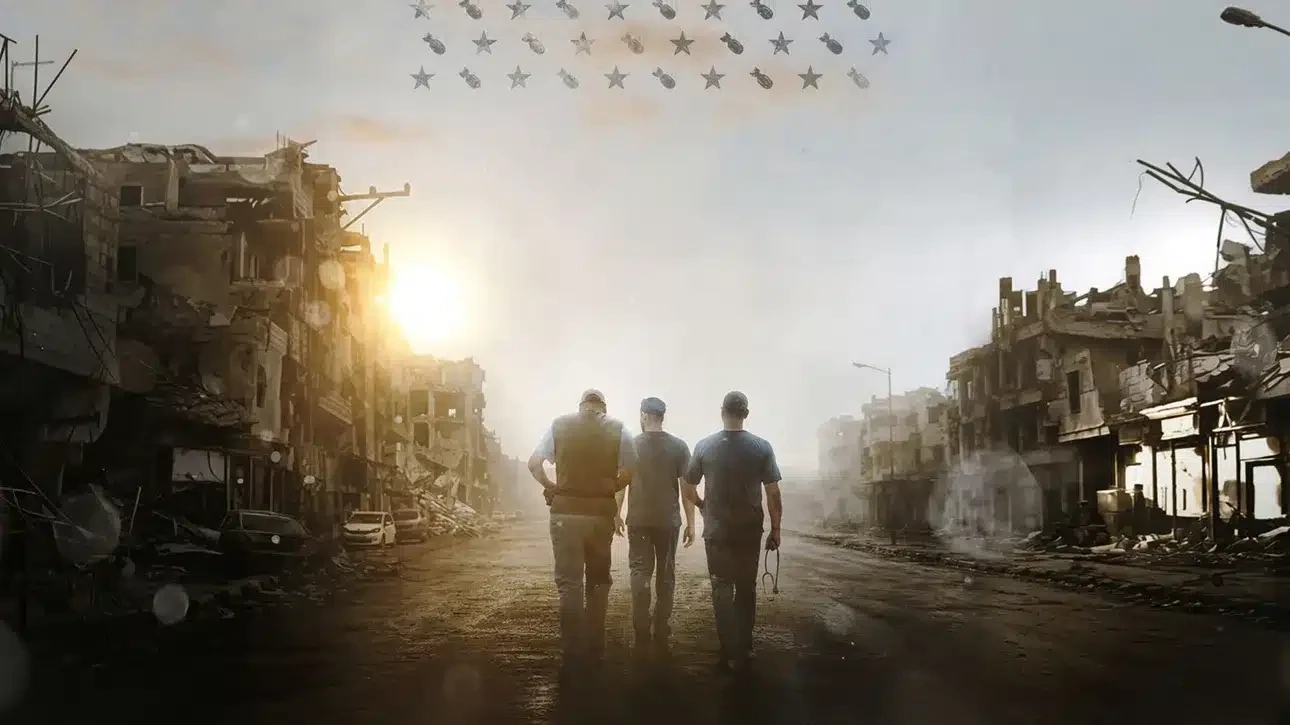
Director Poh Si Teng’s documentary, American Doctor, offers an unflinching, yet strangely disoriented, window into the humanitarian catastrophe in Gaza. Following three American medical professionals who volunteered in the region before, during, and after the 2025 ceasefire, the film captures the visceral, unadulterated horrors of modern urban warfare through the eyes of those desperately trying to mend the broken. The subjects—Jewish-American orthopedic surgeon Mark Perlmutter from North Carolina, Palestinian-American emergency room physician Thaer Ahmad from Illinois, and Parsi-American trauma surgeon Feroze Sidhwa from California—are all "birthright" United States citizens. Their dual identities place them at the hyper-politicized intersection of American foreign policy and Middle Eastern geopolitics.
Yet, despite its noble intent to bear witness, American Doctor struggles with a fundamental identity crisis. By strictly adhering to an observational, old-school documentary style that refuses to contextualize, fact-check, or probe deeper into the explosive claims made by its subjects, the film risks reducing immense geopolitical suffering to a mere sequence of aestheticized tragedies. Teng’s cinematic eye, alongside cinematographers Ibrahim Al Otla and Chris Renteria, creates compositions that are often breathtaking in their lighting and framing. However, this artistic polish raises a deeply unsettling question: Can a documentary about war be too well-made, transforming the visceral agony of real human beings into a series of images indistinguishable from Hollywood fiction?
As the film tracks these doctors from the blood-slicked corridors of Gaza’s overburdened hospitals to the sterile, indifferent halls of the United States Congress, it exposes a profound systemic numbness. The documentary does not reveal unknown facts; rather, it underscores a chilling reality—the world already knows what is happening, and the machinery of global politics continues to turn regardless.
Detailed Chronology
The Opening Debate: Ethics of the Unblurred Image
American Doctor commences with an immediate, high-stakes meta-discussion between Director Poh Si Teng and Dr. Mark Perlmutter regarding the exhibition of a photograph depicting dead children. Teng initially argues for blurring the image, invoking the standard of preserving the "dignity of the dead"—a principle supported by international human rights audiovisual organizations such as WITNESS. Her underlying editorial question is profound: Does exposing viewers to raw, unvarnished horror deepen the emotional and political stakes of the documentary, or does it merely shock them into emotional numbness?
Perlmutter counters fiercely, arguing that blurring the photograph continues a pattern of sanitization that ultimately strips victims of their dignity a second time. Backed by family consent, Perlmutter insists that audiences must bear witness to the unvarnished physical realities of what occurs in Gaza. Ultimately, the photograph is shown—revealing a composition that is surprisingly tranquil and sublime rather than overtly grotesque. This pivotal disagreement opens the floodgates; from this moment onward, the documentary leans into progressively graphic depictions of violence.
Abstract Violence and the Hollywood Aesthetic
Moving past the operating rooms, the film transitions to what can only be described as abstract violence. Drone footage glides effortlessly over miles of pulverised concrete, collapsed apartment blocks, and skeletal infrastructure. Below, tiny human figures wander like specks of dust along improvised paths carved through apocalyptic rubble.
These visual choices evoke haunting parallels to the post-war ruins of Dresden, Hiroshima, or Berlin in 1945. Yet, their hyper-stylized nature flirts dangerously with cinematic cliché. A viewer might easily mistake these establishing shots for a dystopian blockbuster starring a Hollywood action hero. This aesthetic familiarity poses a profound dilemma: When real-world devastation is captured with the sweeping grandeur typically reserved for Hollywood fiction, it risks flattening human suffering into passive entertainment. The documentary observes this aesthetic risk without interrogating it, leaving audiences to navigate the thin line between authentic historical documentation and desensitizing spectacle.
The Washington Circuit: Advocacy Meets Apathy
The final movement of American Doctor shifts its focal point from the surgical suites of Gaza to the corridors of power in Washington, D.C. The documentary follows Perlmutter, Ahmad, and Sidhwa as they embark on a grueling advocacy circuit, navigating the office buildings of the U.S. Congress, panel discussions, and media interviews.
Exhausted, hollow-eyed, and operating more out of grim obligation than fiery enthusiasm, the doctors attempt to impress upon lawmakers the urgency of halting Gaza’s destruction and ensuring humanitarian access. The resulting scenes are kinetic and fragmented. Quick cuts emphasize a frantic rhythm that yields remarkably little tangible output. Some elected officials listen with polite detachment; many more are simply absent, leaving their congressional staffers to field the medical delegation’s pleas with rehearsed political platitudes and bureaucratic pushback. The narrative thrust of these final sequences makes a sobering statement: the impasse in Washington is not born of ignorance, but of willful, entrenched political indifference.
Supporting Context & Metrics
To fully understand the weight—and the structural limitations—of American Doctor, one must examine the broader geopolitical landscape of global humanitarian crises. The film focuses its entire lens on Gaza, a choice that begs a rigorous comparative inquiry.
| Global Crisis / Conflict Zone | Documented Scale of Suffering / Displacement | International Monitoring Body |
|---|---|---|
| Gaza (2023–Present) | Tens of thousands of civilian casualties; widespread infrastructural collapse; acute systemic famine. | United Nations OCHA, Human Rights Watch, various NGO medical delegations. |
| Ukraine | Approximately 20,000 children systematically transferred or abducted; extensive civilian urban devastation. | Yale Humanitarian Research Lab, UN Human Rights Monitoring Mission. |
| Sudan | Widespread systemic mass sexual assault, ethnic violence, and mass displacement of millions. | United Nations Human Rights Council. |
| Myanmar / Bangladesh | Over one million Rohingya refugees hosted in camps following state-sponsored military campaigns. | United Nations High Commissioner for Refugees (UNHCR), U.S. State Department. |
| United States Domestic Policy | Daily immigration detention averages of ~50,000 individuals; over 500,000 total detained annually (2026 metrics). | Department of Homeland Security (DHS) statistics. |
By isolating Gaza while remaining analytically detached from the systemic global mechanisms that enable mass violence across multiple continents, American Doctor risks operating in a vacuum. Critics point out that without contextualizing the Gaza war within a broader framework of international geopolitical complicity—whether examining arms manufacturing, veto-wielding security council politics, or systemic refugee crises elsewhere—the film functions more as a primary source archive than a self-contained analytical documentary.
Official Statements & Subject Perspectives
The core of American Doctor relies entirely on the unfiltered testimonies of its three primary subjects. Teng consciously adopts an observational framework, allowing her subjects to voice their rage, grief, and political diagnoses with minimal editorial framing.
-
Dr. Mark Perlmutter (Orthopedic Surgeon, North Carolina):
As a Jewish-American surgeon operating in a war zone, Perlmutter’s voice carries a specific rhetorical weight. Unafraid to deploy highly charged vocabulary, he directly critiques Israeli military operations and explicitly invokes terms like "Zionism" and "genocide." His perspective centers on the absolute moral imperative to show unedited, raw evidence of the destruction:"We have to show what is happening to human bodies. If we hide the reality behind polite abstractions and blurred frames, we are participating in the erasure of these victims’ lives and dignity."
-
Dr. Thaer Ahmad (ER Physician, Illinois):
Ahmad’s reflections focus on the sheer psychological and physical toll exacted upon medical personnel attempting to function in an environment stripped of basic medical supplies and infrastructure. Describing the operational environment, Ahmad notes:"The last nine months have been nothing short of horrific. You are asked to play God every single minute of your shift, deciding who has a chance at survival and who must be left to die because resources simply do not exist."
-
Dr. Feroze Sidhwa (Trauma Surgeon, California):
Sidhwa is vocal in his refutation of official justifications presented for military strikes on healthcare facilities. During congressional briefings and on-camera interviews, he directly challenges assertions regarding militant infrastructure beneath hospitals, stating bluntly:"The claims made to justify the targeting of medical spaces are categorically untrue. We worked inside these facilities; we saw what was there, and what was not there."
Despite these impassioned testimonies, the documentary draws criticism for leaving such explosive assertions hanging in the narrative space without rigorous journalistic follow-up, independent fact-checking, or counter-perspectives. Consequently, viewers are left suspended between competing political interpretations: supporters of Israel’s military campaign are likely to dismiss the film as uncritical polemic, while opponents will view it as a reinforcement of existing moral outrage. For the undecided, the film induces profound sadness without supplying analytical clarity.
Future Outlook
American Doctor ultimately serves as a complex cultural artifact rather than a definitive historical account of the Gaza war. Its future utility may lie less in its ability to sway public opinion—given that the political facts of the conflict have long been entrenched in global consciousness—and more as primary source material for future historians and researchers analyzing the media ecology of twenty-first-century warfare.
As documentary filmmaking grapples with the ethics of representing mass violence in an era of oversaturated digital media, Poh Si Teng’s work highlights both the power and the peril of pure observation. When a film chooses to document without contextualizing, it preserves the raw emotional truth of its immediate subjects, but it risks abandoning the audience in a moral wilderness. Moving forward, the critical reception of American Doctor will likely spur deeper academic and journalistic discussions regarding how documentary artists can bridge the chasm between bearing witness and providing genuine comprehension in the face of ongoing global atrocities.








Belum ada komentar. Jadilah yang pertama berkomentar!